 5 min read
Quick answer: Institutions can buy fertilizers, pesticides, bio-inputs and seeds on GeM using direct purchase (up to ₹50,000), L1 purchase after comparing at least three manufacturers (above ₹50,000, up to the applicable limit) or bid/reverse auction for larger orders. Register as a buyer, write clear specs with CIBRC or FCO compliance, check the OEM, inspect on delivery and issue CRAC.
Key Takeaways
- GeM (Government e Marketplace) is the national online procurement portal, and GFR Rule 149 requires central government buyers to use it for items available there.
- Direct purchase is allowed up to ₹50,000; above that, L1 comparison of at least three manufacturers or a bid/reverse auction is needed depending on value.
- For agri inputs, write specs by molecule, strength and formulation, not by brand, and require CIBRC or FCO compliance, shelf life and a COA.
- Prefer OEM sellers or resellers with valid OEM authorisation, and check registration documents before ordering.
- Inspect and test on delivery before issuing the Consignee Receipt and Acceptance Certificate (CRAC).
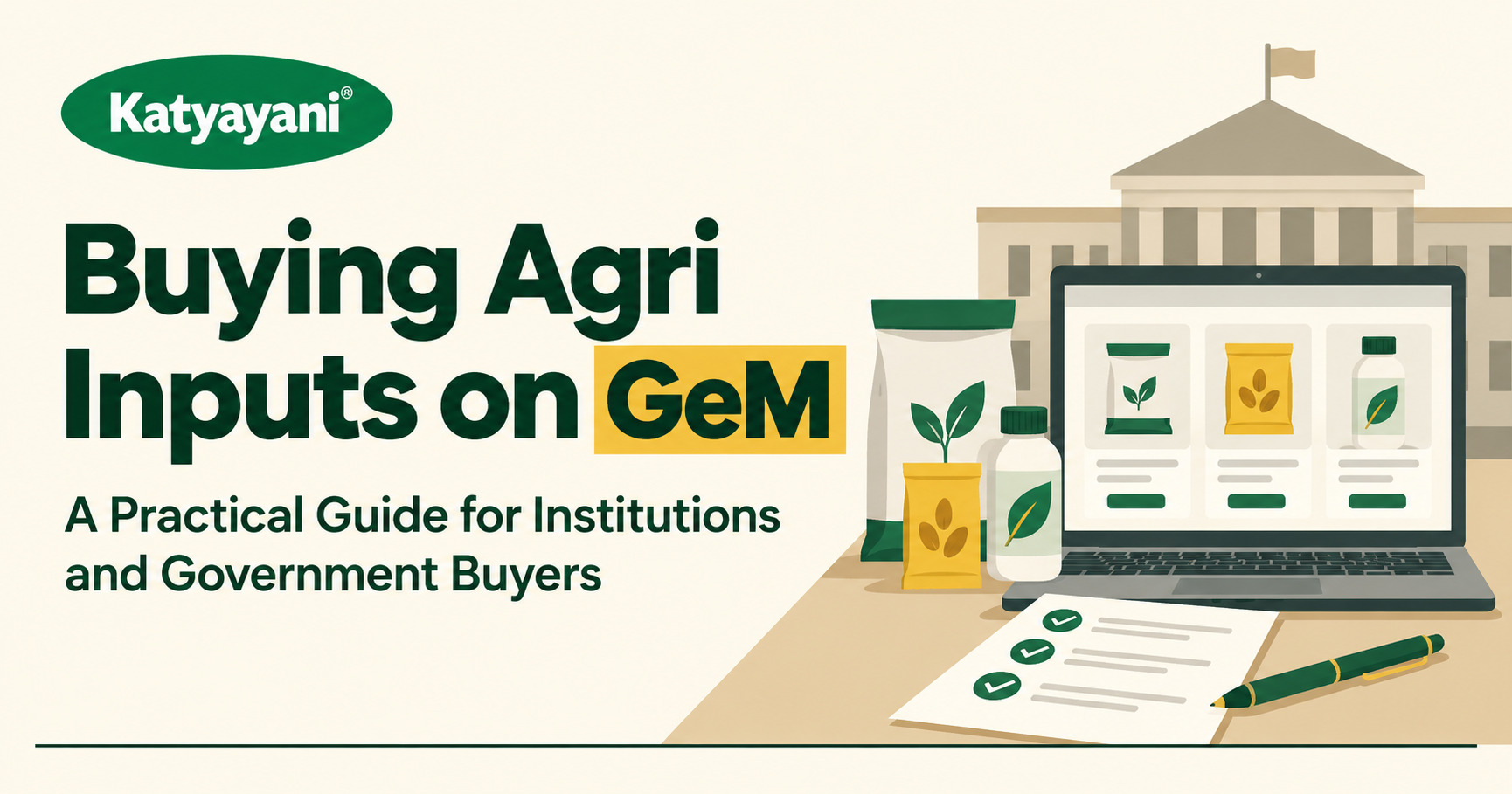
What is GeM and who buys agriculture products on it?
GeM, the Government e Marketplace, is the national public procurement portal of the Government of India. Buyers place orders directly with registered sellers, and the portal records every step from order to payment.
Rule 149 of the General Financial Rules, 2017 makes GeM procurement mandatory for central ministries and departments for goods and services available on the portal. Many state governments, PSUs, autonomous bodies and universities also use GeM under their own rules.
Typical buyers of agri inputs include ICAR institutes and Krishi Vigyan Kendras (KVKs), state agricultural universities, state agriculture, horticulture and forest departments, seed and demonstration farms, municipal parks departments, defence and railway estates, and PSU townships that maintain gardens and green belts.
Which agri inputs can be bought on GeM?
GeM lists thousands of product categories, and agricultural items are among them. Buyers can search the catalogue by product name or molecule to see which categories and sellers are available.
- Fertilizers and crop nutrition: NPK grades, water-soluble fertilizers, micronutrients, organic manure.
- Bio-inputs: bio-fertilizers such as Azotobacter, PSB and Rhizobium, and bio-pesticides such as Trichoderma and Beauveria.
- Crop protection: insecticides, fungicides, herbicides and neem-based products.
- Seeds, planting material, garden tools, sprayers and small farm equipment.
If no suitable catalogue item exists, a buyer can create a custom bid or BOQ bid with its own specifications. Check the category's specification parameters before deciding, because a well-defined category makes comparison easier.
Before you finalise the requirement, check how many sellers and how many different manufacturers are active in the category. If fewer than three manufacturers offer a product, an L1 comparison may not be possible and a bid may be the better route. Also compare catalogue prices with recent market rates, since the portal price should be reasonable for the quantity and delivery location you need. Record this market check on file, because auditors often ask how reasonableness of price was established.
GeM buying modes: direct purchase, L1 and bid/RA
The buying mode depends mainly on order value. Under GFR Rule 149, as amended by the Ministry of Finance in July 2024, the value bands for goods are as follows.
| Order value | Buying mode | What the buyer does |
|---|---|---|
| Up to ₹50,000 | Direct purchase | Buy from any seller meeting quality, specification and delivery needs |
| Above ₹50,000, up to ₹10 lakh (GFR band) | L1 purchase | Compare offers from at least three different manufacturers (OEMs) and buy from the lowest-priced suitable one |
| Above ₹10 lakh | Bid or reverse auction (RA) | Create an online bid; optionally follow with RA to reduce price |
The GeM buyer FAQ currently describes L1 purchase for orders up to ₹30 lakh and bid/RA above that, while the GFR band for most goods is ₹10 lakh. Organisations follow the limit in their own delegation of financial powers, so confirm with your finance or purchase section before choosing the mode.
Splitting a requirement into small orders to stay under a limit is not allowed. Plan annual or seasonal quantities and buy through the correct mode.
OEM vs reseller: which seller should you choose?
An OEM on GeM is the original manufacturer of the product. A reseller sells another company's product and must hold a valid authorisation from that OEM.
For regulated agri inputs, buying from the OEM or an authorised reseller keeps the chain of responsibility clear. Before ordering, check the seller's GST details, the manufacturer's licence and registration for the specific product, and, for resellers, the OEM authorisation document on the portal.
In L1 purchases, GeM asks buyers to compare offers from at least three different OEMs. This rule stops one manufacturer from filling the comparison with its own resellers.
How to register as a GeM buyer
GeM buyer accounts are created by a primary user, usually the head of office, who then creates secondary users for day-to-day buying.
- The primary user registers with Aadhaar, an Aadhaar-linked mobile number and an official government email address, plus details of the verifying authority.
- The primary user creates secondary user accounts and assigns roles: buyer, consignee, DDO (drawing and disbursing officer) and PAO (pay and accounts officer).
- Each secondary user sets a password and completes profile details.
- Buyers complete GeM's online training modules, which cover direct purchase, L1, bids and CRAC.
- The office links its budget and payment method (PFMS, state treasury or internal system) so payments can be released through the portal.
Roles are kept separate for control. For example, a buyer cannot act as the PAO for the same order.
How to write specifications for fertilizers and pesticides
Good specifications are generic, measurable and legal. They describe the product by content and quality, not by brand name, so that any compliant manufacturer can compete.
- Molecule, strength and formulation, for example mancozeb 75% WP or azoxystrobin 23% SC.
- Mandatory CIBRC registration for pesticides, with approval for the crop and pest you need. Buyers can check approvals in the CIBRC major uses of pesticides list.
- FCO compliance for fertilizers, micronutrients and bio-fertilizers, including minimum nutrient content or viable cell count (CFU) for bio-inputs.
- Minimum shelf life at delivery, for example at least 12 months for chemicals and a clearly stated period for bio-products.
- Pack size, labelling in the local language, and a batch-wise certificate of analysis with each delivery.
- Delivery location, schedule and unloading responsibility, timed to the crop season.
- Right to draw samples and test at a government or NABL-accredited lab, and to reject failed batches.
For a KVK demonstration plot, for instance, a buyer might specify an Azotobacter nitrogen-fixing bio-fertilizer with a stated minimum CFU, a contact fungicide such as mancozeb 75% WP, and a neem oil based insecticide for low-residue demonstrations. Doses in any extension material should follow the product label and local agriculture officer advice.
Delivery, inspection, CRAC and payment
After delivery, the consignee inspects the goods and issues the Consignee Receipt and Acceptance Certificate (CRAC) on GeM. The CRAC triggers billing and payment, so inspect before you accept.
- Match quantity, pack size, product name, strength and batch numbers with the order.
- Check labels for registration number, manufacturing licence, batch, manufacturing and expiry dates.
- Collect the COA for each batch and check it against the specification.
- Draw samples for lab testing where the contract allows, especially for large orders.
- Issue CRAC for accepted quantity, or record rejection with reasons on the portal.
- The DDO or PAO releases payment through the linked system within the time allowed under GeM terms.
Delays in CRAC or payment are tracked on GeM and affect the buyer organisation's record, so assign clear responsibility for each step.
How to plan a seasonal agri-input purchase on GeM
Agri inputs are time-bound: a fungicide that arrives after the disease peak or a bio-fertilizer that arrives after sowing is wasted money. Work backwards from the date the input must be in the field.
| Season | Inputs needed in field | Start GeM process by |
|---|---|---|
| Kharif (June to October) | Seed treatment, bio-fertilizers, basal fertilizers, herbicides | March to April |
| Kharif protection | Insecticides and fungicides for July to September | May |
| Rabi (October to March) | Seed treatment, bio-fertilizers, basal fertilizers, wheat herbicides | July to August |
| Rabi protection | Fungicides and aphid control for December to February | September to October |
Direct and L1 purchases can close in days, but a bid with technical evaluation and reverse auction can take four to eight weeks. Add time for sample testing if your contract requires it, and ask for staggered delivery so bio-products and short-shelf-life items arrive close to use.
Using bids, reverse auction, EMD and performance security
For larger agri-input orders, a bid lets the buyer set technical eligibility first and then compare price. A reverse auction after technical evaluation often brings prices down further.
- Set technical eligibility clearly: valid manufacturing licence, product registration, past supply experience if needed, and compliance documents to upload.
- Keep eligibility fair. Very high turnover or experience criteria can shut out capable small manufacturers and MSMEs.
- Per the GeM buyer FAQ, buyers may ask for an earnest money deposit (EMD) in bids above ₹25 lakh and an electronic performance bank guarantee (ePBG) in bids above ₹30 lakh.
- Use a bill of quantities (BOQ) bid when you need several different products from one supplier in one contract.
- Build in a sampling and testing clause with a clear rejection and replacement process.
Publish the bid with enough time for sellers to respond, and answer pre-bid queries on the portal so all bidders see the same clarifications.
Common mistakes government buyers make with agri inputs
Most problems come from weak specifications or poor timing, not from the portal itself.
- Using brand names or proprietary features in specs, which limits competition and can be challenged.
- Not asking for CIBRC or FCO compliance, shelf life or COA, then receiving near-expiry or substandard stock.
- Starting the process too late, so fungicides or bio-fertilizers arrive after the sowing or spray window.
- Buying one large lot of bio-inputs that expire before use in the field.
- Issuing CRAC without inspection, which removes the buyer's main control over quality.
A simple fix is to plan agri-input purchases twice a year, before kharif and before rabi, with a spec sheet agreed with the institute's agronomist or plant protection scientist.
What to do next
List your crop season needs by product, quantity and delivery date, and estimate value to decide the buying mode. Prepare a generic spec sheet with registration, shelf life, COA and testing clauses, then search the GeM catalogue for matching categories.
Share the draft spec sheet with your agronomist, accounts section and consignee before you publish anything. Agreeing on the testing clause, delivery schedule and who issues CRAC at the start avoids most disputes later, and it gives new staff a template they can reuse every season.
If you need technical inputs to frame specifications for bulk fertilizers or crop protection products, manufacturers such as Katyayani Organics can share product data sheets and registration details for reference.
Why trust this guide
Written by Team Katyayani, Editorial Team at Katyayani Organics. Cross-checked against published research and university extension programs.

Leave a Comment