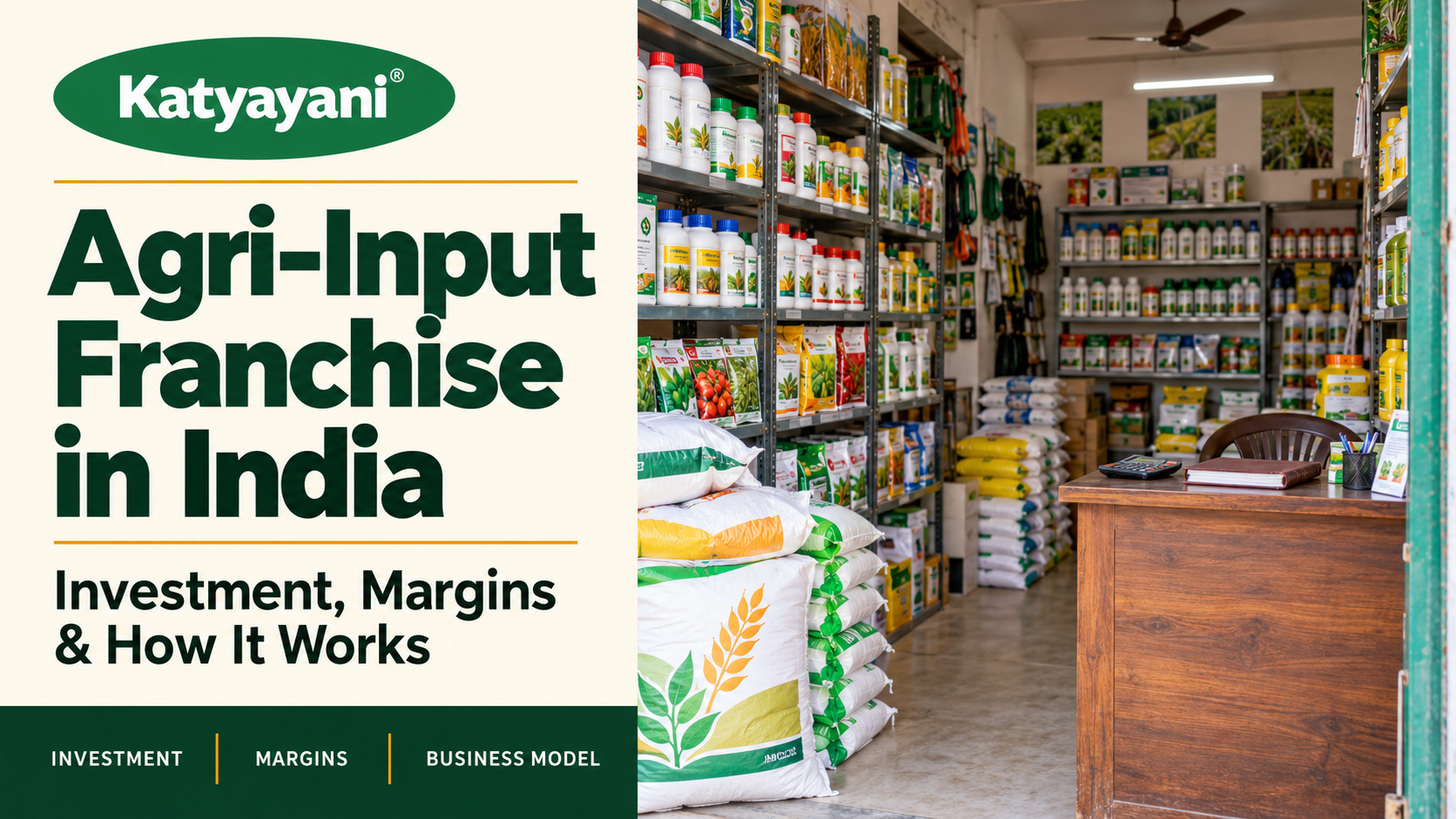
 5 min read
What is an agri franchise?
An agri franchise is a business arrangement where a company (the franchisor) lets a local entrepreneur (the franchisee) run an outlet under its brand, usually selling farm inputs and services. The franchisor supplies products, branding and training; the franchisee invests in the shop, holds the licences and serves farmers.
Research from IIM Ahmedabad by Sukhpal Singh (2014) groups these into two types. Product franchising gives you distribution rights for certain products. Business format franchising adds a full package: store layout, extension advice, soil testing, credit linkage and sometimes produce buyback.
India has run such models for decades. The IIMA study records NAFED with about 2,000 franchisees in 8 states, IFFCO working through cooperative societies, and Tata Kisan Sansar with 421 franchisees, which reported a 25 to 30% market share in its areas compared with about 10% elsewhere.
Types of agri franchise models in India
Agri-input franchises differ mainly in how much the franchisor controls and how much you invest. Pick the model that matches your capital, location and skills.
| Model | How it works | Suits |
|---|---|---|
| Company-branded input store | Store in company colours; stocks mainly that company's range plus allowed third-party items | Entrepreneurs with a shop location and some capital |
| Multi-brand agri retail with franchisor support | Franchisor supplies a wide range from several makers, plus software and training | Existing dealers wanting better supply and systems |
| Agritech rural partner | App-based ordering, small or no store, franchisor delivers to farmers | Young, digitally active entrepreneurs with low capital |
| Cooperative or FPO outlet | Run by a PACS or farmer producer organisation with a supplier tie-up | Farmer groups |
| Agri clinic plus input sales | Soil testing, advisory and input sales combined | Agri graduates using the ACABC scheme |
Several input manufacturers now run their own branded store programmes. Katyayani Organics, for example, has one called Krishi Seva Kendra. Compare such offers on the same checklist given later in this guide.
Licences and qualifications you still need
Every agri-input franchisee must hold state licences in its own name. The franchisor cannot lend you its licence.
- Pesticide sale licence under the Insecticides Act, 1968: you or an employee need a graduate degree in agriculture, chemistry, botany, zoology, biochemistry, biotechnology or life sciences, or a state-accepted DAESI diploma.
- Fertilizer dealer authorisation under the Fertiliser (Control) Order, 1985: B.Sc (Agriculture or Chemistry), a Diploma in Agricultural Science, or a 15-day certificate course.
- Seed licence under the Seeds (Control) Order, 1983.
- GST registration, shop and establishment registration, and local trade licence or panchayat NOC.
- PoS device for subsidised fertilizer sales where DBT applies.
From mid-September 2026, the Insecticides (Amendment) Rules, 2026 also require digital licence applications, electronic stock registers and monthly returns. Ask the franchisor whether its billing software supports this.
How much investment does an agri-input franchise need?
There is no single figure. Investment depends on shop size, location and how much stock the franchisor expects you to carry. Use these cost heads to build your own estimate, and get the franchisor to put its numbers in writing.
| Cost head | What it covers | Notes |
|---|---|---|
| Franchise or onboarding fee | Brand use, training, launch support | Some programmes charge none; ask if it is refundable |
| Shop and godown | Rent deposit, repairs, racks, signboard | Pesticides need separate, ventilated storage |
| Licences and qualification | State licence fees; DAESI (₹28,000, or ₹14,000 for licensed dealers) or 15-day course (₹12,500) | Licence fees vary by state |
| Equipment | Computer or tablet, billing software, printer, weighing scale, fire extinguisher, PoS if required | Some franchisors provide software |
| Opening stock | Seeds, fertilizers, crop protection, bio-inputs | Usually the largest item |
| Working capital | Farmer credit, next season's stock, salaries | Plan for one full season |
The IIMA study found that high upfront franchise fees without a clear return were a major reason some past programmes failed. Be wary of any offer where the fee is large compared with the stock you receive.
What margins can an agri-input franchise earn?
Margins vary by product category, not by franchise brand. Subsidised and price-controlled fertilizers such as urea and DAP leave very thin margins, while specialty nutrition, biologicals and branded crop protection carry more room.
- Subsidised fertilizers: low margin, but they bring farmers into the shop every season.
- Water soluble and micronutrient fertilizers: better margin, and demand grows with drip and fertigation.
- Crop protection chemicals: higher value per sale, but expiry and credit risk are also higher.
- Bio-inputs and organic products: growing demand among farmers reducing chemical use; good for repeat sales when paired with advice.
- Services: soil testing, spraying services or drone booking can add fee income.
A balanced shelf might pair zinc sulphate fertilizer for widespread zinc deficiency, a phosphate solubilizing bacteria biofertilizer as a low-cost add-on to DAP, and an activated neem oil insecticide for early sucking pest control. Always tell farmers to follow the product label and local agriculture officer advice.
How to estimate your own margin
- List the 30 to 40 products that make up most sales in your area, by season.
- For each, note the franchisor's price to you and the MRP or local selling price.
- Estimate yearly volume per product from dealer or farmer conversations.
- Multiply to get gross margin, then subtract rent, salaries, power, transport and expected bad debts.
- Test a bad year: cut volume by a third and see whether you still cover fixed costs.
Government schemes and loans for agri-input entrepreneurs
Agri graduates and diploma holders can use the Agri-Clinics and Agri-Business Centres (ACABC) scheme, run through MANAGE with NABARD subsidy. Others usually rely on MUDRA or regular bank business loans.
| Scheme | Who can use it | Key features |
|---|---|---|
| Agri-Clinics and Agri-Business Centres (ACABC) | Graduates or postgraduates in agriculture and allied subjects, or diploma holders with 50%+ marks, age 21 to 60 | 45-day free residential training; project cost up to ₹20 lakh (individual) or ₹100 lakh (group of 5); 36% subsidy, 44% for women, SC/ST, North East and hill states |
| PM MUDRA Yojana | Non-farm micro and small enterprises, including trading | Collateral-free loans through banks and NBFCs under Shishu, Kishor and Tarun categories |
| Bank MSME or trade loans | Registered businesses | Working capital limits against stock and receivables |
Details for ACABC, including the toll-free number 1800-425-1556, are in the AC&ABC scheme brochure. The subsidy is credit-linked and back-ended with a three-year lock-in, so you need a bank loan first.
Questions to ask before signing a franchise agreement
Most disputes come from terms that were not read carefully. Ask for the full agreement and get answers in writing.
- Territory: what area is exclusive, and what happens if the franchisor appoints another dealer nearby?
- Purchase targets: are there minimum monthly or seasonal purchases? What happens if you miss them?
- Product range: can you sell other brands, especially subsidised fertilizers and seeds you already stock?
- Expiry and returns: will the franchisor take back near-expiry or slow-moving stock?
- Credit terms: how many days of credit do you get, and is there interest on late payment?
- Support: who provides agronomy advice, farmer meetings, demo plots and staff training?
- Exit: notice period, refund of deposits and buyback of stock if you leave.
Common mistakes new franchisees make
Most agri-input shops that struggle do so because of cash flow, not a lack of customers. These are the patterns seen most often in the first two seasons.
- Giving too much credit too early. Farmers pay after harvest, and one poor monsoon can freeze most of your capital. Set a credit limit per farmer and stick to it.
- Overstocking slow movers. Fungicides and insecticides for a pest that does not appear this year may expire before the next season. Order in smaller lots and reorder often.
- Ignoring advisory. Farmers return to the shop that solved last season's problem. Field visits, demo plots and soil testing build that trust.
- Poor record keeping. Missing invoices or batch numbers cause problems in inspections and make returns to the franchisor difficult.
- Relying only on subsidised fertilizers. They bring footfall but little margin, so plan your mix around specialty nutrition, biologicals and crop protection.
Keep a simple weekly review of stock, cash and outstanding credit. It takes less than an hour and catches problems before they grow.
Step-by-step: how to start an agri-input franchise
- Study your market: main crops, number of existing shops, distance farmers travel for inputs.
- Arrange the qualification (degree, DAESI or 15-day course) or hire a qualified person.
- Shortlist two or three franchise programmes and visit their existing outlets.
- Compare offers on fees, stock, margin, territory, credit and returns.
- Secure the shop and apply for pesticide, fertilizer and seed licences on your state portal.
- Arrange finance (own funds, ACABC, MUDRA or bank loan).
- Sign the agreement only after licences are in process and terms are clear.
- Launch before the sowing season with a farmer meeting and soil testing camp.
What to do next
Start with the parts only you can control: qualification, location and licences. These take the longest and are needed whichever franchise you choose.
Then visit working outlets of the programmes you are considering and talk to their owners about real sales, credit and returns. Their answers will tell you more than any brochure.
Why trust this guide
Written by Team Katyayani, Editorial Team at Katyayani Organics. Cross-checked against published research and university extension programs.




Leave a Comment