

 9 min read
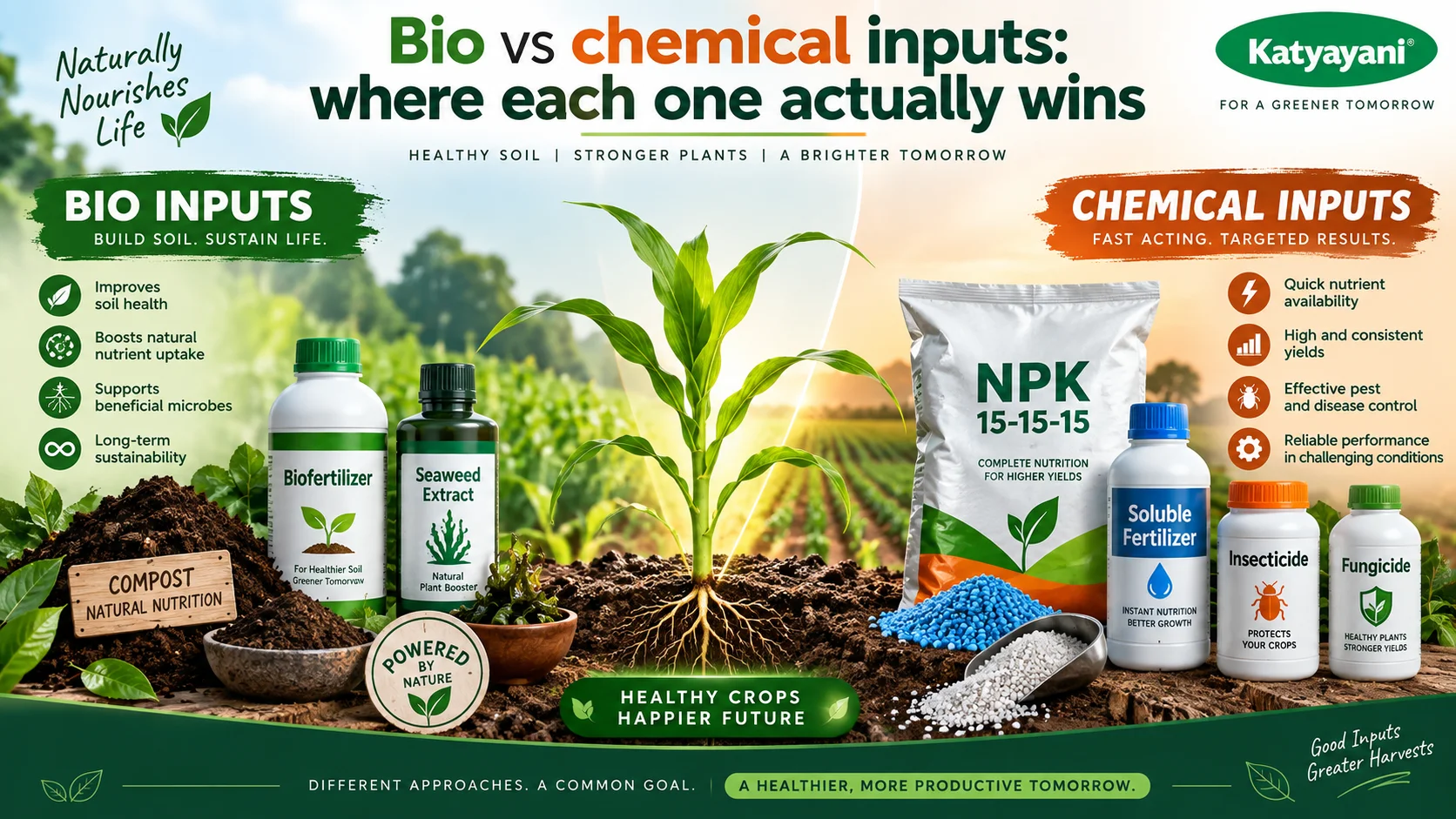
Chemical inputs stop an outbreak that is already underway. Biologicals prevent one from starting, protect the soil, and keep produce free of residue. They are not competitors. Used in the wrong order, both disappoint.
The argument usually gets framed as a choice, and that framing is what causes most of the failures. A grower sprays a biological on a heavy infestation, sees nothing happen in two days, and writes off the whole category. Another grower sprays the same chemical for six seasons and cannot understand why the dose keeps climbing.
Both problems come from the same mistake: expecting one type of product to do the other one's job.
How they work, and why that changes the timing
A chemical insecticide or fungicide is a molecule that kills on contact or after ingestion. It acts within hours. Concentration at the target is what decides the result.
A biological is a living organism. Trichoderma colonises the root zone and crowds out pathogens. Beauveria bassiana spores stick to an insect, germinate, and grow through the cuticle. Both need time, moisture and a surface temperature they can survive on. Cornell's work on Beauveria puts the kill window at several days, not hours.
That is the whole difference. One is a treatment. The other is a population you establish.
Where biologicals genuinely win
Soil-borne disease
This is their strongest ground. Wilt, root rot, damping off and collar rot start in the root zone, and a chemical drench rarely reaches far enough or lasts long enough. A Trichoderma applied at nursery or sowing sets up a protective layer around the root before the pathogen arrives. Hattrick (Trichoderma harzianum) and Tyson (Trichoderma viride) are both used this way, mixed with farmyard manure and broadcast, or applied as a seed treatment.
For bacterial soil problems, Striker (Pseudomonas fluorescens) fills the same role. On foliar disease with an early start, BAXIL (Bacillus subtilis) works on leaf blight, anthracnose and mildews.
Resistance has already built up
When a molecule that used to work at 1 ml per litre now needs 2 ml and still leaves survivors, resistance is the likely cause. Biologicals attack through several mechanisms at once, so insects and fungi do not develop resistance to them the way they do to a single chemical group.
Rotating a biological into the programme also slows resistance to the chemicals you still need. Bhasam (Beauveria bassiana) on sucking pests, or Triple Attack where you are dealing with more than one pest group, gives you a spray that does not add to the resistance load.
Produce going to an export or residue-checked market
Biologicals have no pre-harvest interval. Grapes, pomegranate, chilli and vegetables sold into markets that test for residue are the clearest case for shifting the last few sprays of a season to biologicals. The yield protection is similar; the rejection risk drops to zero.
Building soil that keeps working
Mycorrhiza extends the root system's reach for phosphorus and water. A VAM biofertilizer applied once at planting keeps functioning through the season, which no soluble fertiliser does. Combined with a phosphate-rich organic manure such as PROM, it makes existing soil phosphorus available instead of adding more.
Where chemicals still win, and there is no substitute
An outbreak that has crossed the economic threshold needs a chemical. If a stem borer population is already inside the tiller or a planthopper colony has reached hopper burn, waiting seven days for a fungus to germinate costs the crop.
Weather that biologicals cannot survive is the other case. Living spores need moisture and moderate temperature. In peak summer heat with low humidity, survival drops sharply and the spray underperforms through no fault of the product.
Weed control is a third. There is no biological herbicide that matches a selective chemical on a standing crop.
Running both in one season
A programme that uses both usually looks like this on a vegetable or cotton crop:
- Seed or nursery treatment with Trichoderma. This is the cheapest disease protection available and it costs almost nothing per acre.
- Soil application of mycorrhiza and organic manure at planting.
- Preventive biological sprays through early vegetative growth, while pest pressure is still low.
- Chemical intervention only when scouting shows the threshold has been crossed.
- Return to biologicals for the final sprays before harvest, so residue clears.
Neem sits usefully in the early part of that sequence. A neem oil at 3000 ppm azadirachtin disrupts feeding and moulting in young insect stages, which reduces how often you need a chemical later.
Four things that make biologicals fail
- Tank mixing with a chemical fungicide. Most fungicides kill Trichoderma and Beauveria as readily as they kill the pathogen. Keep at least a week between them.
- Spraying in full afternoon sun. Ultraviolet light destroys spores. Spray in the late afternoon or early morning.
- Storing bottles in a hot shed. These are live cultures with a real expiry date and a temperature limit.
- Applying once and expecting a season of protection. Biologicals need repeat application to hold a population, especially after heavy rain.
Cornell's IPM programme covers the handling requirements for the main biocontrol organisms in more detail, and it is worth reading before you commit a large area. Their biocontrol agents index is here.
What to do this season
If you have never used biologicals, do not convert the whole farm. Take one field, add a Trichoderma seed treatment and two preventive sprays in the early vegetative stage, and keep your usual chemical programme for the rest. Compare the number of chemical sprays you needed on that field against the others at the end of the season.
That number is the honest measure. Not what the label claims, and not what the neighbour says.
Frequently asked questions
1. Are bio pesticides as effective as chemical pesticides?
They are effective against the same pests but on a different timescale. Biologicals take five to fourteen days and work best as a preventive or early-stage treatment. For an infestation that has already crossed the economic threshold, a chemical is the faster and more reliable choice.
2. Can I mix bio pesticides with chemical pesticides in the same tank?
Generally no. Most chemical fungicides kill the beneficial fungi and bacteria in biological products. Keep a gap of about seven days between a chemical fungicide and a biological application.
3. How long does Trichoderma take to work?
It starts colonising the root zone within a few days but the protective effect builds over two to three weeks. This is why it is applied at sowing or transplanting rather than after disease appears.
4. Do biologicals have a pre-harvest interval?
No. Because they leave no chemical residue, there is no mandatory waiting period between the last spray and harvest. This is the main reason growers supplying residue-tested markets shift their final sprays to biologicals.
5. Why did my bio pesticide spray not work?
The four common causes are spraying in strong afternoon sunlight, which destroys the spores; mixing with a chemical fungicide in the same tank; storing the product in heat; and applying it after the pest population was already high.
6. Are biofertilizers a replacement for NPK fertiliser?
No. Biofertilizers improve the availability and uptake of nutrients already present, and fix atmospheric nitrogen in some cases. They reduce how much fertiliser you need but do not supply the full requirement of a high-yielding crop.
7. What is the shelf life of a biological product?
Usually six to twelve months, and it shortens quickly if the container is stored above about 30 degrees Celsius or in direct sunlight. Check the manufacturing date and keep stock in a cool, dark place.
8. Do biologicals work in hot summer conditions?
Performance drops in high heat and low humidity because the spores need moisture to germinate. In peak summer, apply in the evening, keep the soil moist for soil applications, and expect a slower response.
9. Can biologicals control weeds?
Not at present. There is no biological product that matches a selective herbicide on a standing crop. Weed control remains a chemical or mechanical operation.
10. Is organic farming possible using only biologicals?
Yes, and it is done at commercial scale, but it requires much stricter scouting, earlier intervention and a tolerance for occasional higher losses. Most growers moving in that direction shift over two or three seasons rather than all at once.
SOURCES CITED
Cornell University IPM — Biocontrol Agents — https://cals.cornell.edu/integrated-pest-management/eco-resilience/biocontrol/biocontrol-agents
Cornell University IPM — Beauveria bassiana Fact Sheet — https://cals.cornell.edu/integrated-pest-management/outreach-education/fact-sheets/beauveria-bassiana
| Category | Field Notes |
|---|---|
| URL slug | /blog/farming/bio-vs-chemical-inputs |
| Primary keyword | bio pesticide vs chemical pesticide |
| Secondary keywords | biofertilizer vs chemical fertilizer, bio fungicide effectiveness, Trichoderma vs chemical fungicide, integrated pest management India, organic inputs for farming, when to use bio pesticides |
| Search intent | Commercial investigation — grower wants an honest comparison before shifting part of the spray programme to biologicals. |
| Meta title | Bio vs Chemical Inputs: Where Each One Actually Wins (52 chars) |
| Meta description | Biologicals are slower but prevent resistance and leave no residue. Chemicals stop an outbreak. Here is where each one genuinely belongs. (137 chars) |
| Word count | ~1,800 |
| Internal links | Hattrick Trichoderma harzianum | Tyson Trichoderma viride | Bhasam Beauveria bassiana | Triple Attack | Striker Pseudomonas | BAXIL Bacillus subtilis | Dr. Neem 3000 | VAM-G Mycorrhiza | PROM |
| External sources | Cornell IPM (biocontrol agents) | Cornell IPM (Beauveria bassiana fact sheet) |
| Biological | Chemical | |
|---|---|---|
| Speed | 5 to 14 days | 6 to 48 hours |
| Best timing | Before or at first sign | After the threshold is crossed |
| Resistance risk | Very low, multiple modes of action | High with repeated use of one group |
| Residue | None, no waiting period | Pre-harvest interval must be followed |
| Effect on soil life | Adds to it | Some products reduce it |
| Shelf life and storage | Limited, keep cool and out of sunlight | Long and stable |
| Cost per spray | Comparable, sometimes lower | Varies widely by molecule |
| The practical rule: biologicals go in when you are ahead of the problem. Chemicals go in when you are behind it. If you are unsure which situation you are in, scout the field and count. That count is the decision, not the price of the bottle. |
|---|
Leave a Comment