 11 min read
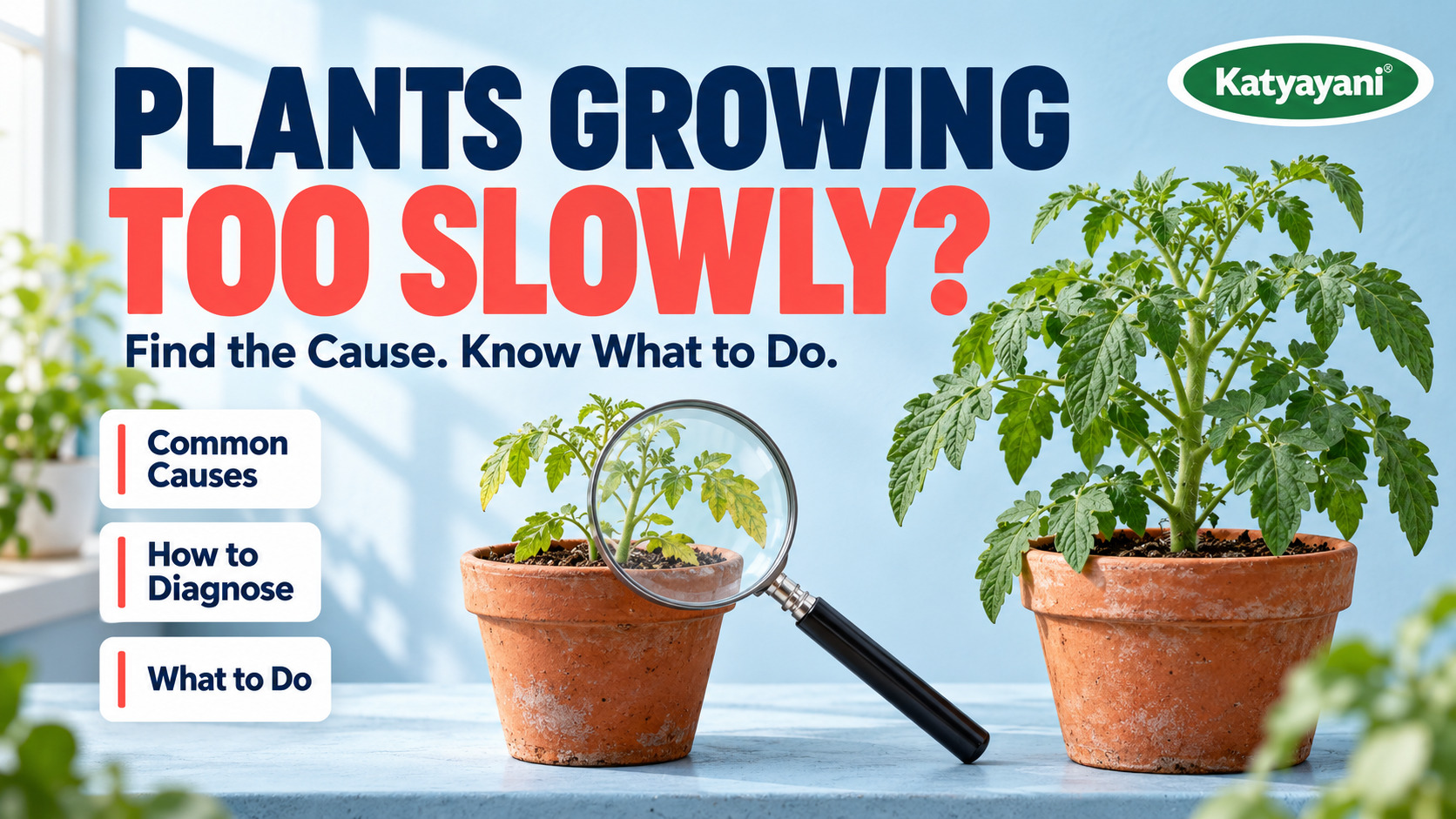
Plants usually grow slowly because something is limiting their roots or leaves: too little light, too much or too little water, soil pH that locks nutrients, a missing nutrient, cramped or compacted roots, pests or disease, cold, or salt in the soil. Look at which leaves show the problem, check the roots, then fix the single biggest limit first.
Why are my plants growing slowly? The quick answer
There is rarely one reason. Slow growth happens when a plant cannot get enough of something it needs, or cannot use what is there. The most common limits, in the order worth checking, are light, water, roots, soil pH, nutrients, pests and disease, temperature and salt.
A simple rule saves time. Check the free things first. Is the plant getting at least several hours of direct sun? Is the soil neither bone dry nor soggy two fingers down? Then pull the plant out of the pot or dig up one weak plant in the field and look at the roots. Only after that think about fertiliser. Many farmers and gardeners add urea or NPK to a plant whose real problem is waterlogged roots, and the plant gets worse.
In winter, slow growth can also just be the season. Cool soil slows root work and nutrient release. Montana State notes that in cold spring soils phosphorus and iron uptake slows and nitrogen release from organic matter drops, and that if cold is the cause, symptoms fade as soil warms and extra fertiliser will not help.
How do I find out what is wrong? A diagnosis table
Start from what you can see. The table below links each symptom to the likely cause and the first thing to check. It is a guide, not a lab result.
| What you see | Likely cause | First check | First fix |
|---|---|---|---|
| Tall, thin, pale stems, big gaps between leaves | Not enough light | Hours of direct sun; distance from window | Move to brighter spot or thin out shading plants |
| Wilting even though soil is wet, yellow lower leaves, soft brown roots | Overwatering or poor drainage | Push a finger 5 cm into soil; slide plant out and look at roots | Let soil dry, improve drainage, trim rotted roots |
| Crisp, curling leaves, soil pulling away from pot edge | Too little water | Weigh pot or dig 5 cm | Water deeply, mulch, water on a steady pattern |
| Old lower leaves pale yellow-green, whole plant small | Nitrogen shortage | Which leaves go yellow first | Feed a nitrogen source per label; check soil test |
| Dark green or purple-tinged old leaves, small plants | Phosphorus shortage (often cold soil) | Soil temperature; compaction | Warm soil, loosen soil, add phosphorus per test |
| Old leaf edges yellow then brown | Potassium shortage | Edge scorch on lowest leaves | Potassium source per soil test |
| New top leaves yellow with green veins | Iron deficiency, often high pH | Soil pH | Chelated iron; fix drainage and pH |
| New leaves small, short gaps between nodes, pale bands | Zinc shortage | High pH or heavy phosphate use | Zinc source per label |
| Roots out of drain holes, water runs straight through | Root-bound plant | Slide out the root ball | Repot into a bigger pot |
| Good soil and water but still weak, roots short or knotted | Compaction, root pests or disease | Dig and look; try a stick or screwdriver for hard layers | Loosen soil, treat the cause |
| White crust on soil or pot, leaf tip burn | Salt build-up | Water and soil EC if you can test | Flush with good water, stop over-feeding |
| Sticky leaves, curled or spotted leaves, visible insects | Pests or disease | Under-leaf check with a magnifier | Targeted control, see pest and disease section |
Is it a light problem?
Light is the engine of growth. Less light means less sugar made, and the plant puts energy into reaching for light instead of building thick stems. Leggy growth, pale leaves and long gaps between leaves point to low light. Most vegetables and flowering plants need several hours of direct sun. Shade from a wall, a neighbour's tree or dense planting counts.
In a field, check spacing. Plants sown too close compete for light, water and nutrients. In a pot or balcony, rotate the pot a quarter turn each week and keep leaves clean of dust. Foliage plants indoors in winter often just need to be moved nearer the window; our guide to indoor plant care in winter covers it.
Can too much or too little water slow plant growth?
Yes, and both look alike. Kansas State lists excessively wet or dry soils among the causes that restrict root growth and access to soil nutrients. Montana State warns that underwatering and overwatering can mimic nutrient deficiency.
Too little water makes plants stop growing to save themselves. Too much water fills the air spaces in soil, roots cannot breathe and start to die back, and the plant then looks hungry or thirsty even though the soil is wet. The test is simple. Dig 5 cm down. If the soil is dark and sticky and smells sour, you are overwatering. If it is dusty and pale, you are underwatering.
- In the field: irrigate when the root zone, not the surface, is dry. Avoid ponding after heavy rain; make drainage channels.
- In pots: water until it runs from the base, then wait until the top soil dries. Never leave a pot standing in a saucer of water.
- Mulch keeps moisture even and cools soil. See benefits of mulching for types and depth.
For potted plants showing soft brown roots, read root rot in containers: diagnosis and recovery.
Can soil pH make plants grow slowly even when there is fertiliser?
Yes. This is one of the most missed causes. Kansas State says the presence of enough nutrients in soil is no guarantee that roots will absorb them, and that unusually low or high soil pH can affect nutrient availability.
The University of Florida says many plants do well in a pH range of 5.5 to 7.5, and that plants often tolerate a span of one to two pH units. At low pH, phosphorus usually becomes less available because it reacts with iron and aluminium. Below about 4.7, nitrogen-fixing microbes are much less active. Above pH 6.5, manganese may become limiting, and phosphorus, copper and zinc also fall in availability.
| pH situation | What it does (University of Florida IFAS) | Typical result in the plant |
|---|---|---|
| Low pH (acidic) | Phosphorus availability falls; aluminium toxicity risk below pH 5.0 in sandy soils; nitrogen-fixing microbes slow below about 4.7 | Purple or dark old leaves, poor roots, poor nodules in legumes |
| pH 5.5 to 7.5 | Range where many plants do well | Normal growth if other things are right |
| High pH (alkaline) | Manganese may become limiting above 6.5; phosphorus, copper and zinc fall in availability | Yellow new leaves with green veins, small new growth |
How do you fix it? The same University of Florida page says sulphur lowers pH only temporarily, and that naturally high-pH soils can hold very large amounts of lime, so lowering pH there is generally impractical. Utah State makes the same point and advises using chelated or foliar forms of iron, zinc and potassium when high pH is blocking uptake, rather than trying to change the soil. Gypsum does not change soil pH.
Get a soil test first. In India, the Soil Health Card lists pH and nutrient status; see how to read your Soil Health Card. For the pH-fertiliser link in simple words, read soil pH and nutrient lock.
Which nutrient deficiency is slowing my plant?
Nutrient shortage is the cause people suspect first. It is real, but confirm it. Montana State says soil testing, tissue testing and visual checks each help, and that visual signs often show up only after yield is already affected.
The old-leaf versus new-leaf rule
Kansas State explains that when uptake is limited, mobile nutrients are moved to the growing parts, so deficiency shows first on the older leaves. Immobile nutrients cannot be moved, so deficiency shows on the young leaves.
| Group | Nutrients | Where symptoms show first |
|---|---|---|
| Mobile | Nitrogen, phosphorus, potassium, magnesium | Lowest, oldest leaves |
| Immobile | Iron, sulphur, calcium, copper, zinc, manganese, molybdenum, boron | Upper, youngest leaves |
Nutrient by nutrient: what to look for
| Nutrient | What the plant shows | What makes it worse | Katyayani product page (check label) |
|---|---|---|---|
| Nitrogen | Pale yellowish-green plant, slow growth, fewer tillers in wheat; yellowing starts on oldest leaves (Kansas State) | Cold or saturated soil, sandy soil, heavy rain leaching, little fertiliser | Ammonium sulphate |
| Phosphorus | Dark green plants with reddish-purple tips and margins on older leaves; smaller, slower plants (Kansas State) | Cold soil, compaction, injured roots | Mono potassium phosphate |
| Potassium | Yellowing and dead edges on the lowest leaves; weak stalks later (Kansas State) | Dry, compacted, wet or sandy soil; heavy removal by the last crop | Organic potash |
| Magnesium | Yellowing from leaf tips moving between veins on old leaves (Kansas State) | Sandy or acidic soil | Magnesium sulphate |
| Sulphur | Yellowing of young upper leaves, stunting, delayed maturity (Kansas State) | Low pH sandy soil, low organic matter, cold dry spring | Ammonium sulphate |
| Zinc | Stunted plants with short internodes; pale bands from the leaf base (Kansas State) | High pH, low organic matter, cool wet soil, very heavy phosphate | Zinc sulphate |
| Iron | Upper leaves pale between veins (Kansas State) | Calcareous, high-pH, cold, poorly aerated soil | Iron EDTA |
| Calcium | Young tissue is affected first because calcium is an immobile nutrient (Kansas State) | High salt levels can bring on calcium deficiency (Utah State); very low pH also favours it (VERIFY) | Calcium nitrate |
| Boron | Young, upper growth is affected first because boron is immobile (Kansas State) | Check by tissue test; avoid guessing | Boron 20% |
Two cautions. First, a table of products is not a prescription. Match the nutrient to a soil or tissue test, and follow the label for dose and crop. Second, Kansas State says zinc deficiency is advanced by high phosphorus applications on soils marginal in zinc, so piling on DAP can make a zinc problem worse in some soils. Wheat is a common Indian example; our guide to wheat yellowing after first irrigation walks through zinc, sulphur, manganese or urea.
If you do not know the problem, a balanced feed or a micronutrient mix is a safer first step than a single nutrient. Browse the NPK fertiliser collection or the NPK 19:19:19 water-soluble fertiliser for a balanced starter, and the micronutrient mix for home garden and nursery for trace elements. For choosing between liquid and granular feed, see water-soluble vs granular fertiliser.
Are the roots the real problem?
Often. A plant is only as good as its roots. Kansas State lists root injury from machines, insects, disease or herbicide among the causes of deficiency symptoms, and it also says compaction can significantly restrict root growth and nutrient access.
Root-bound plants in pots
NParks says all potted plants may eventually become root-bound. As roots reach the pot sides they curl back or push out through drainage holes. Water is absorbed mainly at root tips, so crowded roots lose contact with moist soil and the plant shows water problems. Signs listed by NParks: sudden wilting that recovers after bottom watering, roots growing out of the drainage hole or along the inside wall, slow growth or no growth, and browning leaf tips (which can also come from uneven watering).
The fix, from NParks: take the plant out, gently separate tangled roots, and replant in fresh soil in a new pot at least 10 cm larger in diameter and depth. Do not jump to a huge pot. A pot far too big holds a lot of wet soil around few roots, which raises the risk of rot. Use a mix that drains well; see terrace garden soil mix.
Compaction and hard layers in fields and beds
Heavy tractors, repeated wet-soil tillage and foot traffic squeeze soil and shut out air. Roots stay shallow and thin, and uptake of phosphorus and potassium suffers (Kansas State). Dig a spade-deep hole. If roots turn sideways at a hard layer, you have a pan. Deep ploughing at the right moisture, adding organic matter and rotating crops with different rooting depths help. Compost or vermicompost improves structure over time; the enriched vermicompost page shows what is on offer, and the manures and soil fertiliser collection shows the range.
Root disease and soil pests
Seedlings that wilt and fall over, or plants whose roots look brown and rotten, may have a soil fungus. Biological soil treatments such as Trichoderma are used by many growers as a preventive; read the label for the crop and method. See the Trichoderma viride powder page. A rooting product can help new cuttings and transplants; check the rooting hormone page for how it is meant to be used.
Could pests or disease be slowing growth?
Yes. Sap-sucking insects such as aphids, whitefly and thrips drain a plant and curl young leaves. Leaf spot and virus diseases reduce the green area that makes food. Montana State warns that disease and insects can look like a deficiency, so check the underside of leaves before you feed.
- Look under leaves with a magnifier. Sticky honeydew, tiny moving dots or silvery streaks mean insects.
- Rub a leaf on white paper. Rusty or black smears can mean mites or thrips.
- Mosaic patterns and twisted new leaves can mean virus carried by insects. Remove badly affected plants.
- Start with the mildest option. Our guide to organic pest control for home gardens explains what works without chemicals, and the organic pest control collection lists options.
Does temperature affect how fast plants grow?
Yes. Every crop has a comfortable range. Cold slows root work and nutrient release, which is why the same field can look fine in November and weak after a cold wave. Montana State notes cold soils slow phosphorus and iron uptake and reduce nitrogen release. Kansas State also lists cold weather among the things that restrict roots.
Very hot weather can slow growth too, because plants close their leaf pores to save water. This is standard crop physiology rather than something taken from one named page here, so match sowing dates to your crop's season. For cold waves and frost, see frost and cold wave protection. Do not add extra fertiliser to a cold-stunned crop; wait for warmth.
Can salt in the soil stunt plants?
Yes. Utah State explains that too many dissolved salts reduce the plant's ability to take up water, a state it calls "chemical drought". Symptoms listed include stunting, reduced vigour, wilting leaves, and leaf-margin burn and dead tissue. Salts build up where water evaporates a lot, in dry areas, in pots watered with hard water, and where fertiliser is over-applied.
Utah State's advice for managing high-salinity and high-pH conditions is to leach the salts out by washing the soil with good water, not to over-apply fertilisers (which are mineral salts), and to keep soil moisture at the right level. In pots, flush the pot with plenty of water until it runs clear from the base, then stop heavy feeding for a while. If you suspect salt, test the soil or water EC; a white crust on the soil surface is a clue.
Slow growth in field crops versus pots and gardens
The causes are the same, but the common mistakes differ.
| Question | Field crop (acre scale) | Pots, balcony and kitchen garden |
|---|---|---|
| Most common cause | Poor early root growth from compaction, waterlogging or cold; missing sulphur, zinc or potassium | Root-bound plant, overwatering, low light, tired potting mix |
| First test | Soil test or Soil Health Card; dig and look at roots in several spots | Slide the plant out of the pot; check drainage and light |
| Best early fix | Right-time irrigation, loosening, balanced basal feed, drainage | Repot, fresh mix, move to more light, water pattern |
| Feeding | Based on soil test and crop stage; label dose only | Light, regular feeding; see the kitchen-garden schedule |
| Common error | Adding extra urea to a root-injured or cold crop | Adding fertiliser to a root-bound or waterlogged plant |
| Scale of loss | Delayed canopy and lower yield | Weak plants, few flowers |
For gardens, follow a steady plan. Our winter kitchen garden feeding schedule explains compost plus liquid feed, and the yellow leaves nutrient deficiency chart helps match leaf colour to a cause. A humic or seaweed product is sometimes used as a general growth aid; see the activated humic and fulvic acid and seaweed extract pages and read the label before use. These help soil and root activity but will not fix a cause such as waterlogging or a lack of light.
A step-by-step plan to fix slow growth
- Look at the whole plant. Note leaf colour, which leaves are affected (old or new), and whether the whole bed or one plant is weak.
- Check light and water. Fix these first because they are free.
- Check the roots. Take one weak plant out. Healthy roots are firm and light-coloured; dark soft roots mean rot, tight circles mean root-bound.
- Test the soil. Get pH and nutrient status. Use your Soil Health Card or a lab test.
- Fix pH or choose the right nutrient form. At high pH use chelated or foliar forms, as Utah State advises.
- Flush if salts are the issue.
- Treat pests or disease only if you find them.
- Wait and watch. New growth takes days to weeks to respond. Compare new leaves, not old damaged ones, because old damaged leaves will not recover colour.
Conclusion
Slow growth almost always has a cause you can find with a few simple checks. Start with light, water and roots, then test soil pH and nutrients, and only then reach for fertiliser. Match what you see on old and new leaves to the right nutrient, flush salts, loosen compacted soil, and repot cramped plants. Fix one limit at a time and judge the result by the new leaves, not the old ones.
Why trust this guide
Written by Team Katyayani, Editorial Team at Katyayani Organics. Cross-checked against published research and university extension programs.

Leave a Comment