 5 min read
Quick answer: Wheat that yellows after the first irrigation usually has one of five causes: temporary waterlogging, nitrogen shortage from late urea, manganese deficiency on light soils, sulphur deficiency on sandy soils, or zinc deficiency. Check which leaves yellow first and the pattern, then correct with drainage, urea, or a manganese, zinc or sulphur dose.
Key Takeaways
- Look at which leaves turn yellow first: old leaves point to nitrogen, young leaves to sulphur or iron, middle leaves with specks to manganese, central leaves with bands to zinc.
- Manganese deficiency is common in light soils under rice-wheat and shows up after the first irrigation; PAU advises 0.5% manganese sulphate sprays on sunny days.
- Waterlogging after a heavy first irrigation yellows the whole field from leaf tips; drain first, then apply urea when the soil is at field capacity.
- Give the first urea split with the first irrigation at crown root initiation (about 21 days). Delaying it is a common, avoidable cause of pale wheat.
- Yellow powder that rubs off on your fingers is yellow rust, a disease, not a deficiency. It needs a fungicide, not fertilizer.
Why does wheat turn yellow after the first irrigation?
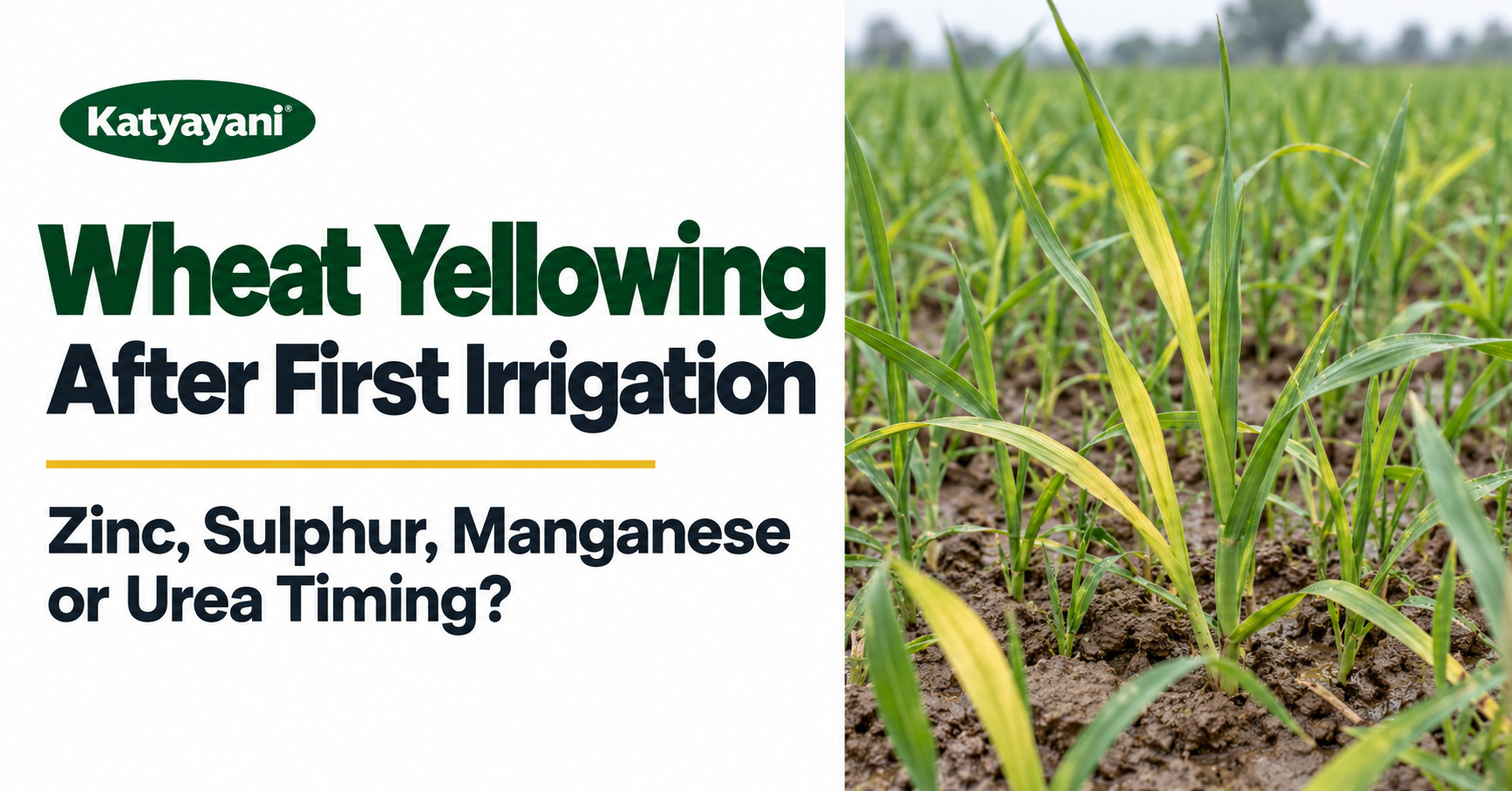
Wheat often turns yellow after the first irrigation because that irrigation, at crown root initiation (CRI), comes at a time when roots are small, soil is cold and nutrient demand is rising fast. Any shortage of nitrogen, sulphur, manganese or zinc, or any lack of oxygen in waterlogged soil, becomes visible within a week or two.
CRI is the stage when the crown roots form, about 21 days after sowing. ICAR-IIWBR lists CRI as one of the two most moisture-sensitive stages of wheat, so the first irrigation cannot be skipped. But heavy irrigation on heavy soil, or a delayed urea dose, can turn a green crop pale.
In December, cold nights and fog also slow root activity and nutrient uptake. Some yellowing from cold is temporary and fades as days warm, so do not rush to spray without checking the pattern first.
How to diagnose wheat yellowing in the field
Diagnose yellowing by checking three things: which leaves are yellow (old, middle or young), the pattern on the leaf (tip, between veins, stripes, spots), and whether the whole field or only patches are affected.
| What you see | Likely cause | Where it is common | Quick fix |
|---|---|---|---|
| Older (lower) leaves yellow from the tip downward, in a V shape; whole field pale | Nitrogen shortage | Late or skipped first urea dose; saline or alkaline soils | Apply the due urea split with or just before irrigation |
| All leaves yellow from tip to base soon after irrigation; soil stays wet | Waterlogging (oxygen shortage in the root zone) | Heavy, poorly drained soils after heavy irrigation or rain | Drain water; apply urea when soil reaches field capacity |
| Middle leaves with yellow between veins and grey, buff or pinkish-brown specks | Manganese deficiency | Light, sandy soils under rice-wheat, after first irrigation | 0.5% manganese sulphate spray, repeat weekly |
| Youngest (top) leaves light yellow, lower leaves stay green | Sulphur deficiency | Sandy soils, long winter rains, no SSP or gypsum used | Gypsum or another sulphur source |
| Central leaves yellow with pale or whitish bands, plants stunted, poor tillering | Zinc deficiency | Alkaline, sandy and high-phosphorus soils | 0.5% zinc sulphate spray; soil zinc next season |
| Yellow stripes of powdery pustules that rub off on fingers | Yellow (stripe) rust, a fungal disease | Cool, humid north Indian plains and foothills, December to February | Recommended fungicide on first foci |
| Scattered yellow, dry plants that pull out easily | Termites or pink stem borer | Sandy soils, fields with paddy residue | Insect control as per local advice |
Causes can overlap. A field can be low in nitrogen and manganese at the same time. If in doubt, take a plant sample to your KVK or show the crop to the local agriculture officer.
Nitrogen shortage and urea timing
Nitrogen shortage is the most common reason for pale wheat after the first irrigation. It usually happens because the first top dressing of urea was delayed, or because heavy irrigation or rain washed nitrate below the shallow root zone.
IIWBR recommends one-third of the nitrogen at sowing and the remaining two-thirds in two equal splits at the first and second irrigations. PAU's schedule for Punjab broadcasts 45 kg urea per acre before each of the first and second irrigations, as per the PAU Rabi package of practices.
- On light and medium soils, broadcast urea just before irrigation so water carries it into the root zone.
- On heavy soils or where water stands, apply urea after irrigation once the soil can be walked on (at wattar), to avoid losses.
- In saline or alkaline soils, PAU experts suggest about 25% extra nitrogen.
- Do not apply the full top dressing in one go on sandy soils; split it as recommended.
Nitrogen-deficient wheat greens up within 7 to 10 days of urea application if moisture is adequate. If it does not, look for another cause.
Manganese deficiency in wheat
Manganese deficiency is a common cause of yellowing right after the first irrigation in light soils, especially in rice-wheat fields of Punjab, Haryana and western UP. It shows as yellowing between veins on middle leaves, with small grey, buff or pinkish-brown specks.
PAU recommends a 0.5% manganese sulphate spray (1 kg manganese sulphate in 200 litres of water per acre). The first spray is given 2 to 4 days before the first irrigation on fields with a history of deficiency, followed by three sprays at weekly intervals. IIWBR gives the same 0.5% concentration.
- Confirm symptoms on middle leaves: interveinal yellowing plus grey or pinkish specks.
- Dissolve 1 kg of manganese sulphate in 200 litres of clean water for one acre.
- Spray on a clear, sunny day, covering leaves fully.
- Repeat at weekly intervals for 2 to 3 more sprays, as symptoms can return with each irrigation.
- Use foliar spray rather than soil application for this problem, as PAU and IIWBR recommend.
Follow the product label and local agriculture officer advice.
Sulphur deficiency in wheat
Sulphur deficiency shows as light yellow top leaves while the lower leaves stay green for longer. This is the opposite of nitrogen deficiency, which starts on older leaves.
It is common in sandy soils, particularly after prolonged winter rains early in the season, and in fields where only DAP and urea have been used for years. IIWBR notes that more than 35% of soils are deficient in sulphur.
- PAU recommends 100 kg gypsum per acre as a cost-effective sulphur source on deficient soils.
- IIWBR notes that where zinc sulphate or gypsum is applied, sulphur deficiency is usually taken care of.
- Where only sulphur is deficient, IIWBR mentions a sulphur 80 WDG product at 8 to 10 kg per hectare at sowing or just before the first irrigation.
- For the next season, use SSP for part of the phosphorus, since it carries about 11% sulphur.
Zinc deficiency in wheat
Zinc deficiency makes plants stunted with poor tillering, and the central leaves turn yellow with pale or whitish bands. It is common in alkaline, sandy and calcareous soils and in fields with heavy phosphorus use.
For a standing crop, IIWBR recommends a 0.5% zinc sulphate spray: 2.5 kg zinc sulphate with 1.25 kg unslaked lime (or 12.5 kg urea) in 500 litres of water per hectare, sprayed 2 to 3 times at 15-day intervals. Per acre, that is about 1 kg zinc sulphate with 0.5 kg lime in 200 litres of water.
For prevention, IIWBR advises 25 kg zinc sulphate per hectare once a year, or 10 kg per hectare to each crop, on zinc-deficient soils, as set out in the ICAR-IIWBR wheat pocket guide. A Soil Health Card test before sowing tells you whether you need it.
Yellow rust or deficiency: how to tell the difference
Yellow rust (stripe rust) is a fungal disease that makes yellow stripes of powdery pustules along the leaf veins. Rub a leaf between your fingers: if yellow powder comes off, it is rust, not a nutrient problem.
It appears first in small patches (foci) in cool, humid weather, usually from December onward in the north-western plains and sub-mountain areas. Spraying nutrients will not stop it. Farmers should inspect fields weekly and spray only when rust is confirmed.
Propiconazole 25 EC at 0.1% is a commonly recommended fungicide for rust in wheat. A propiconazole 25 EC fungicide can be sprayed on affected patches and the surrounding area as per label. Tebuconazole and strobilurin mixtures are other options listed by state universities. Follow the product label and local agriculture officer advice.
How to prevent yellowing next season
Most yellowing after the first irrigation can be prevented at sowing. A soil test, balanced basal dose and correct urea timing remove the common causes.
- Test soil before sowing and read the zinc, sulphur and manganese ratings on the Soil Health Card.
- Apply zinc sulphate at sowing where zinc is deficient, and use SSP or gypsum where sulphur is low.
- Laser level the field so the first irrigation does not pond water in low spots.
- Give a light first irrigation at CRI (about 21 days), not a flood, on heavy soils.
- Apply the first urea split with the first irrigation, not a week later.
- On light soils with a manganese history, schedule the first manganese spray 2 to 4 days before the first irrigation.
Notes for dealers and retailers
In December and January, dealers see many farmers describing yellow wheat. A few questions at the counter (which leaves, which pattern, soil type, when urea was given, does powder rub off) point to the right answer and avoid selling the wrong input.
Keep manganese sulphate, zinc sulphate, gypsum, urea and a rust fungicide in stock through the season, since demand rises sharply after the first irrigation. For bulk micronutrient and fungicide supply, Katyayani Organics serves distributors and institutional buyers across India.
What to do next
Walk your field this week and check the oldest, middle and youngest leaves. Match what you see to the diagnosis table, fix drainage or urea first, and then correct manganese, zinc or sulphur as needed. If yellow powder rubs off, treat for rust. Follow the product label and local agriculture officer advice for all doses.
Why trust this guide
Written by Team Katyayani, Editorial Team at Katyayani Organics. Cross-checked against published research and university extension programs.

Leave a Comment