
 9 min read
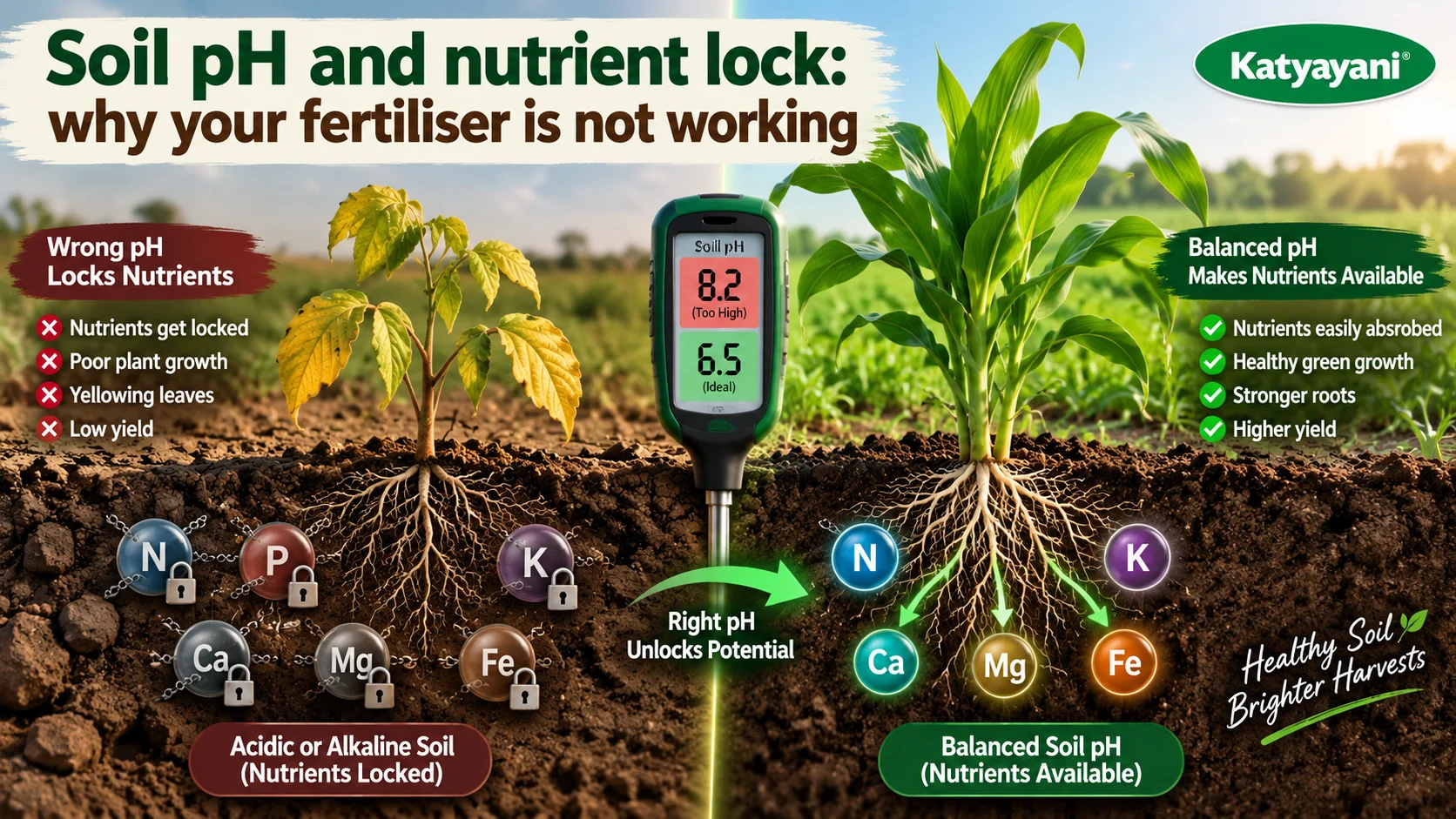
If you applied fertiliser and the crop did not respond, the nutrient is often still sitting in the soil in a form the root cannot absorb. Soil pH is the usual reason. Most nutrients are freely available between pH 6.0 and 7.0, and several shut down outside that band.
This is one of the most expensive problems in Indian farming because it is invisible. The bag was bought, the dose was correct, the application was on time, and nothing happened. The natural response is to apply more next season, which makes the loss bigger.
What nutrient lock actually means
A nutrient has to be dissolved in the soil water, in a specific chemical form, before a root hair can take it in. Soil pH decides which form it takes.
In alkaline soil, iron, zinc, manganese and phosphorus react with calcium and carbonates and become insoluble compounds. The iron is there. A lab test will find it. The root cannot use it.
In acidic soil, phosphorus binds with iron and aluminium instead, and the same thing happens from the other direction. Meanwhile aluminium and manganese become soluble enough to damage roots.
Nothing has been lost from the field. It has just been converted into a form the plant cannot open.
Which nutrient locks at which pH
Cropnuts publishes a detailed availability chart showing how each nutrient tapers off across the pH range, and it is worth keeping a copy alongside your soil test report. Their explanation is here.
Reading your soil test for this
Three numbers on the report tell you most of what you need.
The pH value itself. Anything below 5.5 or above 7.5 means you should expect lock-up before you look at any other figure.
Electrical conductivity, or EC. High EC means salts have built up, which usually accompanies high pH and makes water uptake harder as well.
Organic carbon. Below about 0.5 percent, the soil has little buffering capacity, so pH swings further and faster after every irrigation and fertiliser application.
A report showing normal nutrient levels and a pH of 8.2 is not a healthy soil. It is a soil where the nutrients are present and locked.
Fixing alkaline soil, which is most of northern and western India
Bringing a high pH down permanently is slow, expensive and rarely practical on a large area. The realistic approach has two parts: reduce the pH slowly over seasons, and bypass the lock in the meantime.
Bypass it now
Chelated micronutrients are the direct answer. A chelate wraps the metal ion in an organic molecule so the soil chemistry cannot bind it. Iron EDTA at 12 percent and Zinco Grow chelated zinc EDTA stay available at pH levels where the sulphate forms would lock within days. Where more than one micronutrient is short, a chelated mix micronutrient covers zinc, iron, manganese, copper, boron and molybdenum together.
Foliar application bypasses the soil entirely and works within days. It does not fix the field, but it saves the standing crop.
Reduce it over seasons
Organic matter is the only tool that works at scale. Every tonne of well-decomposed organic matter buffers pH, feeds microbial activity and releases weak acids as it breaks down. Enriched vermicompost and PROM both do this, and PROM has the additional advantage of supplying phosphorus in a form that resists fixation.
Humic and fulvic acid act faster than compost because they are already in the active form. Applied through drip or as a soil drench, an activated humic and fulvic acid chelates metal ions in the soil solution and holds them available for the root. On a high-pH field this often produces a visible response faster than adding more fertiliser does.
Where the soil is also short of calcium and magnesium, a calcium magnesium sulphate conditioner improves structure and supplies sulphur, which helps in sodic conditions.
Fixing acidic soil
Acidic soils, common in the eastern states, the north east and parts of the Western Ghats, need the opposite correction. Agricultural lime raises pH, and the rate depends on soil texture and the current reading, so it should follow a lab recommendation rather than a rule of thumb.
Lime is slow. Apply it well before sowing, ideally at the end of the previous season, and incorporate it rather than leaving it on the surface. In the meantime, phosphorus is the nutrient most worth protecting, so place it in a band near the seed rather than broadcasting it.
Four habits that make lock-up worse
- Broadcasting phosphorus on the surface. In both acidic and alkaline soils, most of it fixes before roots reach it. Band placement puts it where the root will be.
- Using hard borewell water for spraying without correction. Water above about pH 8 raises the pH of the spray solution itself and reduces the performance of several products.
- Skipping organic matter because it is bulky and slow. It is the only input that changes the underlying problem rather than working around it.
- Testing the soil once and treating that report as permanent. pH shifts with irrigation water quality and fertiliser use. Retest every two to three years.
A season plan for a locked-up field
- Test the soil before the season, and test your irrigation water as well if it comes from a borewell.
- Apply organic matter at land preparation. This is the slow correction and it has to start somewhere.
- Band the phosphorus rather than broadcasting it.
- Use chelated forms for any micronutrient the report shows as low.
- Add humic and fulvic acid with the first two irrigations to improve availability while the organic matter breaks down.
- Watch the new growth. Deficiency symptoms on new leaves point to availability. Symptoms on old leaves usually point to actual shortage.
Michigan State University Extension has a clear sequence for reading deficiency symptoms correctly, including the old-leaf versus new-leaf distinction that decides most diagnoses. It is worth reading before you buy anything.
Correcting pH is a multi-season job. Bypassing it is a same-season job. Do the second one now and start the first one this year.
Frequently asked questions
1. What is the ideal soil pH for most crops?
Between 6.0 and 7.0. In that range nitrogen, phosphorus, potassium and the micronutrients are all reasonably available. Rice tolerates slightly lower and some pulses tolerate slightly higher, but the working band is narrow.
2. What is nutrient lockout?
It is when a nutrient is physically present in the soil but chemically bound in a form the root cannot absorb. Soil pH is the main cause. The nutrient shows up on a lab test but produces no crop response.
3. Why is my crop yellow even after applying fertiliser?
Usually because the nutrient is locked rather than missing. At high pH, iron and zinc become unavailable and produce yellowing between the veins of new leaves. A foliar chelated micronutrient spray will confirm this within about five days.
4. How do I lower soil pH?
Slowly, through organic matter, elemental sulphur where a lab recommends it, and acidifying fertilisers. There is no quick fix on a field scale. In the meantime, use chelated micronutrients so the crop is not waiting for the correction.
5. How do I raise soil pH in acidic soil?
Agricultural lime, applied at a rate set by a soil test and incorporated into the soil rather than left on the surface. Apply it well before sowing because it acts over months.
6. Does irrigation water affect soil pH?
Yes, and it is commonly overlooked. Borewell water with high bicarbonate steadily raises soil pH over seasons. Testing the water alongside the soil often explains a field that keeps drifting alkaline.
7. What is a chelated micronutrient and why does it help?
A chelate is an organic molecule that wraps around a metal ion such as iron or zinc and shields it from soil reactions. That keeps the nutrient available at pH levels where the ordinary sulphate form would lock up within days.
8. Can humic acid correct nutrient lockout?
It reduces it. Humic and fulvic acid bind metal ions in the soil solution and hold them in a form roots can take up. It does not change soil pH significantly, but it improves availability while slower corrections take effect.
9. Deficiency on old leaves or new leaves, what is the difference?
Nutrients that move within the plant, such as nitrogen, phosphorus, potassium and magnesium, show symptoms on older leaves first. Nutrients that do not move, such as iron, zinc, calcium and boron, show on new growth first. That tells you which group to look at.
10. How often should soil be tested?
Every two to three years for a normal field, and every year if you are actively correcting pH or salinity. Test before the season starts so the results can change what you buy.
SOURCES CITED
Cropnuts — Soil pH and Nutrient Availability — https://cropnuts.com/soil-ph-and-nutrient-availability/
Michigan State University Extension — Six Steps to Identifying Nutrient Deficiencies — https://www.canr.msu.edu/news/six_steps_to_identifying_nutrient_deficiencies_in_ornamental_plants
| Category | Field Notes |
|---|---|
| URL slug | /blog/farming/soil-ph-and-nutrient-lock |
| Primary keyword | soil pH nutrient availability |
| Secondary keywords | nutrient lockout in soil, why fertilizer is not working, alkaline soil iron deficiency, acidic soil phosphorus fixation, ideal soil pH for crops, how to correct soil pH, soil test report reading |
| Search intent | Problem-solving — grower has applied fertiliser, seen no response, and is looking for the cause. |
| Meta title | Soil pH and Nutrient Lock: Why Fertiliser Stops Working (55 chars) |
| Meta description | Applied fertiliser and saw no response? Soil pH may have locked the nutrient before the root could reach it. Here is how to find out and fix it. (144 chars) |
| Word count | ~1,800 |
| Internal links | Humic + Fulvic Acid | CMS soil conditioner | Iron EDTA | Zinco Grow Zinc EDTA | Mix Micronutrient | PROM | Enriched Vermicompost |
| External sources | Cropnuts (soil pH and nutrient availability) | Michigan State University Extension (identifying deficiencies) |
| Soil pH | What becomes unavailable | What you see in the field |
|---|---|---|
| Below 5.5 | Phosphorus, calcium, magnesium, molybdenum | Purple tinge on older leaves, stunted roots, poor nodulation in pulses |
| 5.5 to 6.0 | Some phosphorus tie-up | Slow early growth, weak tillering |
| 6.0 to 7.0 | Nothing significant | This is the working range for most crops |
| 7.5 to 8.0 | Iron, zinc, manganese, boron | Yellowing between veins on new leaves, small leaf size |
| Above 8.0 | Iron, zinc, phosphorus, copper | Severe interveinal chlorosis, poor flowering, stunted crop |
| A quick field check before you spend anything: take a leaf showing symptoms and spray a dilute micronutrient solution on it. If the yellowing improves within four to five days, the nutrient was unavailable in the soil rather than absent from it. That distinction changes what you buy. |
|---|

Leave a Comment