

 9 min read
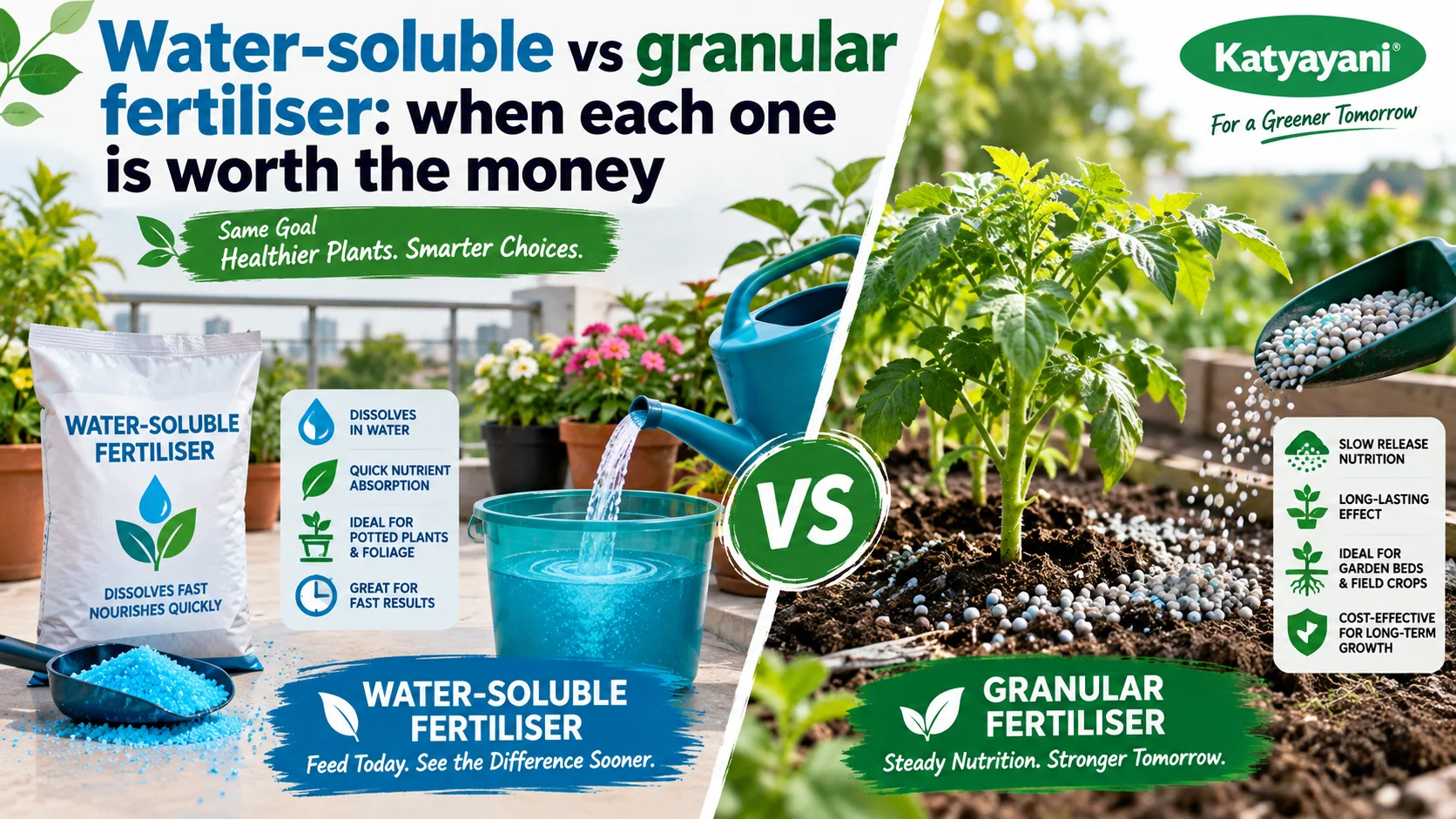
Water-soluble fertiliser costs two to four times more per kilogram than granular. It is worth that premium only when the crop needs a nutrient fast, or when you are already running drip. For the base dose at sowing, granular still wins on cost.
Most growers pick a format out of habit. The dealer stocks it, the neighbour uses it, so it goes in the field. That is fine until input costs climb and you start asking whether the expensive bag actually returned anything. This is the arithmetic behind that question.
What actually separates the two
Granular fertiliser is a solid prill that you broadcast or place in the soil. It has to dissolve in soil moisture before a root can take anything up. That takes days to weeks, and how much of it reaches the plant depends on soil moisture, pH and how the granule was placed.
Water-soluble fertiliser dissolves fully in water. You deliver it through drip, or you spray it on the leaf. There is no waiting for it to break down, and no fixation in the soil because most of it never touches soil in the first place.
That single difference drives everything else.
The cost-per-acre maths growers skip
Comparing price per bag is the wrong comparison. Compare cost per kilogram of nutrient that the plant actually absorbs.
Take nitrogen. Urea is 46 percent N and cheap. But under flood irrigation on a light soil, a large share of that nitrogen is gone before the root system gets to it. A water-soluble source delivered through drip in four splits puts a far higher fraction into the plant.
So the honest comparison looks like this:
- Take the cost of the bag and divide by the kilograms of actual nutrient in it.
- Multiply by your realistic recovery for that soil and irrigation method.
- Compare the two numbers, then add the cost of the extra labour or the drip set.
Run that for your own field and the gap narrows sharply. On drip-irrigated vegetables it often closes completely. On a rainfed cereal, granular still wins by a distance.
When granular is the better buy
Use granular for the base dose. Before sowing or at transplanting, the crop is not in a hurry and the roots have weeks to find the nutrient. Paying a premium for speed at that stage buys you nothing.
Use it for bulk nitrogen, phosphorus and potash on cereals, pulses and oilseeds where the total requirement is large and the margin per acre is thin. The crop needs a lot of nutrient over a long window, and speed is not the constraint.
Granular also makes sense for correcting a known soil-level deficiency that will not resolve in one season. Zinc is the classic case in Indian soils. A soil-applied Zinc Sulphate Monohydrate 33% at sowing carries the crop through, where a foliar spray would need repeating. The same logic applies to Ammonium Sulphate when the field is short of sulphur as well as nitrogen.
And if there is no drip and no sprayer, the argument ends there. Water-soluble fertiliser without a delivery system is just an expensive powder.
When water-soluble pays for itself
Three situations justify the extra cost.
The crop is at a peak demand stage
Flowering, fruit set and grain filling are short windows. A deficiency during those weeks costs yield that no later application can recover. This is where a balanced NPK 19:19:19 through drip, or a targeted NPK 12:61:00 before flowering, earns back its price. At grain or fruit filling, a potassium-heavy NPK 13:00:45 does the same job.
You are already running drip
If the pipes are in the ground, fertigation adds almost no labour. You are splitting the same nutrient into eight or ten small doses instead of two big ones, and the plant takes up far more of it. On drip-irrigated vegetables this is usually the cheapest nutrition per kilo of produce, not the most expensive.
A visible deficiency has already appeared
Yellowing between the veins, poor flowering, stunted new growth. Soil application at that point is too slow. A foliar spray moves nutrient into the leaf within a day or two. It is a rescue tool, not a routine, but nothing else works that fast.
The mistake that wastes money on both sides
Broadcasting water-soluble fertiliser on dry soil is the most common one. It behaves worse than granular there, costs more, and the grower concludes the product is useless.
The reverse mistake is trying to fix a mid-season deficiency by throwing more granular on the surface. By the time it dissolves and moves down, the window has passed.
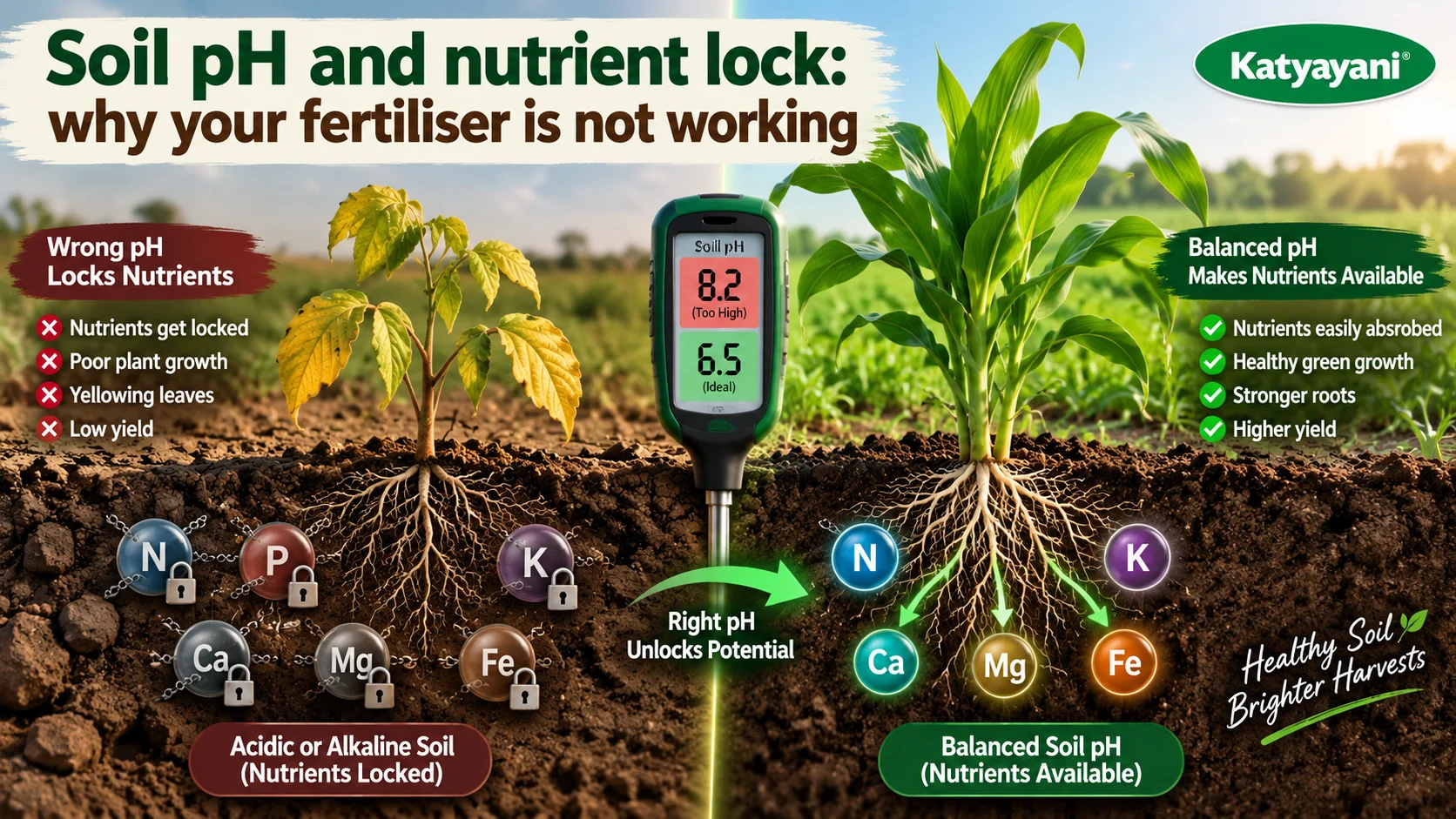
A third one is ignoring soil pH entirely. Above pH 7.5 or below 5.5, several nutrients are chemically locked and unavailable no matter which format you buy. Cropnuts has a clear breakdown of which nutrient locks at which pH. In those fields, adding an activated humic and fulvic acid alongside the fertiliser improves what the roots can actually pick up.
A practical split for one season
Most growers do best with both formats rather than one. A workable pattern on an irrigated crop:
- Basal dose at sowing or transplanting, granular, carrying the bulk N, P, K and any soil-level micronutrient correction.
- First split at active vegetative growth, granular top dress or fertigation depending on what you have.
- Peak demand stage, water-soluble through drip or as a foliar spray, in two or three small doses.
- Corrective foliar spray only if a deficiency actually shows.
That gives you the cheap bulk nutrition from granular and the precision from water-soluble, without paying premium prices for the whole programme.
Deciding for your own field
Ask three questions. Do you have drip or a working sprayer? Is the crop margin high enough to justify precision? And is the nutrient needed now or over the next month? If the answer to all three points the same way, the choice makes itself.
Get a soil test before the season starts. Choosing between formats matters far less than knowing what your field is actually short of.
Frequently asked questions
1. Is water-soluble fertiliser better than granular?
Neither is better in general. Water-soluble delivers nutrient faster and with less loss, which matters at peak crop demand and on drip systems. Granular costs far less per kilogram of nutrient and works well for the base dose. Most growers use both in one season.
2. Can I spray granular fertiliser after dissolving it in water?
Not reliably. Granular products often contain fillers and coatings that do not dissolve fully, so they clog nozzles and leave residue on leaves. Use a product labelled 100 percent water soluble for spraying or fertigation.
3. How much more does water-soluble fertiliser cost?
Usually two to four times more per kilogram of nutrient. The gap narrows once you account for how much of the granular dose is lost to leaching, fixation and volatilisation before the plant reaches it.
4. Which is better for drip irrigation?
Water-soluble, and it is not close. Granular fertiliser will not pass through drip lines and will block emitters. If you have drip installed, fertigation with a fully soluble grade is the main reason the system pays for itself.
5. What is NPK 19:19:19 used for?
It is a balanced grade used during active vegetative growth and early reproductive stages, when the crop needs nitrogen, phosphorus and potassium in roughly equal measure. It is applied through drip or as a foliar spray.
6. When should I switch from 19:19:19 to a potassium-heavy grade?
At fruit filling or grain filling. Potassium drives sugar movement and grain weight at that stage, so a grade such as 13:00:45 or 00:52:34 fits better than a balanced one.
7. Does foliar spraying replace soil fertiliser?
No. A leaf can only absorb small quantities at a time, so foliar feeding covers micronutrients and short-term corrections. The bulk nitrogen, phosphorus and potassium requirement still has to come through the soil or through drip.
8. Why did my granular fertiliser not show any effect?
The three usual reasons are dry soil, so the granule never dissolved; a soil pH that has locked the nutrient chemically; and surface broadcasting on a crop whose roots are already deep. A soil test will tell you which one applies.
9. Can water-soluble and granular fertiliser be used together?
Yes, and that is the normal practice. Granular carries the base dose at sowing, water-soluble handles the peak demand stages and any corrections during the season.
10. How do I calculate the real cost of a fertiliser?
Divide the bag price by the kilograms of actual nutrient it contains, then adjust for how much of that nutrient your soil and irrigation method allow the crop to recover. Comparing bag prices alone hides the difference.
SOURCES CITED
Cropnuts — Soil pH and Nutrient Availability — https://cropnuts.com/soil-ph-and-nutrient-availability/
Verdesian Life Sciences — Liquid vs Granular Fertilizer — https://vlsci.com/blog/liquid-vs-granular-fertilizer/
| Category | Field Notes |
|---|---|
| URL slug | /blog/farming/water-soluble-vs-granular-fertiliser |
| Primary keyword | water soluble vs granular fertilizer |
| Secondary keywords | water soluble fertilizer uses, granular fertilizer advantages, fertigation vs broadcasting, NPK 19 19 19 uses, fertiliser cost per acre, which fertilizer is better for crops, foliar spray fertilizer |
| Search intent | Commercial investigation — grower is choosing between two fertiliser formats and wants to know which is worth the extra cost. |
| Meta title | Water-Soluble vs Granular Fertiliser: Which Is Worth It? (56 chars) |
| Meta description | Water-soluble fertiliser costs more per kilo but wastes less. Here is the cost-per-acre maths, and when granular is genuinely the better buy. (141 chars) |
| Word count | ~1,750 |
| Internal links | NPK 19:19:19 | NPK 12:61:00 | NPK 13:00:45 | Ammonium Sulphate | Zinc Sulphate | Humic + Fulvic Acid |
| External sources | Cropnuts (soil pH and nutrient availability) | Verdesian Life Sciences (liquid vs granular) |
| Granular | Water-soluble | |
|---|---|---|
| Cost per kg of nutrient | Low | High, often 2 to 4 times more |
| Speed of response | 10 to 25 days | 2 to 5 days by drip, 24 to 72 hours foliar |
| Nutrient reaching the plant | Roughly 30 to 50 percent for nitrogen, lower for phosphorus | Roughly 80 to 95 percent through drip |
| Equipment needed | None, or a basic spreader | Drip set or a knapsack sprayer |
| Labour | One or two operations | Repeated small doses |
| Best suited to | Basal dose, bulk N-P-K, rainfed fields | Correction, peak demand stages, drip-irrigated crops |
| The efficiency numbers are the whole argument. If half your granular urea is lost to leaching and volatilisation, the cheap bag is not as cheap as the price tag suggests. But if your soil is holding nutrients well and the crop is not in a hurry, paying four times more to save that loss makes no sense. |
|---|
Leave a Comment