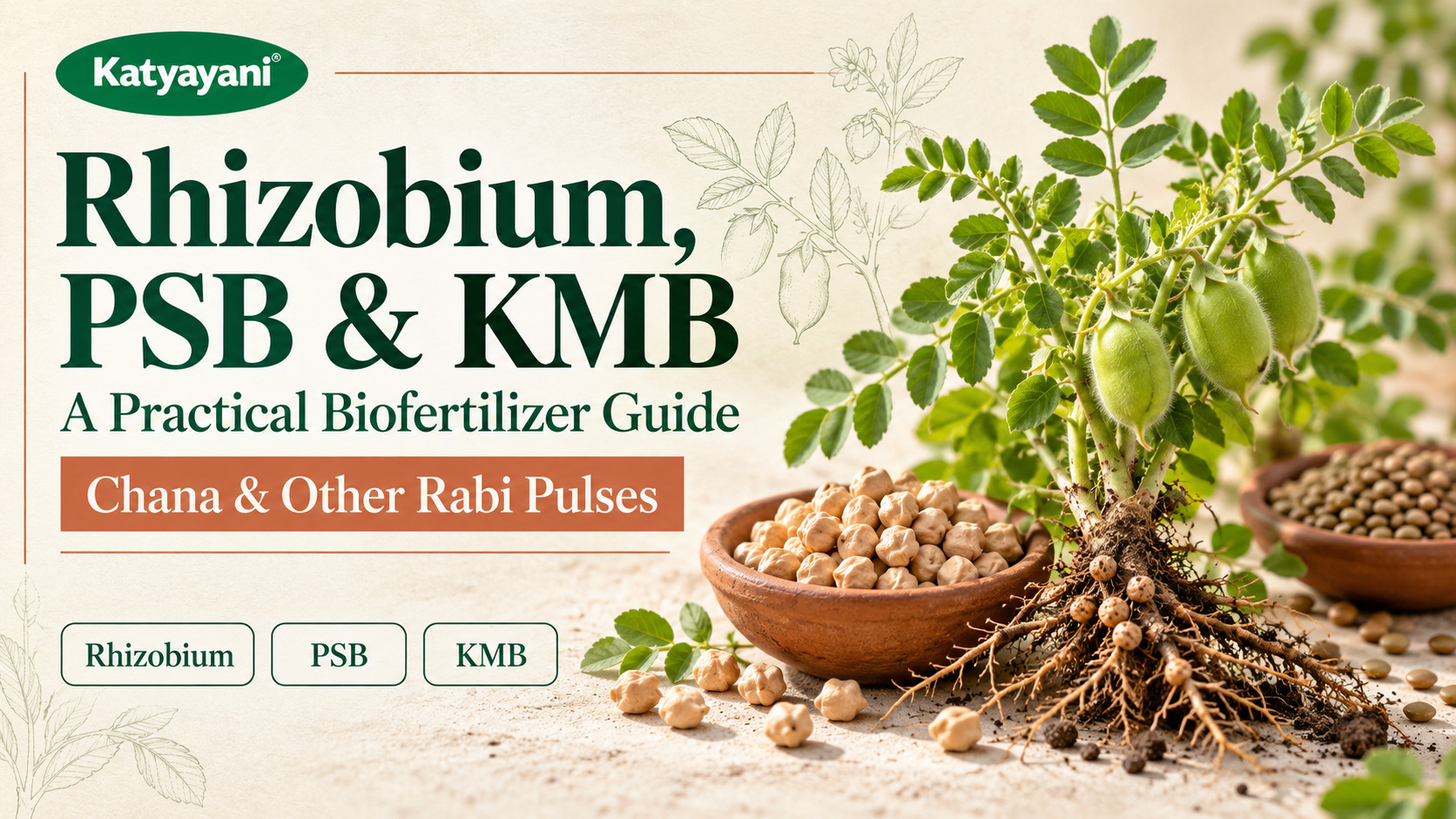
 5 min read
What is a biofertilizer and why does chana need one?
A biofertilizer is a ready-to-use product containing live, beneficial microbes that make nutrients available to plants when applied to seed, roots or soil. Unlike urea or DAP, it does not carry much nutrient itself. It works by fixing nitrogen from the air or by releasing nutrients already locked in the soil.
Chana (chickpea or Bengal gram) is a legume, so it can meet much of its nitrogen need through root nodules. The catch is that the right bacteria are often missing or weak, especially in fields where chana was not grown recently, in soils after long paddy or cotton cycles, or where heavy chemical use has reduced soil life. Inoculating the seed puts the correct bacteria right where the root emerges.
Phosphorus and potash are the other two nutrients that limit chana yield. Indian soils often hold good total phosphorus and potassium, but most of it is in forms plants cannot absorb. PSB and KMB help release part of that reserve.
Rhizobium, PSB and KMB: what each one does
Rhizobium fixes nitrogen, PSB solubilises phosphorus and KMB mobilises potash. Used together, they cover the three major nutrients in a biological way.
| Biofertilizer | What it does | How it is applied in chana | What you may see |
|---|---|---|---|
| Rhizobium (chickpea strain, Mesorhizobium ciceri) | Enters root hairs, forms nodules and converts air nitrogen into ammonia for the plant | Seed treatment just before sowing; soil application with FYM as backup | Pink-red nodules on roots at 30 to 45 days, greener plants |
| PSB (phosphate solubilising bacteria) | Releases organic acids that dissolve bound phosphate in soil | Seed treatment along with Rhizobium, or with FYM in furrows | Better root growth and early vigour |
| KMB / KSB (potash mobilising bacteria) | Makes fixed potassium from soil minerals available | Soil application with FYM or compost, or as per label | Stronger stems, better grain filling |
Rhizobium for chana
Rhizobium bacteria infect the legume root, form nodules and reduce atmospheric nitrogen to ammonia inside them, as explained in the TNAU biofertilizer technology guide. The same guide lists Bengal gram among crops fixing roughly 75 to 117 kg N per hectare. Rhizobium is host specific, so a culture for soybean or groundnut will not nodulate chana well. Choose a Rhizobium nitrogen-fixing biofertilizer whose label names chickpea or gram.
PSB for chana
Phosphate solubilising bacteria lower the pH around them and dissolve bound phosphate in soil. For a pulse crop that needs phosphorus for root and nodule development, a phosphate solubilizing bacteria biofertilizer applied with the Rhizobium makes the most of the phosphorus you apply as DAP or SSP.
KMB for chana
KMB (also called KSB) works on potassium bound in soil minerals. It is most useful in soils where potash is not applied at all, which is common in chana. A potash mobilizing bacteria biofertilizer is usually mixed with FYM or compost and placed in furrows or broadcast before the last ploughing.
How much biofertilizer to use for chana (dose per acre)
Dose depends on whether the product is a carrier (powder) or liquid, so always read the pack. The figures below are general extension recommendations.
| Method | Carrier (powder) dose | Liquid dose | Source / note |
|---|---|---|---|
| Seed treatment, Rhizobium | 200 g per 10 kg seed | As per label, mixed with a little water | TNAU general recommendation |
| Seed treatment, PSB | 200 g per 10 kg seed | As per label | Used along with Rhizobium |
| Soil application, Rhizobium + PSB | 2 kg each per hectare with 25 kg FYM and 25 kg soil | As per label, with FYM | TNAU Bengal gram guidance |
| Soil application, KMB | As per label, mixed with FYM or compost | As per label | Apply before sowing |
Chana seed rate is usually 60 to 75 kg per hectare for desi types and 100 to 120 kg per hectare for kabuli types, which is roughly 25 to 30 kg and 40 to 48 kg per acre. So for one acre of desi chana you would need about 500 to 600 g of carrier Rhizobium and the same of PSB at the 200 g per 10 kg rate.
Biofertilizers do not replace the starter fertiliser dose. TNAU recommends 25 kg N, 50 kg P2O5, 25 kg K2O and 20 kg S per hectare for irrigated Bengal gram, and half of that under rainfed conditions. Decide your final dose from a soil test and your state's package of practices.
How to treat chana seed with Rhizobium and PSB, step by step
Seed treatment takes about 30 minutes and should be done on the day of sowing. Work in shade, never in direct sun.
- If you use a chemical fungicide or insecticide seed dresser, apply it first, mix well and let the seed dry completely.
- Prepare a sticker: boil about 50 g jaggery in half a litre of water (or use thin rice kanji) and let it cool fully.
- Mix 200 g Rhizobium and 200 g PSB (carrier type) into the cooled sticker for every 10 kg seed. For liquid products, add the label quantity.
- Spread seed on a clean sheet in shade and pour the slurry over it. Mix gently by hand so every seed gets a thin, even coat without breaking the seed coat.
- Dry the treated seed in shade for about 30 minutes.
- Sow within 24 hours, preferably the same day. Close the furrow quickly so the bacteria are not exposed to sun.
For extra insurance, mix 2 kg Rhizobium and 2 kg PSB with 25 kg FYM and 25 kg soil per hectare and apply in furrows at sowing. This helps in fields where chana is grown for the first time.
Can you mix biofertilizers with fungicide or Trichoderma?
Do not mix Rhizobium or PSB with chemical fungicides, insecticides, herbicides or chemical fertilisers in the same slurry. Chemicals can kill the bacteria. Microbial products, on the other hand, are generally compatible with each other.
Wilt and root rot are serious in chana, so many farmers want both protection and inoculation. The accepted order is FIR: Fungicide first, Insecticide second, Rhizobium (with PSB) last, with the seed dried between steps.
- Chemical fungicide seed treatment (as recommended locally) goes first, then the seed is dried.
- Insecticide seed treatment, only if recommended for termites or cutworm in your area, goes second.
- Rhizobium and PSB are applied last, just before sowing.
- A Trichoderma viride bio-fungicide is a biological option against wilt and root rot and is generally compatible with Rhizobium and PSB. Follow the product label and local agriculture officer advice on doses.
How to check if Rhizobium is working in your chana field
Dig out, do not pull, five or six plants at 30 to 45 days after sowing and wash the roots gently. Healthy nodules are firm and pink to red inside when cut. The colour comes from leghaemoglobin and shows active nitrogen fixation.
- Many pink nodules on the main root near the crown: inoculation worked well.
- Few, small or white or green nodules: nodules are not fixing much nitrogen. Check soil moisture, acidity and whether the culture was exposed to heat or chemicals.
- No nodules at all: the strain did not establish. Next season buy fresh, crop-specific culture and follow the steps above.
Do not respond to poor nodulation by pouring heavy urea. Excess nitrogen early in the season actually suppresses nodule formation. Use a small top-up only if your agronomist advises.
Biofertilizers for other rabi pulses: masoor, matar and rajma
The same PSB and KMB products work across rabi pulses, but Rhizobium must match the crop. Masoor (lentil) and matar (pea) belong to the pea cross-inoculation group, which TNAU lists as fixing about 62 to 132 kg N per hectare. Rajma belongs to the bean group.
| Crop | Rhizobium group | Tip |
|---|---|---|
| Chana (chickpea) | Chickpea specific (Mesorhizobium ciceri) | Most responsive where chana has not been grown for some years |
| Masoor (lentil) | Pea group (Rhizobium leguminosarum) | Use a lentil or pea labelled culture |
| Matar (pea) | Pea group (Rhizobium leguminosarum) | Same group as lentil |
| Rajma (French bean) | Bean group | Nodulation is naturally weaker; soil application with FYM helps |
Mistakes that kill biofertilizer bacteria
Biofertilizers are living products, so most failures come from handling, not from the product. Avoid these common errors.
- Storing packs in a hot shop, vehicle or under the sun. Keep them in a cool, dry, shaded place.
- Using a culture past its expiry date or a pack with a torn seal.
- Using a general legume culture for chana instead of a chickpea strain.
- Mixing Rhizobium into the same bucket as a chemical fungicide or DAP.
- Treating seed today and sowing three days later.
- Sowing into very dry soil and waiting weeks for rain, which lets the bacteria die on the seed.
When buying, check that the pack shows the product name, target crop, manufacturer, batch number, manufacturing and expiry dates, and usage instructions, as TNAU advises. Products sold in India must meet the biofertilizer standards of the Fertiliser (Control) Order.
What to do next
Before sowing, calculate seed quantity for your area and buy enough Rhizobium and PSB for seed treatment, plus KMB for soil application. Keep the packs cool until the sowing day. Do the seed treatment in the shade on the morning you sow.
At 30 to 45 days, dig a few plants to check nodules and note the result for next season. Dealers and FPOs who want bulk biofertilizer stock for the rabi pulse season can reach Katyayani Organics for supply.
Why trust this guide
Written by Team Katyayani, Editorial Team at Katyayani Organics. Cross-checked against published research and university extension programs.




Leave a Comment