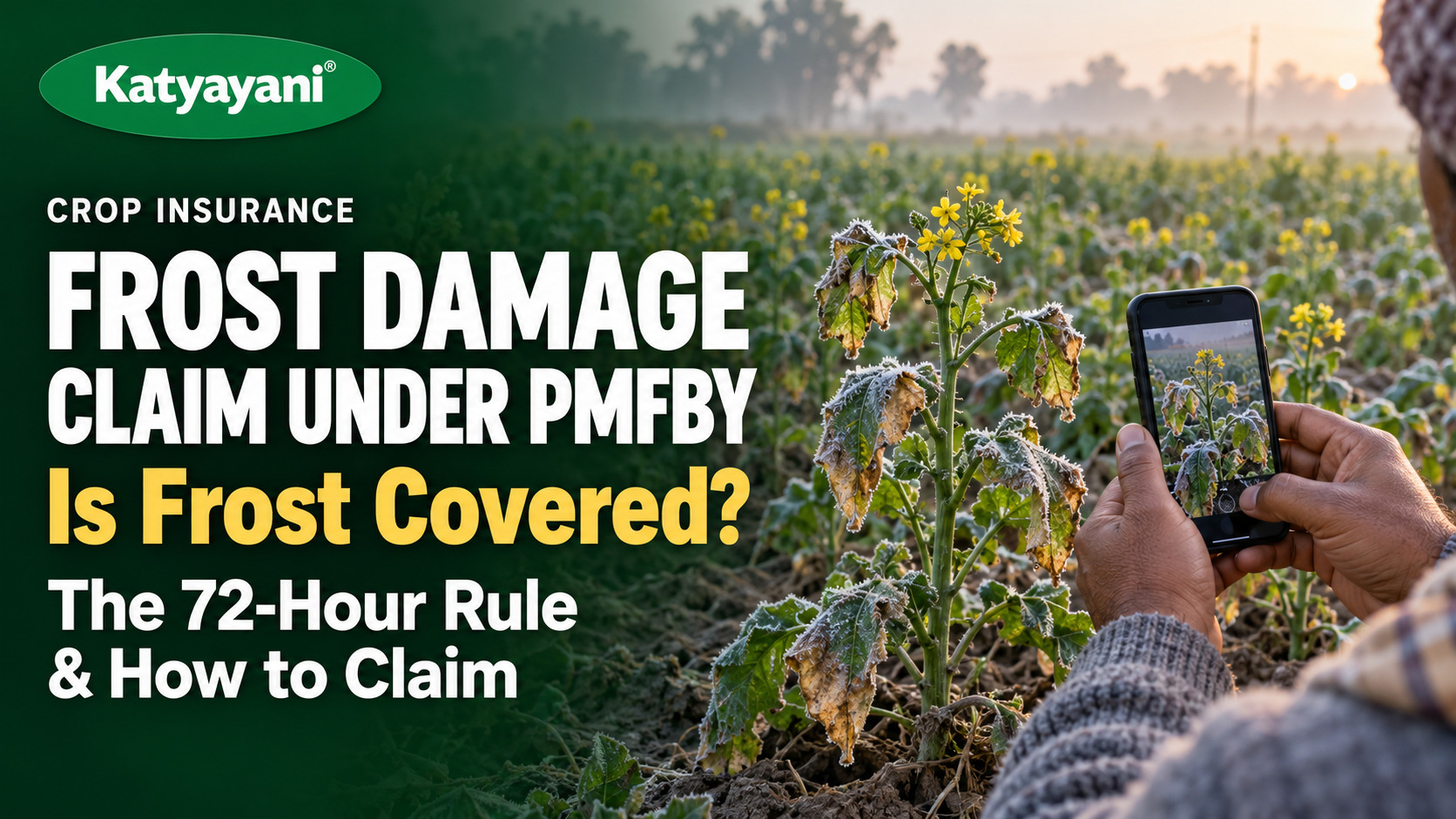
 5 min read
Is frost covered under PMFBY? What the official
lists say
The answer depends on which of four cover types applies.
Here are the exact words from the official texts (original guidelines ↗ and PIB FAQ ↗):
|
Cover type |
Exact wording |
Frost named? |
|
Standing crop (yield loss) |
"Comprehensive risk
insurance is provided to cover yield losses due to non-preventable risks,
such as (i) Natural Fire and Lightning (ii) Storm, Hailstorm, Cyclone,
Typhoon, Tempest, Hurricane, Tornado etc. (iii) Flood, Inundation and
Landslide (iv) Drought, Dry spells (v) Pests/Diseases etc." |
No |
|
Localized calamities
(single farm) |
"identified localized
risks i.e. hailstorm, landslide, and Inundation affecting isolated farms in
the notified area" |
No |
|
Post-harvest |
Up to 14 days from
harvesting for crops kept in "cut and spread" condition, against
specific perils of cyclone, cyclonic rain and unseasonal rain (hailstorm
added later) |
No |
|
Prevented sowing |
Majority of insured farmers
prevented from sowing by adverse weather, up to 25% of sum insured. The
original text makes this cover available in Kharif for recognised rain-fed
areas. |
No |
The later, revamped guidelines are quoted in an Odisha government resolution (Odisha resolution ↗). It lists localized risks as "hailstorm, landslide, inundation, cloud burst and natural fire due to lightning", and basic cover as drought, dry spells, flood, inundation, widespread pest and disease attack, landslide, fire due to lightning, storm, hailstorm and cyclone. Frost is absent from both. The 2018 revision note from PIB confirms that cloudburst and natural fire were added to the localized list (PIB note on 2018 revisions ↗).
|
WHAT ABOUT INSURER PAGES THAT SAY FROST IS
COVERED? Some insurer pages do say so. The Kshema blog says the scheme
"compensates losses from frost, hailstorms and unseasonal rainfall
during Rabi season" (Kshema blog ↗). The IFFCO-Tokio page mentions frost only in its introduction
about weather risks, and its own list of localized risks names only
hailstorm, landslide and inundation (IFFCO-Tokio page ↗). These are commercial pages, not the guidelines. Do not rely on
them for a claim. Ask your insurer for the notified perils for your crop and
district in writing. |
I could not open the full 2020 and 2023 operational guidelines, and I found no state rabi notification that lists frost or cold wave for any crop. One summary suggests states cannot add perils beyond the central list. So please check Sections 5 and 21 of the current guidelines on the PMFBY portal ↗.
Which route can pay for frost damage?
|
Loss type |
How it is assessed |
Can frost fit here? |
|
Localized calamity
(hailstorm, landslide, inundation, cloudburst, natural fire) |
Assessed for a cluster of
affected farms or village; the District Administration helps the insurer;
each farmer is settled individually |
No, frost is not on the
list |
|
Post-harvest loss (cut and
spread crop) |
Farm-level assessment |
No |
|
Area yield shortfall |
If actual yield per hectare
falls short of the threshold yield, all insured farmers growing that crop in
the area are deemed to have suffered shortfall |
Possibly. A Rajya Sabha
answer is reported to say claims follow season-end yield data regardless of
the reason for loss. This is a summary, so verify. |
|
Mid-season adversity |
The insurer decides on an
on-account payment where expected yield is likely below 50% of normal. The
PIB FAQ says up to 25% of sum insured, while the original text says up to 25%
of likely claims. It is not used within 1 month of the start of normal sowing
or within 15 days before normal harvest (Odisha resolution). |
The listed events are
floods, prolonged dry spells, severe drought and unseasonal rain. Frost is
not named. |
The threshold yield was changed in 2018 to use the moving average of the best 5 of the last 7 years. Farmers choose among 70%, 80% and 90% indemnity levels in the original rules, although some states fix a single level. Odisha, for example, used 70% for all crops.
What is the 72-hour rule and who do you tell?
PIB records that in 2018 the time for a farmer to inform
about an individual claim was extended to 72 hours, instead of 48, through any
stakeholder or directly on the portal. This applies to localized calamities and
post-harvest loss. You can inform:
·
The Crop Insurance app, with geo-tagged photos.
·
The national helpline 14447, which a news report
says sends an SMS ticket. A second source gave a different number, so confirm
it on the official portal.
·
The insurance company call centre, your bank
branch, or the agriculture or revenue official, who must forward your report
within 48 hours (as reported by a news site).
A March 2026 news report lists what to give: your name,
survey-wise area, crop, application number, mobile number and bank details.
Take geo-tagged, time-stamped photos and video. Keep your Aadhaar, passbook or
Kisan Credit Card, land record, sowing receipt and PMFBY acknowledgement (GoodReturns report ↗). If you
miss 72 hours, secondary sources say a localized claim is often rejected. That
is not guideline text.
What should you do right after a frost night?
Act on the same day. Even though frost is not a listed
localized peril, a quick report creates a dated record. Treat it as a safe
step, not a guarantee of payment.
1.
Take
dated photos and a short video from several spots: leaves, flowers and the
soil.
2.
Note the
date, time and local temperature, if you know it.
3.
Report
the loss within 72 hours through the app, helpline, insurer, bank or
agriculture office. Ask for a ticket number or written acknowledgement.
4.
Ask in
writing whether frost is a notified peril for your crop and district.
5.
Keep
papers safe: policy copy, premium receipt, land record, passbook.
6.
Protect
what is left. See our frost protection guide.
How is the claim paid, and how long does it
take?
For an area yield shortfall, the state gives yield data from
crop-cutting experiments, the insurer calculates claims and pays them to the
bank accounts of eligible farmers. PIB records that insurers must pay 12% a
year interest for delay beyond two months from the prescribed cut-off date, and
states pay 12% for subsidy delayed beyond three months. A Rajya Sabha answer is
reported to say yield claims are paid within 21 days of calculation, and a
search snippet says localized claims are paid within 15 days of assessment. I
could not open those, so ask your insurer for the due date of your claim.
What changes for Rabi 2026-27?
A May 2026 advisory from the agriculture ministry says
existing insurer contracts end with Rabi 2025-26. States may continue the
2023-26 rates and contracts, or tender again for Kharif 2026 and Rabi 2026-27
under the PMFBY Operational Guidelines 2023. All terms of the 2023 guidelines
continue to apply, and states must adopt the CLAP app, the CCE Agri app and
AgriStack validation (advisory copy ↗). Wild
animal attack was added as a fifth add-on under localized risks in late 2025,
according to a secondary source, and states notify the animals and districts.
|
Crop group |
Farmer pays |
|
Rabi food grains and
oilseeds |
1.5% of the sum insured or
the actuarial rate, whichever is less |
|
Kharif food grains and
oilseeds |
2% |
|
Annual commercial and
horticultural crops |
5% |
The rabi cut-off differs by state. Examples seen in news snippets include 15 December 2025 for wheat and barley in Chamba (Himachal), 31 December 2024 in Madhya Pradesh and 15 January 2026 for pulses and vegetables in the Andaman and Nicobar Islands. I found no official Rabi 2026-27 notice, so check your state. Use our PMFBY rabi enrolment guide for the steps, and the eligibility and benefits guide for who can join. Loan farmers can enrol through their Kisan Credit Card bank.
How often does frost actually hit farmers?
In mid-December 2024, frost damaged mustard and vegetable
crops in Hisar, Haryana, and farmers asked for assessment and compensation, but
the report names no insurance scheme (The Tribune ↗). In
February 2024, cold and fog damaged rabi crops in Bihar, and the state asked
districts for damage reports, without a PMFBY mention. The lesson is that
relief for frost often comes through state damage surveys rather than a PMFBY
claim.
What if a claim is rejected or delayed?
·
Ask the insurer for the reason in writing.
·
Go to the district-level monitoring committee
and the District Collector.
·
Use the national grievance portal,
pgportal.gov.in, if the district level does not help.
·
Keep your ticket number and photos for every
step.
These escalation steps are from a secondary farmer guide, so
confirm the correct office in your district.
Conclusion
Frost is the gap in PMFBY that many guides skip. The
official lists do not name it. A widespread frost loss can only reach you
through the area yield shortfall at season end, while individual claims cover
hailstorm, landslide, inundation, cloudburst and natural fire. Still,
photograph the damage, report within 72 hours, ask your insurer for the
notified perils in writing and look for state relief. Enrol early, and check
the 2023 guidelines on the portal for the final word.
Why trust this guide
Written by Team Katyayani, Editorial Team at Katyayani Organics. Cross-checked against published research and university extension programs.



Leave a Comment