Government Schemes
Information about government agricultural schemes and subsidies for farmers.
41 articles
 11 min
Nano Urea and Nano DAP Subsidy in Rajasthan: Rates, Crops, How to Claim and What Studies Say
Yes, for this rabi season. As reported on 25 Oct 2026, Rajasthan is paying half of a fixed spray cost under its 2026-27 budget announcement, run through RKVY: Rs 1,000 per hectare for nano urea (cost fixed at Rs 2,000) and Rs 1,450 per hectare for nano DAP (cost fixed at Rs 2,900). That is about Rs 405 and Rs 587 per acre. Reported crops are wheat, barley, mustard, gram and cumin. You must be in a village cluster of at least 10 farmers, with 0.4 to 10 hectares sprayed under the supervision of the agriculture department, and the money comes by DBT after the field check. It is not a discount at the shop: you still buy the bottle at the printed price. Contact your Krishi Paryavekshak or the nearest agriculture office to join a cluster, because each district has a limited target. We could not read the official order, so confirm the rates there before you spray.
 12 min
Subsidy for Mushroom Cultivation in India: MIDH, NHB, Loan and How to Apply
The main national scheme is MIDH (Mission for Integrated Development of Horticulture). For a private mushroom unit it gives 40 percent of the cost norm as a credit linked, back ended subsidy. It is 50 percent in North Eastern and Himalayan states, Scheduled Areas, vibrant villages and the islands. The cost norms are Rs 30 lakh for a production unit, Rs 20 lakh for a spawn unit and Rs 30 lakh for a compost unit, so the top subsidy is Rs 12 lakh, Rs 8 lakh and Rs 12 lakh in general areas. A small 200 sq ft unit gets 50 percent of Rs 2 lakh, up to 5 units. You take a bank loan, build, and the subsidy is adjusted in your loan account after inspection. Apply through your District Horticulture Officer or the state horticulture portal. Rates and ceilings come from the 2025 guidelines, so confirm the current state circular before you start building.
 8 min
Krishi Vistara Yojana Karnataka 2026: What the Chief Minister's Scheme Offers and What Is Still Unknown
The Chief Minister's Krishi Vistara scheme is a Karnataka Budget 2026-27 announcement: Rs 100 crore over the next three years to strengthen work after harvest, such as processing, value addition, value chain development, recycling of farm waste and market linkages. The aim, in the budget's words, is stable and additional income for rural farmers. As of 26 October 2026 we found no guidelines, eligibility rules, subsidy rates or application process. Do not pay anyone to apply. Keep your FRUITS ID and land record ready, think about joining a group, and watch Raitamitra and your Raitha Samparka Kendra.
 12 min
Krishi Bhagya Scheme Karnataka: Farm Pond (Krishi Honda) Subsidy, Sizes, Eligibility and How to Apply in 2026
Krishi Bhagya is running in 2026-27. The Karnataka Department of Agriculture issued its 2026-27 guidelines on 8 May 2026, with Rs 100 crore set aside. It pays 80% for general farmers and 90% for SC and ST farmers on the farm pond (krishi honda), and on field bund, pump set and polythene lining. Fencing gets 40% and 50%. Ponds come in five sizes, from 10 x 10 x 3 m to 21 x 21 x 3 m. You apply at your Raitha Samparka Kendra, where staff enter your application in the K-KISAN system. Seats are limited each year and are given in order of application date. Krishi Honda is just the Kannada name for the pond, so it is not a different scheme.
 9 min
FRUITS ID Registration in Karnataka: Step-by-Step Guide for Farmers
FRUITS stands for Farmer Registration and Unified Beneficiary Information System. It is the Karnataka government farmer database. You register once with your Aadhaar, fetch your land from Bhoomi, pick an approving officer and get a FRUITS ID (FID) after approval. Registration is online through Citizen Login on fruits.karnataka.gov.in, or in person at a Raitha Samparka Kendra or the taluk Horticulture office. Keep ready: Aadhaar with a linked mobile, RTC for each survey number, an Aadhaar-seeded bank passbook, and a caste certificate only if you want a category recorded. The official FAQ does not mention a fee. Check with your office before you pay anyone.
 13 min
Digital Agriculture in India: How Technology Is Changing Crop Input Decisions
Digital agriculture means using phones, data, satellites, sensors and drones to decide what to put on a field, how much, and when. In India the base is public: the Digital Agriculture Mission (approved 2 September 2024, Rs 2,817 crore, seven years) is building AgriStack with a Farmer ID, a Krishi Decision Support System and soil profile maps. For a farmer, the most useful tools today are a soil test (Soil Health Card), a weather advisory app such as Meghdoot, a mandi price source such as e-NAM, and a drone service for spraying. Data does not replace local advice. It helps you choose the right input, the right dose and the right day, and avoid buying what the field does not need.
 11 min
Punjab DSR Incentive Scheme: Rs 1,500 Per Acre for Direct Seeding of Rice, Eligibility, Registration and Field Tips
The Punjab DSR incentive scheme pays Rs 1,500 per acre to farmers who sow paddy by direct seeding instead of transplanting. The scheme started in 2022. For the 2026 Kharif season the state reported over 4 lakh acres, 31,478 registered farmers and about Rs 61 crore in assistance. A farmer registers the area on the state DSR portal, officials verify the field twice, and the money goes straight to the bank account. Registration dates change each year, so check the Agriculture Department notice for the current season.
 11 min
Weather Based Crop Insurance Scheme (RWBCIS): Coverage, Premium, Triggers and Claims
The Restructured Weather Based Crop Insurance Scheme (RWBCIS) pays farmers when recorded weather, such as rainfall, temperature, humidity or wind, crosses a preset limit, even if nobody measures the actual crop loss. It runs alongside PMFBY, and farmer premium follows the same caps: up to 2% of sum insured for Kharif food crops and oilseeds, 1.5% for Rabi, and 5% for annual commercial and horticultural crops. Payouts are worked out from the weather station linked to your area, not from your field.
 11 min
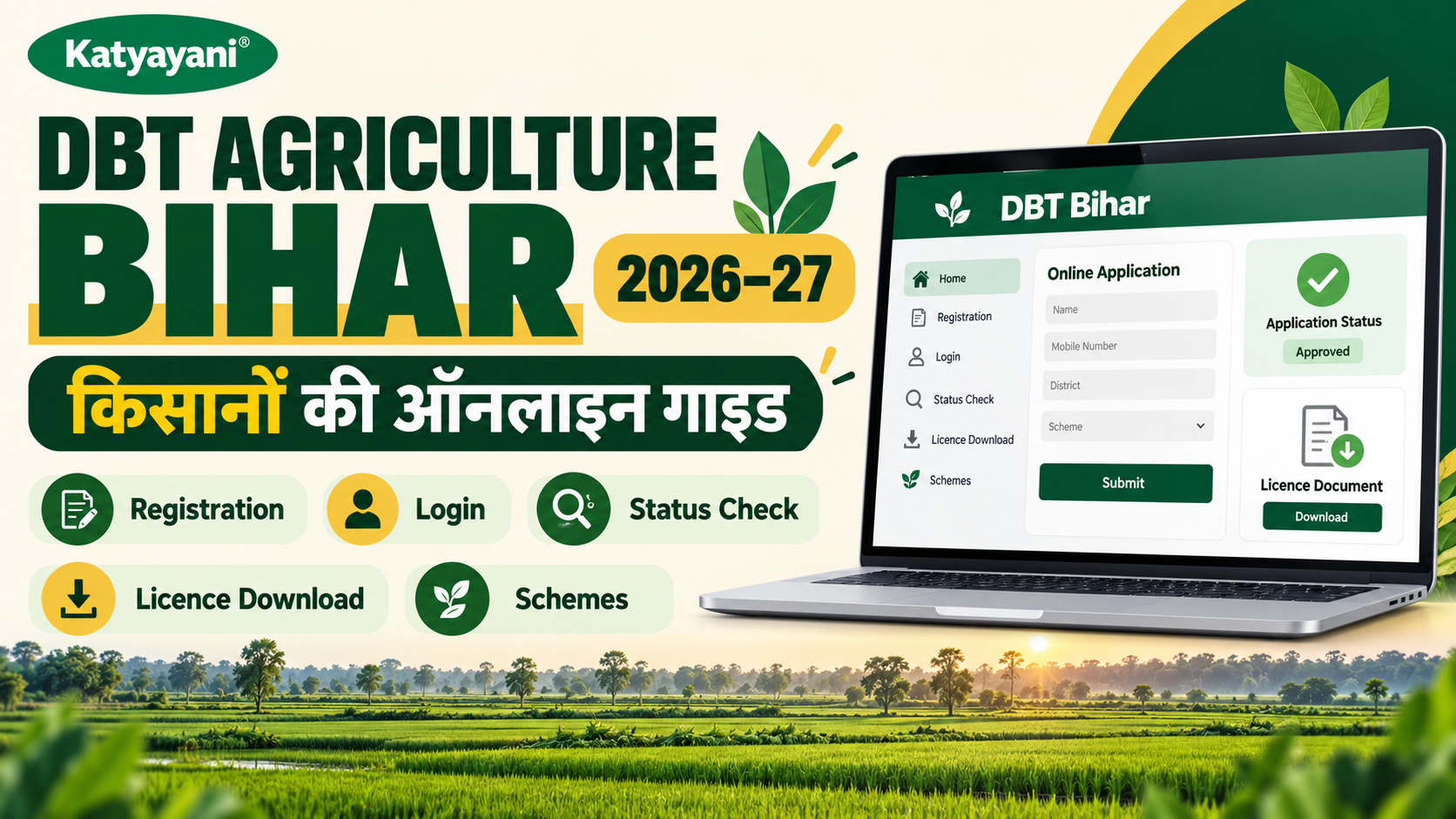
DBT Agriculture Bihar: Registration, Login, Status Check, Licence Download and Schemes (2026-27)
DBT Agriculture Bihar is the Bihar Agriculture Department portal at dbtagriculture.bihar.gov.in. A farmer first registers (Aadhaar-based, by OTP online or at a Vasudha Kendra with biometrics) and gets a 13-digit registration number. After about 48 hours that number can be used to log in and apply for schemes. Status, detail correction, beneficiary lists and the seed, fertiliser and pesticide licence services all sit on the same portal.
 11 min
Rajasthan Agriculture Department: Raj Kisan Saathi Login, Apply Online, Subsidy Status and MSP Procurement
Rajasthan farm subsidies are applied for online on the Raj Kisan Saathi portal (rajkisan.rajasthan.gov.in). You log in with an SSO ID or with your Jan Aadhaar number and an OTP, apply for the scheme, and track it through the "Know Application Status" option. The portal says grant applications are online only and no papers need to go to the agriculture office. MSP sales are separate: wheat registration for RMS 2026-27 ran on mspproc.rajasthan.gov.in with a Jan Aadhaar card.
 12 min
How to Check Land Records Online: State-Wise Guide to Bhulekh, Jamabandi, 7/12 and Khatauni
To check land records online, open your state's official land record portal (for example Bhulekh in Uttar Pradesh, Bhoomi in Karnataka, Apna Khata in Rajasthan, AnyRoR in Gujarat, Jamabandi in Punjab and Haryana), choose district, tehsil and village, then search by khasra, survey number, khata or owner name. Viewing is usually free. A certified copy may need a small fee or a kiosk visit.
 11 min
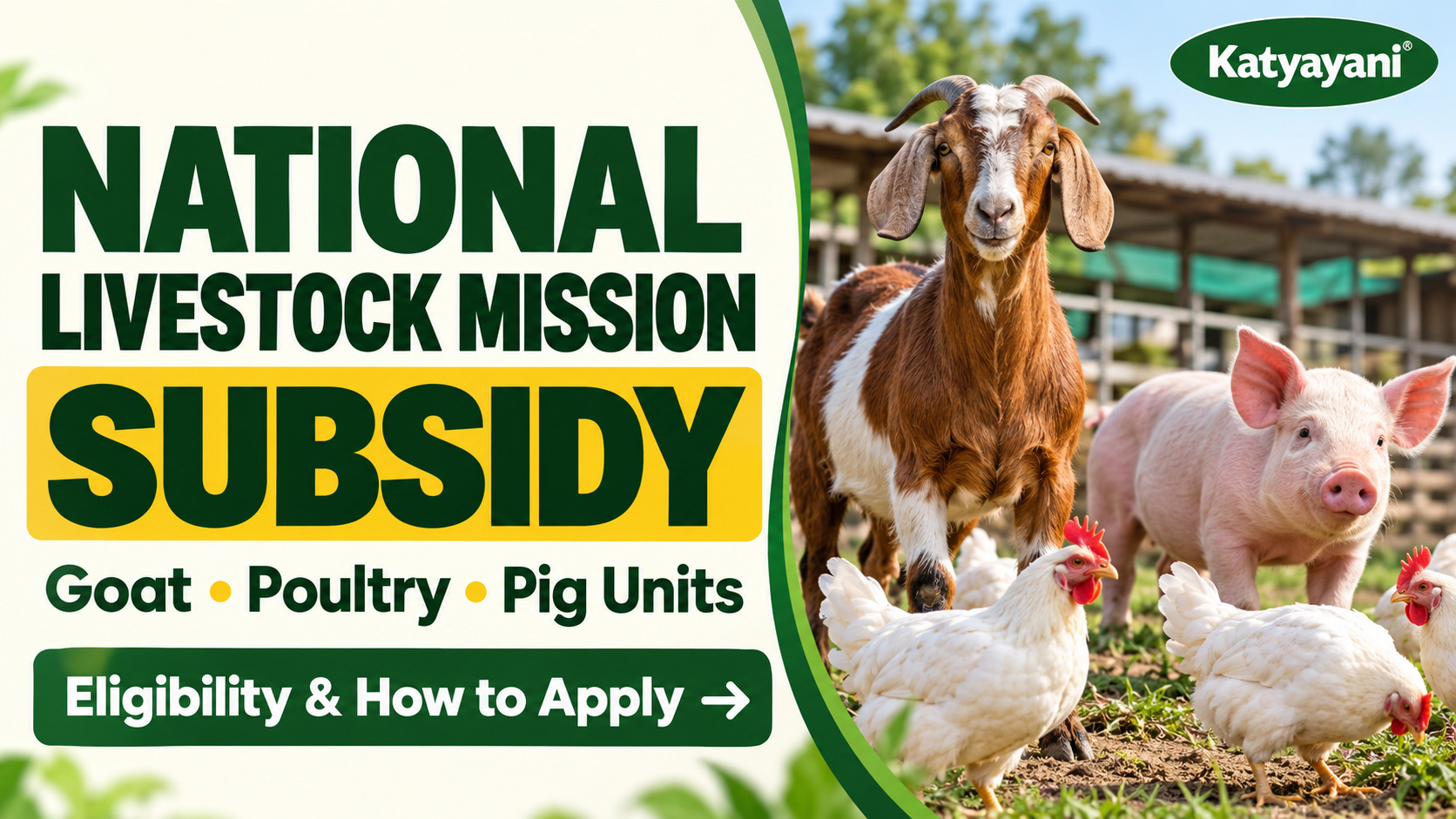
National Livestock Mission Subsidy: Goat, Poultry and Pig Units, Eligibility and How to Apply
Under the National Livestock Mission Entrepreneurship Development Programme (NLM-EDP), the Government of India gives a back-ended capital subsidy of up to 50% of project cost for new goat, sheep, rural poultry, pig and fodder units. The cap depends on unit size: Rs 10 lakh to Rs 50 lakh for goat or sheep, Rs 25 lakh for the rural poultry parent farm, Rs 15 lakh or Rs 30 lakh for pig breeding. You apply online on nlm.udyamimitra.in, and a bank loan sanction is part of the process.
