 12 min read
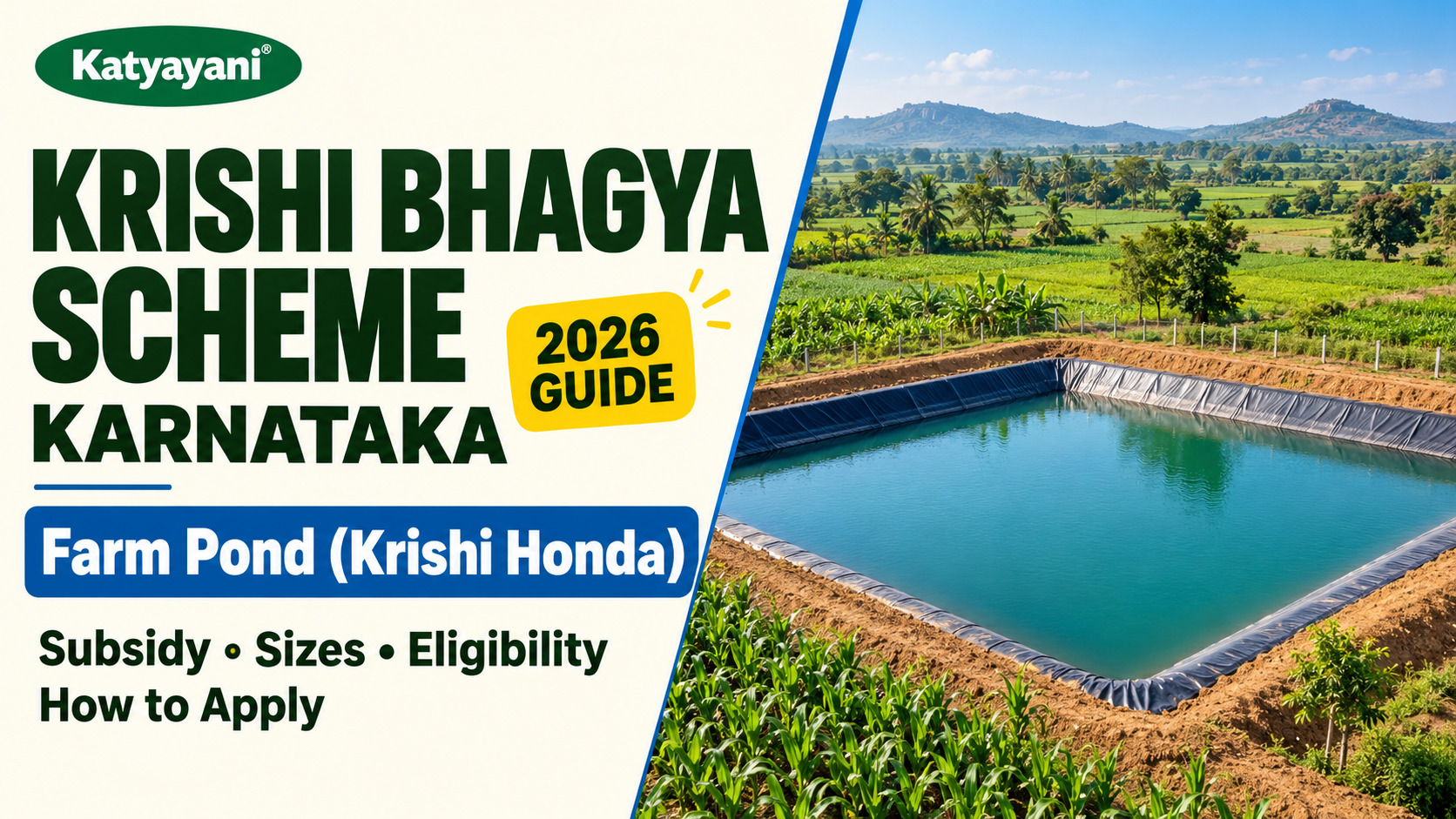
Krishi Bhagya is running in 2026-27. The Karnataka Department of Agriculture issued its 2026-27 guidelines on 8 May 2026, with Rs 100 crore set aside. It pays 80% for general farmers and 90% for SC and ST farmers on the farm pond (krishi honda), and on field bund, pump set and polythene lining. Fencing gets 40% and 50%. Ponds come in five sizes, from 10 x 10 x 3 m to 21 x 21 x 3 m. You apply at your Raitha Samparka Kendra, where staff enter your application in the K-KISAN system. Seats are limited each year and are given in order of application date. Krishi Honda is just the Kannada name for the pond, so it is not a different scheme.
Is the Krishi Bhagya scheme still running in 2026?
Yes. The Karnataka Department of Agriculture lists Krishi Bhagya Guidelines for 2026-27, dated 8 May 2026, on its Raitamitra scheme page. The guidelines say Rs 100 crore was released for the scheme in the 2026-27 estimates, and that it continues as an ongoing scheme. The same page lists polythene lining circulars dated 28 April 2026.
| Phase | Period | What the official page or guideline says |
|---|---|---|
| First phase | 2014-15 to 2020-21 | Run across the state under the rainfed agriculture policy (Government Order dated 22 July 2014) |
| Revival | From 2023-24 | Guidelines for 2023-24 dated 13 December 2023; the 2026-27 guideline says the scheme has been revived since 2023-24 |
| All taluks | 2024-25 | Page lists "extension of the scheme to all taluks of all districts", dated 20 May 2024 |
| Current | 2026-27 | Guidelines dated 8 May 2026; Rs 100 crore in the 2026-27 estimates |
The guideline says about 64% of Karnataka's cultivated area is rain-fed. That is why the state keeps this scheme going: a pond lets a farmer save runoff from the monsoon and give one protective irrigation when a dry spell hits the crop.
What is the Krishi Bhagya scheme in Karnataka?
Krishi Bhagya is a Karnataka government scheme that helps rain-fed farmers catch rainwater on their own land in a farm pond and use it to protect crops in dry spells. It works as a package of six components. A farmer is meant to take all of them, so the pond actually works.
| No. | Component | What it is |
|---|---|---|
| 1 | Field bund | A bund or trench on the farm so rain soaks in or flows to the pond |
| 2 | Farm pond (krishi honda) | Rainwater storage structure dug on the field |
| 3 | Polythene lining | HDPE sheet that stops seepage from the pond |
| 4 | GI wire fencing | Fence around the pond for safety |
| 5 | Pump set | Diesel, petrol or solar pump to lift pond water |
| 6 | Micro irrigation | Drip or sprinkler set to use the stored water well |
The guideline gives three aims. Turn rain-fed farming into stable farming. Raise yield and income through water saving. Use pond water for protective irrigation when crops face dry spells. It also notes that many farmers in low-rainfall areas spend up to Rs 2 lakh on a borewell that can fail, and suggests they put that money into the Krishi Bhagya package instead.
Krishi Bhagya or Krishi Honda: what is the difference?
There is no difference in the scheme. Krishi Honda is the Kannada word for a farm pond. Krishi Bhagya is the name of the scheme under which the pond is built. So when a farmer says "krishi honda subsidy", he means the pond part of Krishi Bhagya.
The confusion comes from the way pages are titled. Some sites use "Krishi Honda Karnataka" and some use "Krishi Bhagya" for the same thing. The official guideline calls the component "Neeru Sangrahana Rachane (Krishi Honda)", which means water storage structure. Ponds can also be dug under other programmes such as MGNREGA, which the guideline treats as an "existing component" (see the section on other schemes below).
How much subsidy does Krishi Bhagya give in 2026-27?
The 2026-27 guideline gives 80% subsidy to general farmers and 90% to SC and ST farmers for the field bund, farm pond, polythene lining and pump set. GI wire fencing gets 40% and 50%. Micro irrigation gets 90% for all farmers, but it is paid through other schemes.
| Component | General farmers | SC / ST farmers | Note |
|---|---|---|---|
| Field bund | 80% | 90% | As per approved estimate; guideline mentions about 100 m of bund as the limit |
| Farm pond (krishi honda) | 80% | 90% | On approved cost for the pond size and soil |
| Polythene lining | 80%, up to Rs 70,000 | 90%, up to Rs 80,000 | Ceiling per farmer |
| GI wire fencing | 40% | 50% | Compulsory for all ponds |
| Pump set, up to 10 HP | 80% | 90% | Diesel, petrol or solar; see pump section |
| Micro irrigation (drip or sprinkler) | 90% | 90% | Paid under PM-RKVY-PDMC or Atal Bhujal, not from Krishi Bhagya funds |
For a broader view of other support, see our guide to agriculture subsidy schemes in India. The guideline source is the Krishi Bhagya Guidelines 2026-27.
What farm pond sizes are allowed and what does each cost?
Five sizes are approved: 10x10x3, 12x12x3, 15x15x3, 18x18x3 and 21x21x3 metres. The guideline gives a fixed cost for each size by soil type. The farmer digs the pond, and the subsidy is paid on the approved cost, not on what he actually spends.
| Pond size (m) | Red soil: approved cost (Rs) | Red soil: 80% subsidy (Rs) | Red soil: 90% subsidy (Rs) | Black soil: approved cost (Rs) | Black soil: 80% subsidy (Rs) |
|---|---|---|---|---|---|
| 10 x 10 x 3 | 28,918.72 | 23,135.00 | 26,026.80 | Not suggested | Not applicable |
| 12 x 12 x 3 | 37,940.10 | 30,352.10 | 34,146.10 | 32,146.11 | 25,716.90 |
| 15 x 15 x 3 | 59,167.02 | 47,333.60 | 53,250.30 | 50,869.39 | 40,695.50 |
| 18 x 18 x 3 | 81,926.92 | 65,541.50 | 73,734.10 | 71,077.83 | 56,862.30 |
| 21 x 21 x 3 | 1,13,639.96 | 90,912.00 | 1,02,276.00 | 1,00,287.23 | 80,229.80 |
There is a third column in the official table for "jambitte" (laterite) soil, with higher costs. A 12x12x3 pond there is approved at Rs 45,451.01. The guideline says the cost can change with soil type, pond size and the latest schedule of rates. It also says a 10x10x3 pond is not advised in deep black soil.
In plain words: a 12x12x3 m pond in red soil is approved at Rs 37,940.10, the government pays Rs 30,352.10 and the general farmer pays the rest. These are rate norms from the 2026-27 guideline (itself based on the 2023-24 schedule of rates), not a promise of what you will receive, so confirm the figure with your Raitha Samparka Kendra.
Which pond size should you choose?
The guideline lets the farmer choose the size, based on his land and the catchment area, after the officer's field check. For black cotton soil that has no natural lining, the guideline gives priority to the large 21x21x3 m pond because polythene is not compulsory there. In red soil, a smaller pond with lining works, but check the area rules below.
Water Math: The guideline says a pond holding 250 cubic metres of water can give one protective irrigation by drip or sprinkler to about 2 to 4 hectares of crop during a dry spell. Use it as a planning guide, not a guarantee. Actual cover depends on the crop and the soil.
How much land do you need to qualify for a farm pond?
For 15x15x3, 18x18x3 and 21x21x3 m ponds, you need at least 1.0 acre of cultivated land in one survey number. For 12x12x3 m and larger, the guideline asks for at least 1 acre of total cultivated land in one survey number, or in one place if it spans more than one survey number.
Small holdings get a path too. A farmer with 0.50 acre can build a 10x10x3 m or 12x12x3 m pond (red or laterite soil) or a 12x12x3 m pond (black soil), as long as the total rain catchment area, including his land, is at least 1.0 acre. This rule comes from a Government Order dated 28 April 2025, as cited in the 2026-27 guideline.
| Your cultivated land | Pond sizes you can ask for | Condition |
|---|---|---|
| 1.0 acre or more in one survey number | 15x15x3, 18x18x3, 21x21x3 m, and the smaller sizes | Officer's field check confirms the land |
| 1 acre in total, spread over survey numbers in one place | 12x12x3 m and above | Land must be together in one place |
| 0.50 acre | 10x10x3 or 12x12x3 m (red / laterite); 12x12x3 m (black) | Total catchment, including your land, at least 1.0 acre |
Who is eligible for Krishi Bhagya?
Any interested farmer in Karnataka can apply, with no taluk limit, since the scheme runs in all districts. The main conditions in the 2026-27 guideline are land in your name, the land-size rules above and no earlier farm pond under any scheme in the last four years.
- Area: the scheme covers all districts of the state, including non-drought areas.
- Land: minimum 1.0 acre in a single survey number for 15, 18 and 21 m ponds. Smaller plots follow the catchment rule above.
- Past benefit: a farmer who already got a farm pond under Krishi Bhagya or any other scheme in the last four years is not eligible. This is checked through the K-KISAN portal or by a field visit.
- Category: SC and ST farmers get the higher subsidy rate fixed by the government.
- Intent: the farmer must be ready to take the full package, because the officer confirms this at the field check.
- No double benefit: if the same component came from another department scheme, it is counted as an "existing component", and the farmer does not get it again from Krishi Bhagya.
Some websites say you must be a "small or marginal farmer" or that the scheme only covers drought-prone taluks. The 2026-27 guideline does not say that. It covers all districts and speaks of any interested farmer, so treat those claims as old or unofficial (marked VERIFY in the table at the end).
What documents do you need for Krishi Bhagya?
The guideline asks for an application in the department format, filled at the Raitha Samparka Kendra, and uses your FRUITS ID (FID) or Aadhaar number to link the record. The detailed checklist sits in the application format, which was not readable in the copy we reviewed, so confirm it at the Kendra.
| Document | Why it is needed | Source level |
|---|---|---|
| FRUITS ID (FID) or Aadhaar number | Farmer record; used in the officer's declarations and receipts | Official guideline |
| Land record (RTC / Pahani) | Proves cultivated area and survey number for the size rules | Usually asked; not listed on the pages we read (VERIFY) |
| Bank passbook linked to Aadhaar | Subsidy is paid to the farmer's account | Guideline says money goes to the farmer account; passbook copy VERIFY |
| Caste certificate (SC / ST) | For the 90% rate | Usually asked (VERIFY) |
| Mobile number linked to Aadhaar | For OTP and status messages | Practical tip, VERIFY |
If you do not yet have a FRUITS ID, register on the state FRUITS portal first. Our guide on the agriculture schemes calendar helps you plan the papers before the season starts.
How do you apply for Krishi Bhagya in 2026-27?
You apply at your nearest Raitha Samparka Kendra (RSK). The staff register your application in the K-KISAN system. After a field check you get a work order, dig the pond, and the subsidy is paid in two parts. The guideline describes no direct online form for farmers.
- Get the application form. The taluk Assistant Director of Agriculture prints the form and supplies it to all Raitha Samparka Kendras. It is free to collect.
- Submit at the Kendra. Fill the form with your details and documents. Kendra staff register eligible applications in the K-KISAN system.
- Wait for selection. Applications are ranked by date of registration (seniority). The department accepts about 20% more applications than the target and keeps the rest on a waiting list. If a lottery is needed, it happens only with district committee approval.
- Field pre-inspection within 7 days. The Agricultural Officer or Assistant Agricultural Officer visits your field through the K-KISAN mobile app and checks your land, the catchment and the pond size you want.
- Work order within a week. The Assistant Director gives the technical sanction and work order in K-KISAN. You must complete the work within 15 to 30 days.
- Dig the pond and fit the package. You build the pond yourself. The empanelled agency supplies the polythene directly. You also fence the pond and put up the warning signboard.
- Check measurement and payment. Officers measure the work on site, take geotagged photos, and release the subsidy to your bank account.
The official process page is the Raitamitra Krishi Bhagya page. The guideline says the district targets can change during the year, so apply as early as you can.
How and when is the Krishi Bhagya subsidy paid?
The subsidy comes to your bank account in two parts. The first part is 75% of the bund and pond subsidy, paid after the pond is finished and you give a letter that you will fence it. The remaining 25% is paid after all six components, the fencing and the signboard are done and photographed.
| Step | What is paid | When |
|---|---|---|
| 1 | 75% of the total subsidy for field bund and farm pond | After bund and pond are finished and the farmer gives an undertaking to fence the pond |
| 2 | Farmer share for polythene paid by you; subsidy paid to the supply agency | After the sheet is fitted and checked |
| 3 | Fencing subsidy | After the fence is built as per the guideline |
| 4 | Pump set and micro irrigation subsidy to the supplier | As per the other scheme rules |
| 5 | Remaining 25% of bund and pond subsidy | After all six components and the signboard are in place and entered in the K-KISAN mobile app |
The guideline also says the department will not pay for any item that is not recorded in the K-KISAN system. So do not start work before you get the work order.
Is polythene lining compulsory for a Krishi Bhagya farm pond?
Lining is compulsory in red soil, because red soil lets water seep out. It is not compulsory in deep black soil, or in the coastal and hill zones (Zone 9 and 10), where it is given only if the farmer asks. In Hassan, Chikkamagaluru and Shivamogga seepage areas, it is given on approval after a field check.
| Item | What the 2026-27 guideline and circular say |
|---|---|
| Subsidy | 80% up to Rs 70,000 for general farmers, 90% up to Rs 80,000 for SC and ST |
| Type of sheet | HDPE geo-membrane, 250 GSM (250 micron, Type-1) or 420 GSM (500 micron, Type-2) |
| Rate (250 GSM) | Rs 83.29 per square metre including 5% GST (circular dated 28 April 2026 extends the rate contract) |
| Rate (420 GSM) | Rs 129.03 per square metre including 5% GST |
| Who supplies | Empanelled agencies supply and fit the sheet directly at your pond. The Kendra does not stock sheets. |
| Payment | You pay your share to the agency. The government share goes to the agency after the officer checks the work |
Here is what that means in rupees for the common 12x12x3 m pond in red soil, which needs 305 square metres of sheet. With 250 GSM sheet the total is Rs 25,403.45, with the government paying Rs 20,322.76 and the general farmer paying Rs 5,080.69. For an SC or ST farmer, the government pays Rs 22,863.11 and the farmer pays Rs 2,540.35. With 420 GSM sheet, the total is Rs 39,354.15.
The 420 GSM sheet is costlier, and the subsidy is capped at Rs 70,000 for general farmers and Rs 80,000 for SC and ST farmers. For the biggest 21x21x3 m pond, the 420 GSM sheet crosses the cap: the general farmer pays Rs 27,417.65 on a total of Rs 97,417.65. Details are in the 250 GSM circular and the 420 GSM circular.
Quality Check: Officers take a sample of every lot and send it to the CIPET lab. The sheet should carry the maker name, batch number and BIS standard mark. Ask the agent for the batch details and the warranty or installation certificate before you sign the receipt.
Is fencing and a signboard compulsory around the pond?
Yes. The guideline makes GI wire fencing and a warning signboard compulsory for every pond. Fencing gets 40% subsidy (50% for SC and ST). The reason is safety: ponds with lining are slippery, and a person or animal that falls in can have trouble climbing out.
- The signboard must be a durable sheet, not a flex banner. It has to show the farmer name, village and pond size, and warn: no entry, no swimming, danger, slippery.
- The farmer pays for the signboard first. The department then reimburses at least Rs 2,000 per beneficiary from the district allotment.
- Ropes with tubes are to be tied at the pond edge as a safety measure.
- The farmer signs a declaration that he is responsible for any accident at the pond.
- The farmer is also responsible for the water inlet and outlet paths and for keeping the pond in good condition.
The inlet and outlet pipes are a smaller detail that farmers often miss. The guideline allows 7.5 m of NP2 RCC pipe, or a single 2.5 m pipe if a silt trap is built in the middle of the bund. PVC pipe is also allowed, but do not pile too much soil on it.
What does Krishi Bhagya give for pumps and sprinklers or drip?
The pump set is covered up to 10 HP at 80% for general farmers and 90% for SC and ST. Solar pump users get a Rs 30,000 incentive. Micro irrigation (drip or sprinkler) is 90% for all, but paid under other schemes, not from Krishi Bhagya funds.
| Item | Support | How it is delivered |
|---|---|---|
| Diesel or petrol pump, up to 10 HP | 80% general, 90% SC/ST (guideline table) | Bought through approved agencies under the SMAM or Krishi Yantrikarana rules. Not given if you already have a pump from another scheme. Krishi Bhagya pays only if no money is available under the other scheme. |
| Solar pump | Rs 30,000 incentive under Krishi Bhagya | For farmers who install a solar pump under the KREDL scheme or another scheme. PM-KUSUM stand-alone solar pumps are up to 7.5 HP, with 80% subsidy (Centre 30%, State 50%), per the guideline |
| Drip or sprinkler, up to 1 hectare | 90% for general and SC/ST | Through PM-RKVY-PDMC or Atal Bhujal. In the 41 taluks of Atal Bhujal, the Atal Bhujal funds are used first |
For solar pump steps, read our post on the PM-KUSUM solar pump subsidy. The micro irrigation set is meant for up to 1.0 hectare, and a farmer can take it under PM-RKVY-PDMC only once in seven years for the same land, as the guideline notes. Krishi Bhagya farmers get first priority in the K-KISAN micro irrigation queue (a "seniority jump"), so say you hold a Krishi Bhagya work order when you apply.
Can you take Krishi Bhagya with MGNREGA or other schemes?
Yes, but you cannot claim the same item twice. If the bund or the pond is done under MGNREGA, or the pump under SMAM, or the solar pump under PM-KUSUM, it is marked as an "existing component" in K-KISAN. Krishi Bhagya then pays only for the parts you have not received elsewhere.
- Field bund: can come from MGNREGA or PMKSY watershed schemes, if available. Krishi Bhagya pays for the bund only if no other scheme can.
- Pump set: from SMAM, state Krishi Yantrikarana, or solar through PM-KUSUM or the horticulture department.
- Micro irrigation: from PM-RKVY-PDMC or Atal Bhujal.
- A No Objection Certificate from other departments is taken to prove that you are not taking the same benefit twice.
If you are planning a polyhouse or shade net on the same farm, those are separate subsidies. See our post on the polyhouse and shade net subsidy. Farmers moving to chemical-free methods can also look at the natural farming mission subsidy.
How can you use farm pond water well?
A pond is only useful if the stored water is used at the right time. Keep it for critical stages such as flowering and fruit or grain filling, give water in small doses by drip or sprinkler, and cover the soil to cut loss. These are good-practice tips from our team, not part of the scheme rules.
- Use drip or sprinkler, not flood. A 250 cubic metre pond goes much further with micro irrigation.
- Mulch the soil. A mulch layer keeps moisture in the field. See mulching types and depth.
- Keep the silt trap clean before each monsoon so the lining and the inlet are not blocked.
- Check the sheet for tears before the rains and fix small cuts early.
- Plan crops by water. Keep the pond for protective irrigation. It is not meant to irrigate a large water-hungry crop through the whole season.
If you need to pay your share of the pond and pump, a crop loan can help. Our guide on the Kisan Credit Card scheme explains how that works.
What mistakes make farmers lose the Krishi Bhagya subsidy?
| Mistake | What happens | How to avoid it |
|---|---|---|
| Digging before the work order | The work is not recorded in K-KISAN and no money is paid | Wait for the sanction order, then start |
| Missing the 15 to 30 day deadline | The application can be cancelled and another farmer takes the slot | Plan labour, JCB and sheet supply before you accept the order |
| Skipping the fence or signboard | The last 25% is held back | Budget for them from day one |
| Taking the same item from two schemes | The second item is refused | Tell the officer about every scheme you used before |
| Wrong pond size for the land | Application rejected at pre-inspection | Check the land rule for your survey number |
| Buying sheet on your own | Not counted; the agency must supply and fit it | Use only the empanelled agency |
Conclusion
Krishi Bhagya is running in 2026-27, with 80% and 90% subsidy on the farm pond and its package. Check the land size rule for your survey number, apply at your Raitha Samparka Kendra as early as possible, and wait for the work order before you dig. Confirm every rupee figure with the Kendra, because rates are reset each year.
Why trust this guide
Written by Team Katyayani, Editorial Team at Katyayani Organics. Cross-checked against published research and university extension programs.




Leave a Comment