 8 min read
What is PM-KUSUM and what does the solar pump part cover?
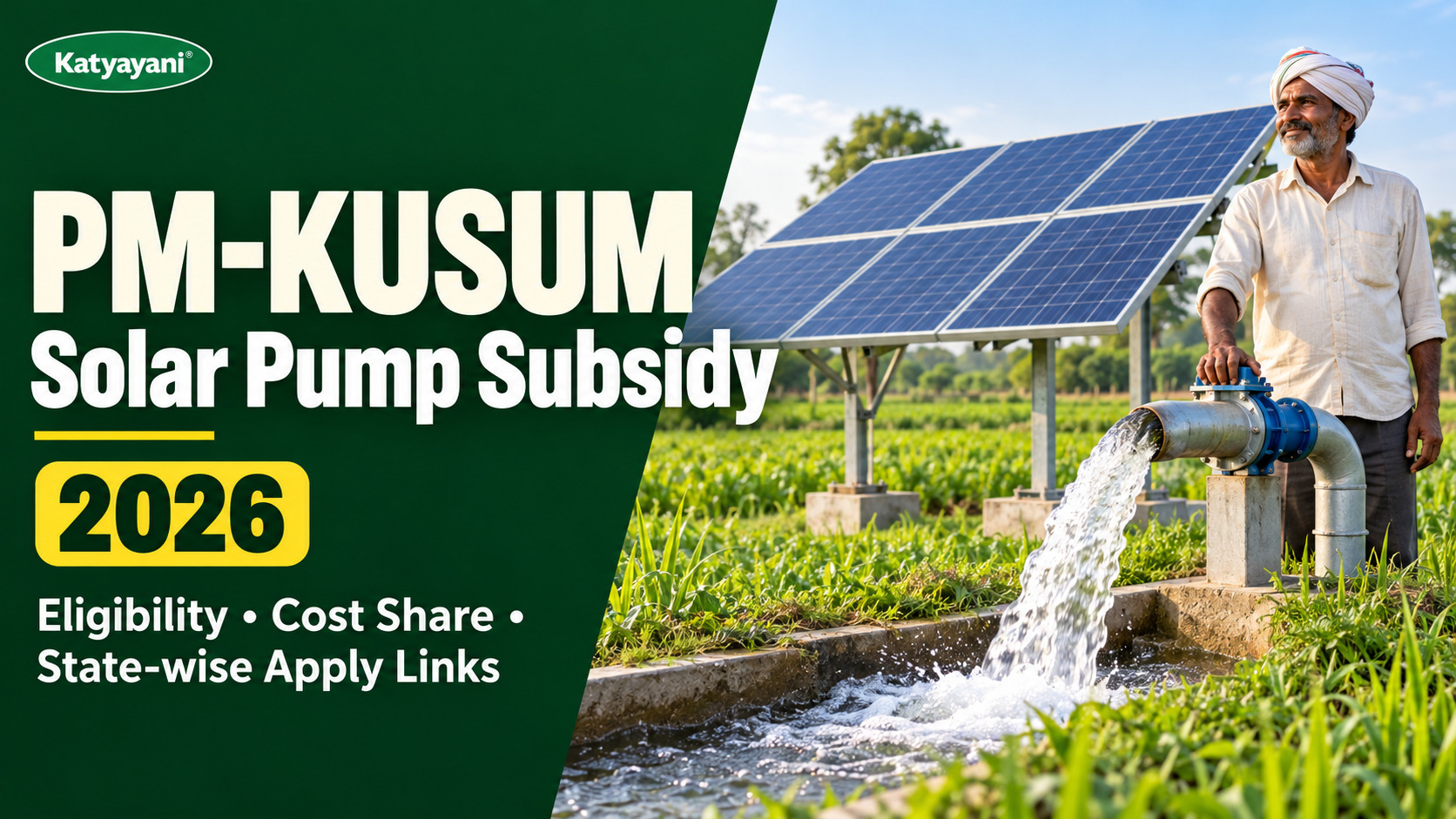
PM-KUSUM stands for Pradhan Mantri Kisan Urja Suraksha evam Utthaan Mahabhiyan. It has three parts. Component A is for small grid-connected solar plants on farm land. Component B is the one most farmers want: standalone off-grid solar water pumps. Component C is for solarising existing grid pumps, one pump at a time or a whole feeder. For a quick view of how it sits next to other schemes, see our agriculture subsidy schemes in India guide.
According to the IBEF scheme summary, the Component B sanction is about 13.07 lakh pumps and around 10.91 lakh were installed by 30 April 2026. This is not a pilot. Over ten lakh farmers already irrigate with sunlight instead of diesel.
PM-KUSUM solar pump subsidy 2026: who pays what
Forget the old "30-30-40" shorthand. A November 2023 MNRE office memorandum removed the compulsory state share for Components B and C. Here is the current picture in plain terms.
| Who | Share | Plain meaning |
|---|---|---|
| Central government (CFA) | 30% of benchmark or tender cost, whichever is lower | 50% for Sikkim, J&K, Ladakh, Himachal Pradesh, Uttarakhand, the North-East, Lakshadweep and Andaman & Nicobar |
| State government | Optional top-up | Earlier at least 30% was expected. Now many states still add their own subsidy and some do not. This is why the pump cost differs by state |
| Farmer | Balance amount | If your state adds nothing, the farmer pays the remaining 70% (50% in the special-category states). A bank loan can cover a large part |
Check Your State: The rupee amount you actually pay depends on your state nodal agency. Ask for the final "farmer contribution" in rupees for your HP before paying anything.
Need money for the farmer share? Look at the Kisan Credit Card scheme and, for women-led groups, our SHG loan for agriculture guide. Ask the bank whether a solar pump qualifies for your loan limit.
Is the scheme still open? Status as of October 2026
This is the part many articles skip. The scheme was due to end on 31 March 2026. After that, MNRE reset the timelines for projects that had power purchase agreements or notices to proceed by 31 December 2025. Standalone pumps (Component B) and individual pump solarisation must be commissioned by 30 September 2026. The later date of 31 March 2027 applies to Component A and feeder-level solarisation, not to a farmer's own pump. Further extensions are only case by case. The September date is now behind us.
- The Union Budget 2026-27 carries Rs 5,000 crore for KUSUM (per IBEF), so funding exists.
- The Department of Expenditure is reported to have said that committed liabilities will move to a proposed PM-KUSUM 2.0. We found no official notice for the new scheme, so treat it as unconfirmed.
- State windows differ. Some state agencies still take applications against sanctioned quota. Others pause until the next order.
So the honest advice: register interest on your state portal now, keep documents ready, and watch the official PM-KUSUM portal. For other deadlines through the year, see our agri schemes calendar.
Who is eligible for PM-KUSUM solar pump Yojana?
- An individual farmer who owns agricultural land (some states also allow tenant farmers with a registered lease).
- No working grid connection on that pump, or a diesel pump you want to replace (state rules vary).
- A water source such as a borewell, open well or pond that can support the pump size you choose.
- Pump capacity up to 7.5 HP for individual farmers. Per the IBEF summary, central support extends up to 15 HP in the North-East, hill states and islands.
- Water-user groups, cooperatives and FPOs can apply for community or cluster irrigation in some states.
How to apply for PM-KUSUM solar pump Yojana: step by step
Every state runs its own portal, so screens look different. The flow is the same almost everywhere.
- Find your state agency. Usually the state renewable energy development agency or the agriculture department. The national portal links to state sites.
- Register. Mobile number, Aadhaar and basic land details.
- Upload documents. Aadhaar, land record (khasra/khatauni or 7/12), bank passbook, passport photo and a water-source proof where asked.
- Select pump size and type. Choose HP according to your borewell depth and acreage, not the biggest one on the list.
- Pay the farmer share. Only on the official portal or bank challan. Never to an agent.
- Vendor installs. An empanelled vendor installs panels, pump and controller. Check the serial numbers match your paperwork.
- Inspection and sign-off. A state officer verifies the installation, then the subsidy is settled with the vendor.
Fraud Warning: There is no registration fee payable to any individual. Fake "KUSUM registration" sites and callers are common. Use only the state government or MNRE portals.
How much does a 5 HP or 7.5 HP solar pump cost under Kusum Yojana?
There is no single national price. The benchmark cost is set by MNRE or by state tender, and it changes with pump HP, AC or DC type and borewell depth. So the subsidy in rupees and the farmer share in rupees differ from state to state. If you see a rupee figure on a random website, check its date. The right number is the one on your state agency's current price list.
On panels: installers usually size the solar array a little above the motor rating, because panels never give their full rating all day. As a rough estimate (not an official norm), plan for about 1.2 to 1.5 times the motor kW as panel kWp, and ask the vendor for the exact figure on your quotation.
Plan your crop around a solar pump
A solar pump runs only in daylight, so plan irrigation for sunny hours. A wheat crop, for example, needs its irrigations at fixed stages, as in our wheat sowing planner. Pairing the pump with drip cuts water use further. If you also want machinery support, see our agri drone subsidy guide.
Common mistakes that delay approval
- Land record name does not match Aadhaar name.
- Bank account not linked or inactive.
- Choosing a pump bigger than the borewell can feed. It runs dry and the claim becomes a headache.
- Paying an agent first. Pay only on official channels.
- Not keeping the installation photos and the vendor invoice.
Conclusion
If your state window is open, apply this week and keep every receipt. If it is closed, register interest, keep your documents ready and watch the national portal for the next notice. Solar irrigation will keep getting central money. The timing, not the idea, is what is uncertain. For the full list of schemes you can stack with it, read our agriculture subsidy schemes guide.
Why trust this guide
Written by Team Katyayani, Editorial Team at Katyayani Organics. Cross-checked against published research and university extension programs.



Leave a Comment