 8 min read
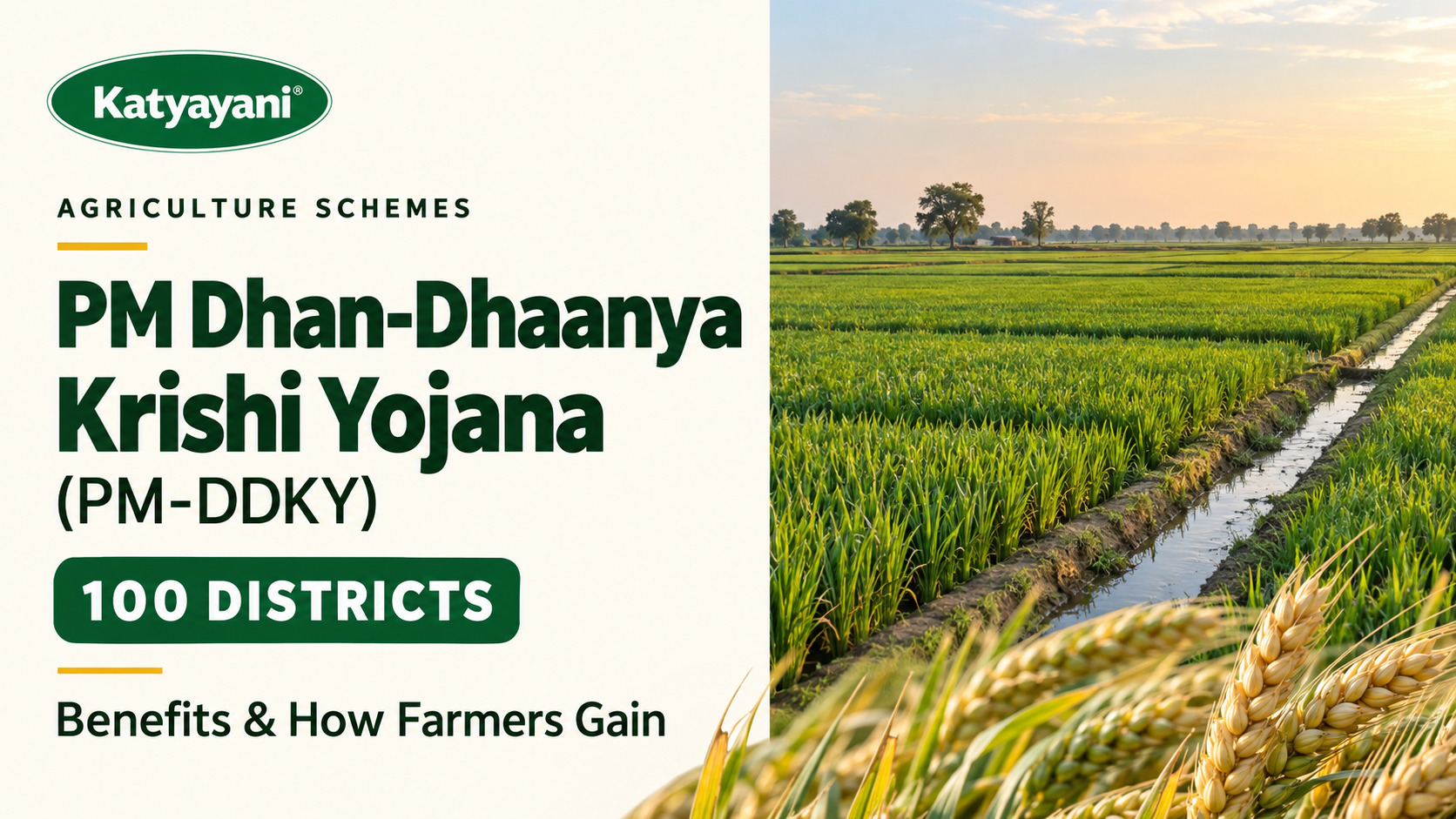
PM Dhan-Dhaanya Krishi Yojana (PM-DDKY) is a six-year government programme. It spends Rs 24,000 crore a year, from 2025-26, to improve farming in 100 weaker districts. It does this by joining 36 existing schemes into one plan for each district. You do not fill a separate form. If your district is on the list, you use the existing schemes through it.
What is PM Dhan-Dhaanya Krishi Yojana?
It is a government programme to help farming in the 100 districts that are lagging behind. The Union Budget 2025 announced it. The Cabinet approved it on 16 July 2025. The Prime Minister launched it on 11 October 2025, as the PMO release shows. It runs for six years, from 2025-26.
The idea is simple. Today, many farm schemes work on their own. Under PM-DDKY, each district puts 36 of them into one plan. The PTI report on the Cabinet decision says these schemes come from 11 central departments. State schemes and private partners can join too. To see where this fits among other schemes, read our agriculture subsidy schemes in India guide.
How much money is allotted, and for how long?
The answer is Rs 24,000 crore each year, for six years, starting 2025-26. On launch day, two schemes were started together: PM-DDKY and a pulses mission. The All India Radio report covers both. The PMO headline puts the two together at Rs 35,440 crore. The table below gives the main facts.
| Item | Detail | Source status |
|---|---|---|
| Cabinet approval | 16 July 2025 | PTI / PIB reporting |
| Launch | 11 October 2025, Pusa, New Delhi | PMO, AIR |
| Duration | 6 years from 2025-26 | Cabinet decision |
| Money each year | Rs 24,000 crore | Cabinet decision |
| Districts | 100 | Cabinet decision |
| Schemes joined | 36 schemes, 11 central departments | PTI |
| Farmers expected to gain | About 1.7 crore | PTI / Deccan Herald |
Please note one thing. Most of this money comes from existing scheme budgets that are pooled together. It is not a brand-new pile of cash. One report says there is no separate budget line for it.
How were the 100 districts chosen?
The government looked at three signs. First, how little the farms produce per hectare. Second, how little the land is used across the year (this is called cropping intensity). Third, how few farm loans are given. Districts that scored badly on these were picked. Each state gets a share based on its farmland and number of farm holdings, and every state or UT has at least one district.
The Indian Express summary gives the state counts. Uttar Pradesh has the most districts (12). Maharashtra has 9. Madhya Pradesh and Rajasthan have 8 each, and Bihar has 7. Other states have fewer. Lists can change, so please confirm your own district with the agriculture ministry or your district agriculture office.
| State | Districts covered | Examples reported |
|---|---|---|
| Uttar Pradesh | 12 | Mahoba, Sonbhadra, Hamirpur |
| Maharashtra | 9 | Palghar, Yavatmal |
| Madhya Pradesh | 8 | Check official list |
| Rajasthan | 8 | Check official list |
| Bihar | 7 | Check official list |
What do farmers actually get from PM-DDKY?
No money comes straight into your bank account. There is also no fixed amount per farmer. Instead, the programme fixes the gaps in your district. The aims reported at the time of approval are:
- Better irrigation, so crops get water on time.
- More storage at village and block level, so farmers need not sell in a hurry.
- Easier farm loans, both short term and long term.
- Growing a wider mix of crops, not just wheat and paddy.
- Support for natural and organic farming, and for saving water.
- Help for dairy and fisheries, which add to farm income.
You can start with your own soil. Ask the nearest office for your soil health card report. It tells you what your soil needs, and it helps you pick a new crop wisely.
Can an individual farmer apply for PM-DDKY?
No. There is no single form for individual farmers. PM-DDKY works at the district level. If your district is covered, you gain by using the schemes in the district plan, such as loans, irrigation, storage, seed and training. Some websites show an "apply online" button. Be careful. The sources I checked do not agree on this, and no official release mentions a farmer form.
Fraud Warning: Nobody can enrol you in PM-DDKY for a fee. Do not pay any agent. Do not share your OTP or Aadhaar details on a "Dhan-Dhaanya registration" website.
How can I use the scheme in my district?
Follow these steps. They are simple, and each one builds on the one before.
- Check the district list. Ask the district agriculture office, or the nearest Krishi Vigyan Kendra, whether your district is one of the 100.
- Meet the district team. Each district has a committee, called the District Dhan-Dhaanya Samiti. It makes the district plan, and progressive farmers sit on it.
- Pick the help you need. For a farm loan, see the Kisan Credit Card scheme. For crop loss cover, see PMFBY registration for Rabi.
- Join a group. Members of a farmer producer organisation (FPO) often get more support. See the FPO credit guarantee scheme.
- Keep your papers ready. You will need Aadhaar, a land record, a bank passbook and a mobile number linked to Aadhaar.
How is progress checked?
Each district gets one officer from the central government to watch progress. NITI Aayog guides and reviews the district plans. Reports also mention an online dashboard that is reviewed every month. It uses about 117 measures, such as water, storage and loans. Another source says 121, so the exact number is not confirmed. The dashboard ranks all districts, so weak ones get attention.
How is PM-DDKY linked to the pulses mission?
Both were launched on the same day, but they are different schemes. The pulses mission aims to grow more pulses so India depends less on imports. PM-DDKY looks at the whole farm system of a district. A district that grows pulses can gain from both. To keep track of dates for these and other schemes, use our agri schemes calendar.
What should a farmer in a covered district do this month?
Start small. These four steps are enough for now:
- Get or renew your Kisan Credit Card before you need money for Rabi sowing.
- Check your payment status on the PM-Kisan installment status page. Fix any bank or Aadhaar problem now.
- Ask the district office about natural farming help. Our natural farming mission subsidy guide explains it.
- Try one new crop on a small plot. Do not change your whole farm at once.
Conclusion
PM-DDKY is less a scheme you apply for, and more a push that your district receives. So the best step is to find out if your district is one of the 100. Then meet the district team and use the loans, insurance and storage help in the plan. For the full picture of what else you can claim, read our agriculture subsidy schemes guide.
Why trust this guide
Written by Team Katyayani, Editorial Team at Katyayani Organics. Cross-checked against published research and university extension programs.

Leave a Comment