 5 min read
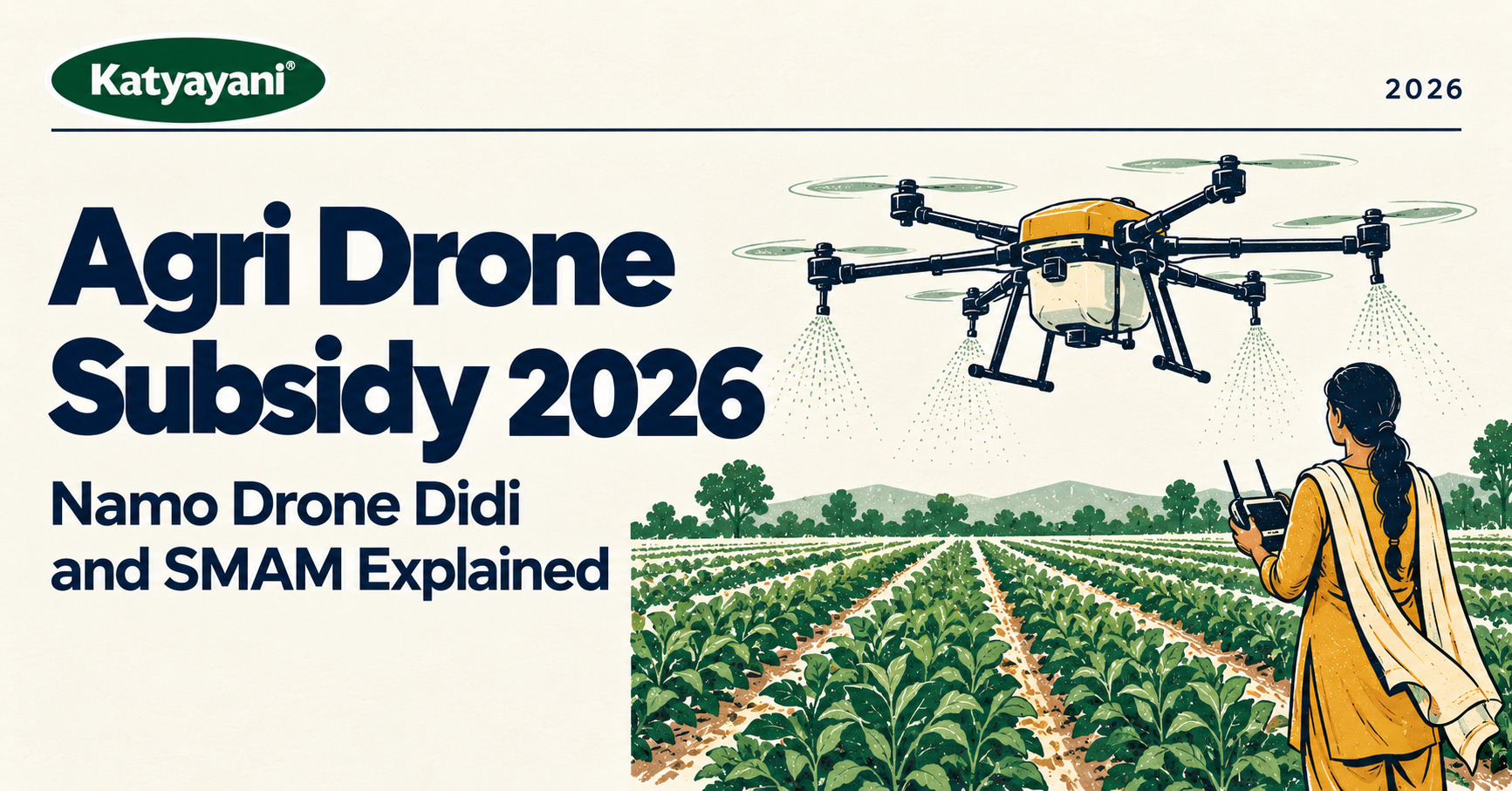
Quick answer: Drone subsidy for farmers comes mainly from two central schemes. Under SMAM, individual farmers get 40% to 50% of the drone cost (up to ₹4 lakh or ₹5 lakh), FPOs up to 75%, and KVKs and ICAR bodies 100% up to ₹10 lakh. Under Namo Drone Didi, women SHGs get 80% up to ₹8 lakh with a full drone package.
Key Takeaways
- SMAM: 50% up to ₹5 lakh for SC/ST, small, marginal, women and North Eastern farmers; 40% up to ₹4 lakh for others.
- Agriculture graduates starting a drone custom hiring centre get 50% up to ₹5 lakh; CHCs run by cooperatives, FPOs and rural entrepreneurs get 40% up to ₹4 lakh.
- Namo Drone Didi: 80% up to ₹8 lakh for women SHGs, the balance can be financed through AIF with 3% interest subvention.
- Namo Drone Didi has an outlay of ₹1,261 crore for 2023-24 to 2025-26; 500 drones went out under the scheme plus 1,094 through fertiliser companies by February 2026.
- A DGCA remote pilot certificate is needed to fly, and only pesticides approved for drone use should be sprayed.
- For most small farmers, hiring a drone service is cheaper than buying one.
Which government schemes give drone subsidy to farmers?
Two central schemes fund agricultural drones in India. The Sub-Mission on Agricultural Mechanization (SMAM) supports farmers, FPOs, custom hiring centres and institutions, and the Namo Drone Didi scheme supports women self-help groups.
SMAM is run by the Department of Agriculture and Farmers Welfare through state agriculture or agricultural engineering departments. Namo Drone Didi is run jointly with the Department of Rural Development, with Lead Fertilizer Companies helping in purchase and distribution. Some states also add a top-up subsidy of their own, so the final amount can be higher in your state.
SMAM drone subsidy rates by category
Under SMAM, the subsidy is a percentage of the drone cost with a rupee cap. These rates were confirmed in a PIB reply on funds for Kisan drones in March 2023 and remain the reference rates for states.
| Who is buying | Subsidy | Maximum amount |
|---|---|---|
| ICAR institutes, KVKs, state agricultural universities, central and state government institutions | 100% of drone cost | ₹10 lakh per drone |
| Farmer Producer Organisations (for demonstrations) | Up to 75% of drone cost | As per scheme norms |
| Agriculture graduates setting up a drone CHC | 50% of drone cost | ₹5 lakh |
| CHCs by cooperatives, FPOs and rural entrepreneurs | 40% of drone cost | ₹4 lakh |
| SC/ST, small and marginal, women and North Eastern farmers | 50% of drone cost | ₹5 lakh |
| Other individual farmers | 40% of drone cost | ₹4 lakh |
Agencies that run drone demonstrations also get contingency support: ₹6,000 per hectare if they hire drones and ₹3,000 per hectare if they buy them. Between 2023-24 and 2025-26, over 40,000 Kisan drone demonstrations were carried out under SMAM.
Example calculation
Suppose a small farmer buys a spray drone costing ₹8 lakh. At 50%, the subsidy would be ₹4 lakh, which is under the ₹5 lakh cap, so the farmer pays ₹4 lakh. For a drone costing ₹12 lakh, 50% is ₹6 lakh, but the cap limits the subsidy to ₹5 lakh, leaving ₹7 lakh for the farmer to pay. The drone cost here is only an example; actual prices vary by model and package.
What is the Namo Drone Didi scheme?
Namo Drone Didi is a central scheme that gives drones to women self-help groups so they can offer spraying services to farmers for a fee. It has an outlay of ₹1,261 crore for 2023-24 to 2025-26 and aims to cover 15,000 women SHGs.
- Subsidy: 80% of the cost of the drone and accessories, up to ₹8 lakh per drone.
- Balance cost: can be taken as a loan under the Agriculture Infrastructure Fund (AIF) with 3% interest subvention.
- Package: drone with spray assembly, carrying box, batteries, fast charger, pH meter and anemometer, one-year warranty, two years of maintenance and insurance.
- Training: 15 days in total, including 5 days of mandatory drone pilot training at a DGCA-authorised centre and 10 days on agricultural use. One SHG member trains as pilot and one as drone assistant.
- Expected work: each drone SHG is expected to cover about 2,000 to 2,500 acres a year and earn at least ₹1 lakh a year.
On progress, the PIB release on drone distribution of February 2026 reported 1,094 drones distributed by Lead Fertilizer Companies from their own resources and 500 drones under the Namo Drone Didi scheme, across 22 states and union territories.
The approved scheme period ended with 2025-26, but the Union Budget 2026-27 set aside ₹677 crore for Namo Drone Didi, up from ₹100 crore in the 2025-26 revised estimates, according to PRS Legislative Research. This points to the scheme continuing in 2026-27; check the latest guidelines with your state rural livelihood mission.
Who is eligible for drone subsidy?
Individual farmers, FPOs, cooperatives, custom hiring centres, agriculture graduates and women SHGs are all eligible under one scheme or another. The scheme you apply under decides the rate.
- Individual farmers: must own agricultural land in the state and generally should not have taken subsidy on the same machine category recently.
- Agriculture graduates: need a degree in agriculture or allied subjects to claim the 50% CHC rate.
- FPOs and cooperatives: must be registered and usually need a business plan for custom hiring.
- Women SHGs: selected under DAY-NRLM by the state, usually in areas where drone spraying is practical.
- The operator must hold a Remote Pilot Certificate from a DGCA-authorised Remote Pilot Training Organisation.
How to apply for drone subsidy
Individual farmers, FPOs and CHCs apply through their state's farm mechanisation or DBT portal. Women SHGs are selected through the state rural livelihood mission and do not apply on an open portal.
- Check whether your state has opened applications for drones under SMAM on its agriculture or agricultural engineering department portal. Many states run a lottery when applications exceed the target.
- Register with Aadhaar, land record, bank details, category certificate if SC/ST, and passport photo.
- Choose the drone model from the list of approved manufacturers and models on the portal. Only drones with DGCA type certification qualify.
- Upload the pilot certificate, or an undertaking that you will hire a certified pilot, as the state requires.
- Wait for selection and the sanction letter. Do not buy before sanction, or you may lose the subsidy.
- Buy from the approved dealer, get the drone verified by the department and receive the subsidy by DBT.
Women SHGs interested in Namo Drone Didi should contact their block mission management unit under DAY-NRLM or the district agriculture office. Lead Fertilizer Companies assigned to each state supply the drones and help with training.
Drone licence and spraying rules
Flying an agricultural drone needs a DGCA Remote Pilot Certificate, a registered drone with a Unique Identification Number on the Digital Sky platform, and flight only in permitted zones. Spraying must follow the Ministry of Agriculture's standard operating procedure for drone application of pesticides.
- Check the airspace map on Digital Sky before flying; red and yellow zones near airports and sensitive areas need permission.
- Use only pesticides and nutrients that carry approval or label claims for drone application from CIB&RC.
- Do not spray when wind speed is high; the anemometer in the kit is there for this reason.
- Keep people and animals out of the spray area, and inform neighbouring farmers before spraying.
- Follow the product label and local agriculture officer advice on dose and waiting period.
What can you spray with an agricultural drone?
Drones are used mostly for foliar sprays: approved pesticides, fungicides, water-soluble fertilisers, micronutrients and nano fertilisers. They use a small spray volume per acre, so products must mix well in water and not clog nozzles.
Drones commonly spray around 10 litres of solution per acre, compared with 150 to 200 litres with a knapsack sprayer, so the concentration in the tank is higher. Fully soluble grades give the fewest problems. A 19-19-19 water-soluble fertiliser is widely used for vegetative growth, while a 0-52-34 mono potassium phosphate grade suits flowering and fruit set. Adding a silicon-based spreader helps the fine droplets spread and stick on the leaf. Always do a jar test before filling the tank, and follow the product label and local agriculture officer advice.
| Point | Drone spraying | Manual knapsack spraying |
|---|---|---|
| Spray volume per acre | About 10 L | 150 to 200 L |
| Time per acre | Few minutes | Several hours |
| Operator exposure to chemicals | Low | High |
| Suited for | Uniform field crops, tall crops like sugarcane and maize, waterlogged fields | Small plots, spot treatment, orchards with dense canopy |
| Product needs | Fully soluble, drone-approved formulations | Most labelled formulations |
Should you buy a drone or hire a drone service?
For most small and marginal farmers, hiring a drone service is cheaper than buying. Ownership makes sense when a farmer, FPO or entrepreneur can keep the drone busy on several hundred acres a season.
The Namo Drone Didi model assumes one drone covers about 2,000 to 2,500 acres a year. An individual with 5 to 10 acres cannot use a drone anywhere near that, and still has to pay for batteries, repairs, insurance and a certified pilot. A better route is to hire from a Drone Didi SHG, an FPO or a custom hiring centre in your area.
For an FPO or an agriculture graduate, a drone CHC can be a viable service business, especially in sugarcane, paddy, cotton, maize and wheat belts. Plan for a spraying calendar across both kharif and rabi to keep the drone working.
What to do next
If you are an individual farmer, check your state portal for the SMAM drone window and your category's rate, or find a drone service near you. If you are in a women SHG, ask your block NRLM office about Namo Drone Didi. FPOs and graduates can plan a drone CHC with the 40% to 75% support available.
Dealers and drone operators who need soluble fertilisers and spray adjuvants in bulk for service work can source them from Katyayani Organics.
Why trust this guide
Written by Team Katyayani, Editorial Team at Katyayani Organics. Cross-checked against published research and university extension programs.

Leave a Comment