 13 min read
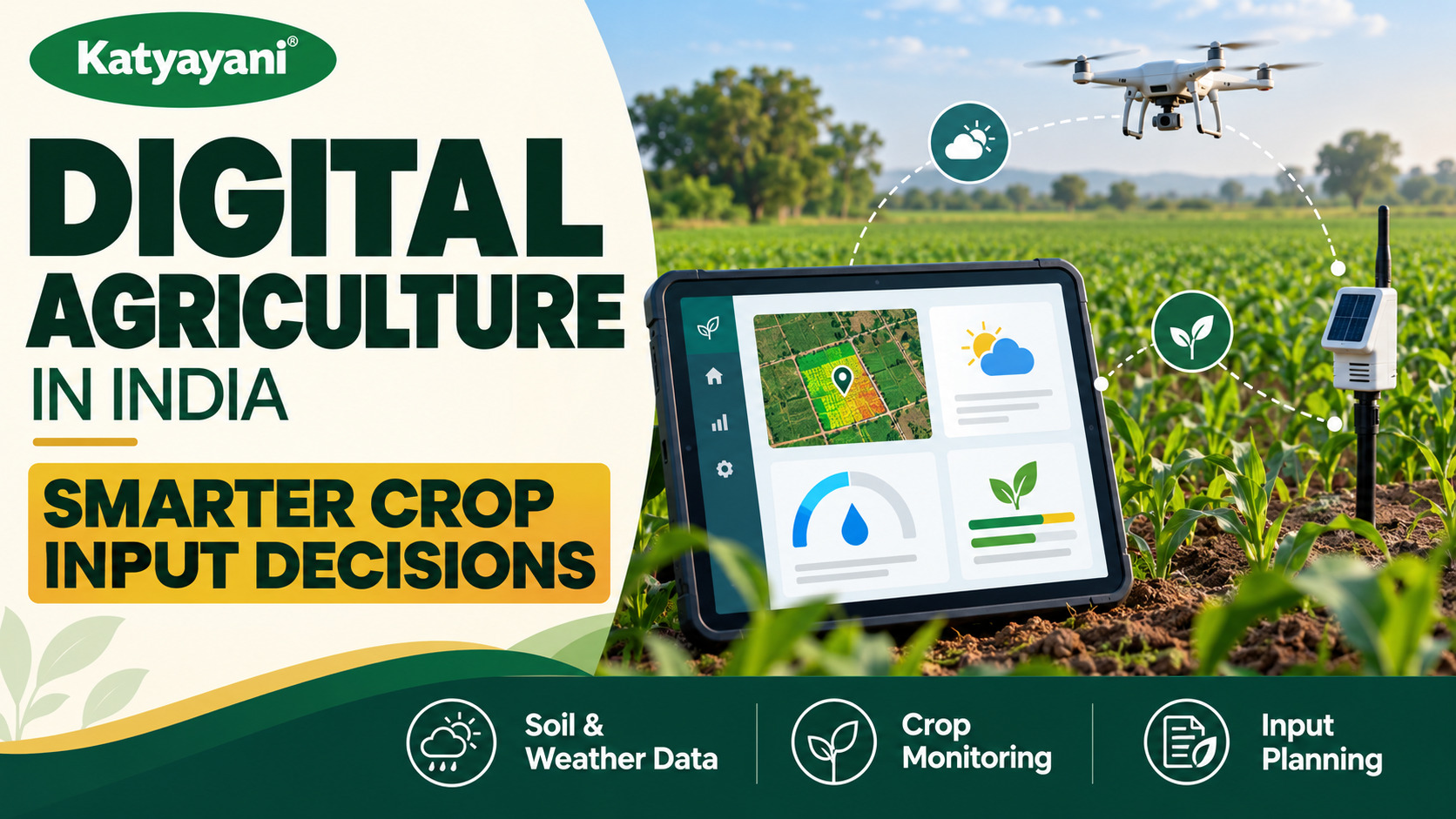
Digital agriculture means using phones, data, satellites, sensors and drones to decide what to put on a field, how much, and when. In India the base is public: the Digital Agriculture Mission (approved 2 September 2024, Rs 2,817 crore, seven years) is building AgriStack with a Farmer ID, a Krishi Decision Support System and soil profile maps. For a farmer, the most useful tools today are a soil test (Soil Health Card), a weather advisory app such as Meghdoot, a mandi price source such as e-NAM, and a drone service for spraying. Data does not replace local advice. It helps you choose the right input, the right dose and the right day, and avoid buying what the field does not need.
What is digital agriculture and how is it different from smart farming and precision farming?
Digital agriculture means using digital tools at every step of farming, from planning the crop to selling it. Smart farming and precision farming are parts of it. The table shows the difference in plain words.
| Term | Plain meaning | Example in India |
|---|---|---|
| Digital agriculture | Digital tools across the whole chain: records, advice, inputs, finance, market | Farmer ID, weather app, e-NAM, online input buying |
| Smart farming | Machines and sensors that collect field data and act on it | Soil moisture sensor linked to a drip timer |
| Precision farming | Give each part of the field what it needs, no more and no less | Variable fertiliser dose after a soil map; drone spraying only on affected patches |
| Agritech | Companies that sell these tools and services | Advisory apps, drone services, input marketplaces |
The NITI Aayog Frontier Tech Hub describes precision agriculture as giving each part of a field exactly what it needs using data, sensors and smart machines. For a farmer, the question is simple. Does this tool help me make a better decision on seed, fertiliser, spray or water? If yes, it is worth using. If not, skip it.
Why does this matter for crop inputs? Because inputs are the biggest cash cost in most seasons. Seed, fertiliser, sprays, water and labour all need a decision, and a wrong decision costs money twice: once when you buy, and again when the crop does not respond. Digital tools do not make the decision for you. They give you facts earlier, so the decision is better informed. Think of it as four questions you ask every season: what does my soil need, what is the weather going to do, what is wrong with my crop, and where will I get a fair price.
What is the Digital Agriculture Mission and what is its status in 2026?
Two things carry this name, so it helps to separate them.
- Digital Agriculture Mission, 2021 to 2025: several secondary sources describe a ministry programme launched in September 2021 to promote AI, remote sensing, drones, blockchain and robots in farming. We could not confirm this on an official page (VERIFY).
- Digital Agriculture Mission, approved 2 September 2024: the Union Cabinet approved it with an outlay of Rs 2,817 crore, including a central share of Rs 1,940 crore. It is planned over seven years, 2024-25 to 2030-31 (PIB).
The 2024 mission is the current one. It builds three public digital systems.
| Component | What it does | Status found (check date) |
|---|---|---|
| AgriStack | Farmer registry, geo-referenced village maps, crop sown registry. Gives each farmer a Farmer ID | Target 11 crore IDs: 6 crore in 2024-25, 3 crore in 2025-26, 2 crore in 2026-27 (PIB). Over 10.31 crore created by 3 August 2026 (news report of Rajya Sabha reply) |
| Digital Crop Survey | Plot-level record of what is sown, taken by field survey | Rabi 2025-26: 648 districts, over 31.3 crore plots (same reply, VERIFY) |
| Krishi Decision Support System | One map-based system joining crop, soil, weather and water data from satellites | Launch status not found (VERIFY) |
| Soil Profile Mapping | Detailed soil maps at 1:10,000 scale for about 142 million hectares planned | About 29 million hectares already done at approval in 2024 (PIB) |
In late August 2026, news reports say the Centre asked states and Union Territories to speed up work on the mission. The government also says AgriStack follows the Digital Personal Data Protection Act, 2023, and the 2025 Rules, with data stored in encrypted form. States keep ownership of their own data in this design.
What are AgriStack and the Farmer ID, and why do they matter for inputs?
AgriStack is the farmer database. A Farmer ID links your name to your land record. Once linked, one record can serve many services, so you do not submit the same papers again and again. Reported links include credit, crop insurance, weather advice and MSP buying. For the money side, see our guides on the Kisan Credit Card and crop insurance under PMFBY.
For input decisions, the real value will come from the crop sown record and soil maps. If the system knows your crop, your plot and your soil, advice can be specific to your field. Today, that depth is still being built. Treat advice from any app as a starting point and compare it with your soil card and local agriculture officer. Our post on the agriculture schemes calendar lists dates to track. For the AI chat tools that answer scheme questions, see our drafts on Kisan e-Mitra and Bharat Vistaar, which cover them in detail.
Which government apps and portals help with crop input decisions?
Most of these are free. The table matches each tool to the question it answers.
| Tool | Answers this question | Key fact (year) |
|---|---|---|
| Soil Health Card portal | Which nutrients does my soil lack? How much fertiliser? | Over 25 crore cards given by July 2025. Card covers N, P, K, S, Zn, Fe, Cu, Mn, B, pH, EC and organic carbon (PIB) |
| Meghdoot app | Should I irrigate, spray or sow in the next few days? | Advisories twice a week, nearly 700 districts, English and 11 regional languages. 4,16,056 registered users on 28 November 2025 (MoES) |
| Kisan Suvidha app | Weather, dealers, market prices, plant protection tips, expert advice on a crop photo | Registration needed. Features per the mKisan and Vikaspedia pages |
| mKisan SMS | What is the crop advisory for my block, in my language? | Portal says its messages reach nearly 8.93 crore farm families (mKisan page, VERIFY year) |
| e-NAM | Where is the better mandi price? | 1,656 mandis, over 1.80 crore farmers registered, as of March 2026 (PIB) |
| Kisan Call Centre | Plain voice advice from an expert | Free helpline; check the number on the mKisan page |
You can read how the mKisan portal works and how to register for SMS advisories on its own page. The Ministry of Earth Sciences report explains that Meghdoot is a joint effort of IMD, IITM, ICAR and ICRISAT. The PIB document on 10 years of e-NAM gives the mandi and trade figures. Download counts quoted by news sites are lower than the registration number above, because they count different things.
How does a soil test change fertiliser and seed decisions?
This is the single most useful digital step for a small farmer. A Soil Health Card shows 12 measures and gives a fertiliser suggestion for your field. The PIB feature reports 8,272 soil testing labs across the country (labs count differs in other sources, VERIFY). Here is how a result changes the buying list.
| Soil test result | Decision it changes | Typical action (confirm with your KVK) |
|---|---|---|
| Low nitrogen, high phosphorus | Skip extra DAP or NPK with high P | Use a nitrogen source in splits; save the phosphorus money |
| Low zinc or boron | Add a micronutrient, not more NPK | Soil or foliar micronutrient on the label dose |
| pH too low or too high | Nutrient uptake is blocked even if fertiliser is applied | Fix pH first with lime or gypsum as advised. See soil pH and nutrient lock |
| Low organic carbon | Add compost, farmyard manure or biofertiliser | Plan manure before sowing; see bio fertilisers |
| High salt (EC) | Choose salt-tolerant crop or variety; improve drainage | Local advice needed |
Read the card line by line with our guide on how to read a soil health card. When your card shows what is missing, you can choose between straight and mixed nutrients in the fertilisers collection. Match the product to the gap on the card, and follow the label for crop and dose.
Soil data also helps with seed. If the soil is saline or waterlogged, a hardy variety does better than a high-input one. If you plan a crop with a high nutrient need, you can budget for splits instead of one heavy dose.
A simple way to use a soil card in practice is to write three lines on the card before you go to the shop: the nutrient that is low, the crop you plan, and the stage when the crop needs it. Show this to the dealer or your local agriculture officer. It stops the common mistake of buying the same NPK bag every year without checking what the field has already stored. If you grow vegetables or fruit, ask also about micronutrients, because a small gap in zinc or boron can limit the harvest even when NPK is enough. Retest every two to three years, or sooner if you change the crop pattern or add a lot of manure.
How do weather apps and advisories change spray, irrigation and sowing timing?
Timing is where weather data saves the most money. A spray applied just before rain is wasted. A fertiliser broadcast before heavy rain is washed away. An irrigation given a day before rain is also lost water.
| Weather signal | Input decision it changes |
|---|---|
| Rain forecast within 24 to 48 hours | Hold the foliar spray and top dressing; wait for dry leaves |
| High humidity with cloudy days | Check for fungal disease early; plan protective fungicide per local advice. See fungicide application methods |
| Dry spell and heat | Plan irrigation timing; avoid spraying in the afternoon heat |
| Strong wind | Do not spray by hand or drone; drift wastes product and harms nearby crops |
| Cold wave or frost warning | Prepare cover or light irrigation as advised for the crop |
Check the advisory for your own district, not the state, because rain differs widely within a state. Use it with what you see in the field. If the advisory and your field disagree, trust the field and ask your local officer.
How are drones and satellites used in Indian farming?
There are two uses. Satellites and drone cameras map crop health and stress. Spray drones apply liquid fertiliser or crop protection products over a field fast. The Namo Drone Didi scheme was designed to put drones in the hands of women self-help groups. The PIB page and related releases describe 15,000 drones, an outlay of Rs 1,261 crore for 2023-24 to 2025-26, and central assistance of 80 percent of the cost up to Rs 8 lakh. One PIB release says 1,094 drones were distributed in 2023-24 through lead fertiliser companies (as of January 2026). Because the scheme period has ended, check the latest status with the Department of Agriculture before telling readers it is open. Our post on drone subsidy for farmers covers eligibility and how to apply.
| Drone job | Input decision it supports | Limit |
|---|---|---|
| Crop health map | Find the patch with stress so you scout and treat only that area | Needs a trained operator and a clear day |
| Spot spraying | Spray the affected strip instead of the whole field | Only drone-approved products on the label; follow pilot rules |
| Nano or liquid fertiliser spray | Cut labour and time at the right growth stage | Cost per acre is set by the service provider; compare quotes |
| Seed or granule spread | Even spread in hard-to-reach fields | Not suited to all crops |
For a small farmer, owning a drone rarely makes sense. Hiring a drone service by the acre, through a custom hiring centre, FPO or SHG, is the practical route. Always check that the product you spray is registered for the crop and is allowed to be applied by drone on its label.
Use the same habit for water. Before you irrigate, check the soil by hand: take a pinch of soil from root depth, and if it holds shape when pressed, the crop does not need water yet. A moisture probe does this more exactly, but the idea is the same. Irrigation by feel and by forecast together save both water and power, and they also lower disease risk because leaves stay dry for less time. This is a small, cheap form of precision farming that any farmer can do today.
Do sensors, IoT and AI really help a small farmer?
They can, in specific cases. Soil moisture sensors tell you when to irrigate, so you avoid watering by habit. Weather stations give field-level rain and humidity. AI tools read a photo of a leaf and suggest a likely problem. Greenhouses and hydroponics use sensors most, see our guides on greenhouse farming costs and hydroponics for beginners.
Here is the honest picture for open-field small farms.
- Worth trying: a soil moisture probe on high-value crops with drip irrigation, where water and power cost real money.
- Use with care: photo-based disease apps. They give a guess, not a lab result. Confirm with an officer before buying a spray.
- Often not worth it yet: full IoT kits on one-acre plots without drip. The cost can be more than the saving.
- Yield claims: vendors quote water and input savings, but we did not find an independent Indian figure to quote. Ask any seller for field results on your crop.
How does data help you choose between bio, chemical and mixed inputs?
Data cannot pick a brand, but it can tell you if you need an input at all. Scouting records, soil cards and weather logs show whether a pest is above the level where a spray pays back. Keep a small notebook or phone note with date, crop stage, pest count and what you applied. After one season you can see which sprays did nothing. For the trade-offs between bio and chemical options, see where bio and chemical inputs win.
How do you use data to decide seed, fertiliser, pesticide and irrigation step by step?
The best way to use all these tools is to follow one simple order each season. The order matters, because each step gives you facts for the next one.
| Input | Data to check first | Decision you make | Where the data comes from |
|---|---|---|---|
| Seed and variety | Soil type, salt level, rain pattern, last year crop | Pick a variety that suits your soil and your sowing window; plan crop rotation | Soil card, district advisory, local agriculture officer, your own notebook |
| Basal fertiliser | Low or high nutrients, pH, organic carbon | Choose the nutrient mix and the quantity; add manure if carbon is low | Soil Health Card |
| Top dressing | Crop stage, rain forecast, leaf colour | Split the dose and apply on a dry-weather day | Weather app, field scouting |
| Pesticide or fungicide | Pest count, disease spread, humidity, wind | Spray only if the pest crosses the local action level; pick the right product and day | Scouting notes, advisory, Kisan Call Centre or officer |
| Irrigation | Soil moisture, crop stage, rain forecast | Irrigate on need, not on habit | Hand test, moisture probe, weather app |
Take seed first. Many farmers choose seed by what a neighbour grew or what the shop has in stock. Data gives you a better start. If your soil card shows high salt or low organic carbon, a variety that tolerates stress will do better than a high-input one that needs perfect conditions. If the district advisory shows that rain usually comes late in your area, choose a variety whose sowing window fits. Also keep a record of the variety, the sowing date and the result for each plot. After two or three seasons, that record is better than any app.
Next comes fertiliser. Buy the nutrient the soil lacks, not the bag that is easiest to get. Then split the dose across crop stages, so the plant takes it up when it needs it and rain does not wash it away. A water-soluble product through drip or a foliar spray suits some cases, and a granular product suits others. Our post on water-soluble versus granular fertiliser explains when each is worth the money.
For pesticide, the key digital habit is to scout first and spray second. Walk the field on the same days each week, count the pest on a few plants in different corners, and write it down. A weather advisory then tells you if the next two days are dry and calm enough for a good spray. This one habit avoids many calendar sprays that do not pay back. Always use a product registered for your crop, and read the label for dose, waiting period and safety gear.
For irrigation, combine the hand test, the forecast and the crop stage. Flowering and grain or fruit filling are the stages where water stress hurts most, so protect water for those weeks. If rain is forecast within two days, wait. If a dry spell is forecast, plan the next irrigation early. In drip fields, a moisture sensor can tell you if the root zone is really wet, which stops over-irrigation and the nutrient loss that comes with it.
How can you buy inputs online and compare prices safely?
Digital marketplaces let you see price, pack size and label details before you pay. e-NAM helps on the selling side. On the buying side, check the seller, batch number, manufacturing and expiry date, and the label before you order. Our checklist on buying agri products online covers these steps, and for scheme support on costs read agriculture subsidy schemes in India.
Scheme data also helps you plan cash. When your Farmer ID, land record and bank details are linked, credit and insurance forms move faster, so you can buy seed and fertiliser on time instead of waiting. Delay in input purchase is itself a risk, because a late dose or a late sowing lowers yield. Keep your documents ready before the season starts, and check the dates on the scheme pages in advance rather than on the last day.
What are the limits and risks of digital farming in India?
| Problem | What it means in the field | What you can do |
|---|---|---|
| Weak network | Apps fail in many villages; advice arrives late | Use SMS advisories (mKisan) and the Kisan Call Centre |
| Cost | Sensors and drones are costly for small plots | Hire by the acre; use free government tools first |
| Data privacy | Land and Aadhaar-linked details are sensitive | Share only on official portals; the government says AgriStack follows the DPDP Act 2023 and Rules 2025 |
| Small, split land | Tools built for large fields do not fit | Work through an FPO or group so one service covers many plots |
| Language and skills | Many apps need reading skills | Choose apps with voice and local languages; ask a family member or local officer to help |
| Wrong advice | A generic tip may not fit your soil or variety | Cross-check with your soil card and KVK before big spending |
Field Rule: Use a digital tip to decide whether to act, not to skip scouting. Look at the plant first, then check the app, then ask a local expert before spending on a new input.
There is also a human limit. Apps give general tips, and a general tip can be wrong for your soil, your variety or your sowing date. The farmers who gain most from digital tools are those who use them as a second opinion, not as the only opinion. A good habit is to take a photo of a problem, send it through an official app or the Kisan Call Centre, and also show it to a neighbour or the local agriculture officer before you spray. If three sources point to the same cause, act. If they disagree, wait a day and scout again.
What can a small farmer start with this season?
- Get a Farmer ID if your state is registering. Keep land record and phone number linked.
- Test the soil before the next crop and read the card. Plan fertiliser from the gaps.
- Install a weather advisory app and set your district. Check it before every spray and irrigation.
- Register for mKisan SMS if the network is weak.
- Keep a simple field notebook with input, date, dose and result.
- Hire a drone service only for tasks that save labour, and compare two quotes.
- Check the schemes you can use in our post on PM-Kisan status and the calendar linked above.
Conclusion
Digital agriculture is useful when it makes one decision better: what to apply, how much, and on which day. Start with the free tools, a soil card and a weather advisory, and keep notes. Add paid tools only when the saving is clear, and always cross-check with a local expert.
Why trust this guide
Written by Team Katyayani, Editorial Team at Katyayani Organics. Cross-checked against published research and university extension programs.



Leave a Comment