 11 min read
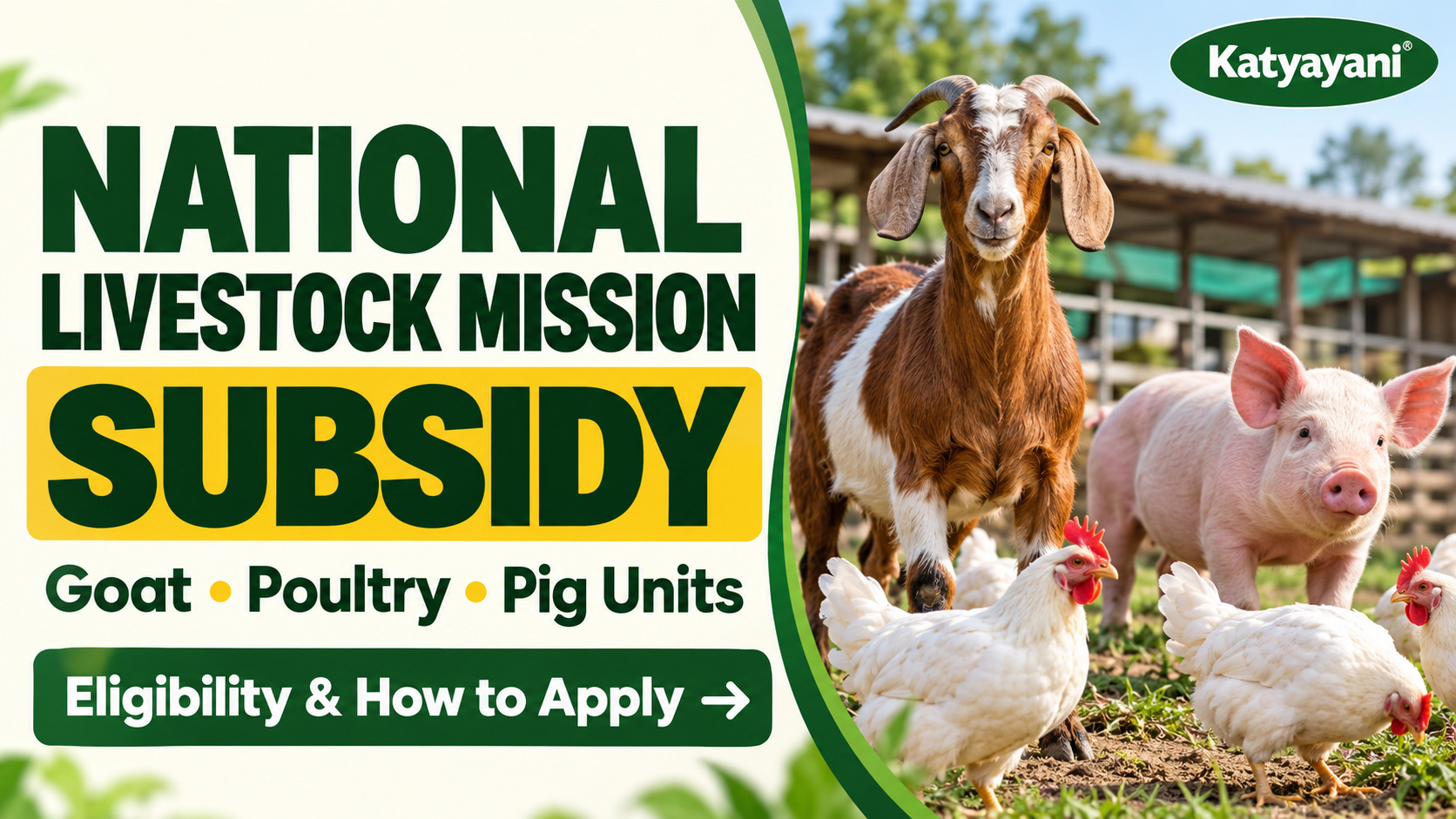
Under the National Livestock Mission Entrepreneurship Development Programme (NLM-EDP), the Government of India gives a back-ended capital subsidy of up to 50% of project cost for new goat, sheep, rural poultry, pig and fodder units. The cap depends on unit size: Rs 10 lakh to Rs 50 lakh for goat or sheep, Rs 25 lakh for the rural poultry parent farm, Rs 15 lakh or Rs 30 lakh for pig breeding. You apply online on nlm.udyamimitra.in, and a bank loan sanction is part of the process.
What is the National Livestock Mission subsidy (NLM-EDP)?
The National Livestock Mission has three sub-missions, according to the official NLM portal: breed development of livestock and poultry, feed and fodder development, and innovation and extension. The subsidy most farmers ask about sits under the first one. It is called the Entrepreneurship Development Programme, or NLM-EDP.
The scheme note on NLM-EDP 2021-26 says the Department of Animal Husbandry and Dairying (DAHD) has run it since 2021-22. The idea is to build entrepreneurs in rural poultry, sheep and goat, pig and fodder so that farmers in the area get a market for their produce. The government gives a maximum of 50% back-ended subsidy on project cost. "Back-ended" means the money does not reach you at the start. It goes to your lending bank in instalments, after you have met certain milestones.
The note also says projects should preferably follow a hub and spoke model. You, the entrepreneur, are the hub, and farmers around you are the spokes who sell kids, chicks or piglets to you or buy from you.
How much NLM subsidy do you get for goat, poultry and pig units?
The table gives the maximum subsidy for each model unit, as written in the DAHD scheme note. The subsidy is 50% of project cost or the cap, whichever is lower.
| Unit | Unit size | Maximum subsidy |
|---|---|---|
| Goat or sheep breeding | 100 females + 5 males | Rs 10 lakh |
| Goat or sheep breeding | 200 females + 10 males | Rs 20 lakh |
| Goat or sheep breeding | 300 females + 15 males | Rs 30 lakh |
| Goat or sheep breeding | 400 females + 20 males | Rs 40 lakh |
| Goat or sheep breeding | 500 females + 25 males | Rs 50 lakh |
| Rural poultry (parent farm with hatchery and brooder unit) | 1,000 female + 100 male birds, low input technology, layer farms only | Rs 25 lakh |
| Pig breeder farm | 50 sows + 5 boars | Rs 15 lakh |
| Pig breeder farm | 100 sows + 10 boars | Rs 30 lakh |
| Feed and fodder (silage making unit, fodder block making unit) | As per project | Up to Rs 50 lakh |
Worked Example (Illustration Only): Say a 100-female goat unit costs Rs 30 lakh in total. Half of that is Rs 15 lakh. But the cap for a 100+5 unit is Rs 10 lakh, so the subsidy would be Rs 10 lakh, not Rs 15 lakh. The Rs 30 lakh is a made-up figure to show the rule. Your real cost comes from your DPR.
For goat and sheep, the note says you can apply in multiples of 100 females and 5 males, up to a limit of 500 plus 25. The portal also links model project reports (DPRs) for poultry, piggery, sheep or goat, and feed and fodder under its Document Formats tab, which are worth downloading before you plan costs.
Who is eligible for the NLM subsidy?
Which applicants can apply?
The scheme note lists individuals, Farmer Producer Organisations (FPOs), Self Help Groups (SHGs), Joint Liability Groups (JLGs) and Section 8 companies. The portal also mentions farmer cooperative organisations. Joint applications may be treated as an individual category. If you are thinking about forming a group first, read our comparison of SHG vs FPO for farmers.
What conditions must you meet?
- Experience or training: you need a certificate of experience in breeding or rearing poultry, goat or pigs (whichever you choose) from a local government veterinarian.
- Land: you must arrange land of suitable size and location yourself. The land documents can be ownership papers or a lease or rent agreement.
- Your own money: for bank-financed projects, at least 10% of total project cost must come from you.
- Several components: one applicant can apply for more than one component at the same time.
- More than one family member: more than one adult in a family can apply, if each meets the criteria.
- Greenfield only: the note says NLM-EDP supports only new projects, not expansion, modification or strengthening of existing ones.
The note warns that applications not meeting the minimum pre-qualification criteria are rejected outright. So fix gaps, such as a missing vet certificate, before you apply.
What documents are needed for the NLM subsidy?
| Applicant type | Documents listed in the scheme note |
|---|---|
| Individual | Detailed Project Report (DPR) with cost, means of finance, recurring cost and net income; land document (ownership, lease or rent agreement) with latest land tax receipt; address proof; photograph of applicant and project site with GIS location; bank mandate form with cancelled cheque; bank statement for the last six months; training or experience certificate from a local government veterinarian; education certificates; PAN card |
| SHG, FPO, company or other non-individual | Partnership deed; certificate of incorporation (for a company); GST registration certificate; list of linked farmers with name, Aadhaar number, mobile number and address; last three years of audited financial statements, if applicable; last three years of income tax returns |
One detail that trips people up: if your land is on lease, the lease agreement has to be registered before the application is forwarded to the State Level Executive Committee and DAHD. Keep an eye on this early, as registration takes time.
How to apply for the NLM subsidy online: step by step
Applications go through the portal at nlm.udyamimitra.in. The portal's own Application Steps page advises you to keep all information and documents ready before you start. Here is the full flow, combining the portal page and the scheme note.
- Register. Open the portal, choose Apply Here, then login as Entrepreneur and register with your mobile number. Enter the six-digit OTP you receive.
- Fill the form. Enter personal details, project details and bank account information, upload documents, accept the declaration and submit.
- State scrutiny. The State Implementing Agency (SIA) checks your application. Eligible applicants are invited to present the DPR, online or offline, and officers visit the site.
- Bank loan. The SIA recommends you to a scheduled bank or financial institution. The bank does its own checks and, if satisfied, sanctions the loan and uploads the sanction letter. If the bank finds the application not eligible, it goes back to you for correction.
- State committee. With the sanction letter in hand, the SIA places the case before the State Level Executive Committee (SLEC), which recommends it to DAHD.
- Central approval. DAHD approves eligible projects through the Project Approval Committee (PAC) and marks the approval on the portal.
- Loan disbursement and first instalment. The bank disburses the loan as per sanction terms. Once at least 25% of the sanctioned loan is released and the SIA verifies it, the first subsidy instalment moves through SIDBI to the bank.
- Project completion and final instalment. After the project is fully set up, the SIA verifies actual capital cost and the final instalment is released.
Good To Know: You also have to submit an Integrity Compliance form and a Surety Bond to the SIA before the project is complete, according to the scheme note. The forms are annexures to the NLM guidelines. All collateral that the bank asks for is arranged by you.
How is the NLM subsidy released?
The subsidy is paid in two instalments, through SIDBI, to your lending bank. The bank then credits it to you. The note lists these rules:
| Stage | What happens |
|---|---|
| First instalment | Released after the bank has disbursed at least 25% of the sanctioned loan and the SIA confirms it |
| Second instalment | Released after the project is complete and the SIA certifies it. The total subsidy cannot go above 50% of actual capital cost or the unit cap |
| Bank to you | The lender must pass the subsidy to the beneficiary within 15 working days of receiving funds from SIDBI |
| Running the project | You must continue operating for at least three years after completion. The SIA follows up for two years, and the project area is monitored through GIS |
| Self-financed projects | The note says SIDBI releases the subsidy through the lender account in both bank-loan and self-financed projects |
In plain terms: the subsidy is not a cheque you collect before building the shed. You build, the bank funds you, and the subsidy reduces your burden as milestones are verified.
Are there new rules or deadlines for NLM in 2026?
The portal home page, read on 23 October 2026, shows three notices worth knowing:
- Beneficiaries who got the first instalment in FY 2022-23 to FY 2025-26 must submit all documents and finish their projects by 31 December 2026. Otherwise the project can be cancelled and the subsidy must be refunded with 10% interest per year.
- Cases approved by the PAC on or before 31 March 2026 with no instalment received must also complete by 31 December 2026, for a single-tranche release. The notice says no further extension will be given.
- The Operational Guidelines have been amended, and the amendment is available on the portal under the Operational Guidelines tab.
The page also says online loan application submission has not started and the date will be shared on the portal. Check the portal before you plan your timeline, and ask your state animal husbandry department about local advertisements for applications.
How to arrange the rest of the money: loan and own contribution
Because the subsidy is capped at half the project cost, the rest has to come from you and a lender. The scheme note fixes only your minimum share at 10% for bank-financed projects. For the loan side, these posts on our site explain options a small livestock entrepreneur commonly looks at:
- A group can start with an SHG loan for agriculture, and the SHG bank linkage programme explains how banks lend to groups.
- For day-to-day running money, see the Kisan Credit Card scheme.
- If you register as a producer company, the FPO credit guarantee scheme may help with collateral.
- Smaller units can compare options in our guide on PMEGP loan for agriculture business.
Do not mix up loan schemes with NLM approval. The bank decides on the loan using its own rules, and a bank refusal stops the NLM application too.
Which of the three should you pick: goat, poultry or pig?
The scheme does not tell you which is more profitable, and I did not find an official profit figure, so none is given here. What the scheme does show is how big each model unit has to be.
| Question | Goat or sheep | Rural poultry | Pig |
|---|---|---|---|
| Smallest eligible unit | 100 females + 5 males | One fixed model: 1,000 female + 100 male birds, with hatchery and brooder | 50 sows + 5 boars |
| Cap on smallest unit | Rs 10 lakh | Rs 25 lakh | Rs 15 lakh |
| Largest cap | Rs 50 lakh (500+25) | Rs 25 lakh | Rs 30 lakh (100+10) |
| Scalable in steps? | Yes, multiples of 100+5 | Not in the note | Two sizes only |
| Notes | Breeding unit, income from sale of kids as per DPR | Layer farms only; hatchery and brooder included | Breeder farm |
If you are leaning towards poultry, read our poultry farming guide on setup cost and profit first. It will help you check whether the project size in the scheme suits your land and budget. For other support, our agriculture subsidy schemes in India page lists more schemes, and the agriculture schemes calendar helps you track dates.
How to prepare a strong project report (DPR) for NLM
The DPR is the document the state committee reads first, and you present it in front of the selection committee if your application is found eligible. The scheme note says it must show the cost of the project, the means of finance, the recurring cost and the expected net income. The portal gives model DPRs for poultry, piggery, sheep or goat and feed and fodder, so start from those rather than from a blank page.
- Be specific on the site. Give the land area, the shed plan and where fodder will come from. The committee officers visit the site to check the proposal.
- Show where the money comes from. Split the cost into your own share (at least 10% if a bank finances), the bank loan and the subsidy.
- Show who buys from you. The scheme prefers a hub and spoke model, so name the farmers or groups in your area who will buy kids, chicks or piglets, or sell you animals.
- Keep recurring costs realistic. Feed, vaccines, labour and electricity should be in the plan, because the bank looks at repayment ability.
- Be ready to explain it. You may be asked to present the DPR online or in person.
Remember that the bank assesses your financial strength using the documents, presentation and field verification. All papers and any collateral the bank asks for are your responsibility, as the scheme note says.
Common mistakes that get NLM applications rejected
- Applying for an existing farm. The scheme supports only green field projects.
- No vet certificate. The experience certificate from a local government veterinarian is a pre-qualification, not an extra.
- Unregistered lease. A lease agreement must be registered before the file goes to the state committee and DAHD.
- Weak DPR. The DPR must show cost, means of finance, recurring cost and net income. Use the model DPR formats on the portal.
- Not planning your own 10%. Bank-financed projects need at least 10% of project cost from you.
- Missing the three-year commitment. Closing the unit early can create trouble with the subsidy.
- Ignoring deadlines. Projects already approved have to finish by 31 December 2026, according to the portal.
Conclusion
The National Livestock Mission subsidy can cover up to half the cost of a new goat, sheep, poultry or pig breeding unit, but only up to the cap for your unit size, and only as a back-ended payment through a bank. The main work is outside the portal: a good project report, a vet experience certificate, land papers, your own 10% and a bank that agrees to lend. Check the Operational Guidelines tab for the latest amendment before you finalise numbers, and apply only when the portal opens fresh submissions.
Why trust this guide
Written by Team Katyayani, Editorial Team at Katyayani Organics. Cross-checked against published research and university extension programs.

Leave a Comment