 11 min read
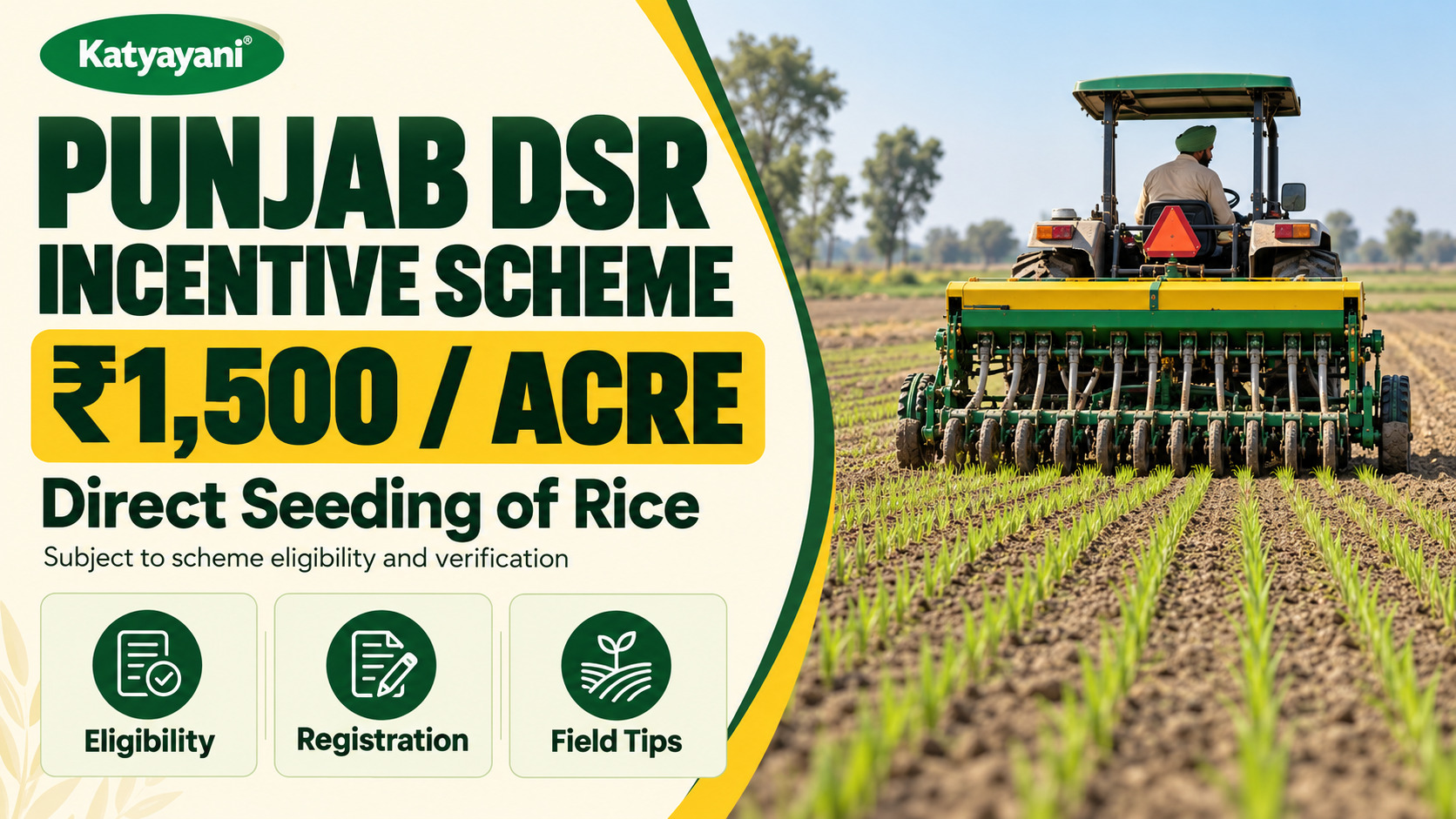
The Punjab DSR incentive scheme pays Rs 1,500 per acre to farmers who sow paddy by direct seeding instead of transplanting. The scheme started in 2022. For the 2026 Kharif season the state reported over 4 lakh acres, 31,478 registered farmers and about Rs 61 crore in assistance. A farmer registers the area on the state DSR portal, officials verify the field twice, and the money goes straight to the bank account. Registration dates change each year, so check the Agriculture Department notice for the current season.
What is the Punjab DSR incentive scheme?
DSR means direct seeding of rice. The seed is drilled into the field with a machine. There is no nursery and no puddling or transplanting. Punjab wants more farmers to do this because transplanted paddy needs a lot of groundwater and labour.
The state cabinet approved the Rs 1,500 per acre incentive in 2022, as per a Punjab cabinet report from that year. The money is a cash reward for the farmer who chooses DSR and whose area is verified. It is not a loan and it is not a subsidy on a machine.
| Point | What is confirmed | Year |
|---|---|---|
| Incentive amount | Rs 1,500 per acre | 2022 start; reported again for 2025 and 2026 |
| Portal | DSR portal launched on 25 May 2022, built by the Mandi Board with the Agriculture Department | 2022 |
| Budget | Rs 40 crore set aside, target 5 lakh acres | Kharif 2025 |
| Registration window | 10 May to 30 June | Kharif 2025 only |
| Area result | Over 4 lakh acres, up 36 percent from 2.94 lakh acres | Kharif 2026 |
| Farmers | 31,478 registered farmers | Kharif 2026 |
| Expected payout | Nearly Rs 61 crore | Kharif 2026 |
Always read the year in the last column. A figure from 2025 is not a promise for the next season.
How much is the DSR incentive in Punjab in 2026?
The rate reported for Kharif 2026 is Rs 1,500 per acre. A news report updated on 19 July 2026 quotes the Punjab Agriculture Minister on the season result and says total assistance is expected to be nearly Rs 61 crore. The same report says the minister told district officers to verify claims fast and pay eligible farmers on time.
A simple example shows the money. If you sowed 10 acres under DSR and all 10 acres pass verification, the incentive is 10 x Rs 1,500 = Rs 15,000. Land that fails verification is not paid.
Note on the future: the rate and rules for the 2027 season were not found in any source. Wait for the official notice from the Punjab Agriculture and Farmers Welfare Department.
What happened in Kharif 2026? Area, farmers and top districts
The numbers below are from the July 2026 news report above. It calls them final validated data. They come from the minister and are not from a published government table, so treat them as reported figures.
| District | Area under DSR (acres) | Farmers |
|---|---|---|
| Fazilka | 1,55,422.77 | 12,063 |
| Sri Muktsar Sahib | 1,06,038.81 | 7,345 |
| Ferozepur | 38,088.59 | 1,929 |
Bathinda and Sangrur were also named among the top five, but the report gave no figures for them. Total area passed 4 lakh acres. In 2025 the area was 2.94 lakh acres, so growth was 36 percent. The 2025 target had been 5 lakh acres, which means the state still fell short of that target in 2025.
The southwest districts lead because they have light water tables and large holdings with machines. That reason is our reading of the district list, not a line from the report.
Who is eligible for the Punjab DSR incentive?
No source we found lists full eligibility rules in one place. What is clear from the reports:
- The farmer must sow paddy by direct seeding, not by transplanting.
- The area must be registered on the Agriculture Department DSR portal.
- The area must pass verification by officials. The 2022 launch report in the Tribune says about 3,000 officials from the agriculture, horticulture, Mandi Board and soil and water conservation departments check sown areas.
- Payment is made to the bank account of the farmer. Keep your bank details and Aadhaar details correct.
What is NOT confirmed: whether tenant farmers on leased land can claim, whether there is an acreage limit, and whether basmati DSR is included in the current season. One report of the 2025 season mentions basmati being sown under DSR in Muktsar, but gives no separate rule. Ask your Block Agriculture Officer before you sow if your case is one of these.
How do you register for DSR in Punjab? Step by step
- Check the notice. Look for the current season notice from the Punjab Agriculture and Farmers Welfare Department or your Block Agriculture Office.
- Keep papers ready. Land details, Aadhaar and bank account details are the usual needs. The exact list is not published in the sources we read, so confirm it with the office.
- Register on the DSR portal. The portal asks the farmer to give consent and declare the area to be sown under DSR. The state portal was built by the Mandi Board.
- Sow the paddy by direct seeding in the area you declared. Do not sow a different area than you registered.
- Be present for verification. Officials check the field two times.
- Wait for payment. After verification, the head office releases the incentive to the bank account.
Dates: In Kharif 2025, registration ran from 10 May to 30 June, and sowing under the scheme began on 15 May 2025 (PTI report). The Kharif 2026 dates were not found. Never plan around last year dates.
How does verification work, and why do payments get delayed?
The rule is simple. A farmer registers on the portal. Officials then make two verifications and send approved data to the head office for payment. This is described in a Tribune report of 4 October 2025.
That same report also shows why delays happen. A complaint said that bogus area was being reported in Muktsar to claim the incentive. The Deputy Commissioner ordered a joint probe by agriculture and revenue officials, and the incentive for the district was waiting for the report. No findings had been published when the report came out, so we do not say what the probe found.
What this means for an honest farmer:
- Register only the area you really sow.
- Keep dated photos of the sown field and the seed bill or machine receipt.
- Keep your portal acknowledgement. You will need it if you have to ask about a pending claim.
- If your payment is late, ask the Block Agriculture Officer first, then the district Chief Agriculture Officer.
Why does Punjab push DSR? Water, labour and cost
Two reasons are given again and again in the official statements: falling groundwater and rising labour cost.
| Claim | Who said it | Year |
|---|---|---|
| Saves 15 to 20 percent irrigation water per acre | Agriculture Minister | 2026 |
| Saves 15 to 20 percent groundwater | Punjab government statement | 2025 |
| Cuts labour cost by about Rs 3,500 per acre | Punjab government statement | 2025 |
| Saves 20 to 25 percent labour | Agriculture Extension Officer, Mudhal circle | 2025 |
These are official claims. Field results change with soil, weed control and rain. DSR can also mature 7 to 10 days earlier than transplanted paddy, according to the 2020 PAU advisory. That helps with the next wheat sowing, but only if the crop was sown at the right time.
DSR is not a free win. Weeds and iron deficiency are more common than in puddled paddy. The sections below show how to prepare for them.
What is the best time to sow DSR in Punjab?
The sowing date depends on the notice of the season, because the state sometimes announces the start date. In 2025 the state allowed sowing under the scheme from 15 May. PAU, in its 2020 advisory, gave these dates:
| Type of paddy | PAU sowing window (2020 advisory) |
|---|---|
| Parmal varieties such as PR 126, PR 114, PR 121, PR 122, PR 127 | 1 to 15 June |
| Basmati varieties such as Pusa Basmati 1121, 1509, 1718 | 15 to 30 June |
These dates are from a 2020 PAU advisory reported by Global Agriculture. Dates and varieties get updated by PAU, so check the current PAU Package of Practices for Kharif. Very early sowing in May is a risk, because PAU experts have cautioned that it raises water use and weed pressure.
Which soil and seed rate suit direct seeded rice?
- Soil: medium to heavy soils. PAU advises against light-textured soils for DSR.
- Field: level the field, ideally with a laser leveler, then give a pre-sowing irrigation (rauni).
- Seed rate: 8 kg per acre, maximum 10 kg. A thicker stand cuts air flow and raises sheath blight and empty grains.
- Seed treatment: soak seed in water for about 8 hours (not more than 12), shade-dry it, then treat with a fungicide before sowing.
- Machine: PAU prefers a Lucky Seed Drill, which sows and sprays herbicide in one pass, or an inclined plate rice seed drill. Where these are not available, a zero-till drill or Happy Seeder can be set to drop 16 to 20 seeds per metre of row.
- First irrigation: 21 days after sowing.
All of these points are from the same 2020 PAU advisory. A soil test helps you decide on nutrients, and our guide to reading a soil health card is there for that purpose.
How do you control weeds in direct seeded rice?
Weeds are the number one reason DSR fails. In transplanted paddy, standing water holds weeds down. In DSR, weeds and rice come up together.
Research papers from Punjab say that the common plan in north-west India is a pre-emergence herbicide right after sowing, followed by a post-emergence herbicide at about 25 to 30 days after sowing. One study found that using pendimethalin alone was not enough for the mixed weeds of DSR. Another reported that repeated use of the same two herbicides moved the weeds from grasses to broadleaf weeds and sedges.
| Stage | What research says | What to do |
|---|---|---|
| Right after sowing | Pre-emergence spray applied within about 48 hours of sowing in a Punjab study | Use a herbicide registered for rice, as per label |
| 25 to 30 days after sowing | Post-emergence spray controlled the weeds that escaped | Scout the field first. Spray only if weeds are present |
| Later | Sedges and broadleaf weeds can build up if the same herbicide is repeated | Rotate herbicide groups, hand-weed patches |
We are not giving doses. Doses in papers are for trials. Read the label of the herbicide you buy, and follow PAU dates. A bispyribac sodium product such as Katyayani Garuda Bispyribac Sodium 10% SC is listed on our site for paddy, with grass, sedge and broadleaf weeds named on its page. The page does not state a dose or whether it is for direct seeded rice, so check the label before you decide. You can compare other options in the paddy crop products collection.
What other problems come up in DSR, and what can you do?
- Iron deficiency: yellow young leaves are a known DSR problem in research literature. PAU has published work on iron sprays in dry DSR, but we could not confirm the spray dose here. Get the dose from the current PAU package.
- Poor stand: caused by seed sown too deep, crusting after rain, or bad seed. Keep to the recommended seed rate and depth.
- Water stress: the first irrigation comes at 21 days, so make sure the field was moist at sowing.
- Disease: thick stands raise sheath blight, so do not use more seed than advised.
If you also face stubble questions after harvest, read how bio-decomposers compare with machines in our guide to parali management and the CRM subsidy.
How does the DSR incentive compare with other Punjab and national schemes?
Do not mix this scheme up with others. The DSR incentive is a per-acre cash reward for a method of sowing. It is separate from machine subsidies, PM-Kisan and crop loans.
| Scheme | What it gives | Where to read more |
|---|---|---|
| Punjab DSR incentive | Rs 1,500 per acre for verified DSR area | This post |
| General subsidy schemes | Machinery, inputs, irrigation support | Our agriculture subsidy schemes guide |
| Crop loan | Short-term credit for seed, fertiliser, pesticide | Our Kisan Credit Card guide |
| All yearly deadlines | Dates of many schemes together | Our agri schemes calendar |
A farmer can use the KCC to fund seed and inputs, and still claim the DSR incentive on verified area. Confirm any combined benefit with the bank and the agriculture office.
DSR or transplanting: what actually changes on the farm?
Before you register, look at the whole season and not only the Rs 1,500. The table puts the two methods side by side using only the points found in the sources above.
| Point | Transplanted paddy | Direct seeded rice (DSR) |
|---|---|---|
| Nursery and transplanting | Needed | Not needed, seed goes in with a drill |
| Labour | High at transplanting time | Officials claim 20 to 25 percent less labour, or about Rs 3,500 per acre saved (2025 statements) |
| Irrigation water | Standing water, more irrigation | Officials claim 15 to 20 percent less per acre (2026) |
| First irrigation | Right after transplanting | About 21 days after sowing (PAU 2020) |
| Seed per acre | Seed for the nursery | 8 kg per acre, maximum 10 kg (PAU 2020) |
| Crop duration | Normal | May mature 7 to 10 days earlier (PAU 2020) |
| Weeds | Standing water holds them down | Come up with the crop, need a clear herbicide plan |
| Soil | Most soils | Medium to heavy soils; avoid light soils (PAU 2020) |
| Incentive | None | Rs 1,500 per acre on verified area |
If your land is light textured, DSR may cost you yield, and the incentive will not cover that loss. This is where a talk with the local Krishi Vigyan Kendra or the block office is worth the time.
What should you do if the DSR incentive is pending or not received?
The reports show that payment waits for two verifications and head office approval. A delay does not always mean rejection. Follow these steps in order:
- Check your portal entry. Make sure the area, bank account and Aadhaar details are right.
- Ask the Block Agriculture Officer if the field verification has been done twice.
- Carry proof. Seed or machine bill, dated field photos and the portal acknowledgement.
- Go to the district Chief Agriculture Officer if the block office cannot tell you the status.
- Keep a written copy of any complaint you give.
We could not find an official helpline number or a public status-check page in the sources read, so none is given here. If the portal has a status page, your block office will know it.
Dos and donts for a DSR season
| Do | Do not |
|---|---|
| Read the season notice before you sow | Copy last year dates |
| Register the exact area you will sow | Declare extra area, because two verifications are done and a probe may follow |
| Level the field and give the pre-sowing irrigation | Sow on light-textured soil without advice |
| Use the advised seed rate of 8 kg per acre | Use more seed thinking it will give a better stand |
| Plan a pre-emergence and a follow-up weed step | Rely on one spray |
| Keep receipts and photos | Throw away the portal acknowledgement |
Which steps and dates matter in a DSR season? A simple calendar
The state notice for each year gives the real dates. The table below only lists what the sources show, and marks the rest as unknown, so you can see where you must check.
| Step | What the sources show | Status for Kharif 2026 |
|---|---|---|
| Registration opens | 10 May in 2025 | Not found |
| Sowing under the scheme begins | 15 May in 2025 | Not found |
| PAU sowing window for Parmal | 1 to 15 June (2020 advisory) | Check current PAU package |
| PAU sowing window for basmati | 15 to 30 June (2020 advisory) | Check current PAU package |
| First irrigation | 21 days after sowing (PAU 2020) | Same advice, confirm in current package |
| Post-emergence weed step | About 25 to 30 days after sowing in studies | Scout first, then decide |
| Registration closes | 30 June in 2025 | Not found |
| Final area figures | Reported 19 July 2026 | Done: over 4 lakh acres |
| Incentive payment | Follows two verifications | No date found |
You can see from the table that the gap between the sowing start and the registration close is long. Even so, do not wait. Register early, so that the field can be verified while the crop is young and the sowing evidence is clear. A late registrant has less time for officials to visit, and the reports show that verification is the step that decides the payment.
Is DSR right for your farm? Five questions to ask first
- What is your soil? PAU advises DSR on medium to heavy soils. If your field is light and sandy, talk to the block office before you sow.
- Can you level the field and give the pre-sowing irrigation? A level field gives an even stand. An uneven field gives patches of weeds and poor seedlings.
- Do you have access to a seed drill? The best choice is a drill that sows and sprays in one pass. If you hire one, book it before the sowing window.
- Do you have a weed plan? Decide which pre-emergence herbicide and which follow-up step you will use, and buy them before sowing day.
- Can you keep records? A bill, photos and the portal acknowledgement protect your claim.
If you can answer yes to most of these, DSR is a reasonable choice. If not, it may be better to try it on a small plot in the first year and then increase the area. This is our suggestion, and it is not part of the scheme rules. The scheme pays by verified acre, so a small trial plot still earns Rs 1,500 per acre.
Conclusion
The Punjab DSR incentive is simple: sow by direct seeding, register the real area, pass two verifications, and get Rs 1,500 per acre in the bank. The rate is confirmed for Kharif 2026, but the registration dates, payment dates and any 2027 changes are not, so check the official notice each season. Most DSR losses come from weeds and a bad stand, not from the paperwork. Plan weed control before sowing day and keep your photos and receipts.
Why trust this guide
Written by Team Katyayani, Editorial Team at Katyayani Organics. Cross-checked against published research and university extension programs.

Leave a Comment