 5 min read
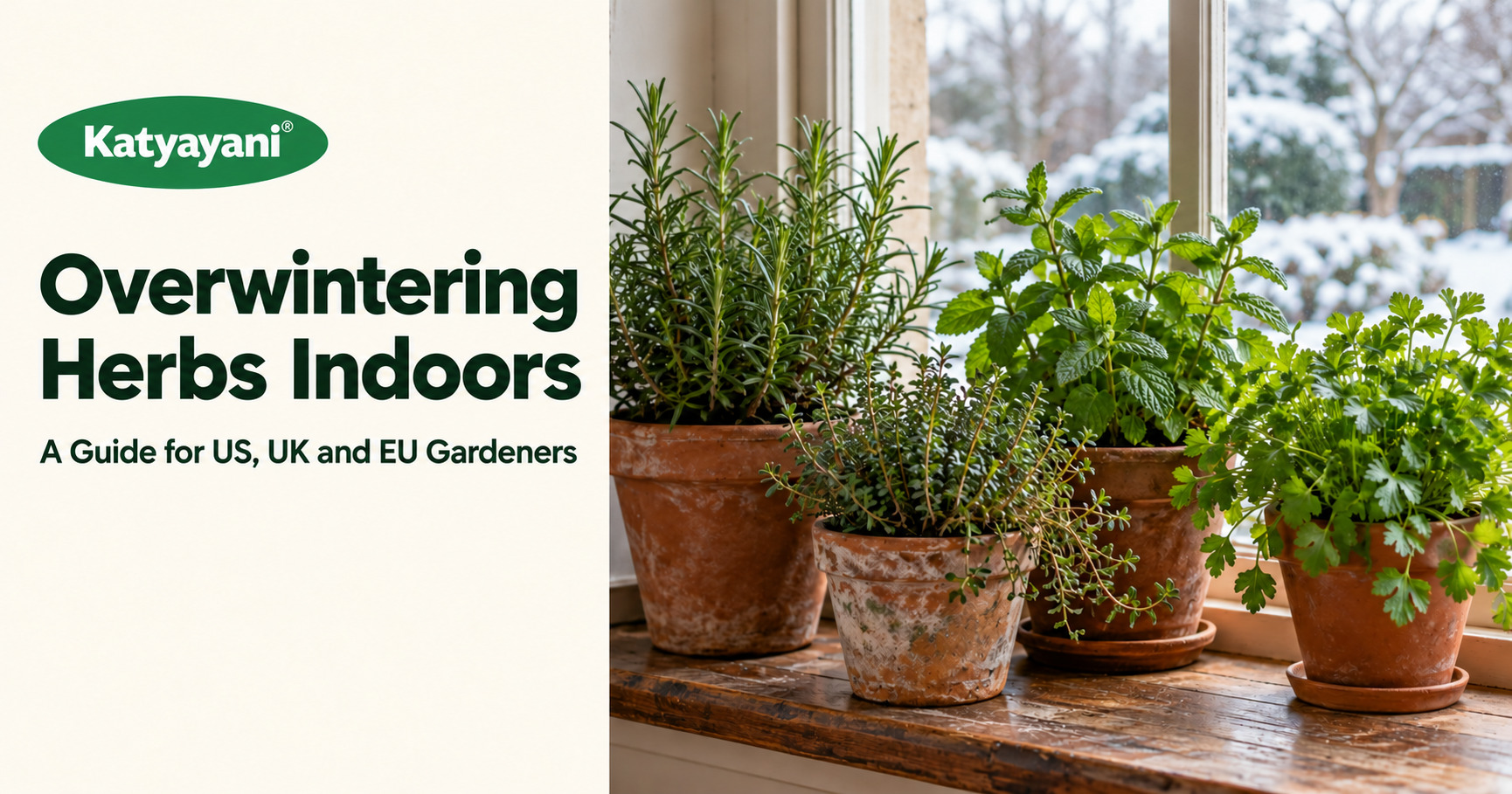
Quick answer: Bring tender herbs such as rosemary, bay, lemon verbena and basil indoors before nights fall below about 45 to 50°F (7 to 10°C). Pot them in free-draining mix, give a south-facing window or 12 to 14 hours of grow light, keep them at 50 to 65°F (10 to 18°C), and water only when the top inch is dry.
Key Takeaways
- Hardy herbs such as chives, thyme, sage, oregano, mint and lavender can usually stay outside in USDA zones 5 to 8 and most of the UK; tender herbs need to come in.
- Rosemary survives down to about 18°F (-8°C) when established in the ground, according to the RHS, but pots are far more vulnerable to cold and wet.
- Acclimatise herbs over 1 to 2 weeks before moving them indoors, and check them for pests before they join your houseplants.
- Indoor herbs need at least 4 hours of direct sun or 12 to 14 hours under a grow light.
- Cool, bright and slightly dry is the target; warm, dim and wet rooms cause most indoor herb losses.
Which herbs should you bring indoors for winter?
Bring tender herbs indoors: basil, rosemary (in cold areas), bay laurel, lemon verbena, lemongrass, marjoram and scented geraniums. Hardy herbs such as chives, thyme, sage, oregano, mint, tarragon and lavender can usually stay outside, though potted ones benefit from shelter.
North Carolina State Extension, in its guide to winterizing the herb garden, groups basil, coriander, dill and lemongrass as tender annuals killed by the first hard frost, and rosemary, lemon verbena and marjoram as tender perennials to bring indoors or heavily mulch.
| Herb | Hardiness | Winter plan (cold regions) |
|---|---|---|
| Basil | Tender annual; damaged below about 50°F (10°C) | Bring in early or take cuttings; short-lived indoors |
| Rosemary | Tender perennial; established plants to about 18°F (-8°C) per RHS | Bring pots indoors in USDA zones 7 and colder; shelter pots in the UK |
| Bay laurel | Tender perennial | Bring pots in where hard frosts are common |
| Lemon verbena | Tender, deciduous | Bring in; it drops all its leaves and regrows in spring |
| Lemongrass | Tender perennial | Cut back and bring in, or pot a divided clump |
| Parsley | Biennial, fairly hardy | Stays outside under cover, or pot up for fresh leaves |
| Chives | Hardy perennial | Stays outside; pot a clump for indoor harvests |
| Thyme, sage, oregano, mint | Hardy perennials | Stay outside with good drainage; mulch in very cold zones |
| Lavender | Hardy (English types) | Stays outside; needs sharp drainage over winter |
| Coriander (cilantro), dill | Annuals | Resow indoors rather than overwinter |
When should you bring herbs inside? (USDA zones and RHS ratings)
Bring tender herbs inside when night temperatures start dropping below about 45 to 50°F (7 to 10°C), well before the first frost. Basil should come in first because it suffers from cold even above freezing.
In the US
Use your USDA hardiness zone as a guide. In zones 7 and colder (average lowest winter temperature 0 to 10°F, or -18 to -12°C, in zone 7), most rosemary, bay and lemon verbena need to come in. In zones 8 to 10, rosemary and bay usually stay outside in the ground, while basil still comes in or is replaced. Some rosemary cultivars, such as 'Arp', are sold as hardier than standard types, but pots still freeze faster than garden soil.
In the UK and Europe
The RHS uses a hardiness scale from H1a to H7. According to the RHS hardiness rating guide, H3 plants cope with -5 to 1°C (23 to 34°F), H4 with -10 to -5°C (14 to 23°F) and H5 with -15 to -10°C (5 to 14°F). Anything rated H1 or H2 needs frost-free winter protection indoors or under glass.
The RHS notes in its rosemary growing guide that rosemary is hardy through much of the UK and established plants survive down to about -8°C (18°F), but potted rosemary is particularly vulnerable. Cold, wet compost rots its roots, so shelter pots from winter rain even in mild areas. In colder parts of central and northern Europe, bring rosemary into a cool, bright room.
How to move herbs indoors without shocking them
Move herbs indoors gradually over 1 to 2 weeks, and check them carefully for pests before they come in. Sudden moves from bright outdoor sun to a dim room cause leaf drop.
- Two weeks before your first expected frost, dig up or choose the herbs you want to keep.
- Pot garden herbs into containers at least 6 inches (15 cm) deep; rosemary needs about 12 inches (30 cm) wide and deep, as the RHS suggests.
- Use a free-draining potting mix, adding grit or perlite (up to about a quarter of the volume) for rosemary, thyme and bay.
- Leave the pots in partial shade outdoors for about a week so they adjust to lower light.
- Check stems and leaf undersides for aphids, whiteflies, spider mites and mealybugs; rinse the plants with a hose.
- Trim leggy growth by up to a third to reduce stress, but avoid hard pruning.
- Bring pots indoors to the brightest window, and keep them apart from houseplants for 1 to 2 weeks while you watch for pests.
How much light do herbs need indoors in winter?
Herbs need at least 4 hours of direct sun a day indoors, and 6 or more is better. In most US, UK and European homes in winter, that means a south-facing window or a grow light.
If your window gets less light, use an LED grow light on a timer for 12 to 14 hours a day, set about 6 to 12 inches (15 to 30 cm) above the plants. Check the manufacturer's guidance, as stronger lights need more distance. Rotate pots every few days so all sides get light.
- Signs of too little light: long, pale stems, small leaves and weak flavour.
- Signs of too much heat with too little light: soft growth and leaf drop, especially on rosemary.
- Keep leaves from touching cold glass on frosty nights.
What temperature and humidity do indoor herbs need?
Most overwintered herbs do well at 50 to 65°F (10 to 18°C) in a bright spot. Rosemary, bay and lemon verbena prefer the cooler end, while basil needs at least 60 to 70°F (16 to 21°C) to keep growing.
A cool, bright room such as an unheated spare room, porch, conservatory or a windowsill away from radiators suits rosemary and bay far better than a warm living room. In very warm, dry rooms, rosemary often dries out at the tips and gets powdery mildew or spider mites.
- Keep herbs 3 feet (about 1 m) or more from radiators, heaters and hot air vents.
- Place pots on trays of damp pebbles to raise humidity around the leaves.
- Group herbs together, leaving some space for air to move and reduce mildew.
- Open a window briefly on mild days for fresh air, avoiding direct cold drafts on the plants.
How to water and feed herbs indoors in winter
Water indoor herbs only when the top inch (2 to 3 cm) of soil is dry, and feed very lightly or not at all until late winter. Overwatering kills more overwintered herbs than cold does.
| Herb | Watering indoors | Feeding |
|---|---|---|
| Rosemary | When top inch is dry; never let it sit in water, but do not let the root ball dry out completely | None until late winter |
| Bay laurel | When top inch is dry | None until spring |
| Lemon verbena (leafless) | Very little, just enough to keep roots from drying out | None |
| Basil | Keep lightly moist; water at room temperature | Light feed every 3 to 4 weeks if growing actively |
| Parsley, chives, mint | Keep evenly moist | Light feed every 4 weeks if you are harvesting |
North Carolina State Extension advises not fertilizing outdoor herbs after early August so they are not pushing soft growth into winter. Indoors, follow the same idea: feed only herbs you are actively harvesting, at half the normal strength.
A diluted seaweed extract liquid fertilizer is a gentle option for basil, parsley and chives under grow lights. When growth picks up in late winter, a thin top layer of enriched vermicompost gives a slow nutrient boost before plants go back outside.
Common problems with overwintered herbs
The most common problems are root rot from overwatering, powdery mildew on rosemary, and pests such as spider mites, aphids and whiteflies in warm, dry rooms. Most can be prevented with good light, cool temperatures and careful watering.
| Problem | Likely cause | Fix |
|---|---|---|
| Rosemary needles turn brown from the tips | Root ball dried out, or roots rotting in wet compost | Check roots; water evenly, improve drainage |
| White powder on leaves | Powdery mildew in still, humid air | Improve air flow, remove affected shoots |
| Fine webbing, speckled leaves | Spider mites in dry heat | Rinse leaves, raise humidity, spray neem oil |
| Tiny white flies when touched | Whiteflies | Yellow sticky traps plus neem oil spray |
| Basil blackens and wilts | Cold damage or wet, cold soil | Move to a warmer spot; take cuttings from healthy stems |
| Leaf drop after moving indoors | Light shock | Brighter spot; new growth usually follows in 2 to 4 weeks |
For pests, a plant-based neem oil insecticide sprayed at the label rate every 7 days covers most soft-bodied insects on herbs. Rinse herbs well before eating, respect any pre-harvest interval on the label, and follow local extension advice for anything stronger.
Should you take cuttings instead?
Taking cuttings is often easier than moving a large plant, especially for basil, rosemary, mint, oregano and sage. Small rooted cuttings fit on a windowsill and adapt to indoor conditions more easily.
- Cut 3 to 5 inch (8 to 12 cm) non-flowering shoot tips in late summer or early autumn.
- Remove leaves from the lower half of each cutting.
- Place basil and mint in a glass of water; they usually root within 1 to 2 weeks.
- Insert rosemary, sage and oregano cuttings into a gritty seed compost and keep them just moist; they take several weeks to root.
- Pot rooted cuttings individually and grow them on in the brightest window.
Cuttings also act as insurance. Even if you move the parent plant indoors, a few rooted cuttings on another windowsill mean you still have rosemary or sage in spring if the big plant struggles. Label each pot with the herb and the date you took the cutting.
Annual herbs such as coriander (cilantro) and dill are better resown indoors than overwintered. Sow small batches every 3 to 4 weeks in pots under a grow light for a steady supply.
What to do next
Check your average first frost date and hardiness zone or RHS rating today, and list which of your herbs need to come in. Start acclimatising them at least two weeks before that date.
In spring, reverse the process. Once nights stay above about 50°F (10°C), move herbs outside to a shaded spot for a week, then into full sun, and restart regular feeding as new growth appears.
Why trust this guide
Written by Team Katyayani, Editorial Team at Katyayani Organics. Cross-checked against published research and university extension programs.

Leave a Comment