 17 min read
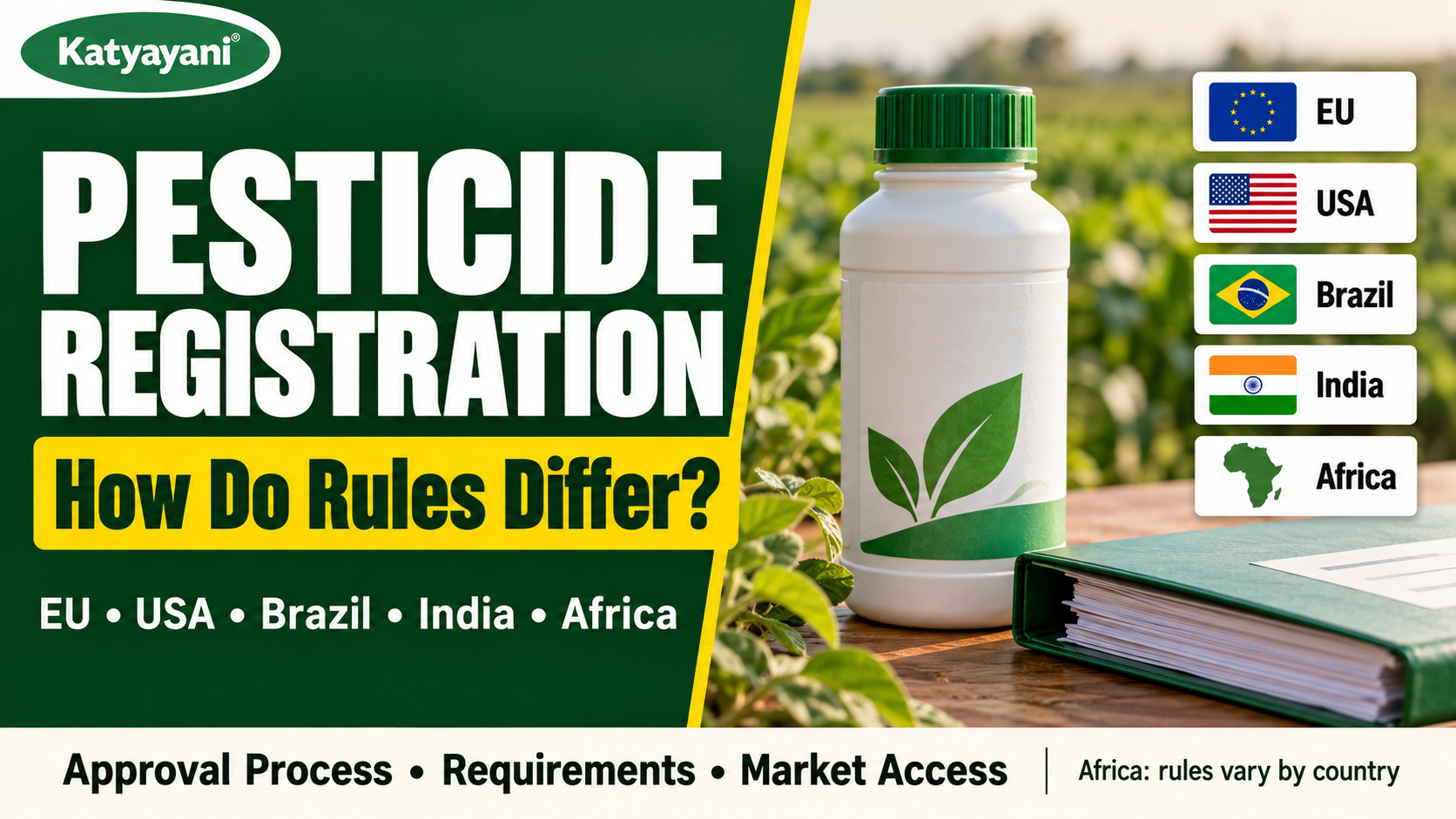
No single global pesticide registration exists. Each country or bloc approves a product before it can be sold. The EU approves the active substance first, then each member state authorises the product. The USA registers under FIFRA through the EPA. Brazil uses a three-agency system under Law 14.785/2023, with a legal deadline of 24 months for a new product. India uses the Insecticides Act, 1968 (sections 9(3), 9(3B) and 9(4)). Africa has no single system: nine Sahel states share one CSP registration, and most others run national boards.
Is there one global pesticide registration, or does each country decide?
Each country, or in a few cases a bloc, decides for itself. No certificate from one regulator is accepted everywhere. The FAO describes the process as running from the first application to the registrar's final decision, and says the exact steps differ from country to country (FAO Pesticide Registration Toolkit). That is why a company with a registration in India still needs a fresh dossier, a fresh fee and often a local partner in each new market.
What is shared is the shape of the dossier: identity and purity of the active ingredient, toxicology, environmental fate, residues and field efficacy, plus a proposed label. What differs is who judges it, how long they take, whether the product holder must live in the country, and how long the registration lasts. The table below puts the main systems side by side. All figures are dated 19 October 2026 and come from the sources cited in the sections that follow.
Pesticide registration by country: how do the main systems compare?
The EU is slowest and most hazard-driven, the USA is the most expensive on paper, Brazil has the tightest legal deadlines, and the Sahel system is the only one that gives one approval for several countries. Read the cells as "what the source says", not as a promise of how long your file will take.
| System | Authority | Legal base | Who can apply and key data | Time (sourced) | Cost (sourced) | Validity and renewal |
|---|---|---|---|---|---|---|
| EU | European Commission and EFSA for the active substance; each member state for the product | Regulation (EC) 1107/2009 | Applicant files with a rapporteur member state; dossier in IUCLID format | Active substance 2.5 to 3.5 years by law, about 4 in practice; product up to 1.5 years | Set by each member state; no single figure found | Active substance up to 15 years per the Commission page (VERIFY); renew by applying 3 years before expiry |
| USA | EPA (federal); state agencies such as California DPR | FIFRA; FFDCA for tolerances; 40 CFR 150-189 | Registrant files data per 40 CFR Part 158 plus labels | New food-use active ingredient: 36 months (R010) | $1,189,991 for R010 in FY2027; California new product $1,500 | EPA reviews each registration at least every 15 years; California certificates expire each 31 December |
| Brazil | MAPA (registrant), ANVISA (health), IBAMA (environment) | Lei 14.785/2023 | Brazilian legal entity (pessoa juridica); foreign firms need a local partner | New product 24 months; generic 12 months; RET 30 days (statutory deadlines) | A fee (taxa) is created by the law; amount set by regulation, not found | Production must start within 2 years of registration or it can be cancelled |
| India | CIB&RC (Registration Committee), Dept of Agriculture | Insecticides Act 1968; Insecticides Rules 1971 | Any person who imports or manufactures; one application per product | 9(3): 12 months, extendable by 6; 9(3B): provisional, 2 years | Rs 100 in the procedure page (looks old; VERIFY on CROP) | Check current CROP rules; 9(3B) lasts 2 years |
| Sahel (9 states) | Sahelian Pesticides Committee (CSP), Bamako | CILSS common regulation, revised Dec 1999 | Firms file one dossier in two binders; local presence in ECOWAS "desirable" | No time figure found | Evaluation fee set by the CSP; no amount found | Provisional APV 3 years, renewable once; registration 5 years, renewable |
| Kenya | Pest Control Products Board (PCPB) | Pest Control Products Act and Registration Regulations | Non-resident applicant must appoint a resident agent and file a binding agreement | No official timeline found | Fees set by the Board; amounts not in the text | 3 years, then renewals of up to 2 years each |
| South Africa | Registrar, Act 36 of 1947 (Dept of Agriculture) | Act 36 of 1947 | South African citizen or juristic person with a registered office in South Africa | 6 to 12 months per gov.za service page | Tariff page exists; amount not captured | Not stated on the service page |
| Nigeria | NAFDAC | Pesticide Registration Regulations 2021 (S.I. 83 of 2021) | Product must come from an agency-approved establishment | No official timeline found | Not found | 5 years in the 2018 guidelines for locally made products (VERIFY for 2021 rules) |
Egypt (Agricultural Pesticides Committee) and Ghana (EPA, Act 490) also require national registration. I could not confirm their validity periods or fees from an official text, so they are left out of the table rather than guessed.
How does pesticide registration work in the EU?
In the EU, registration is two steps: the active substance is approved once at EU level, then each member state authorises the finished product. Both steps are governed by Regulation (EC) 1107/2009.
Step 1: active substance approval
The applicant sends a dossier in IUCLID format to a rapporteur member state, which checks it is admissible and writes a draft assessment report. EFSA then runs a peer review with a public consultation, the Commission proposes a Regulation, the standing committee votes, and the approval is published in the Official Journal. The Commission states that a first approval takes 2.5 to 3.5 years from admissibility to publication under the Regulation, and averages about 4 years in practice. Approval lasts up to 15 years on the Commission page (I could not check this against the regulation text, so treat it as VERIFY). Renewal must be applied for at the latest 3 years before expiry (European Commission, approval of active substances).
Step 2: product authorisation by zone
Once the substance is approved, companies apply to member states to sell the product. The EU is split into three zones, North, Central and South. One member state acts as zonal rapporteur, assesses for the others in its zone, and each country then decides for itself. Greenhouse uses, post-harvest treatments, empty-store treatments and seed treatments are assessed once for the whole EU. If you later want the same product in another country, you apply for mutual recognition under Articles 40 to 42. The Commission says granting an authorisation can take up to 1.5 years from application, emergency authorisations last at most 120 days, and parallel trade permits take 45 days. Fees vary by country (European Commission, authorisation procedure).
Hazard cut-offs and data protection
The EU is the only major system here with hazard-based "cut-off" rules. Advocacy and academic summaries of Annex II describe them as: no approval for a substance classified as a category 1A or 1B carcinogen, mutagen or reproductive toxicant, or one with endocrine-disrupting properties, unless exposure is negligible. Persistent and bioaccumulative substances face similar limits. I could not open the regulation text, so this is VERIFY. Data protection for studies is described by the Norwegian regulator as ten years from the date of authorisation in each member state, with longer periods for low-risk products; check Articles 59 to 62 before you rely on it.
How does pesticide registration work in the USA?
In the USA the EPA registers each product under the Federal Insecticide, Fungicide, and Rodenticide Act (FIFRA), and a separate food-residue limit called a tolerance is set under the Federal Food, Drug, and Cosmetic Act (FFDCA). Many states then require their own registration.
The legal test is that the pesticide, used as directed, "will not generally cause unreasonable adverse effects on the environment". EPA weighs risk against benefit, may add label limits, and can refuse registration if risk cannot be reduced. An application includes the fee, forms, the identity and quantity of each chemical, human health and environmental data including food residues, a reliable manufacturing process and the proposed label. EPA must review every registration at least once every 15 years (EPA, about pesticide registration). Data follow 40 CFR Part 158: product chemistry (830 series), toxicology (870), ecological effects (850), environmental fate (835) and residue chemistry (860).
Cost and time are written into the Pesticide Registration Improvement Act (PRIA 5, enacted 29 December 2022). The EPA table for fiscal year 2027, effective 1 October 2026 after a 5% rise, lists the following examples:
| Action code | What it covers | FY2027 fee | Decision time |
|---|---|---|---|
| R010 | New conventional active ingredient, food use (EPA fee page) | $1,189,991 | 36 months |
| R122 | Enriched isomer of a registered mixed-isomer active ingredient | $501,116 | 27 months |
| A390 | New antimicrobial active ingredient, direct food use | $363,016 | 26 months |
EPA pages show 50% and 75% fee waivers (for example $594,996 and $297,498 for R010), but I did not read the eligibility rules, so check that you qualify as a small business before you budget. For state registration, California requires a product to be registered with EPA first. Its Department of Pesticide Regulation lists $1,500 for a new product, $300 for an amendment and $2,300 for annual renewal; certificates expire each 31 December (California DPR registration page, read 19 October 2026).
How does pesticide registration work in Brazil?
Brazil registers pesticides under Law 14.785 of 27 December 2023, which replaced the old Law 7.802/1989. Three federal bodies judge each file: MAPA (agriculture) registers and checks efficacy, ANVISA (health) assesses toxicology, and IBAMA (environment) assesses environmental risk.
The law makes the agriculture ministry the registering body and requires the application to go through an electronic system (Art. 4 and Art. 12). Article 58 creates the unified system Sispa for petitions and evaluation. Article 3 sets the legal deadlines, counted from submission (Lei 14.785/2023, full text):
- New formulated product and new technical product: 24 months.
- Formulated or generic product, and technical product by equivalence: 12 months.
- Identical formulated product: 60 days.
- Registro Especial Temporario (RET), the research permit: 30 days.
- The set of changes listed in Art. 26: 30 days. Other changes: 180 days.
Two details matter to exporters. First, the applicant (registrante) must be a legally qualified legal entity (Art. 2). ANVISA says foreign companies cannot apply to it directly and must work through a Brazilian partner company that carries legal responsibility. Second, once a registration is issued the holder has two years to start production and sale, or it can be cancelled (Art. 35). Making, importing or selling an unregistered pesticide is a crime with a prison term of 3 to 9 years (Art. 56).
On practice, the Agrolink report of 5 January 2026 on the Ministry's annual balance says 912 registrations were granted in 2025, 323 of them industrial technical products. A trade-news item says that from 15 September 2025 new petitions go only to MAPA through its SEI system (VERIFY: I could not read the Ato 40 text). I found no published average analysis time, so the 24 and 12 month figures are legal limits, not measured performance. The registration fee is created by Art. 59 but its amount is left to a later regulation, which I did not find.
How do you register a pesticide in India?
In India any person who wants to import or manufacture an insecticide applies to the Registration Committee (CIB&RC) under section 9 of the Insecticides Act, 1968. The directorate procedure page states that a separate application is needed for each insecticide (DPPQS registration procedure).
| Route | What it is | Time or term (per directorate page) |
|---|---|---|
| Section 9(3) | Regular registration. The Committee registers the product once satisfied it matches the applicant's claims and the fee is paid, then issues a number and certificate | Decision within 12 months of receipt, extendable by up to 6 months |
| Section 9(3B) | Provisional registration for a product being introduced to India for the first time, pending inquiry | 2 years |
| Section 9(4) | Later applicants for an already registered product get their own number and certificate on the same conditions (the "me-too" route) | On application and prescribed fee |
The filing starts with Form I, a fee and a data dossier, and the Committee may inspect the testing facility. The Committee can refuse if safety precautions are hard to observe or use still poses serious risk. An appeal on Form II-B goes to the Central Government. The fee quoted on that page is Rs 100, which looks like the original 1971 figure, so confirm current charges on the online system.
The online system named in official notices is the Comprehensive Registration of Pesticides (CROP) portal. A CIB&RC public notice of June 2026 says a production-data module went live on CROP on 16 April 2026 and asks manufacturers, importers and exporters to upload manufacture, import and export data (the DPPQS procedure page lists CROP as the registration link). On "IPMS registration", a question that appears in Google, I found no official document using that name, so I cannot describe it. Use CROP.
Export-only manufacture and import for export
India lets a company register a product only to make it for export. The Committee minutes of 9 April 2025 record 9(3) approvals for "manufacture for export" of Tolclofos methyl 50% WP and WG. The same meeting shows an "import for export" case under the Star Export category being sent back, because an earlier decision requires such cases to use the Fast-track category (463rd Registration Committee minutes). Those minutes also show the Committee asking for a 5-batch analysis report with a full impurity profile from a GLP laboratory for an imported technical product. I did not find the CIB&RC document that lists which data an export-only file may skip, so ask the directorate before assuming any waiver. For the buyer side of this trade, see our guide on importing pesticides from India. If you plan to make bio-products, biostimulants follow a separate rulebook, explained in our biostimulant and FCO rules guide.
How does pesticide registration work in Africa?
Africa has no single system. Nine Sahel countries share one regional registration through the CSP, a growing West African body (COAHP) has just begun to list products, and most other countries run national boards with their own rules.
The Sahel: CSP and the new COAHP
The Sahelian Pesticides Committee (CSP), based at the Institut du Sahel in Bamako, has registered pesticides for all CILSS member states since 1994. The 1999 revised regulation names nine states: Burkina Faso, Cabo Verde, Gambia, Guinea-Bissau, Mali, Mauritania, Niger, Senegal and Chad. A product approved by the CSP carries one number valid in all of them. A new dossier does not get the five-year registration straight away. It first gets a provisional sale authorisation (APV) valid 3 years and renewable once, and only after large-scale use can it move to a registration valid for 5 years and renewable for the same term. The dossier is filed in two binders, covering physical-chemical, efficacy and packaging data in one, and analytical, toxicology, environment and residue data in the other. Article 16 protects submitted data from use for other applicants unless the first applicant agrees. Article 15 calls it "desirable" to have a seat or representation in an ECOWAS state (CSP practical guide).
The newer West African committee, COAHP, held its first registration session in Banjul on 11 to 13 December 2025 and adopted the first regional list of authorised pesticides. It was built from the CSP list of July 2023 and national lists from Benin, Guinea and Togo. How COAHP and CSP will divide the work is not clear in the newsletter I read (INSAH newsletter, Oct to Dec 2025), so ask INSAH before you file.
Kenya, South Africa, Nigeria, Egypt and Ghana
- Kenya (PCPB): a non-resident applicant must appoint an agent permanently resident in Kenya and deposit a binding agreement with the Board. Five copies of the label and product samples go with the application. A certificate is valid for three years and can be renewed for up to two years at a time. Label extension to a new crop needs a two-season efficacy trial and residue data for edible crops (Kenya Law regulations text, as at 31 December 2022; Kenya Law marks it with a confusing "repealed" watermark, so confirm it is current).
- South Africa (Act 36 of 1947): the gov.za service page says only a South African citizen or a juristic person with a registered office in South Africa qualifies, and the supporting studies (toxicology, efficacy, residue, physical specification) go in three copies. Stated time: six to 12 months.
- Nigeria (NAFDAC): the 2021 regulations bar manufacture, import, export or sale unless registered, require efficacy assessment over two seasons in two zones (or as the Agency prescribes), and want the residue level stated against the tolerance level.
- Egypt: the Agricultural Pesticides Committee is the statutory registering body, files are in Arabic, and field efficacy is reported to run over three seasons. One procedure website claims a one-month process and three-year validity; that conflicts with the efficacy period, so treat both as unconfirmed.
- Ghana: the EPA registers under Part II of Act 490 through its Chemicals Control and Management Centre. I did not find the validity period.
Regional harmonisation in East and Southern Africa
In Southern Africa, the SAPReF regulators' forum promotes cooperation, and a 2021 to 2024 STDF project covering six SADC countries led to a policy brief proposing mutual recognition and data sharing for biopesticide registration (secondary sources; I did not open the full reports). I found no East African Community framework for mutual recognition. Plan on separate national files in East Africa.
What are the steps in the pesticide registration process?
The FAO toolkit splits registration into four phases: pre-registration, registration, post-registration and review of existing registrations. Most national systems follow this pattern, even when names differ.
- Pre-registration: confirm the product needs registration, pick the legal route (for example 9(3) or 9(4) in India), appoint the local holder or agent, and ask the regulator what data it expects. The EU allows pre-submission advice from EFSA and the rapporteur; EFSA suggests asking at least six months before filing.
- Registration: submit the dossier. The authority checks administrative completeness, then does a technical and scientific evaluation, then decides, and publishes the decision. The decision can carry limits, such as restricted uses and label statements, per the FAO toolkit.
- Post-registration: the holder reports production or sales, updates labels, files amendments and renewals, and meets reporting duties. India's June 2026 CROP notice on production data is one example.
- Review of existing registrations: regulators re-open old approvals. The EPA does so at least every 15 years, and Brazil's Art. 30 to 33 set a one-year re-analysis, extendable by six months, for environmental control products and related items.
What data do you need for a pesticide registration dossier?
Every system asks for the same core packages: chemistry and purity, toxicology, environmental fate and ecotoxicology, residues and field efficacy. Laboratories usually need to follow Good Laboratory Practice (GLP), and the regulator decides whether a study from another country is acceptable.
| Data package | What it shows | Where it appears in the sources |
|---|---|---|
| Product chemistry and 5-batch analysis | Identity, content and impurities of the technical across five production batches | India: the April 2025 Committee asked for a 5-batch report with full impurity profile from a GLP laboratory. USA: 830 series |
| Toxicology | Acute (oral, dermal, inhalation, eye, skin), chronic, cancer and mutagenicity studies | USA: 870 series. Brazil: ANVISA assesses toxicology. Kenya form asks for toxicology of the technical and the formulated product |
| Ecotoxicology and environmental fate | Effects on birds, fish, bees and aquatic life; persistence and movement in soil and water | USA: 850 and 835 series. Brazil: IBAMA dossier |
| Residue chemistry | Residues on food and feed after use, used to set MRLs or tolerances | USA: 860 series. Kenya, Nigeria and South Africa ask for residue data |
| Efficacy (bio-efficacy) trials | Whether the product controls the claimed pest at the label dose | Kenya: two seasons for label extension. Nigeria: two seasons in two zones |
| Label, packaging and samples | Draft label in the local language, pack type, reference samples | Kenya: five copies of the label. CSP: label languages by country |
One tip for planning: a dossier built for the EU or the EPA usually answers most questions elsewhere, but not all. Regulators in Nigeria and Kenya want local-season efficacy, and Egypt's dossier language is Arabic. Budget for local trials from the start.
Do you need a local representative to register a pesticide abroad?
In most markets here, yes. The rule is explicit in Brazil, Kenya and South Africa, preferred in the Sahel, and indirect in the USA and the EU.
| Market | Local presence rule | Source |
|---|---|---|
| Brazil | Registrant must be a legal entity; ANVISA says foreign firms need a Brazilian partner | Lei 14.785 Art. 2; ANVISA pesticides page |
| Kenya | Non-resident applicant must appoint an agent permanently resident in Kenya and file a binding agreement | Registration Regulations, reg. 4 |
| South Africa | Applicant must be a citizen or a juristic person with a registered office in South Africa | gov.za service page |
| Sahel (CSP) | Seat or representation in an ECOWAS state is "desirable" | CILSS regulation, Art. 15 |
| India | The Act speaks of "any person desiring to import or manufacture"; I found no separate rule for foreign applicants on the page, so confirm how a foreign maker should file | DPPQS procedure page |
| EU and USA | No local agent rule found in the pages I opened; the applicant files with a member state or with EPA. Check the manual before filing | EC and EPA pages |
What are MRLs and import tolerances, and why do exporters of treated crops care?
An MRL (called a tolerance in the USA) is the highest pesticide residue legally allowed on a food. If your farmers spray a product abroad, the buyer country still tests the crop against its own limit, so the residue limit matters even if you never register a product there.
In the EU, MRLs are set by the Commission and listed in a public database. When a crop is grown outside the EU, or a pesticide is not used in the EU, an importer, exporter, grower or manufacturer can ask for an import tolerance. The file goes to a rapporteur member state, then EFSA publishes a Reasoned Opinion, and the Commission drafts a Regulation that member states vote on. It needs the good agricultural practice (GAP) of the exporting country and residue trials from comparable conditions. A farm-trade explainer from AgrInfo says the process "can take time and can be costly" and gives no figures. A worked example shows the scale: an application for tricyclazole on rice went to Italy, Italy sent its report to EFSA on 26 April 2018, and EFSA adopted a favourable opinion on 18 January 2023, about four and a half years later. Treat any import tolerance as a multi-year project.
In the USA, EPA sets tolerances for food and feed under the FFDCA, and before a food use is registered it must find a "reasonable certainty of no harm". In Brazil, Art. 2 defines the residue limit (LMR), and where no Brazilian limit exists the law points to limits from FAO, Codex or OECD-supervised laboratories. For growers who sell into organic channels, residues are handled differently; our guide to NPOP organic certification for export buyers explains that route. I did not research India's own residue limits for this post.
What mistakes delay pesticide registration?
Most delays come from incomplete files, the wrong legal route and missing local paperwork, not from the science. The regulator minutes and rules I read point to these repeat problems:
- Choosing the wrong route. In India a "me-too" 9(4) filing only works once the molecule holds a 9(3) registration. In the April 2025 minutes an import-for-export case under the Star Export category had its certificate withdrawn and had to be refiled under Fast-track.
- Assuming a change in paperwork means no new data. An applicant argued a new certificate number needed no fresh 5-batch report. The Committee rejected this, because the substance was no longer permitted in the source country, and told the applicant to submit the report with a full impurity profile.
- Missing local presence. Kenya, South Africa and Brazil each require a resident agent, a local registered office or a Brazilian partner before they take the file.
- Skipping local efficacy trials. Nigeria asks for two seasons in two zones, and Kenya asks for two seasons before a new crop use. A foreign trial may not be accepted.
- Sending a label in the wrong language. The CSP lists the official labelling language for each member state, from French to Portuguese, English and Arabic.
- Letting the registration lapse. In Brazil a holder has two years to start production and sale. In California the certificate expires each 31 December. In Kenya renewals run for no more than two years at a time.
- Ignoring post-registration duties. India's June 2026 notice reports that many registrants had not uploaded production data to CROP, despite earlier notices and SMS reminders.
Before you file, also check the quality of the maker you work with. Our 10-point checklist for choosing an agrochemical manufacturer in India lists the documents a registration file will later need from the factory. Counterfeit and sub-standard stock also harm approvals; see how regulators and farmers identify fake pesticides.
Which country should an Indian exporter register in first?
Start where one file reaches the most buyers for the least cost, then move to the slower and costlier systems. The sourced facts point to the order below, but this is my reading, not a regulator's advice, and your molecule, patent status and buyer decide the final call.
| Option | Why it may suit a first file | What to watch |
|---|---|---|
| Sahel (CSP) | One dossier, one number valid in nine states | A new product starts with a 3-year provisional authorisation; the COAHP change is unsettled |
| Kenya or South Africa | Published rules and a clear local-agent or local-office requirement; South Africa lists 6 to 12 months | You need a resident agent or a registered office; Kenyan fees and timelines are not published in the text |
| Brazil | Legal deadlines of 12 months for generic or equivalent products and a formal route for technical equivalents | Needs a Brazilian legal entity; fee amount not found; no data on real analysis times |
| USA | Clear fee and time table | A fee of $1,189,991 for a new food-use active (R010) is a barrier for a first export; check waivers and whether the product is a new active at all |
| EU | An approved substance opens many member-state markets through zones and mutual recognition | About 4 years for a new active substance; first check whether your active is already approved |
If your molecule is an off-patent generic, look first at systems that have a "me-too", equivalence or generic route (India's 9(4), Brazil's equivalent technical product, EU generics). If you plan to sell treated produce rather than a pesticide, check the buyer country's MRL first. For a broader view of where Indian product is already selling, read our Indian agrochemical export market guide.
Conclusion
Pesticide registration is national or regional, never global. The EU is slow and hazard-driven, the USA is costly but clear, Brazil sets short legal deadlines but needs a local entity, India runs on sections 9(3), 9(3B) and 9(4) through the CROP portal, and Africa is a mix of one Sahel system and many national boards. Plan around three questions: who will hold the registration locally, which data you already have under GLP, and how long you can wait. Check fees and timelines with the regulator or a registered regulatory consultant before you commit, because several of the numbers above change every year. This guide is a general explainer, not legal advice.
Why trust this guide
Written by Team Katyayani, Editorial Team at Katyayani Organics. Cross-checked against published research and university extension programs.



Leave a Comment