Loading…
Loading…
Explore guides on agricultural exports, imports, global trade, and international markets.
17 articles
 14 min
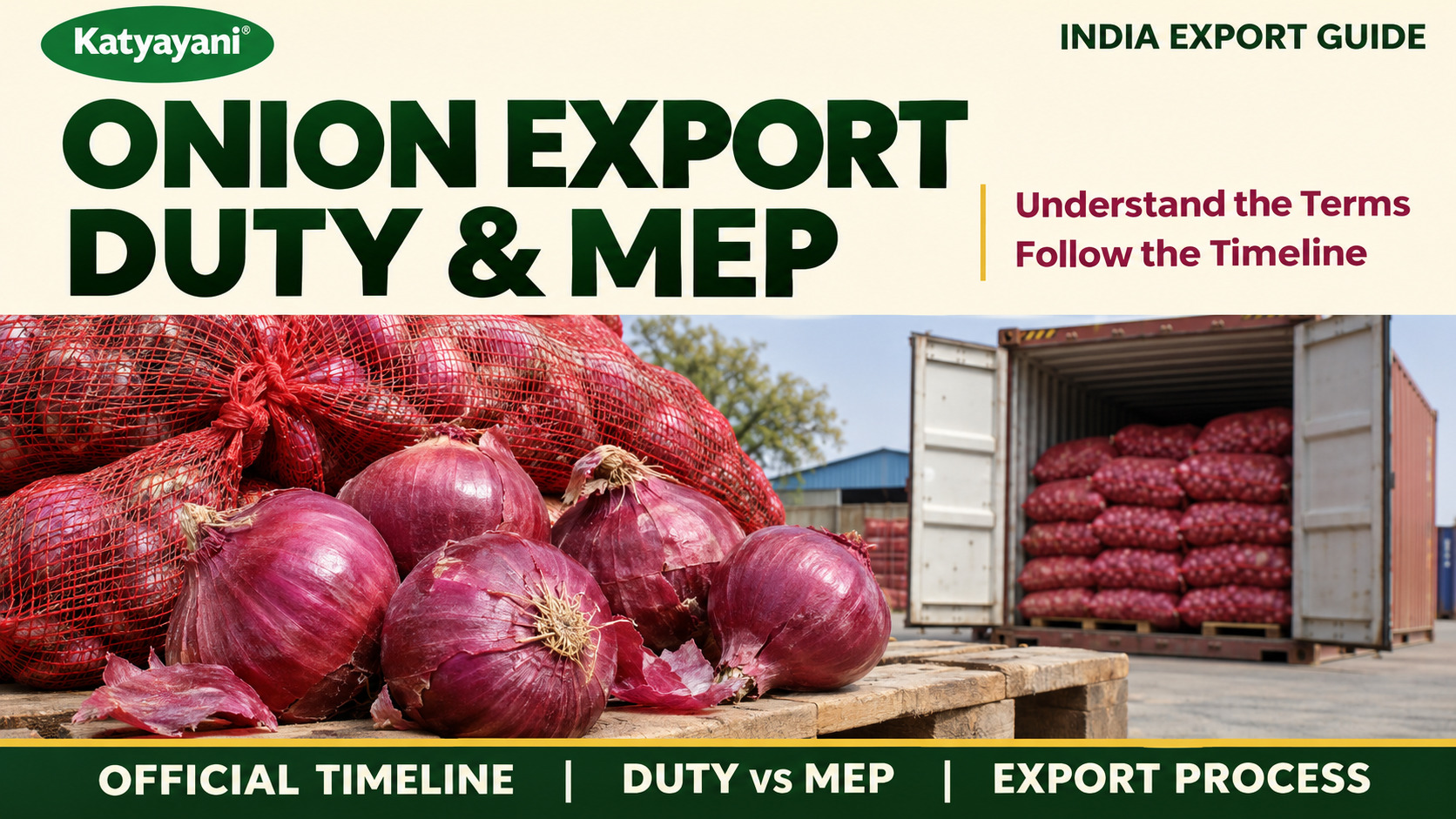
As per PIB of 22 March 2025, the 20% export duty on onion was withdrawn from 1 April 2025, and the minimum export price (MEP) was removed earlier. The 20% duty had applied since 13 September 2024, and before it the duty was 40% when export reopened on 4 May 2024 (PIB, 7 Aug 2024). DGFT Notification 28/2024-25 removed the minimum export price (MEP) of USD 550 per tonne on 13 September 2024. Export was prohibited from 8 December 2023 to 3 May 2024. Duty changes are notified by CBIC (cbic.gov.in) and MEP or ban changes by DGFT (dgft.gov.in).
 15 min
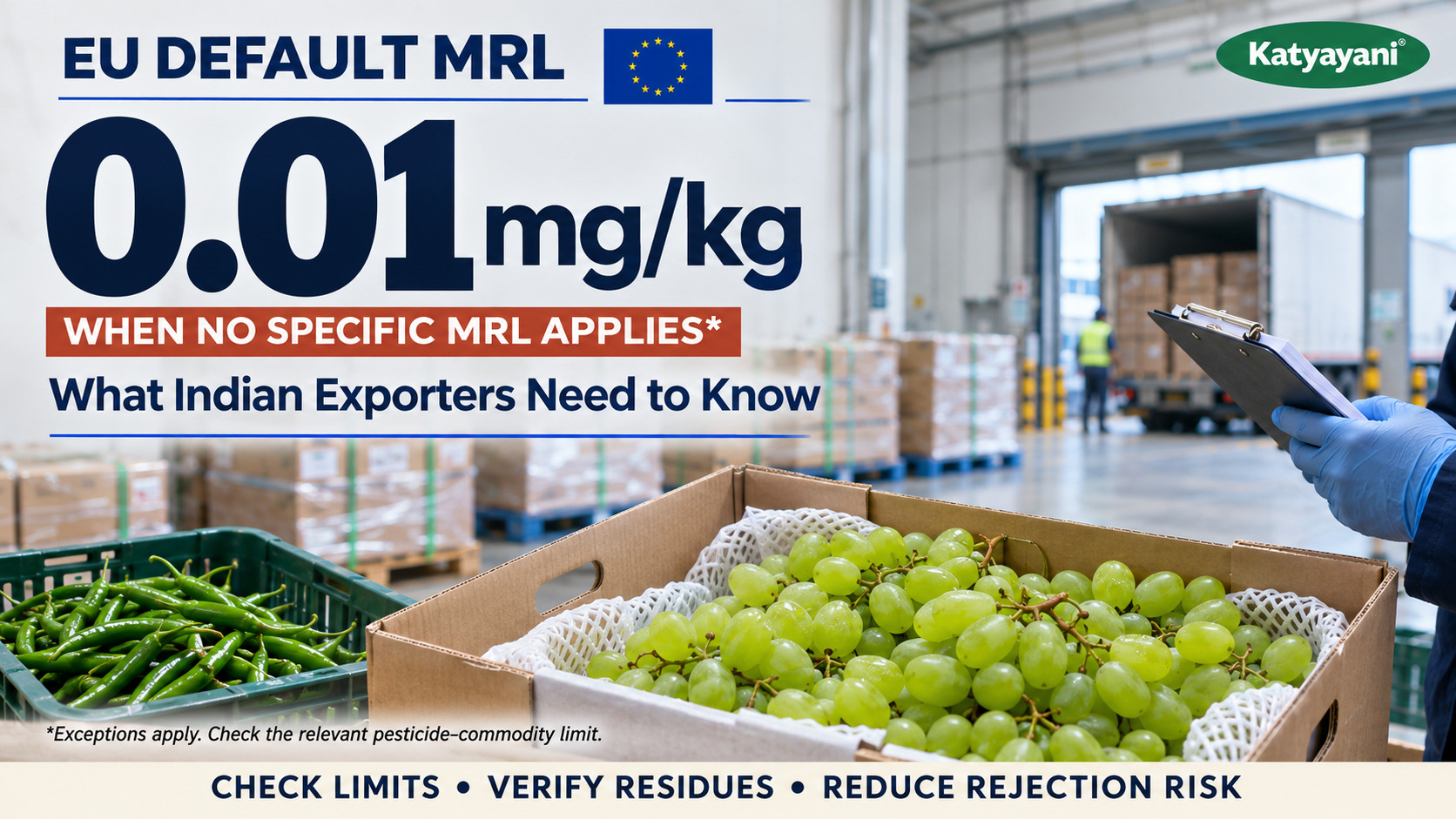
The EU default MRL is 0.01 mg/kg. It applies when EU law has no specific limit for a pesticide on a food or feed, so a pesticide that is not named for your crop is held to this level, which is about the smallest amount a laboratory can measure. In practice, a pesticide with no EU limit for your crop cannot be used on it. A product can be legal under India's CIB&RC label and still fail in the EU. Look up every active ingredient in the EU Pesticides Database before you spray.
 15 min
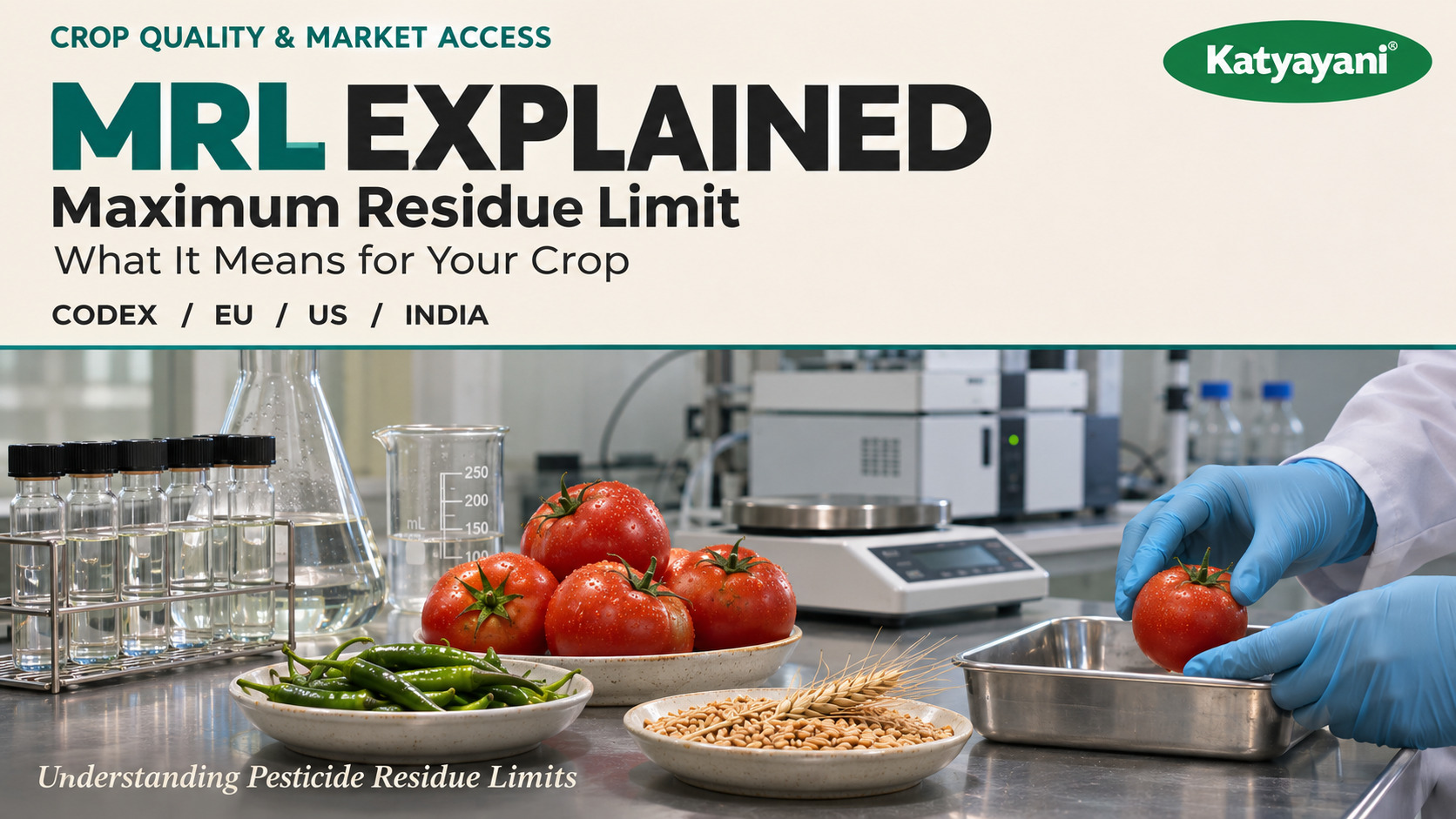
A maximum residue limit (MRL) is the highest amount of a pesticide residue that is legally allowed in or on a food, written in mg/kg. It is worked out from field trials where the pesticide is used exactly as the label says. It is a compliance number, not a line between safe and poisonous. Codex sets the international MRLs, and the EU, the US (where it is called a tolerance) and India each set their own. A crop stays inside the limit when you use a registered product, at the label dose, and wait the full days before harvest.
 14 min
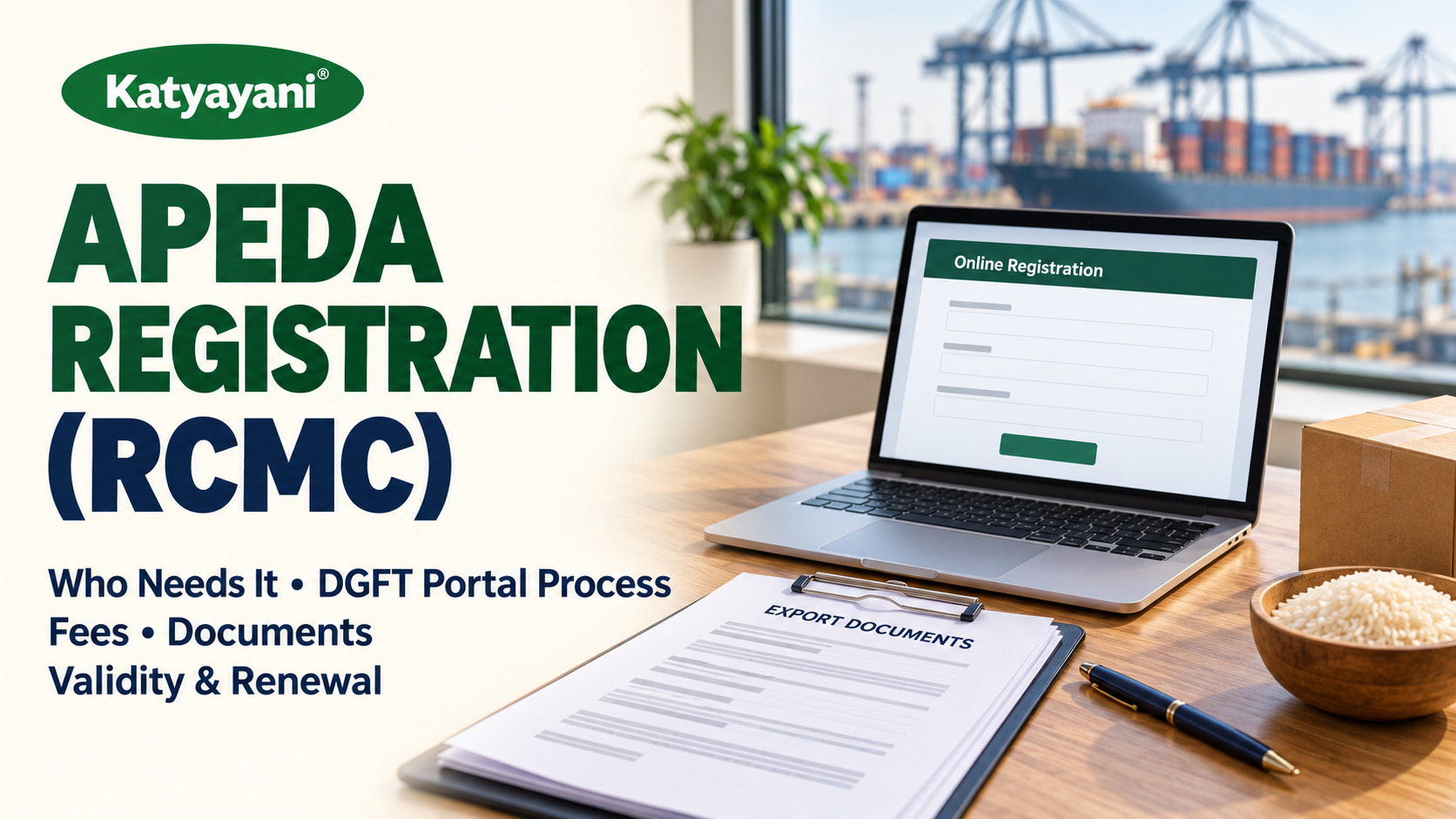
APEDA registration means getting an RCMC (Registration-cum-Membership Certificate) from APEDA if you export any APEDA scheduled product such as fresh fruits and vegetables, cereals, meat, dairy, honey, processed food or floriculture. Since 17 July 2023 you apply online on the DGFT e-RCMC portal after getting an IEC. The fee is Rs 5,000 plus 18 percent GST (Rs 5,900), valid 5 years, renewal also Rs 5,900. A merchant exporter needs the IEC; a manufacturer exporter also needs manufacturing proof such as FSSAI or Udyam. Agrochemicals and fertilisers are not APEDA scheduled products.
 12 min
A letter of credit (LC) is a written promise from the buyer's bank to pay the exporter a stated sum against stipulated documents, within a time limit. Banks deal in documents, not goods, so payment depends on your papers matching the LC (APEDA). Under UCP 600 practice a bank has a maximum of five banking days to decide (ICC). In India, lodge your shipping documents with your AD bank within 21 days of export, and realise the proceeds within nine months (RBI). Read every LC line on the day it arrives, and ask your bank to pre-check your document set.
 17 min
An export food pack carries two sets of rules. India expects the exporter to hold the right FSSAI licence and to check FSSAI and Export Inspection Council requirements for the product. The label content itself is set by the buyer country: EU rules, US FDA rules, Japanese-language labels, or Arabic labels for Saudi Arabia. Wooden pallets need an ISPM 15 mark, organic goods need the correct organic logo, and a barcode helps retail listing. Confirm every artwork with the importer before printing.
 20 min
A spice export business needs an IEC from DGFT, a Spices Board CRES (Certificate of Registration as Exporter of Spices), a GST registration and a yearly GST LUT, plus FSSAI and a unit inspection if you process the spice yourself. India exported 17.34 lakh tonnes of spices worth Rs 39,140 crore (US$ 4.43 billion) in 2025-26, down from 17.99 lakh tonnes and US$ 4.72 billion the year before. The hard part is not the licence. It is passing buyer tests for ethylene oxide, Salmonella, aflatoxin and pesticide residue. Margins on plain whole spices are thin and depend on your own costing, so the costing section below gives a framework you can fill with real quotes.
 12 min
A phytosanitary certificate (phyto) is an official plant-health document for one export consignment. In India it is issued by the Directorate of Plant Protection, Quarantine and Storage (DPPQS) through its Plant Quarantine Stations. Register once as an exporter on the PQMS portal, then apply online before every export (DPPQS FAQ). The consignment is inspected, treated if needed, and the certificate is issued in the ISPM 12 model format (DPPQS). The importing country decides whether you need it. Fees and processing time are not printed on the pages checked, so check PQMS.
 19 min
An IEC (Importer Exporter Code) is a 10-digit number from DGFT that you need before you export, unless you fall in an exempt category such as goods for personal use. Apply online at dgft.gov.in. The government fee is Rs 500, the code is permanent, and a modification costs Rs 200.
 14 min
There is no single biopesticide registration for the world. The EU approves the active substance first and then each member state authorises the product, under Regulation (EC) 1107/2009. The USA registers through the EPA under FIFRA, with a separate biopesticide division and lighter data rules for biochemicals and microbials. Africa has no one regulator: Kenya, South Africa and Nigeria each run their own system, and regional groups such as the East African Community and SADC are still working on shared guidelines. In a published comparison, EU registration of microbial agents took about 1.6 years longer than the US on average. For an Indian exporter, the safe path is to pick one target market, use a local registration partner, and start the dossier and efficacy trials early.
 13 min
To export agrochemicals from India you need an IEC from DGFT, a GST registration with an annual LUT, and a legal product. For the product, either use a pesticide already registered in your name with CIB&RC (no separate export registration is needed) or get an export-only certificate of registration. You also need a manufacturing licence under the Insecticides Act, a safety data sheet, a certificate of analysis, UN-approved packing marked under IMDG rules, and your buyer's own country registration or import permit. Then you raise a commercial invoice and packing list, file the shipping bill through your customs agent and ship. Phytosanitary certificates are normally for plant material, not chemicals. The longest step is usually the buyer country's registration, not Indian paperwork.
 10 min
By 2025 crop protection sales, the five biggest agrochemical companies are Syngenta, Bayer, BASF, Corteva and UPL, in that order, according to an AgroLatam ranking (29 Sep 2026). In India the largest by FY26 revenue is UPL at Rs 51,839 crore, followed in the crop-protection space by PI Industries, Bayer CropScience India and Sharda Cropchem.
