
 15 min read
A maximum residue limit (MRL) is the highest amount of a pesticide residue that is legally allowed in or on a food, written in mg/kg. It is worked out from field trials where the pesticide is used exactly as the label says. It is a compliance number, not a line between safe and poisonous. Codex sets the international MRLs, and the EU, the US (where it is called a tolerance) and India each set their own. A crop stays inside the limit when you use a registered product, at the label dose, and wait the full days before harvest.
What is a maximum residue limit (MRL)?
A maximum residue limit is the highest level of a pesticide residue that the law allows in or on a food or feed. It is written in milligrams of residue per kilogram of produce (mg/kg). The European Commission defines it as the highest amount of a pesticide residue legally permitted on a food or feed product, and adds that the same MRLs apply to products grown in the EU and to imports.
Picture a tomato grower who sprays on Monday and picks on Saturday. A lab can wash, crush and test that tomato and say how many milligrams of the spray chemical are left in each kilogram. The MRL is the legal ceiling for that number. If the lab figure is at or below the ceiling, the lot passes. If it is above, the lot is a violation.
The word "residue" covers more than the spray itself. The EFSA report explains that a residue is the measurable amount of an active substance, plus related metabolites and breakdown products, found on harvested crops or in foods of animal origin. Each MRL comes with a residue definition that says exactly which compounds the lab must add up.
MRL stands for maximum residue limit in the Codex and Indian texts and for maximum residue level in EU texts. Both mean the same number. In the United States the word is tolerance.
Is an MRL the same as a safety limit?
No. An MRL is a compliance number that shows whether a pesticide was used the way the label allows. The health safety check is a separate step: scientists compare the daily intake of the residue with health-based values called the acceptable daily intake (ADI) and the acute reference dose (ARfD). A product is cleared only when that intake stays well below them.
The FSSAI guidance document says it plainly. The supervised trial data give three numbers: the median residue (STMR), the highest residue (HR) and the MRL. The STMR and HR go into the dietary risk assessment. The MRL is used to compare monitoring data and decide whether the pesticide was used in line with the label, and for enforcement.
The FAO page on JMPR splits the work in the same way. An FAO panel reviews residue field trials and processing studies to estimate residue levels. A separate WHO group reviews the toxicology and estimates the ADI and the ARfD. Both then feed the Codex process.
| Term | What it tells you | Who uses it |
|---|---|---|
| MRL | Highest residue legally allowed in or on a food | Inspectors, labs, buyers, exporters |
| ADI (acceptable daily intake) | Amount a person can take daily over a lifetime without harm | Risk assessors (WHO group in JMPR, FSSAI panel) |
| ARfD (acute reference dose) | Amount that can be taken in one meal or one day without harm | Risk assessors |
| STMR (supervised trials median residue) | The middle residue value from the field trials, used to estimate typical intake | Risk assessors |
| HR (highest residue) | The highest residue found in the trials, used to estimate high-end intake | Risk assessors |
| GAP (good agricultural practice) | The approved dose, timing and method that leaves the least residue while still controlling the pest | Regulators, trial designers, farmers |
So when a lot exceeds the MRL, the first meaning is "the pesticide was not used as approved, or the wrong pesticide was used". It does not automatically mean the food is poison. It does mean the lot cannot legally be sold in that market, and that is the part that hurts a grower.
How is an MRL worked out from field trials?
Scientists spray a crop exactly as the approved label allows, pick samples at set days after the last spray, and measure the residue in a lab. Trials are repeated in many locations. A statistical tool then turns the results into the MRL, which is set high enough to cover the residues expected when the label is followed.
The FSSAI guidance gives the Indian rules. Good agricultural practice means the nationally approved dose, with the recommended amount of water and equipment, applied so that the residue left is the smallest that still controls the pest. In India the GAP is approved by CIB&RC. The guidance adds that a residue above the smallest amount practicable, caused by an overdose or a waiting period that is too short, is against the idea of GAP.
| Trial rule | What the FSSAI guidance says |
|---|---|
| Number of trials | At least 8 independent trials, and ideally at least 15 for major crops, because MRL estimates get less reliable with fewer data points |
| Where | In the agro-climatic zones where the crop is mainly grown, following the state package of practices |
| Plot size | At least 20 square metres for row crops, four trees for orchard crops and eight vines for vineyard crops |
| Doses | CIB&RC asks for data at the recommended dose and at double the recommended dose |
| Sampling days | Samples are taken from day 0 (about 2 hours after the last spray) until residues fall below the limit of quantification |
| Calculation | The OECD MRL calculator turns the trial data into STMR, HR and the MRL; it works better with 10 to 15 data sets than with 4 to 6 |
| Check after calculation | The MRL stands only if the dietary risk check passes, and fresh trials are needed if the approved GAP changes |
Notice the last row. The MRL is tied to the approved use. If the approved dose, number of sprays or waiting period changes, the old trial data no longer apply and new trials are required. This is why a limit can change when a label changes.
What does a real MRL calculation look like? The cypermethrin on cauliflower example
The FSSAI guidance walks through one case. ICAR's network on pesticide residues sprayed cauliflower with cypermethrin at 50 g of active ingredient per hectare (and 100 g at the double dose) in 10 locations, then measured residues from day 0 to day 30. The calculated MRL was 0.7 mg/kg with a waiting period of 3 days.
| Days after last spray | Residue at one location (PAU Ludhiana), mg/kg | What it shows |
|---|---|---|
| 0 (2 hours after spraying) | 0.40 | Highest, because the spray has just dried on the curd |
| 1 | 0.26 | Falling fast |
| 3 | 0.17 | The proposed waiting period |
| 5 | 0.06 | Close to the detection floor |
| 7 | Below 0.05 (BDL) | Too small to measure at this lab |
The guidance marks anything under 0.05 mg/kg in that table as below the determination level. The same table shows the spread between sites. At IIHR Bangalore the day-3 residue was 0.44 mg/kg, and at IARI New Delhi it was 0.05 mg/kg. A limit has to cover that spread, and that is why trials are run in many places.
Then comes the health check. The guidance multiplies the median residue (0.7 mg/kg) by the average cauliflower intake of 0.078 kg a day, giving about 0.055 mg of residue per person per day. It compares that with the ADI of cypermethrin, 0.05 mg per kg of body weight a day, multiplied by a reference body weight of 60 kg, which gives 3 mg per person a day. By this simple arithmetic the cauliflower intake uses under 2% of the allowed daily intake. The document prints the share as 0.03% in one line and as leaving 98.2% of room in the next, so the percentage is shown here as my own calculation from its inputs.
The guidance also states the working rule: the estimated intake from all approved uses should stay at or below 80% of the ADI, leaving the rest for other sources such as water and unapproved uses. If it goes above, the label claims must be changed or dropped until it comes back under 80%.
Who sets MRLs at world level? How Codex works
The Codex Alimentarius Commission (CAC), a joint FAO and WHO body, adopts the international MRLs, which Codex also calls CXLs. A Codex committee of governments, the CCPR, proposes them, using scientific advice from JMPR. Codex MRLs are meant for food moving in international trade, and countries are free to use them or set their own.
The FAO JMPR page describes the chain. JMPR is an expert body run jointly by FAO and WHO. It proposes MRLs. The CCPR considers those proposals and tries to reach agreement among governments. The CCPR then passes its recommendation to the CAC, which adopts it as a Codex MRL. The committee also sets the priority list of pesticides JMPR should study next.
The 2022 Codex Secretariat slides to the WTO give a sense of the pace. A July 2021 session of the CCPR dealt with the backlog from two JMPR meetings held in 2019. The outcome was 500 MRLs for different pesticide and commodity combinations adopted by the CAC in 2021, and 6 new compounds added to the Codex list. The same slides list the committee's own challenges, including data from developing countries and the fact that JMPR and the European Food Safety Authority use different risk assessment policies.
JMPR works in sessions. In its September 2023 meeting in Washington it evaluated 35 pesticides and recommended maximum residue levels for adoption as MRLs, along with STMR and HR values for dietary exposure. A star after a value in its tables means the level is at or about the limit of quantification, the smallest amount the lab method can measure.
Why does this matter to a farmer? Because many countries, including India for spices, fall back on a Codex value when they have no limit of their own. A Codex MRL is the common reference point when buyer and seller sit in different countries.
How does the EU set and use MRLs?
The EU fixes MRLs for food and feed in Regulation (EC) 396/2005. A company, farmer or importer sends residue trial data to an EU Member State, which sends its evaluation to EFSA. EFSA does the risk assessment and the European Commission drafts the rule. Member States then vote on it. The same limits apply to EU produce and to imports.
The Commission Q&A page lists what the application must contain: details of the good agricultural practice, results of residue field trials and toxicology data. EFSA checks the risk for all consumer groups, including babies, children and vegetarians. If no health risk is found it recommends an MRL.
For a grower outside the EU the key tool is the import tolerance. It is an EU MRL set on the basis of a pesticide use in a non-EU country, and the same criteria and process apply as for a use inside the EU. The Commission says the evaluation takes about 24 months on average. A long wait is why an exporter who plans a new spray for a European crop has to think ahead.
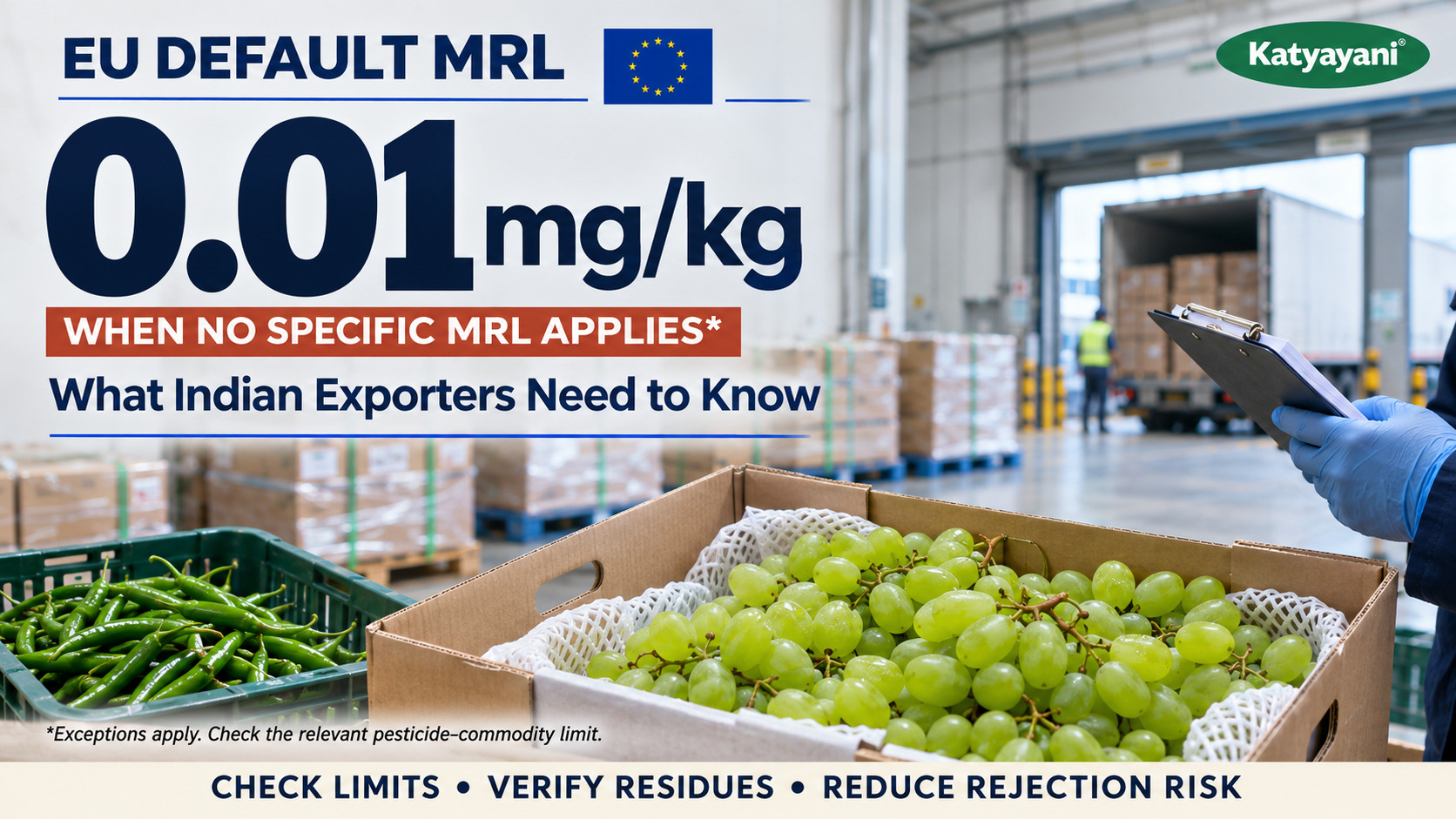
The EFSA 2020 report puts numbers on the system. EU-harmonised MRLs exist for more than 1,300 pesticides across 378 food products or food groups, and a default MRL of 0.01 mg/kg applies to nearly 690 of those pesticides that are not specifically listed. The Commission page adds one rule worth remembering: where no specific MRL is set, the default level of 0.01 mg/kg applies. A separate sibling post in this set covers the EU default value in depth.
Limits are not fixed for ever. The Commission says it is running a systematic review of existing MRLs under Article 12 of the regulation, and EFSA publishes a quarterly work programme of the substances under review. A limit that helped your crop last season can be lowered or removed in the next.
How does the US set tolerances?
In the United States the MRL is called a tolerance. The EPA sets a tolerance for each crop use of a pesticide after a risk assessment, and it must find a reasonable certainty that no harm will result from aggregate exposure. The FDA enforces tolerances for most foods, and the USDA enforces them for meat, poultry and some egg products.
The EPA page on tolerances lists what the risk assessment looks at: aggregate exposure from diet, drinking water and home use, the combined effect of pesticides that act in the same way, the extra sensitivity of infants and children, and endocrine effects. The tolerance for a pesticide is written crop by crop in the federal regulations.
One rule from the federal text, 40 CFR 180.1 is useful for anyone who sells processed food. If a raw crop carries a residue within its tolerance and is made into a processed food, the processed food is not treated as unsafe on that ground alone, as long as the residue has been removed as far as good manufacturing practice allows and the level in the processed food is not higher than the tolerance on the raw crop. Raw crops in that text include fresh fruit and vegetables, grains, nuts, eggs, raw milk and meat. Cooked, frozen, dried or milled foods count as processed.
How does India set MRLs? CIB&RC, ICAR and FSSAI each have a part
In India three bodies share the job. The CIB&RC registers a pesticide under the Insecticides Act, 1968 and approves the crops, doses and waiting periods. ICAR and the state agricultural universities run the residue trials on those approved uses. FSSAI then fixes the MRL after checking dietary exposure, and only after the registration committee has approved the use.
That chain comes straight from the FSSAI guidance document. It also tells the history: India began prescribing tolerance limits in the 1970s, under the Prevention of Food Adulteration Rules, 1955, using Indian data and values taken from international standards. After the Food Safety and Standards Act of 2006, FSSAI took over the job and wrote the written procedure.
The limits themselves sit in the FSSAI Contaminants, Toxins and Residues Regulations, in regulation 2.3.1. It defines "insecticide" by the Insecticides Act and says no insecticide shall be used directly on articles of food, with one exception for registered fumigants. It then lists the MRL for each insecticide and food in a table that covers 213 insecticides in the 2020 version. The table ends with a note: a tolerance limit of 0.01 mg/kg applies for pesticides for which no MRL has been fixed.
The default does not cover everything. The USDA FAS report says FSSAI clarified on 11 January 2021 that the 0.01 mg/kg default applies to agricultural commodities and their physically processed foods only, and not to thermally or chemically processed foods.
Spices have their own rule. The FSSAI order of 8 April 2024 says MRLs for spices are fixed from CIB&RC field trial data and, until that data is available, from the national monitoring scheme run by the Department of Agriculture and Farmers Welfare. If a pesticide is registered with CIB&RC and has MRLs for other foods, the Codex MRL applies to spices, and if Codex has none then 0.1 mg/kg applies. If a pesticide is not registered with CIB&RC, 0.1 mg/kg applies to spices and culinary herbs. The order replaced two earlier ones of 21 April 2022 and 30 August 2022.
Codex, EU, US and India: how do the four systems compare?
All four use field trials, a health check and a number in mg/kg. They differ in who decides, what happens when no limit exists, and what the number is called. Codex and the EU publish crop-by-crop lists, the US writes tolerances into federal rules, and India lists limits in an FSSAI table with a default of 0.01 mg/kg.
| Point | Codex | European Union | United States | India |
|---|---|---|---|---|
| Name used | MRL (also CXL) | MRL (maximum residue level) | Tolerance | MRL (maximum residue limit) |
| Who decides | Codex Alimentarius Commission, on CCPR and JMPR advice | European Commission, after EFSA risk assessment and a Member State vote | US EPA | FSSAI, after CIB&RC approves the use |
| Legal basis (as opened) | Codex standards for international trade | Regulation (EC) 396/2005 | Federal tolerance rules, 40 CFR part 180 | FSSAI Contaminants, Toxins and Residues Regulations 2011, regulation 2.3.1 |
| If no limit is listed | No Codex MRL exists; countries decide | Default of 0.01 mg/kg | Not covered by the pages opened | Default of 0.01 mg/kg; spices 0.1 mg/kg under the 2024 order |
| Who enforces | Not an enforcement body | Member States run controls and report to EFSA | FDA, and USDA for meat, poultry and some egg products | FSSAI and state food safety officers |
| Import route for a foreign use | Not applicable | Import tolerance, about 24 months on average | Not covered by the pages opened | Not covered by the pages opened |
For the registration side of the same story, the live post on pesticide registration by country compares how the EU, the US, Brazil, India and Africa approve a product. This post stays on the residue number that follows the approval.
Why can a crop pass in India and fail in Europe?
Because each country sets its own limit from its own approved uses and diets. A spray that is legal in India may have no import tolerance in the EU, or a lower limit there. Overdose, a short waiting period or a product the EU does not approve are the usual reasons a lot fails.
Here is a real pair of numbers. The APEDA grape procedure of 17 February 2026 lists azoxystrobin 23 SC on grapes with an EU MRL of 3.0 mg/kg. The FSSAI table of 2020 lists azoxystrobin on grapes at 2 mg/kg. So India's own limit was lower than the EU's for that pair in those documents. The point is not which is stricter overall. The point is that you cannot assume the two lists match for any crop and chemical.
The EFSA report lists why third-country samples failed in 2020. Some carried a pesticide that is not approved in the EU and has no import tolerance, for example tricyclazole in rice. Some had an approved pesticide used above the recommended dose. In one case a breakdown product, omethoate from dimethoate in chilli peppers, was the problem. EFSA also names a sesame seed case where a treatment meant to cut Salmonella left ethylene oxide residues.
| EU 2020 sample group (EFSA) | Samples | Above the MRL | Non-compliant after uncertainty |
|---|---|---|---|
| All samples | 88,141 | 5.1% | 3.6% |
| From the reporting EU countries | 59,026 | 1.6% | 0.9% |
| From third countries | 25,014 | 3.3% | 2.6% |
Two cautions on that table. First, the 2020 figures are older; the Commission page lists 3.7% of samples above the MRL and 2.2% non-compliant for its 2022 data. Second, EFSA notes that its high figures for items such as cumin seed (48% above the MRL) come from risk-based sampling aimed at problem products, so they do not describe the average EU market. Even so, for a spice exporter they show where inspectors look.
What does an MRL table look like for a real crop?
An MRL table lists the pesticide, the food and the limit in mg/kg. The same pesticide can have a different limit for each food, and fresh and dried forms of one crop can carry very different numbers because drying concentrates the residue. You must always read the row for your exact crop and form.
The FSSAI compendium of 2020 gives clear examples for chilli. These are examples of how a table reads. FSSAI has amended limits since, so do not use them as today's legal values.
| Pesticide (FSSAI table, 2020 version) | Fresh chilli, mg/kg | Dried chilli, mg/kg | Other rows in the same entry |
|---|---|---|---|
| Acetamiprid | 2 | 20 | Rice 0.01, okra 0.1, cabbage 0.7 |
| Carbendazim | 5 | 50 | Citrus (orange) 15, wheat 0.05, rice 2.0 |
Dried chilli is allowed ten times the fresh figure in both rows. Drying removes water, so each kilogram of dried chilli holds more residue than a kilogram of fresh fruit. The FSSAI guidance has a full section on processing factors and dehydration factors for this reason. For a chilli grower the lesson is practical: a lot that tests fine fresh can fail once it is dried if the residue was high to begin with.
Look at the other rows too. Acetamiprid is allowed at 2 mg/kg on chilli but at 0.01 mg/kg on rice. The difference reflects the approved use. Where a pesticide is not approved for a crop, the limit drops to the default or the smallest measurable amount.
How does an MRL link to the label dose and the waiting period?
The MRL is the outcome and the label is the recipe. The dose, number of sprays and waiting period (pre-harvest interval, PHI) printed on the label are the exact conditions under which the trials produced the limit. Follow all three and the residue at picking should fall within the MRL. Skip one and the number can go over.
APEDA's grape procedure puts the two side by side in its list of chemicals with a CIB&RC label claim for grapes. The table below copies five rows from it. The notice also says the list is advisory and that compliance with the EU MRL rests with the growers.
| Chemical on grapes (APEDA list, Annexure 5) | Label dose | EU MRL, mg/kg | Pre-harvest interval, days |
|---|---|---|---|
| Azoxystrobin 23 SC | 494 mL per hectare | 3.0 | 7 |
| Captan 50% WP | 2500 g per hectare | 0.03 | 70 |
| Cyazofamid 34.5% SC | 200 mL per hectare | 2.0 | 30 |
| Amisulbrom 17.7% SC | 375 mL per hectare | 0.5 | 59 |
| Mancozeb 75 WP | 1.5 to 2.0 g per litre | 5.0 | 66 |
Read the table the way a grower would. Captan has a very low EU limit of 0.03 mg/kg and the longest waiting period on the list, 70 days. Azoxystrobin has a higher limit and a 7 day wait. Two products with the same crop can have waiting periods ten times apart. The days are not decoration. They are what lets the residue fall below the limit. A sibling post in this set explains the pre-harvest interval in detail; here it is enough to know it belongs to the MRL.
The FSSAI guidance warns about the same thing from the regulator's side. In its definition of GAP it says that residues above the smallest practicable amount, caused by unnecessary overdose or by an unnecessarily short waiting period, are contrary to good agricultural practice.
How do exporters stay within an MRL? The grape and spice examples
They control the farm, not just the factory. Under APEDA's grape plan, farms and plots are registered, spray records are kept, a recognised lab samples and tests the grapes, and the certificate of analysis is issued through the GrapeNet system within six days of sampling. If a result exceeds the MRL the lab must inform the authorities within 24 hours.
The APEDA notice of 17 February 2026 sets the objective as a system to control residues in table grapes at farm and plot level, and also to monitor chemical residues in soil and water at farms and pack houses. The list of chemicals to be monitored each season is taken from the EU pesticides database. For natural products with no EU MRL, the notice says the limit is set at the limit of quantification of a method validated at the national referral laboratory.
The grower's declaration in the same notice carries a rule you can copy on any farm. After a sample is drawn for residue testing, no pesticide is to be sprayed or applied until the lot is cleared. In other words, the last spray date is a fixed point, and nothing happens between sampling and shipment.
Spices work differently but follow the same logic. The Spices Board circular of 5 June 2025 says the EU was testing cumin from India for pesticide residues at a frequency of 30% under EU Regulation 2024/3153. From 16 June 2025, testing and Spices Board clearance became mandatory for exporters whose cumin consignments had been notified by the EU or UK for MRL non-compliance. A consignment that does not meet the EU residue standards does not get the cleared report and is not permitted to export. The Board also offers voluntary testing so that exporters can check a lot before they ship.
If you export, the live posts on starting a spice export business, APEDA registration and exporting agrochemicals from India cover the licences and documents around this. Note that the APEDA post says agrochemicals are not APEDA scheduled products, so the residue rules here apply to your fresh produce and spices, not to the sprays you sell.
What happens when a lot goes above the MRL?
The lot cannot legally be sold in that market. In the EU, Member States run official controls and report the results, and a sample counts as non-compliant when it is above the MRL even after allowing for measurement uncertainty. For exporters, repeated failures lead to heavier testing of the whole product line, as the cumin case shows.
EFSA explains why the uncertainty step exists. A lab result is never exact, so the system separates samples that are above the MRL from samples that are clearly above it after the measurement error is counted. In the 2020 EU data, 5.1% were above the limit and 3.6% were non-compliant in that stricter sense. EFSA reports that the dietary exposure to pesticides with health-based guidance values was unlikely to pose a risk to EU consumers, and that where exposure was calculated to exceed a guidance value, authorities took corrective steps.
There is also a quiet statistical fact that explains why even careful growers sometimes fail. EFSA says the MRL is usually set to cover at least the upper confidence interval of the 95th percentile of the expected residue distribution. A figure of around 1% exceedance is therefore expected even when good agricultural practice is fully respected. That is the system working as designed, and it is the reason your own margin should be wide: skip the shortest allowed waiting period if you can.
What should a farmer do in the field to stay within the MRL?
Do four things every time you spray: use only a product registered for that exact crop, use the label dose and water volume, do not spray inside the label waiting period, and write down the date, product and dose. These four habits match the conditions behind every MRL and are what buyers and labs ask to see.
- Pick a product whose label names your crop. The EFSA list of third-country failures includes pesticides with no EU import tolerance, such as chlorpyrifos in sweet peppers and carbendazim in rice.
- Measure the dose. Overdose is one of the three reasons EFSA gives for failures in third-country samples, with the example of acetamiprid on sweet peppers used above the recommended dose.
- Count the waiting days from the last spray to the picking day, not to the day you load the truck. If you pick in stages, as with chillies, tomatoes or okra, the count applies to each picking.
- Keep a spray diary: date, product, dose, water volume and crop stage. APEDA's grape plan is built on exactly this record, and the grower's declaration depends on it.
- Do not spray between sampling and shipment. The APEDA declaration says no pesticide may be sprayed or applied after the sample is drawn.
- Sell what the buyer's list allows. If you supply an exporter, ask for the list of chemicals the buyer monitors for your crop. APEDA publishes one for grapes each season, taken from the EU database.
Also read the pack label before you buy. The live post on how to identify fake pesticides and fertilisers lists the label details to look for, including the maker, registration number, batch and expiry. A fake or misbranded product has no trial data behind it at all, so no MRL can protect you.
Do organic and biological inputs have an MRL?
Organic produce has no separate MRL. In the EU, the same MRLs apply to organic and conventional food, and organic rules restrict which products a farmer may use. Natural products with no listed limit can fall to the limit of quantification. Organic samples show fewer exceedances, but they are not zero.
If you use biological sprays, microbial products such as Beauveria, Metarhizium and Bt are listed in the bio-pesticides collection. The same rule applies to them: read the pack for its waiting period.
The EFSA report is clear on the rule: no specific MRLs are established for organic products, and the limits of Regulation 396/2005 apply equally to organic and conventional food. In its 2020 data the trends for exceedance and quantification were generally lower in organic food. For animal products, samples from organic production had a higher quantification rate (16% against 7%), and the exceedances were mostly old persistent pesticides such as DDT. EFSA also reports that pesticides not authorised in organic farming were found sporadically in crops labelled organic, including chlorpyrifos and lambda-cyhalothrin.
The Codex slides mention work on guidelines for low-risk compounds, including biopesticides, that may be excepted from Codex MRLs. The APEDA grape list handles natural products in the same spirit, setting their limit at the method's limit of quantification when no EU MRL exists. For the farm side of organic export, see the live post on NPOP organic certification, which says certification includes sampling for pesticide residues where required. For product types, biopesticides: types, examples and limits explains what they are. A biological label still needs reading. The rule that matters is the one printed on the label for your crop.
Does a phytosanitary certificate prove the produce meets the MRL?
No. A phytosanitary certificate says the consignment was inspected and is free from quarantine pests. It does not cover pesticide residues. Residue compliance is proved by a separate lab report from a recognised lab, which is why exporters need both documents for most fresh produce.
The live post on the phytosanitary certificate in India states the point: the certificate is not a food safety, residue or quality certificate, and residue or quality reports are separate documents. APEDA's grape notice shows the two running side by side. The residue analysis certificate is issued through GrapeNet by the lab, and the same notice tells the lab to inform the phytosanitary certificate issuing authority if a result exceeds the MRL.
For label text, shelf life and food label rules for export packs, see packaging and labelling rules for food exports, which notes that residue limits and approved pesticides differ by destination.
Where can you look up an MRL yourself?
Use the source for the market you sell into. For India, the FSSAI Contaminants, Toxins and Residues Regulations list limits in regulation 2.3.1. For the EU, the Commission's pesticides database lists the MRL for each pesticide and food. For the US, tolerances are written in the federal regulations. Codex keeps its own MRL database.
| Market | Where the limit is published | What to check |
|---|---|---|
| India | FSSAI Contaminants, Toxins and Residues Regulations, regulation 2.3.1, with later amendments | Your exact food (fresh or dried), the pesticide name, and whether FSSAI has amended the row |
| India, spices | FSSAI order of 8 April 2024 | Whether the pesticide is registered with CIB&RC and whether Codex has a limit |
| European Union | EU pesticides database on the Commission site, linked from the Commission MRL page | The product group, because limits are set for groups, and whether the default 0.01 mg/kg applies |
| United States | Pesticide tolerances in 40 CFR part 180, reached from the EPA tolerance pages | Raw crop versus processed food, since processing is treated differently |
| International trade | Codex pesticide residue MRL database | Whether a Codex limit exists and whether your buyer accepts it |
When you find a number, write down the date you read it. Limits change. The Commission says it is reviewing existing EU MRLs under Article 12, and FSSAI has amended its table since 2020. A limit you copied last year is a draft, not a promise.
What are the most common mistakes and myths about MRLs?
The usual mistakes are treating the MRL as a safety line, assuming one country's limit works in another, ignoring the drying factor, and picking too close to the last spray. Each one comes from a gap between the rule and the field. The facts above correct all of them.
| Myth or mistake | What the sources say |
|---|---|
| "If it is under the MRL it is safe and if it is over it is poison." | The MRL is a compliance number. Health is judged against the ADI and ARfD (FSSAI guidance, FAO JMPR page). |
| "A spray approved in India is fine anywhere." | The EU and other markets set their own limits. EFSA lists pesticides without an import tolerance as a main reason for third-country failures. |
| "No MRL listed means no limit." | In the EU and in India the default of 0.01 mg/kg applies (Commission; FSSAI compendium), with the 0.1 mg/kg rule for spices in India. |
| "Dry chilli and fresh chilli have the same limit." | In the FSSAI 2020 table dried chilli is allowed ten times the fresh figure for acetamiprid and for carbendazim. |
| "Organic means no residue rules." | The same MRLs apply to organic food in the EU (EFSA). |
| "A phytosanitary certificate covers residues." | It does not; residue reports are separate documents. |
| "A good farmer never fails a test." | EFSA says about 1% exceedance is expected even with good practice, so keep a margin. |
One last practical point. The numbers in this guide are mostly mg/kg values from published tables. They show how the system works. They are not a spray schedule for your farm, and no table in a blog replaces the current label of the product you hold in your hand.
Conclusion
A maximum residue limit is the legal ceiling for a pesticide residue on food, built from field trials that follow the label to the letter. Codex, the EU, the US and India each set their own number from their own approved uses, so a crop can pass in one market and fail in another. You stay inside the limit by using a product registered for your crop, at the label dose, with the full waiting days before picking, and by writing it all down.


Leave a Comment