
 15 min read
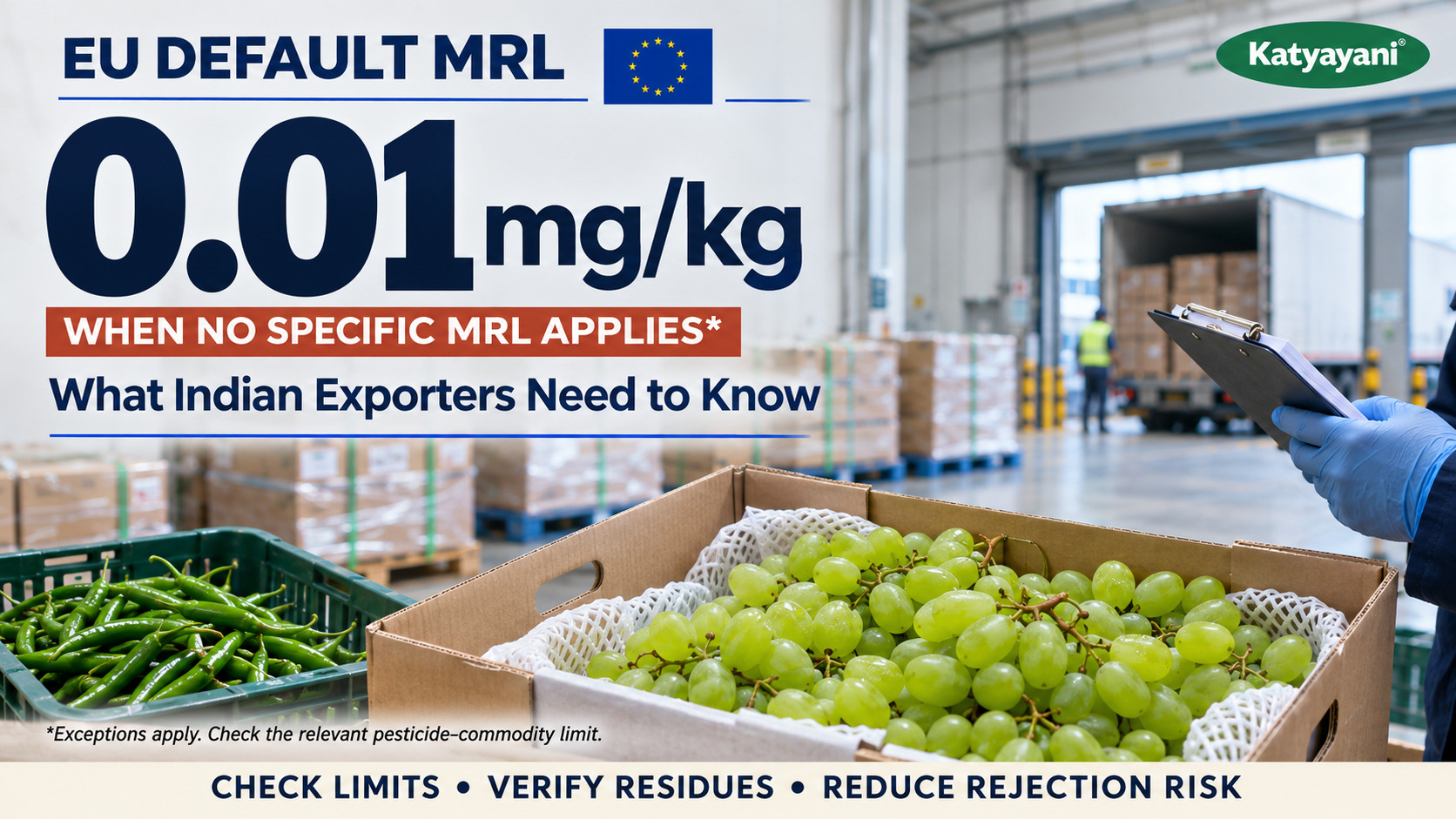
The EU default MRL is 0.01 mg/kg. It applies when EU law has no specific limit for a pesticide on a food or feed, so a pesticide that is not named for your crop is held to this level, which is about the smallest amount a laboratory can measure. In practice, a pesticide with no EU limit for your crop cannot be used on it. A product can be legal under India's CIB&RC label and still fail in the EU. Look up every active ingredient in the EU Pesticides Database before you spray.
What is the EU default MRL for pesticides, and what does 0.01 mg/kg mean?
When EU law has no specific limit for a pesticide on a given food or feed, a default of 0.01 mg/kg applies. The European Commission describes this as a general default, and AGRINFO adds that it is generally the limit of determination, the lowest level a laboratory can measure. For an exporter it works like a ban.
The Commission questions and answers page states the rule in one line: where Regulation (EC) 396/2005 has no specific MRL for a given active substance on a given product, a default level of 0.01 mg/kg applies. The page says this approach protects consumers and gives legal certainty. The same limits apply whether the food was grown in Spain or in Punjab.
This post starts from that rule. If you want the basics of what an MRL is and how Codex, the EU, the US and India set theirs, read the first post of this series, the maximum residue limit explainer. Here the question is narrower: what does the default do to your crop, and what do you do about it?
How does the default rule work in EU law?
The default sits in Article 18(1)(b) of Regulation 396/2005. If a pesticide is not named for a crop, or the EU has refused to approve the substance and cut its limits to the analytical floor, the value in Annex V applies, usually 0.01 mg/kg. The limit is then checked in the lab like any other.
You can see the mechanism written out in the Official Journal. In the recitals of Regulation 2017/983 on tricyclazole, the Commission says that because the active substance was not approved, its MRLs must be set at the limit of determination under Article 18, and that Article 18(1)(b) requires default values to be listed in Annex V. The Annex then adds a tricyclazole column with 0.01 for product groups, marked with an asterisk, and the legend says the asterisk shows the analytical limit of determination.
AGRINFO describes the same logic from the exporter side in its guide to EU MRLs. Where there is no EU MRL, the limit is set at the limit of determination or at the 0.01 default, and in most cases the substance then cannot be used on crops exported to the EU. Use may still work if residues stay below what a lab can detect, but that is a risky plan.
| Situation | Limit that applies | Where you see it |
|---|---|---|
| The pesticide has a specific EU MRL for your crop | That MRL | EU Pesticides Database, searched by crop or by pesticide |
| The pesticide is not named for your crop | Default 0.01 mg/kg | Same database, shown as the default or the limit of determination |
| The EU did not approve the substance and cut its MRLs to the floor | Limit of determination, often 0.01 mg/kg (shown with an asterisk in Annex V) | Annex V of the regulation and the database |
| A lower MRL has been adopted but its start date has not arrived | Still the old limit until the date | The database also shows MRLs adopted but not yet applicable |
The Commission legislation page adds that MRLs apply to 315 fresh products and to the same products after processing. So the rule follows the crop into its dried, ground or pressed forms.
How small is 0.01 mg/kg in a real consignment?
It is 0.01 milligrams in each kilogram of food, which is 0.01 parts per million or 10 parts per billion. A 25 kg bag at the limit holds at most 0.25 mg of residue, and a 20-tonne container holds 200 mg in total. That is why spray drift and old residues can matter.
These are simple arithmetic examples, not figures from a source. They show the scale. APEDA's grape notice itself talks about traces of chemicals left by earlier use of the land, so a trace does not have to come from your own spray this season. If the lab looks for that pesticide and finds it, the number is the number.
Laboratories do not all have the same floor. In the recitals of Regulation 2017/983 the Commission says EU reference laboratories concluded that technical progress allows lower limits of determination for some products. So the default is not one frozen number for every pesticide and crop. It is the lowest level the method can reliably measure, and 0.01 mg/kg is the usual value.
Why can a pesticide be legal in India and still fail in the EU?
In India the Central Insecticides Board and Registration Committee (CIB&RC) registers a pesticide with label claims for named crops. The EU approves the active substance on its own and then sets a residue limit for each crop. A label claim in India says nothing about the EU limit, so you must check both.
APEDA says this plainly in its export procedure for grapes. The notice allows farmers to use chemicals registered by CIB&RC, and then adds that the responsibility for compliance with the EU MRL rests with the grower. Its list of chemicals with a CIB&RC label claim for grapes, revised on 3 November 2025, prints the EU MRL and the pre-harvest interval beside every chemical. If the label were enough, those columns would not be needed.
The registration side is covered in the live post on pesticide registration by country, which compares the EU two-step system with India. For biological products, the live post on biopesticide registration in the EU, US and Africa explains how the EU treats them as active substances under the same regulation as chemicals.
One crop, many limits: what does the APEDA grape table show?
The table shows that EU limits for one crop run from 0.01 to 50 mg/kg depending on the chemical, and waiting periods run from 7 to 120 days. There is no single number to remember. You look up each chemical, and you compare its limit and its waiting period with your spray dates.
The rows below are copied from Annexure-5 of the APEDA trade notice of 17 February 2026 (list revised 3 November 2025). All are chemicals with a CIB&RC label claim for grapes. Limits are in mg/kg on grapes. Doses are left out on purpose.
| Chemical and formulation | EU MRL on grapes (mg/kg) | Pre-harvest interval listed by APEDA (days) |
|---|---|---|
| Azoxystrobin 23 SC | 3.0 | 7 |
| Copper hydroxide 53.8 DF | 50.0 | 12 |
| Cyazofamid 34.5% SC | 2.0 | 30 |
| Bifenazate 22.6% SC | 0.01 | 45 |
| Captan 50% WP | 0.03 | 70 |
| Hydrogen cyanamide 50 SL | 0.01 | 90 to 120 |
Look at the pattern. A copper product has a limit of 50 mg/kg and a short wait. Three of the six rows sit at or close to the default (0.01, 0.01 and 0.03) and carry waits of 45 to 120 days. APEDA adds a rule for reading the table: the listed waiting period is valid only if two applications are given per fruiting season at an interval of 7 to 15 days at the recommended dose, unless the table says otherwise.
You do not need to be a grape grower to learn from this. The same question applies to chilli, okra, rice or cumin: for the exact chemical in your tank, what is the EU limit on your crop, and how many days must pass before harvest?
How does a pesticide fall to the default? The tricyclazole case in rice
A limit falls to the default when the EU stops approving the substance. Tricyclazole, a fungicide used against rice blast, is the clearest example for India. The EU refused to approve it in 2016, and Regulation 2017/983 then removed the rice MRL, applying from 30 June 2017 and, for Basmati rice, from 30 December 2017.
| Date | What happened | Source |
|---|---|---|
| 14 Oct 2016 | Implementing Regulation (EU) 2016/1826: tricyclazole not approved. All existing authorisations of products containing it were revoked in the EU | Recital 2 of Regulation 2017/983 |
| 9 Jun 2017 | Regulation (EU) 2017/983 signed. The rice MRL is deleted from Annex III, and a tricyclazole column is added to Annex V at the limit of determination | Official Journal L 148, 10 Jun 2017 |
| 30 Jun 2017 | New rule applies to all products except Basmati rice. Rice imported or placed on the market before this date stays under the old rule | Articles 2 and 3 |
| 30 Dec 2017 | New rule applies to Basmati rice. Basmati imported before this date stays under the old rule | Articles 2 and 3 |
Why the extra six months for Basmati? Recital 8 explains that Basmati goes through a specific maturation process before it can be sold, so a six-month period was allowed for rice grown in 2016 or earlier. Recital 7 is harsher for growers: given uncertainty about some properties of tricyclazole, the time limits in the regulation allow no treatment with it in 2017 or later.
Recital 5 shows the notice process. The Commission consulted its trade partners through the World Trade Organization and took their comments into account. That is the window in which a country can speak up. After the date passes, the limit is the floor. If you want the Indian side of rice and Basmati exports, the APEDA registration steps are in the live post on APEDA registration (RCMC), which lists rice as a registered product.
What happened with chlorpyrifos, and why does stock in the shed matter?
The EU voted not to renew chlorpyrifos and chlorpyrifos-methyl in 2020 and then lowered their MRLs to the lowest level a laboratory can measure. The Commission gave a shorter deferral of three months instead of the usual six and no transition for goods already on the market. A bottle in your shed does not change the limit.
The Commission page gives the dates. Member States voted on non-renewal on 6 December 2019 and the Commission adopted the regulations on 10 January 2020. Member States endorsed the MRL reduction on 18 February 2020. The page says the lowered MRLs apply to food and feed produced in the EU and to imports, and that they would become applicable around October 2020. It also says no further transitional period is granted for products already on the market on the date of application.
For products, Member States could grant a short grace period for final storage, disposal and use, with a maximum of three months. That grace is for pesticide stock inside the EU. It does not help a crop you sprayed in India and shipped later.
The CBI page on herbs and spices shows why this matters for Indian exporters. CBI counted 279 spice and herb issues in the EU rapid alert system RASFF in 2025, and the most common was exceeding pesticide limits. Among the pesticide cases it counted, chlorpyrifos made up 35 cases, 35 percent, pesticide cocktails 33 cases and ethylene oxide 16 cases.
Does the EU apply the same limit to imported and EU-grown food?
Yes. The Commission states there is no difference in MRL enforcement between imported and EU-produced products. The limit that applies depends on whether a transitional measure exists. If there is none, the limit in force on the date of application applies. If there is one, the limit in force when the product is placed on the market applies.
The Commission also says it inspects third countries to check compliance or equivalence, under Articles 116 to 123 of the Official Controls Regulation. Member States act on non-compliance under Article 138. The measures the page lists include ordering treatment of the goods, restricting their sale, and ordering recall or destruction.
For a sense of how often limits are exceeded in the EU, the EFSA summary of the 2023 data gives two sets of figures. In random sampling of 13,246 samples, 70 percent had no quantifiable residues, 28 percent had residues within limits, 2 percent exceeded the MRL and 1 percent were non-compliant after allowing for measurement uncertainty. In targeted sampling of 132,793 samples, 3.7 percent exceeded the MRL and 2 percent were non-compliant. The EFSA page gives no separate figure for imported food, so none is quoted here.
What about dried, ground and processed products?
MRLs follow the crop into its processed forms, and the limit is adjusted for water loss. For dried herbs and spices, CBI explains that the limit for the fresh product is multiplied by a dehydration factor that runs from 3 for dried garlic to 13 for coriander leaves. So a dried spice can carry a higher number than the fresh crop.
Here is an illustration with made-up numbers. If a pesticide had a fresh-crop limit of 1 mg/kg and a dehydration factor of 10, the dried product could carry up to 10 mg/kg. That is how the rule works, not a figure for any real spice.
The tricyclazole regulation shows the same idea in print. A footnote says that the limit for dried horseradish in the spice group is the limit set for horseradish as a root vegetable, adjusted for the change in levels caused by drying, under Article 20(1) of Regulation 396/2005. The live post on starting a spice export business makes a related point: each importing country sets its own limit for each pesticide on each spice, and the lot should be tested before packing.
How do other markets treat a pesticide with no MRL?
Markets differ. The Commission says India and Japan use the same 0.01 mg/kg default as the EU, Canada and New Zealand use 0.1 mg/kg, and Australia and the USA have no default level. A lot that is acceptable in a market with a higher default can still fail in the EU.
| Market | Default when no specific MRL exists (Commission Q&A) |
|---|---|
| European Union | 0.01 mg/kg |
| India | 0.01 mg/kg |
| Japan | 0.01 mg/kg |
| Canada | 0.1 mg/kg |
| New Zealand | 0.1 mg/kg |
| Australia | No default level |
| United States | No default level |
So if you ship the same crop to more than one market, plan for the strictest one. One residue plan that meets the EU usually meets markets with a looser default, but the reverse is not true. Packing and label rules also differ by destination, and the live post on packaging and labelling rules for food exports covers those.
Which Indian exports face extra EU checks for pesticide residues?
The EU keeps a list of non-animal-origin foods that get more border checks because of repeated problems. It is Regulation 2019/1793, reviewed normally every six months. The sources opened for this post name cumin seeds, rice, okra and several dried spices from India as listed for pesticide residues.
The AGRINFO update for January 2026 covers Implementing Regulation (EU) 2026/194 of 28 January 2026, which applies from 18 February 2026. It removed aflatoxins and ochratoxin A for Indian rice but says rice remains listed for pesticide residues. It removed ethylene oxide for okra, which also remains listed for pesticide residues.
The June 2026 update covers Implementing Regulation (EU) 2026/1206 of 9 June 2026, which applies from 30 June 2026. It increased the frequency of identity and physical checks on cumin seeds from India for pesticide residues, and it shows several dried spices from India under Annex II for pesticide residues, now identified by customs codes.
| Indian product | Pesticide-residue listing seen in the sources | Source |
|---|---|---|
| Cumin seeds | Listed for pesticide residues; check frequency increased from 30 June 2026 | AGRINFO, June 2026 |
| Rice | Still listed for pesticide residues after aflatoxin and ochratoxin A were removed | AGRINFO, January 2026 |
| Okra | Still listed for pesticide residues after ethylene oxide was removed | AGRINFO, January 2026 |
| Several dried spices | Annex II, pesticide residues, now identified by CN codes | AGRINFO, June 2026 |
The lists change twice a year. Treat the table as a record of what the sources showed on 14 November 2026, and read the latest annexes before you plan a season. The Embassy of India in Brussels also circulates a pesticide newsletter that flags changes to the list and to MRLs for Indian export bodies.
What do Annex I and Annex II mean for an exporter?
Annex I products face a higher share of identity and physical checks at EU border posts. Annex II products need more: each consignment must carry an official certificate from the exporting country with sampling and lab results. The certificate is valid for up to 4 months from issue and up to 6 months from the lab result, and the lab must hold ISO/IEC 17025 accreditation.
These details come from the AGRINFO summary of Regulation 2019/1793. Annex I covers products from certain countries with an increased frequency of checks at border control posts. Annex II covers products with special conditions on entry, where each consignment needs a lab analysis and checks by the authority in the exporting country.
Cumin shows what this looks like at home. Spices Board Circular 03/2025-26, dated 5 June 2025 and in force from 16 June 2025, says the EU was testing cumin from India for pesticide residues at a frequency of 30 percent under Regulation 2024/3153. The Board made pesticide-residue testing and Board clearance mandatory for exporters whose cumin consignments the EU or UK had notified for non-compliance during 2024-25. If such a consignment fails the EU standard for pesticide residues, the cleared analytical report for ethylene oxide is not issued and the consignment is not allowed to leave.
The circular also lets other exporters add the pesticide-residue test as an optional parameter, and says a consignment that fails will not be permitted for export. In plain words, one bad notification can put an exporter under a gate at home. If you grow cumin for export, the live post on cumin blight and wilt control explains when the disease sprays fall in the crop calendar.
What happens when a lot fails an EU residue test?
In the EU, the authority can order the goods treated, restricted, recalled or destroyed, and serious risks are reported through the rapid alert system RASFF. In India, an alert can trigger action by the export body. For table grapes, APEDA suspends an exporter for 15 days on a second RASFF and cancels the RCMC on a third.
AGRINFO notes that border checks on imports are risk-based and that serious risks are reported through RASFF, which can lead to border rejection or withdrawal from the market. The Commission page lists the legal measures. The APEDA trade notice shows what follows at home for grapes.
| Event under the APEDA grape procedure | What follows |
|---|---|
| A lab test exceeds the MRL of the consignment | The lab informs the national referral lab, the phytosanitary authority, the inspecting officer, the exporter or farmer and APEDA within 24 hours |
| An internal alert is issued for a farm or plot | The State Government suspends export from that farm or plot until the alert is revoked after a passing re-test |
| First RASFF or rejection | Warning letter to exporter and lab, explanation due in 7 days, and the exporter is told to stop exporting the failing product |
| Second RASFF or rejection | 15-day temporary suspension of the exporter, compliance reports required, and no phytosanitary or grading certificate in that period |
| Third RASFF or rejection | Cancellation of the exporter's RCMC and of the recognition certificates of the exporter and pack house |
These penalties are written for grapes. Other products have their own rules, but the pattern is a useful warning. A phytosanitary certificate will not protect you either. The live post on phytosanitary certificates notes that the certificate is about plant health and that a buyer who wants a residue report needs a separate document.
How do you look up an EU MRL before you spray?
Use the EU Pesticides Database on the European Commission website. It has two routes: search by food product to see every residue limit for that crop, or pick a pesticide to see the limits for it on different products. It also shows MRLs that are adopted but not yet applicable. Do this before you buy, not after you harvest.
The database page says the tool holds information on active substances, approved or not approved in the EU, and on MRLs. It adds that the database is made available only for information and that the official text is published in the Official Journal. So treat it as your working tool and keep the regulation number for any limit you rely on.
- List every active ingredient you plan to use or have used, including each part of a ready-mix. A ready-mix has two or more limits to check.
- Search the database by pesticide residue, then choose your crop. Note the limit in mg/kg and whether it carries an asterisk, which marks the limit of determination.
- Search by food product too, so you see the other pesticides with limits on your crop and can compare alternatives.
- Check the date the limit applies from. A lower limit that is adopted but not yet applicable will still bite at the shipment date if it starts before then.
- Compare the limit with the pre-harvest interval on your label and with the interval in APEDA or Spices Board guidance for your crop.
- Write the limit, the regulation number and the date you looked in your spray record, next to the application date and dose.
If the database shows no specific limit for your pesticide on your crop, treat the default of 0.01 mg/kg as the limit and plan not to use that pesticide on the crop. That one habit prevents most surprises.
How do you plan a spray programme for an EU-bound crop?
Start from the limits, not from the label. Pick chemicals registered by CIB&RC, confirm each has an EU limit for your crop, keep a written spray record, respect the waiting period, and avoid repeat sprays when a product is not working. APEDA's grape procedure turns these ideas into rules that any exporter can copy.
The APEDA procedure sets out what a registered grape farm must do. Farmers keep a record of every chemical applied, and the laboratory may refuse to test a sample if that record is incomplete. Farms must not use chemicals that are under trials and not registered with CIB&RC. The second and final inspection takes place at most 20 days before sampling. APEDA also asks growers not to repeat applications of a product that is not controlling the pest, because repeats raise residues and build resistance.
The notice gives one specific example for a plant growth regulator: forchlorfenuron should not be applied after 65 days from pruning or after the berry reaches 6 to 8 mm, to reduce the chance of detection. AGRINFO lists the elements an exporter should check when an EU limit changes: dose rate, number of applications, application method and pre-harvest interval.
- Rotate chemical groups as the label allows. The live post on integrated disease management in chilli says not to use the same chemical for every spray and to follow the waiting period before picking.
- Count the sprays. A waiting period in a table is often valid only for a set number of applications at a set interval, as APEDA notes for grapes.
- Watch for residues from before your season. APEDA's objectives include controlling traces of other chemicals that may come from previous use of the land, and its forms ask for a sketch of neighbouring plots.
- Consider biological options where they fit the pest. The live post on biopesticides says they usually leave fewer residues, and Katyayani lists microbial and other products on its biopesticides collection. Look up the active substance of any product in the EU database before you use it on an EU-bound crop.
How do EU MRL changes reach you in time?
Changes follow a public process. The Commission drafts a regulation, Member States vote, the change is notified to the World Trade Organization with a 60-day comment period, and a lower limit usually applies after a deferral of about six months. A draft non-renewal of a pesticide approval is an early warning, often three to four years ahead.
| Step | What happens | Source |
|---|---|---|
| Application and assessment | Data go to a Member State and to EFSA, which recommends a value | Commission Q&A |
| Vote | The Commission drafts a regulation and Member States vote in the standing committee (SCoPAFF) | Commission Q&A |
| WTO notice | Notified to the WTO before adoption, which opens a 60-day feedback period through national enquiry points | AGRINFO |
| Deferral | A lower MRL usually applies about six months after entry into force. Chlorpyrifos had three months | Commission Q&A and chlorpyrifos page |
| Transitional measure | Goods placed on the market before the date may stay. None where the old MRL raises a health concern | Commission Q&A |
| Early warning | A draft decision not to renew an approval signals likely MRL changes, on average 3 to 4 years before they apply | Commission Q&A |
The Commission says the database also covers MRLs adopted but not yet applicable, and draft regulations appear in the comitology register and in the summary reports of the standing committee. Export bodies read these. AGRINFO notes that before new limits apply, product labels may also need to change, and that exporter associations and national authorities should act early when a widely used substance is affected.
The Embassy of India in Brussels newsletter for November and December 2025 shows how this reaches Indian bodies. It names the export promotion body to act on each substance, such as APEDA or the Tea Board, and it reports renewals, extensions and MRL changes in plain terms.
Can India or an exporter get an EU import tolerance?
Yes, but it is slow and costly. An import tolerance is an MRL set on the basis of good agricultural practice in a non-EU country, for a substance not authorised in the EU. It goes through the same risk assessment as an EU use, and the Commission says evaluation takes about 24 months on average.
AGRINFO lists what the dossier needs: residue data, toxicology and consumer risk information, proof that the substance is approved in the producing country, and a proposed MRL. An application makes sense when there is no EU MRL and residues exceed the limit of determination. It also notes that minor crops often have few or no MRLs because the market is too small to justify the data cost.
The other route is Codex. Codex limits (CXLs) are set by the joint FAO and WHO meeting on pesticide residues. The Commission says the EU takes CXLs into account but sets its own, and that between 2018 and 2023 it implemented around 50 percent of the CXLs proposed for adoption. A farmer cannot file either application alone. Exporter associations, the manufacturer of the pesticide and the national authorities do that work, so the useful step for a grower is to tell the association which pesticides the crop really needs.
What do EU buyers test for, and which labs do they accept?
Buyers in North-West Europe may test for more than 500 pesticide residues, according to CBI. They usually want accredited laboratory reports that are not older than six months. Under Regulation 2019/1793 an official certificate must come from a laboratory accredited to ISO/IEC 17025. Your own pre-shipment test should follow the buyer's method and list.
The CBI buyer requirements page also recommends using integrated pest management, working with farmers on sustainable pesticide use, and using ISO/IEC 17025-accredited labs. It notes that organic producers may not use non-authorised pesticides, and that residues can be accepted only if they came from accidental contamination and precautions were in place.
For organic exports, the live post on organic certification under NPOP and PGS says certification bodies may sample for residues during inspections, and that buyers should ask for an accredited lab report tied to the specific lot. The same lot-by-lot habit helps conventional exporters. Keep one report per lot, with the sample number printed on it and matched to your spray record.
What mistakes cost exporters a shipment?
The costly mistakes are simple: trusting the label alone, using an old limit list, spraying a chemical with no EU limit, repeating sprays that are not working, keeping no spray record, and shipping on an old lab report. Each one connects to a document quoted above, so each can be avoided with a routine.
| Mistake | What the documents show | What to do instead |
|---|---|---|
| Trusting the CIB&RC label alone | APEDA says compliance with the EU MRL rests with the grower and prints EU limits beside label claims | Look up each chemical for your crop in the EU database |
| Using an old limit list | The database also lists MRLs adopted but not yet applicable. A lower limit usually applies after about six months | Check the database before every season and before every shipment |
| Spraying a chemical with no EU limit | The default of 0.01 mg/kg applies and AGRINFO says use is then normally not possible | Pick a chemical that has a limit for your crop |
| Keeping stock after a ban | Chlorpyrifos had a three-month deferral and no transition for goods already on the market | Remove banned products from the shed at once |
| Using unregistered or trial chemicals | APEDA says farms must not use chemicals under trials that are not registered with CIB&RC | Use only CIB&RC-registered products |
| Repeating sprays that are not working | APEDA warns that repeats raise residues and build resistance | Change the chemical group, as the label allows |
| No spray record | APEDA says labs may not test a sample if the application record is incomplete | Write dose, date and product on every spray day |
| Shipping on an old lab report | CBI says buyers want reports not older than six months. Annex II certificates have their own validity limits | Test close to shipment and match the report to the lot |
Conclusion
The EU default MRL of 0.01 mg/kg is a safety net with a hard edge: if a pesticide has no EU limit for your crop, the limit is the lowest level a lab can measure, so you should not use it. A CIB&RC label does not settle the EU result. Look up every active ingredient in the EU Pesticides Database before you spray, note the limit and the start date, keep a spray record, respect the waiting period, and test close to shipment with an accredited lab. Cases like tricyclazole in rice and chlorpyrifos show how fast a limit can fall, and the cumin gate at the Spices Board shows what one bad notification can cost.


Leave a Comment