
 16 min read
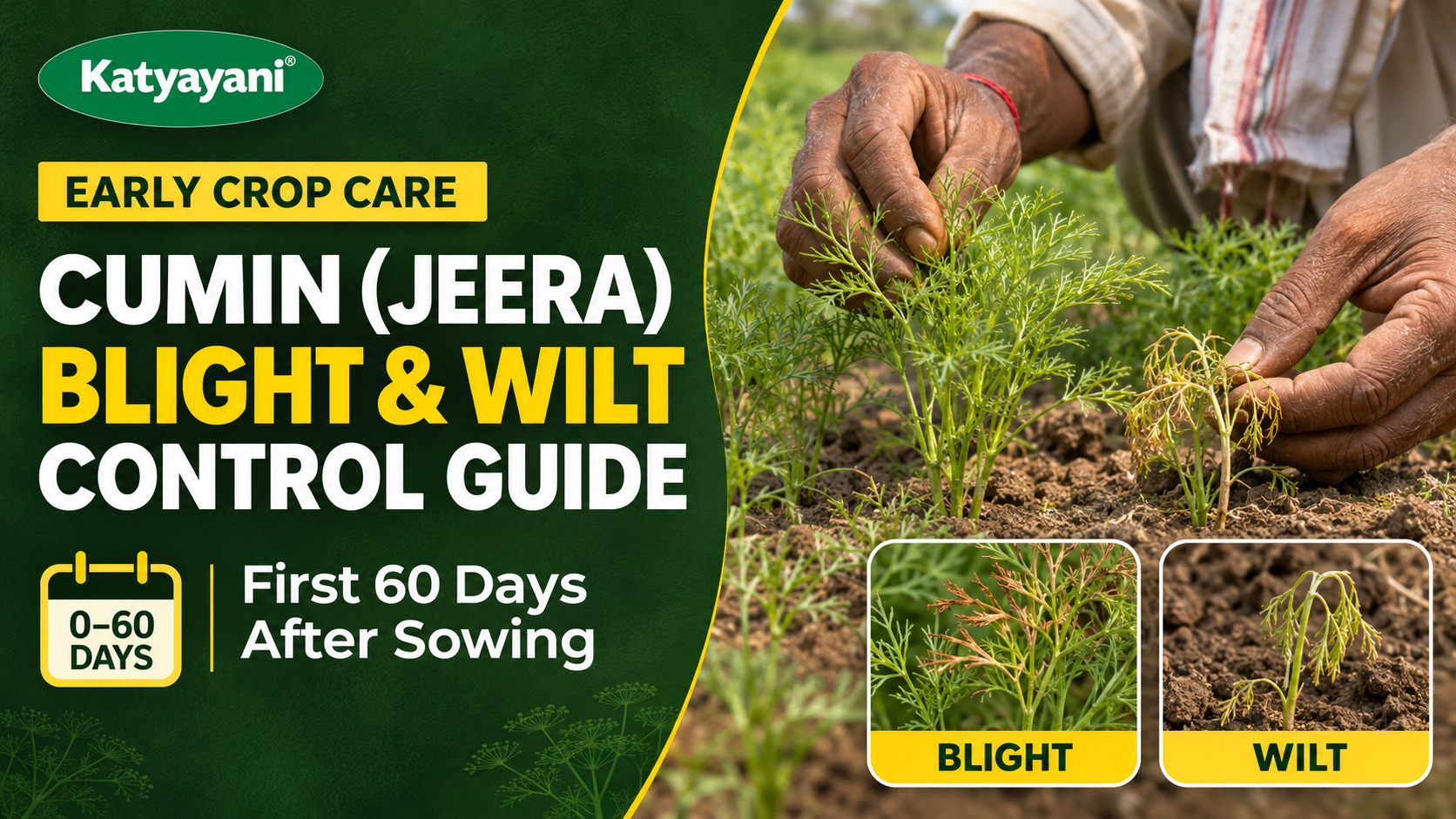
Cumin gets two serious diseases early. Wilt (Fusarium oxysporum f. sp. cumini) lives in the soil and seed and shows from about 30 days after sowing. Blight (Alternaria burnsii) lives on seed and crop debris and needs humid, cloudy weather. In an SDAU Jagudan trial, untreated plots had 24.94 to 33.30 percent wilt at 30 days and 46.84 to 53.16 percent at 60 days, while plots given Trichoderma-enriched farmyard manure stayed at 15.58 to 16.56 percent at 60 days. Published blight spray starts are day 35 (ICAR-IISR integrated module), day 40 (ICAR-IISR booklet, TNAU) and day 45 (ICAR-NRCSS trial, repeated every 15 days). So the first 60 days are the window: rotate and plough in summer, treat the seed, put enriched manure in the soil, sow on time, irrigate on a sensible schedule and watch for the first spots from day 30. Always follow the label and your state advisory.
What are wilt and blight in cumin, and why do the first 60 days matter?
Wilt is a soil and seed-borne fungal disease that kills whole plants. Blight is a leaf, stem and umbel disease that blackens the crop in humid weather. Both start building in the first two months, when seed treatment, soil preparation, sowing date and the first sprays decide how much of the crop survives to flowering.
The ICAR-NRCSS Ajmer review lists the main diseases of cumin: Alternaria blight (Alternaria burnsii), powdery mildew (Erysiphe polygoni), leaf spot, bacterial blight, witches broom and a newly reported virus-type yellowing (ICAR-NRCSS review, 2022). Wilt, caused by Fusarium oxysporum f. sp. cumini, is described by SDAU Jagudan scientists as the most devastating soil-borne disease of the crop (SDAU Jagudan, 2024).
This guide does not repeat a general cumin growing guide. It follows one question: what should a grower do between the summer before sowing and about day 60 so that wilt and blight never get a foothold? For chickpea, which shares the Fusarium wilt problem, our chana wilt guide covers the same logic on a different crop.
What causes wilt in cumin and how does the fungus survive?
Fusarium oxysporum f. sp. cumini causes it. The fungus is internally seed-borne and soil-borne, living on diseased plant debris and in infected soil. It builds up when cumin is grown on the same land year after year, and it attacks at every growth stage.
The ICAR-IISR booklet adds that the pathogen is heat tolerant, with a lethal temperature of 60 to 62 degrees C in moist conditions and 62 to 65 degrees C in dry conditions. It also says wilt gets worse when root-knot nematode (Meloidogyne incognita) attacks the plant first (ICAR-IISR Good Agricultural Practices, 2019).
- Seed: infected seed carries the fungus inside, so a clean-looking seed lot can still bring wilt (ICAR-IISR).
- Soil and debris: the fungus lives on diseased roots and stalks left in the field (ICAR-IISR).
- Repeated cumin: inoculum increases under continuous cumin cultivation (ICAR-IISR).
- New races: SDAU authors note that new pathogenic races have appeared and are weakening the durability of wilt-tolerant varieties (SDAU Jagudan, 2026).
What do wilt symptoms look like in young cumin plants?
Plants drop tips and leaves and then die. TNAU describes leaf drop leading to the death of the whole plant, with young plants hit hardest. The ICAR-IISR booklet adds that surviving diseased plants give small, thin, shrivelled seeds, and that the disease can show at any stage of the crop.
In practice, wilt often shows as patches. A few plants dry in one spot, then the patch widens along the row. The SDAU trials scored wilt at 30, 45 and 60 days after sowing, and untreated plots already showed 24.94 and 33.30 percent wilt at 30 days in the two years (SDAU Jagudan, 2026). That means day 30 is the first date to walk the field with intent.
A related problem is root rot. In North Gujarat, researchers isolated Fusarium oxysporum f. sp. cumini and Macrophomina phaseolina from root-rot samples, and earlier reports from Rajasthan name Fusarium oxysporum, F. solani and F. equiseti (SDAU Jagudan, 2024). The same field often has both.
What is Alternaria blight in cumin and when does it strike?
Alternaria blight is caused by Alternaria burnsii. Tiny brownish spots appear on leaves, stems and umbels, then turn black and merge. It is favoured by humid and cloudy weather. It can show at any stage, but it is worst at flowering and seed formation.
The ICAR-NRCSS review says small necrotic spots develop on almost all aerial parts, enlarge, join and turn brown to black. Under humid conditions stems and flowers are infected and may be killed. Either no seed forms on diseased plants, or the seed is small, shrivelled, very light and blackish (ICAR-NRCSS review, 2022). Blight also lowers the volatile oil content of the seed, according to the same review.
The fungus is carried on the seed and in crop debris. The ICAR-IISR booklet says it stays alive in seed and debris for 10 to 12 months and that none of the available varieties is resistant to it (ICAR-IISR, 2019). The ICAR-NRCSS review notes that cumin is generally attacked after flowering, so the first 60 days are about stopping the inoculum from building up, not about waiting for symptoms.
How much yield do wilt and blight cost cumin growers?
Published losses are large but depend on year and place. The ICAR-IISR booklet reports wilt incidence of 25.7 to 60.0 percent in some fields, with yield loss up to 25 percent in North Gujarat and up to 60 percent in Rajasthan. For blight, ICAR-NRCSS reports severe epidemics cutting yield 40 to 60 percent or more.
| Disease | Reported figure | Source |
|---|---|---|
| Wilt | Incidence 25.7 to 60.0 percent in some fields; yield loss up to 25 percent (North Gujarat) and up to 60 percent (Rajasthan) | ICAR-IISR, 2019 |
| Wilt | Potential loss up to 80 percent (cited by SDAU authors) | SDAU Jagudan, 2026 |
| Alternaria blight | Disease intensity up to 80 percent in surveys of Ajmer, Nagaur, Jodhpur, Barmer, Jaisalmer and Pali (Rajasthan) and Banaskantha (Gujarat) | ICAR-NRCSS, 2025 |
| Alternaria blight | Yield reduction 40 to 60 percent or higher in severe epidemics | ICAR-NRCSS, 2025 |
| Aerial diseases (all) | Up to 100 percent loss on susceptible cultivars under ideal disease conditions | ICAR-NRCSS review, 2022 |
| Powdery mildew | Seed yield reduced up to 50 percent in favourable weather | ICAR-NRCSS review, 2022 |
These ranges are wide because disease pressure follows the season. Treat them as the size of the risk, not as a prediction for your field. The same SDAU trial that recorded 39.41 percent mean wilt in untreated plots over two years gave 2.39 quintals per hectare there, against 6.54 quintals where Trichoderma harzianum-enriched manure was used.
How can you tell wilt, blight, root rot, powdery mildew and aphid damage apart?
Look at where the damage starts. Wilt and root rot begin at the root and plant base and kill whole plants. Blight begins as tiny spots on leaves, stems and umbels. Powdery mildew leaves a white powder. Aphids leave sticky honeydew and sooty mould. The ICAR-NRCSS review warns that look-alike symptoms make diagnosis hard.
| Problem | What you see | When it usually shows | Source |
|---|---|---|---|
| Wilt | Drooping tips and leaves, whole plant dies; patches in the field | Any stage; worse in young plants | TNAU, ICAR-IISR |
| Root rot | Plant death linked to rotting roots; Fusarium and Macrophomina found together in Gujarat samples | Rabi season, reported in North Gujarat and Rajasthan | SDAU Jagudan |
| Alternaria blight | Minute brown necrotic spots turning black on leaves, stems and umbels; seed light and blackish | Any stage; severe at flowering and seed formation | ICAR-NRCSS, ICAR-NRCSS review |
| Powdery mildew | White powdery coating on leaves, stems, petioles and seed; seed turns white and shrivelled | February and March, at flowering | ICAR-NRCSS review, ICAR-IISR |
| Aphids | Sap sucking, honeydew, sooty mould; seed fails to form | December to March, flowering and fruit stage | ICAR-IISR |
| Cumin yellowing (virus type) | Mosaic, leaf distortion, yellowing, stunting; losses reported up to 30 percent | Young plants first | ICAR-NRCSS review |
If you cannot tell which problem you have, take a fresh sample with healthy and affected tissue to your KVK or the SAU plant pathology department before spraying. The wrong fungicide on an aphid or root problem wastes money and delays the right step.
Which weather brings blight and powdery mildew, and why does it matter before day 60?
Blight likes humid, cloudy weather and 23 to 28 degrees C. Dewfall, leaf wetness, relative humidity and the number of rainy days all raise it. Powdery mildew needs warm, moist weather of 27 to 35 degrees C. A foggy, dewy spell around day 40 to 60 is the warning to spray on time.
| Disease | Weather that favours it | Source |
|---|---|---|
| Alternaria blight | 23 to 28 degrees C optimum; humid and cloudy weather; blight incidence rises with longer dewfall, leaf wetness, relative humidity and more rainy days | ICAR-NRCSS review, 2022 |
| Powdery mildew | 27 to 35 degrees C with moist conditions; appears in February and March at flowering | ICAR-NRCSS review, 2022 |
| Wilt | Builds under continuous cumin and spreads through seed, soil and debris; no weather range given in the sources opened | ICAR-IISR, 2019 |
The review also reports that in one study the December-sown crop had the least blight and the October-sown crop the most. The next section looks at what that means for your sowing date.
Does sowing date change blight and wilt risk?
Yes, for blight. Earlier sowing brings more blight, and later sowing escapes it but matures faster and yields less. In the SDAU Jagudan trial, sowing on 5 November gave the best growth and a seed yield of 600 kg per hectare in 30 cm rows, with the lowest values for 20 December sowing.
The trial tested 5 November, 20 November, 5 December and 20 December, with broadcasting, 30 cm rows and 15 cm rows. The authors write that early-sown crops enjoy good growth conditions but face more disease, while late-sown crops escape disease but reach maturity sooner. The 30 cm row on 5 November also gave the best net return in that study (SDAU Jagudan, 2022). Blight was moderate to severe during that trial even in the best treatment, which is why spraying still matters.
For wilt, the ICAR-IISR booklet recommends line sowing and does not give a sowing date that avoids wilt. Our sources do not show a sowing date that removes the wilt risk, so treat date as a blight lever and handle wilt through seed and soil. For regional dates in Rajasthan, use your state advisory.
What should you do before sowing to lower wilt risk?
Plough deep in summer, rotate with a non-host crop for about three years, pick a field with no cumin in the past three years and enrich farmyard manure with bio-agents 15 days before sowing. Where practical, add 20 to 30 days of soil solarization. The ICAR-IISR booklet, SDAU trials and an ICAR-NRCSS trial support these steps.
- Summer ploughing and a three-year rotation: the ICAR-IISR booklet lists both as helpful; rotation with a non-host crop such as mustard or pearl millet reduced wilt (ICAR-IISR, 2019). Our crop rotation plans and the mustard farming guide help plan the sequence.
- Oil cakes and manure: mustard cake and groundnut cake reduced the disease, and castor cake and poultry manure before sowing reduced wilt (ICAR-IISR). TNAU names neem cake with crop rotation (TNAU).
- Select the field: the ICAR-IISR booklet says to choose land where cumin has not been grown for the past three years.
- Enriched farmyard manure: SDAU enriched farmyard manure with bio-agents 15 days before sowing and applied it at sowing (see the bio-agent section below).
- Soil solarization, where practical: in an ICAR-NRCSS Ajmer trial, covering irrigated soil with clear 100-micron polythene for 20 or 30 days before sowing, then adding neem cake at 0.5 tonne per hectare and treating the seed with Trichoderma viride at 8 g per kg, brought the wilt disease index down to 5.31 and 5.69 from 58.81 in untreated plots. The authors say it still needs testing in other regions and seasons (ICAR-NRCSS, 2026).
TNAU is blunt about the limit: no chemical control is available for wilt, and rotation, neem cake and disease-free seed are what check the spread (TNAU Agritech Portal). That is why this plan front-loads the work.
Which cumin varieties tolerate wilt and blight?
Several varieties are listed as tolerant, but none is resistant to blight. The ICAR-IISR booklet lists RZ-209 (tolerant to wilt and blight), RZ-223 (resistant to wilt), RZ-345 (moderate resistance to wilt, blight and powdery mildew), Gujarat Cumin 2 (tolerant to wilt, blight and powdery mildew) and Gujarat Cumin 4 (tolerant to wilt).
| Variety | Reaction stated in the source (ICAR-IISR booklet unless noted) | Recommended area stated |
|---|---|---|
| RZ-209 | Tolerant to wilt and blight | Rajasthan |
| RZ-223 | Resistance to wilt | Rajasthan |
| RZ-345 | Moderate resistance to wilt, blight and powdery mildew | Not stated in the text read |
| Ac-01-167 | Resistant to wilt | Rajasthan |
| Gujarat Cumin 2 | Tolerant to wilt, blight and powdery mildew | North Gujarat and Saurashtra |
| Gujarat Cumin 4 | Tolerant to Fusarium wilt (also the variety used in the SDAU and ICAR-NRCSS trials) | Not stated in the text read |
| Jodhpur Jeera-1 | Moderate resistance to Fusarium wilt and Alternaria blight under natural field conditions; mean blight incidence 26.0 percent against 34.4 percent in GC-4 (Agriculture University Jodhpur, 2026) | Irrigated, timely sown rabi crop in Rajasthan; recommended in 2025 |
Jodhpur Jeera-1 is a recent release, so the only evidence is its release paper and it has had little time on farmers' fields. Remember the SDAU warning that new races of the wilt fungus can weaken a tolerant variety over time. Even in the SDAU trials, which used Gujarat Cumin 4, untreated plots reached 39.41 percent mean wilt. A tolerant variety lowers the risk but does not replace seed treatment, enriched manure and rotation.
How should you treat cumin seed before sowing?
Use seed from a disease-free plot, then treat it with a fungicide or a bio-agent before sowing. The ICAR-IISR booklet calls seed treatment with thiram, captan or carbendazim a general practice for wilt. TNAU recommends captan or thiram for blight seed treatment. Follow the label for the dose of whichever product you use.
The ICAR-NRCSS review adds that a plant protection schedule built on seed treatment with carbendazim plus thiram (1:1) or tebuconazole, soil drenching with metalaxyl or carbendazim, then foliar mancozeb followed by propiconazole and dinocap at a later stage, was reported effective against wilt, blight and powdery mildew (ICAR-NRCSS review, 2022). The same review cites a recommendation of mixing a Trichoderma formulation with the seed to cover all cumin diseases. In the ICAR-NRCSS Ajmer wilt trial, a carbendazim seed treatment on its own left the wilt disease index at 43.32 against 58.81 in untreated plots, far weaker than the integrated solarization package (ICAR-NRCSS, 2026).
- Why seed matters: wilt is internally seed-borne and blight is seed-borne (ICAR-IISR), so a seed dressing is the cheapest first step.
- Fungicide or bio-agent, not both at once: if you want both, treat in the order the label allows; our chana seed treatment guide explains why the order of seed treatments matters.
- Method: our fungicide application methods post explains seed treatment, drenching and spraying.
- Product choice: check the pack label of any fungicide or bio-agent for cumin, the dose and the current CIB&RC registration before you use it.
Do Trichoderma and Pseudomonas work against cumin wilt?
In SDAU Jagudan field trials, farmyard manure enriched with Trichoderma harzianum or Trichoderma viride cut wilt sharply. T. harzianum-enriched manure reached 15.58 to 16.56 percent wilt at 60 days after sowing against 46.84 to 53.16 percent in untreated plots. Bio-agents work as prevention, applied before the disease.
| Wilt incidence (percent) | 30 days after sowing | 45 days after sowing | 60 days after sowing |
|---|---|---|---|
| 2022-23: FYM enriched with T. harzianum | 4.17 | 11.24 | 16.56 |
| 2022-23: untreated control | 24.94 | 32.00 | 46.84 |
| 2023-24: FYM enriched with T. harzianum | 5.08 | 15.48 | 15.58 |
| 2023-24: untreated control | 33.30 | 45.83 | 53.16 |
Source for the table: SDAU Jagudan, Int J Seed Spices 2026. The trial used Gujarat Cumin 4 and applied 1 kg of Trichoderma formulation per 100 kg of farmyard manure. Reduction over control at 60 days was 64.65 percent in the first year and 70.69 percent in the second. Pooled over both years, mean wilt was 11.46 percent with T. harzianum, 14.23 percent with T. viride and 39.41 percent in the control. Pooled seed yield was 6.54, 6.24 and 2.39 quintals per hectare. Volatile oil stayed at 4.41 to 4.54 percent in all plots.
An earlier four-year SDAU trial found the best control of wilt and root rot from enriched farmyard manure with Trichoderma viride or T. harzianum plus Pseudomonas fluorescens, applied at sowing after enriching the manure 15 days earlier. Pooled wilt was 7.97 percent for the T. viride plus P. fluorescens treatment against 21.37 percent for the untreated control (SDAU Jagudan, 2024). The ICAR-IISR booklet also lists Trichoderma harzianum grown on sorghum grains and applied to soil at 24 g per 6 square metres as having reduced wilt.
The ICAR-NRCSS Ajmer trial adds a soil-heating step. Treatments combining 20 or 30 days of soil solarization, neem cake at 0.5 tonne per hectare and Trichoderma viride seed treatment at 8 g per kg seed gave a wilt disease index of 5.31 and 5.69, against 58.81 in untreated plots, and cut soil pathogen counts by 81.7 and 78.9 percent (ICAR-NRCSS, 2026). It was run at one research farm, and its authors call for tests in other regions and seasons. Bio-agent products differ in strain, strength and registration, so check the pack label for crop, dose and method, and see the full bio fungicide range. Our biopesticides guide and bio vs chemical inputs post explain why bio-agents must go in before the disease, not after.
How should you irrigate and feed cumin in the first 60 days?
Irrigate on a fixed, sensible schedule. The ICAR-IISR booklet says cumin generally needs 4 to 6 irrigations, set by soil and weather, and lists optimum irrigation time and number among the steps that reduce soil-borne disease build-up. Its drip advice is a low-pressure system at a gap of 4 to 5 days for 40 to 45 minutes.
The booklet adds that drip irrigation cuts water use by 30 to 70 percent compared with surface irrigation and makes inter-cultural work easier when the crop is sown in lines (ICAR-IISR, 2019). This guide gives no day-by-day irrigation calendar, because no recent ICAR or state university paper opened gave one for the first 60 days. Follow your KVK schedule for your soil and water.
| Item | What the sources say | Source |
|---|---|---|
| Irrigation number | Generally 4 to 6 irrigations; the schedule depends on soil and weather | ICAR-IISR, 2019 |
| Drip irrigation | Low-pressure drip at a gap of 4 to 5 days for 40 to 45 minutes is described as appropriate; water use falls 30 to 70 percent against surface irrigation | ICAR-IISR, 2019 |
| Nitrogen and phosphorus in the SDAU sowing trial | 40 kg nitrogen and 15 kg phosphorus per hectare; all phosphorus and half the nitrogen at sowing; remaining nitrogen top dressed in two equal parts at 12 and 30 days after sowing | SDAU Jagudan, 2022 |
| Potassium and spacing against blight and powdery mildew | 30 cm by 10 cm spacing with 10 kg K2O per hectare along with 40 plus 15 kg N and P per hectare reduced blight and powdery mildew and raised yield (study cited in the review) | ICAR-NRCSS review, 2022 |
| Row spacing | 25 cm by 10 cm and sowing depth not beyond 1.5 cm (ICAR-IISR); 30 cm rows in the SDAU trials | ICAR-IISR, 2019 |
If your field or irrigation water may be salty, our soil salinity guide explains how to read EC and what to do about it before sowing.
When should you start spraying for blight, and what did ICAR trials use?
Start between day 35 and day 45 and repeat the sprays. The ICAR-IISR module puts its first protective spray at 35 days and its mancozeb advice at 40 days, and TNAU also says 40. The ICAR-NRCSS trial began at 45 days with 15-day gaps. Scout from day 30 and spray earlier in cloudy, humid weather.
| Source | First spray | Notes |
|---|---|---|
| ICAR-IISR booklet, integrated module | 35 days after sowing | Second spray at 45 days and a third after 55 days; the module names the fungicide groups (ICAR-IISR, 2019) |
| ICAR-IISR booklet, blight section | 40 days after sowing (mancozeb) | Avoid two continuous mancozeb sprays and alternate chemicals (ICAR-IISR, 2019) |
| TNAU Agritech Portal | 40 days after sowing (mancozeb) | Gives four sprays at 10-day gaps (TNAU) |
| ICAR-NRCSS Ajmer trial | 45 days after sowing | 3 to 4 sprays at 15-day gaps (ICAR-NRCSS, 2025) |
The ICAR-NRCSS field trials used the variety Gujarat Cumin 4 over two rabi seasons at Ajmer, with plots sprayed using a knapsack sprayer. The best schedule used a contact fungicide first and then two systemic ones, mancozeb then difenoconazole then azoxystrobin, and cut disease by 66.2 percent over the untreated plots (ICAR-NRCSS, 2025).
| ICAR-NRCSS Ajmer schedule trial (3 to 4 sprays from 45 days, every 15 days) | Disease intensity (percent) | Disease reduction (percent) |
|---|---|---|
| Mancozeb, then difenoconazole, then azoxystrobin | 9.4 | 66.2 |
| Mancozeb, then azoxystrobin, then difenoconazole | 9.5 | 65.8 |
| Difenoconazole, then azoxystrobin, then mancozeb | 11.3 | 59.5 |
| Azoxystrobin, then difenoconazole, then mancozeb | 11.9 | 57.5 |
| Difenoconazole, then mancozeb, then azoxystrobin | 12.0 | 57.1 |
| Azoxystrobin, then mancozeb, then difenoconazole | 13.0 | 53.5 |
| Untreated control | 28.0 | None |
In a separate trial of ready-mix products, azoxystrobin plus difenoconazole gave the largest disease reduction (79 percent in the abstract) and seed yield of 416 kg per hectare against 167 kg in untreated plots. Metiram plus pyraclostrobin came second. Tebuconazole plus trifloxystrobin, hexaconazole and copper hydroxide gave smaller reductions. The abstract says the combination products work because they bring more than one mode of action (ICAR-NRCSS, 2025). Untreated plots in this second trial had 50.6 percent disease against 28.0 percent in the schedule trial, so compare products only within each trial. In the schedule trial, every sprayed plot yielded 280 to 369 kg per hectare against 213 kg untreated, but the paper's own margin (CD 127 kg per hectare) means the schedules should not be ranked on yield. Doses are on the label, not in this guide.
Practical reading of the trial: the two schedules that began with mancozeb had the lowest disease, and the ICAR-IISR booklet advises against two continuous mancozeb sprays and says to alternate chemicals. Check the label and the current CIB&RC registration for cumin before buying any fungicide, and browse the fungicide range for the groups named. Our sprayer guide helps with nozzles and coverage.
Can fungicides cure wilt once plants start drying?
Not reliably. TNAU says no chemical control is available for cumin wilt, and the ICAR-IISR booklet says efficient control is not possible with chemicals. An SDAU trial found a carbendazim soil drench cut wilt to 10.38 percent against 21.37 percent untreated, but bio-agent-enriched manure did better, so chemicals only help.
| SDAU Jagudan trial, 4 rabi seasons (pooled wilt, percent) | Wilt incidence |
|---|---|
| Untreated control | 21.37 |
| Copper oxychloride soil drench at 20 days after germination | 12.03 |
| Carbendazim soil drench at 20 days after germination | 10.38 |
| T. viride plus Pseudomonas fluorescens, enriched FYM at sowing | 7.97 |
Source: SDAU Jagudan, 2024. The drench was given at 20 days after germination, which is early, before the field is full of dying plants. That timing is the point. A drench on a field that is already wilting will not bring dead plants back. Remove and destroy wilted plants and their roots, do not leave them as debris, and plan rotation for next season.
What does a day-by-day plan for the first 60 days look like?
Plan in four blocks: before sowing, sowing day, days 10 to 30, and days 30 to 60. Each block has one or two actions that the ICAR or state university papers support. Dates here count days after sowing (DAS); adjust the sowing date to your region and state advisory.
| When | What to do | Source |
|---|---|---|
| Summer before sowing | Deep plough; plan about three years of rotation with a non-host crop; pick a field with no cumin in the past three years; where practical, solarize moist soil under clear plastic for 20 to 30 days | ICAR-IISR, ICAR-NRCSS |
| 15 days before sowing | Enrich farmyard manure with Trichoderma (and Pseudomonas) and keep it moist and covered | SDAU Jagudan |
| Sowing day | Use disease-free seed, treat it, sow in lines at 25 to 30 cm, not deeper than 1.5 cm; apply the enriched manure | ICAR-IISR, SDAU Jagudan |
| 12 DAS | First nitrogen top dressing if your plan includes one (SDAU trial split the remaining nitrogen at 12 and 30 DAS) | SDAU Jagudan |
| 30 DAS | Walk the field for drying patches and note the percent; second nitrogen split if your plan includes one | SDAU, SDAU |
| 35 to 40 DAS | First weeding and hoeing (the booklet gives 35 to 40 DAS for irrigated cumin) | ICAR-IISR |
| 35 to 45 DAS | Begin the blight spray programme (published starts are 35, 40 and 45 days); rotate groups; spray sooner in a cloudy, humid spell | ICAR-IISR, TNAU, ICAR-NRCSS |
| After 55 DAS | Third protective spray window in the ICAR-IISR module; repeat it if the weather favours disease | ICAR-IISR |
| 60 DAS | Second wilt count; compare with day 30; keep the spray rhythm you chose | SDAU Jagudan, ICAR-NRCSS |
Keep a simple notebook: sowing date, seed treatment, manure enrichment date, irrigation dates, wilt count at 30 and 60 days, and every spray with product group and date. It is the only way to know what worked on your own soil.
What comes after day 60: powdery mildew and aphids?
Two problems arrive at flowering. Powdery mildew shows from February and March, and aphids peak from December to March. The ICAR-NRCSS review recommends a single dusting of 300-mesh sulphur at 20 to 25 kg per hectare at flowering in January. The IISR booklet says aphids can cause over 50 percent loss in unprotected crops.
Powdery mildew spreads fast at 27 to 35 degrees C with moisture, and late-sown irrigated crops are hit hardest (ICAR-NRCSS review, 2022). Wettable sulphur at 0.2 percent, dinocap, carbendazim and tridemorph are also listed in the review. The Sulfotop 80 (sulphur 80 wdg) page on this site lists cumin powdery mildew; read the pack label for dose.
For aphids, the IISR booklet says heavy infestation between December and March can cause more than 50 percent yield loss, that infestation at flowering and fruiting leaves fruits unformed or shrivelled, and that parasitoids and ladybird beetles are natural enemies (ICAR-IISR, 2019). The same threshold logic is covered in our mustard aphid control post. A cumin aphid control combo page on the site names cumin and aphids; follow the label for dose and timing.
Which mistakes make blight and wilt worse?
The common ones are repeating cumin on the same land, sowing untreated seed, sowing too early, watering too often, starting sprays late or using one fungicide again and again. Each is backed by the sources above, and each costs the most in the first 60 days.
- Cumin after cumin: wilt inoculum increases under continuous cultivation (ICAR-IISR).
- Skipping seed treatment: both diseases ride on the seed (ICAR-IISR).
- Too-early sowing: more blight (SDAU sowing trial and the ICAR-NRCSS review).
- Careless irrigation timing and number: ICAR-IISR lists optimum irrigation time and number among the steps that cut soil-borne disease build-up.
- Waiting for flowering to spray: the ICAR trial began at 45 days, not at flowering.
- Repeating one fungicide group: the ICAR-IISR booklet advises against two continuous mancozeb sprays and says to alternate chemicals; the ICAR-NRCSS trial also rotated groups.
- Leaving wilted plants and debris in the field: blight survives 10 to 12 months in debris and the wilt fungus lives on diseased plant material (ICAR-IISR).
- Ignoring the label: confirm crop, disease, dose, interval and waiting period on the pack and the current CIB&RC registration.
If you are planning a larger seed-spice operation, our guide to Spices Board schemes for spice farmers explains the support available, though it does not name cumin.
Conclusion
For cumin, the first 60 days are a prevention window, not a spraying window. Plough in summer, rotate for about three years, treat the seed, put Trichoderma-enriched manure into the soil before sowing, sow in the right window, irrigate on a steady schedule, and walk the field at day 30 and day 60. Start the blight programme between day 35 and day 45 (the published starts differ), keep to a regular interval and alternate fungicide groups. Tolerant varieties help but do not replace any of this, and no source opened shows a chemical that rescues a field after wilt has set in. Confirm doses, intervals and waiting periods on the pack, check the current CIB&RC registration for cumin, and ask your KVK or state agriculture department when the label and the advice differ.

Leave a Comment