
 17 min read
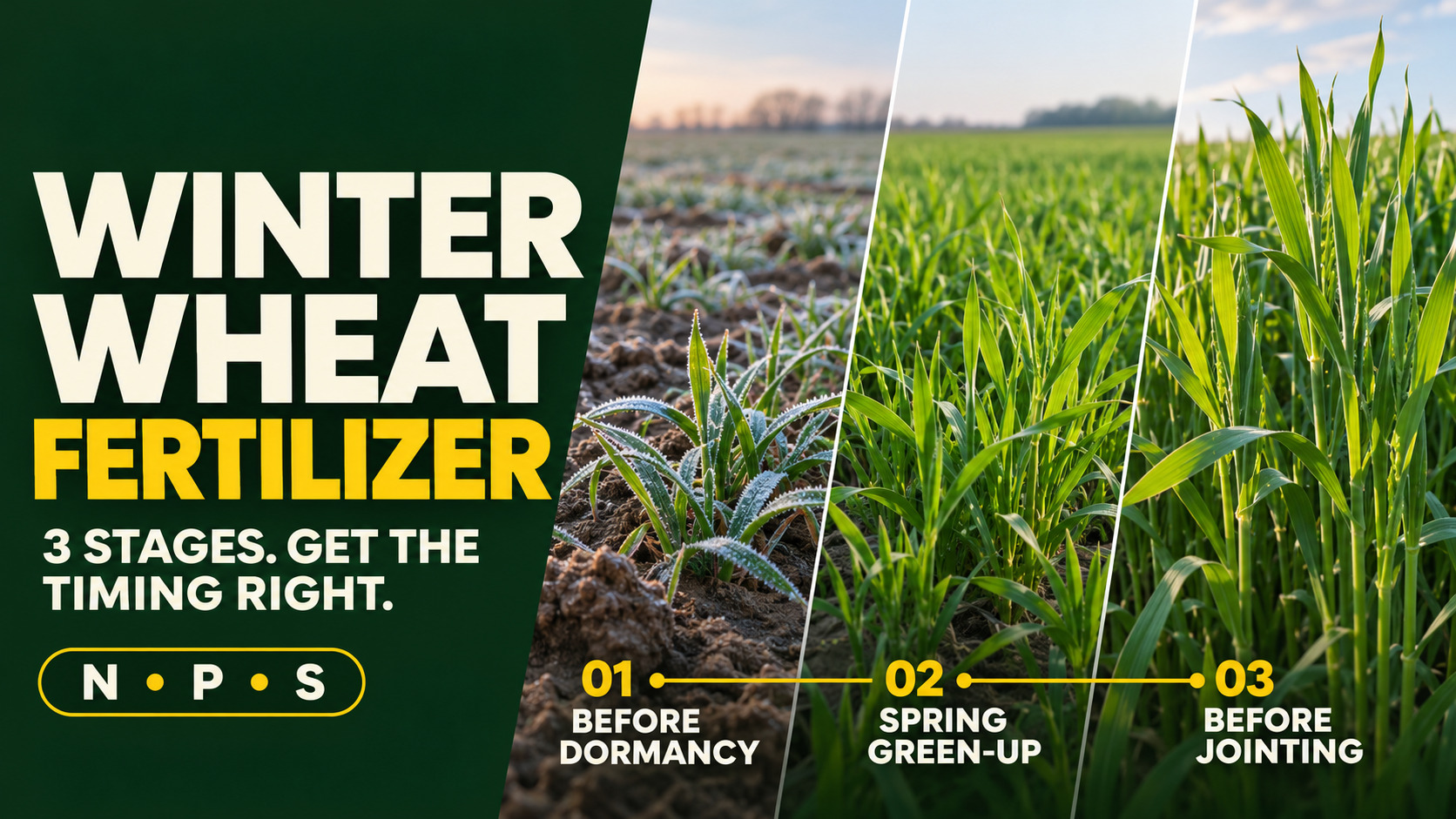
Winter wheat is fed in three steps. Before winter, a thin stand gets a small dose of nitrogen (Purdue says 20 to 30 lb per acre) and phosphorus goes in at seeding. At spring green-up, nitrogen goes on once fields are fit, and Purdue calls Feekes 4 to 5 the best window. Stop around Feekes 6 (jointing). Total nitrogen is set by yield goal: Penn State uses about 1 lb per bushel, while the Tri-State guide gives 120 lb for 100 bushels. Check sulphur on light soils.
What happens to winter wheat between fall seeding and spring green-up?
Winter wheat is sown in fall, tillers, hardens off, rests through the cold months and restarts growth in late winter. K-State describes it plainly: tillers are formed only in the fall but make most of their growth the following spring. The growing point sits about 1 inch below the soil surface in winter, which protects it. See the K-State Wheat Production Handbook.
Picture a field seeded in autumn. By the first hard frost the plant may have a main stem and a few side shoots. Falling temperatures and shorter days trigger cold hardiness, and many varieties change from an upright to a flat, prostrate growth form. Hardiness is greatest in early winter and is lost slowly as the season moves on. Then a warm spell arrives, the leaves darken, and the tillers stand up again. That is green-up.
The pattern drives every fertiliser decision. In fall the plant needs a small, steady supply to build tillers. Over winter it takes up almost nothing. At green-up it starts a fast run toward jointing, and the nitrogen it needs then has to be in the root zone already. The rest of this post follows that calendar.
One scope note. This post is about temperate winter wheat in the US, Canada, the UK and Europe. India grows its wheat on a different calendar, and our India posts cover that system. See the next section.
How is winter wheat feeding different from India rabi wheat?
The calendars differ. Our India zone guides give November sowing windows and irrigation schedules that run into March, and they talk about CRI-stage irrigation and urea splits. Temperate winter wheat adds a dormancy period and a green-up decision. Use this post for the dormancy system and the India posts for Indian zones.
For Indian conditions, start with our wheat sowing time and seed rate guide, which lists sowing windows by ICAR zone and the basal dose. Then read the first irrigation and urea timing post for the CRI stage and the nitrogen split. If leaves are pale, the wheat yellowing guide sorts the causes by leaf pattern, and the zinc deficiency in wheat post covers zinc.
The nitrogen doses in those posts are Indian package figures for Indian soils. The doses below belong to Kansas, Pennsylvania, Ohio, Indiana, Alberta, Saskatchewan and the UK. Do not carry a number across. A reader in Punjab and a reader in Kansas both apply nitrogen in split doses to wheat, but the stage, the soil and the yield goal behind each number are different.
Which growth stages matter for fertiliser, and what does each look like?
Five stages matter: Feekes 1 (emergence), Feekes 2 to 3 (tillering), Feekes 4 to 5 (green-up and erect growth), Feekes 6 (jointing) and Feekes 7 to 8 (two nodes to flag leaf). Purdue says Feekes 4 to 5 is the best time for spring topdress nitrogen, and Feekes 6 is a good time to stop.
| Feekes stage | What you see | Fertiliser point (Purdue ID-422) |
|---|---|---|
| 1 | Seedling emerged | Check emergence and weeds |
| 2 to 3 | Side shoots (tillers) forming; may start in fall and finish in spring | Early nitrogen for thin stands. Fall N of 20 to 30 lb per acre is enough for fall tillers; 30 to 50 lb at dormancy break, balance at Feekes 5 |
| 4 to 5 | Green-up. Plants turn dark green and grow upright; head size is set at Feekes 5 | Best time for spring topdress nitrogen |
| 6 | Jointing. First node visible at the base of the shoot | Good time to cut off nitrogen to prevent injury |
| 7 to 8 | Two nodes visible, then flag leaf | Herbicide and fungicide decisions, not nitrogen |
Source: Purdue Extension ID-422, Managing Wheat by Growth Stage. Purdue adds that Feekes 5 will not occur before vernalization (chilling), and that tillers formed after Feekes 5 do not contribute to yield. UK readers: Purdue notes that the Zadoks and BBCH scales are the common ones in Europe, and AHDB uses GS31 for first node.
To find jointing in the field, Purdue says to dig up a plant, remove the tillers and split the main stem. If a node shows, the plant is at Feekes 6. The first node often feels like a swollen bump at the base of the shoot. It takes about a week to go from Feekes 6 to Feekes 7, so check weekly in spring.
How much nitrogen does winter wheat take up, and when?
AHDB, the UK levy body, gives a clear picture. A winter wheat crop takes up about 279 kg N per hectare in total. About 81 kg of that (about 30 percent) is taken up from sowing to first node (GS31). About 167 kg is taken up from first node to flowering, and most of that in May in the UK. Late spring is when the crop is hungriest.
| Period (AHDB, winter wheat) | N taken up | Share of total |
|---|---|---|
| Total uptake by harvest | 279 kg N per hectare (about 249 lb per acre, our arithmetic) | 100 percent |
| Sowing to first node (GS31) | 81 kg N per hectare (about 72 lb per acre) | About 30 percent |
| First node to flowering | 167 kg N per hectare | About 60 percent (about 40 percent between first node and flag leaf, a period of only five weeks, and about 20 percent between flag leaf and flowering) |
| After flowering | The remainder | About 10 percent |
Source: AHDB, nitrogen supply, demand and utilisation in winter wheat. The same page says soil nitrogen supplies roughly half the nitrogen needed for unlimited yield, that fertiliser supplies the other half, and that nitrogen taken up before stem extension promotes tillering, which is the main way fertiliser nitrogen controls canopy size. It also warns that soil nitrogen is prone to leaching when uptake is slow over winter.
Two lessons follow. First, nitrogen put on in early spring is sitting in the soil for weeks before the crop wants most of it, so the form and the weather matter. Second, because the plant uses so little before jointing, big early doses carry the most risk of loss.
How much total nitrogen should you plan for?
It depends on yield goal and where you farm. Penn State uses about 1 lb of nitrogen per bushel of expected yield. The Tri-State guide (Ohio, Indiana, Michigan) gives 120 lb N for a 100-bushel goal. K-State uses a formula with a 30 lb minimum. Treat each as that state's answer, and keep fall, seeding and spring nitrogen in one total.
| Source | How the rate is set | Example given |
|---|---|---|
| Penn State Extension (Pennsylvania Agronomy Guide) | 1.0 lb N per bushel of expected yield; total includes planting, fall and spring nitrogen | 100 bu per acre needs 100 lb N in total |
| Ohio State (Tri-State guide, Table 10, total N) | For mineral soils with 1 to 5 percent organic matter and good drainage: N rate = (1.33 x yield potential) - 13. Yield potential is the average of the middle three of the last five yields | 70 bu: 80 lb; 80 bu: 90 lb; 90 bu: 110 lb; 100 bu: 120 lb N per acre (as printed in the article) |
| K-State MF2586 (January 2024) | N = (ie/fe) x expected yield, less soil nitrate, less 10 lb per 1 percent organic matter, less manure, plus or minus other adjustments. ie = 1.45 lb per bushel; fe = 0.65 if injected or split, 0.55 default | A minimum of 30 lb N per acre is recommended for early growth |
| IHARF, Saskatchewan (2 seasons, Indian Head) | Trial with 60 to 180 kg N per hectare, soil plus fertiliser | Yield was best at 120 to 150 kg N per hectare |
Sources: Penn State Extension, Ohio State C.O.R.N. newsletter, K-State MF2586 and the IHARF demonstration. Our arithmetic from the K-State formula: at its default efficiency, 1.45 divided by 0.55 is 2.64 lb of nitrogen per bushel, so a 60-bushel goal comes to about 158 lb before credits. At the 0.65 efficiency for split or injected nitrogen it is about 134 lb. A field with 2 percent organic matter then loses 20 lb to the organic matter credit. Soil nitrate and manure credits come off as well.
Some credits are blunt. K-State credits 10 lb of nitrogen per acre for each 1 percent soil organic matter under wheat. Ohio State and the Tri-State guide give no nitrogen credit for a previous soybean crop or a cover crop, and the K-State handbook explains why: wheat needs its nitrogen early in spring, before soybean residue has broken down. Ohio State's fall credit is covered in the next section.
Ohio State also notes that over 20 years of trials at its north-west research station, the best rate changed from year to year, but the long-run average matched the equation. Yields did not rise above 120 lb of spring nitrogen except in one year. If you want a number to work from, work from your own yield history, not the best year.
Does winter wheat need nitrogen in the fall?
Only a small amount, and mostly for thin stands. Purdue says 20 to 30 lb N per acre (22 to 34 kg per hectare) is enough for fall tillers. Penn State, drawing on the University of Kentucky method, says a thin stand of fewer than 50 tillers per square foot at Feekes 3 can take 15 to 30 lb N. A strong stand does not need it.
Penn State's page gives a simple ladder, based on tiller counts taken at Feekes 3:
| Fall tillers per square foot (Feekes 3) | What the page says |
|---|---|
| 80 to 100 | A strong stand. Fall nitrogen is unlikely to help; a higher rate is not needed |
| 50 to 80 | May respond to fall nitrogen, but less predictably |
| Below 50 | Apply 15 to 30 lb N per acre to encourage fall tillering |
Source: Penn State Extension, wheat stand assessment. The same page warns that heavy, fast-growing stands, especially on high-organic-matter soils with plenty of soil nitrogen, can winterkill if given fall nitrogen. More growth is not always safer growth.
If you do put nitrogen on in fall, count it. The Tri-State guide, as described by Ohio State, subtracts fall nitrogen from the spring total, with a credit of no more than 20 lb per acre, and leaves it to you to decide how much credit to take based on your risk tolerance. Saskatchewan and Alberta work differently because their winters are harsher; the section on fall versus spring in cold climates covers that.
How do you count wheat tillers and judge the stand?
Dig or count plants in a 1, 2 or 3 foot length of row, convert to plants per square foot, and compare. Penn State says to count at Feekes 3 in fall and again between Feekes 3 and 5 in spring. Its example: 80 plants in 2 feet of 7.5-inch rows equals 64 plants per square foot. Below 15 plants per square foot, the page says do not keep the field.
| Plants per square foot | Stand (as % of full) | Yield potential (Penn State Table 2) |
|---|---|---|
| 30 to 35 | 100 | 100 percent |
| 24 to 28 | 80 | 100 percent |
| 18 to 21 | 60 | 90 to 95 percent |
| 15 to 18 | 50 | 75 to 80 percent |
| 12 to 14 | 40 | 60 to 70 percent |
| 6 to 7 | 20 | 40 to 50 percent |
Source: Penn State Extension. Penn State links the stand count to the spring plan. Where yield potential is 75 to 90 percent, put the first topdress near green-up (Feekes 3 to 4) and a second around Feekes 6 to 8. Where it is 90 percent or more, apply between Feekes 3 and 6, with a possible second dose around Feekes 8.
Its worked example is useful. A field had 45 tillers per square foot in fall, so 15 lb N went on. In spring the Feekes 3 count was 17 per square foot (78 percent potential), so 40 lb went on at Feekes 4. With a 90-bushel goal and 55 lb already applied, the Feekes 6 dose was 45 lb. The three doses add up to 100 lb. The example shows how the plan changes with what you see in the field.
When should you apply nitrogen at spring green-up?
Once the crop has greened up and the field can carry the machine. Purdue calls Feekes 4 to 5 the best window. K-State says to top-dress at green-up and finish by jointing. Ohio State found no yield benefit to earlier nitrogen as long as the application was made by Feekes 6, and warns that early nitrogen can be lost.
Here is how the sources line up:
- Purdue: Feekes 4 to 5 is the optimal window for spring topdress nitrogen. In thin stands, 30 to 50 lb per acre at dormancy break, with the balance at Feekes 5. Feekes 6 is a good cut-off to prevent injury.
- K-State handbook: Top-dress nitrogen when wheat greens up, to feed the tillers that produce most of the grain. Spring applications should be finished by jointing, which in Kansas normally comes in early to mid-March. Later nitrogen may raise grain protein but has less effect on yield.
- Ohio State: Spring nitrogen can go on once fields are fit after green-up. Research shows no yield benefit to early applications provided they are on by Feekes 6, and early nitrogen is at risk of loss because wheat takes up little until after jointing.
- Penn State: Where yield potential is 75 to 90 percent, first topdress near green-up (Feekes 3 to 4) and a second around Feekes 6 to 8; at 90 percent or more, apply between Feekes 3 and 6.
Sources: Purdue ID-422, K-State handbook, Ohio State and Penn State. The advice agrees on the core: the crop wants nitrogen after green-up, thin stands want a first dose early, and nothing much is gained after jointing. The edges differ by region and soil, so use the source for your state.
For the plant-side reasons the first warm weeks can turn leaves yellow or purple even when fertiliser is fine, our post on cold weather and nutrient uptake explains why cold soil slows roots, and the nitrogen deficiency guide shows how to tell it from sulphur shortage and root problems.
Should you split spring nitrogen or apply it all at once?
Ohio State has not found a consistent yield gain from splitting compared with a single dose after green-up. If you split, it says to apply the first part no sooner than green-up, in a smaller amount, and the larger part nearer Feekes 6. Saskatchewan trials found a 50:50 split the most flexible option, not the highest-yielding one.
The Saskatchewan project is the cleanest comparison in this post. Over two seasons at Indian Head, urea was applied at 60 to 180 kg N per hectare in three ways: all side-banded at seeding, all broadcast in early spring, or half and half. Yields tended to be highest with side-banded nitrogen and protein was higher with spring broadcast. Split applications sat in between and were closer to the side-banded result. The author concludes that splits give the most flexibility and buffer against both fall losses and early-spring shortage.
| Method (IHARF, Indian Head, Saskatchewan) | Yield | Protein |
|---|---|---|
| 100 percent side-banded at seeding | Tended to be highest | Lower |
| 100 percent early spring broadcast | Lower | Higher |
| 50:50 split | Intermediate, closer to side-banded | Intermediate |
Source: IHARF/ADOPT project 20190371. The seasons were dry overall with well-timed spring rain, and the report says conditions were not especially wet for leaching or denitrification of fall nitrogen. A wetter fall could change the result. Alberta found something similar in older work: a 30/30 split (30 kg N per hectare banded in fall plus 30 kg broadcast in spring) was often better than 60 kg broadcast in spring (Agdex 112/542-1).
Practical rule: split when the crop is thin, the soil is sandy or the spring is likely wet. Apply once when the stand is strong and the soil holds nitrogen well, since Ohio State found no gain from the extra pass.
What changes in cold climates like the Canadian Prairies?
Fall nitrogen is more common. Alberta research found that fall-applied nitrogen did not reduce winter hardiness, plant numbers or yield, and that nitrogen put down at seeding was as effective as, and often more effective than, spring broadcast. Saskatchewan notes the risk of loss in wetter conditions, which is why splits are popular there.
Alberta Agriculture's two documents are dated (2000 and 2007), but they are specific. They say winter wheat needs three leaves and a crown before winter, that about 4 inches of snow normally insulates it enough to survive, and that delaying seeding from early September to early October cut yields by up to 30 percent in southern Alberta research. Seed 0.5 to 1 inch deep; deeper seeding weakens plants. These are from Agdex 112/10-1.
| Safe seed-placed N rate, urea (lb N per acre) | 10% seedbed utilisation | 50% seedbed utilisation |
|---|---|---|
| Soil moisture above 75 percent | 55 | 70 |
| Soil moisture below 50 percent | 30 | 40 |
Source: Alberta Agdex 112/542-1. The table has no urea row for 50 to 75 percent moisture. The same document lists higher safe rates for ammonium nitrate. Agdex 112/10-1 gives a simple ceiling of 30 lb N per acre as urea in the seed row, with more banded or broadcast, and says polymer-coated urea can be seed-placed up to 80 lb N per acre. K-State sets a lower limit for the US Plains: no more than 20 lb of nitrogen plus potash per acre in direct contact with the seed.
Fall nitrogen in Alberta is balanced with phosphate. Agdex 112/10-1 says to apply about 20 to 25 lb of phosphate per acre with or near the seed, which improves fall growth and winter hardiness. If dry fall conditions or no time for soil testing mean you cannot plan, it suggests putting 40 to 70 percent of the estimated nitrogen on at seeding and soil testing in late fall.
Which nitrogen source works best for winter wheat topdressing?
Urea, UAN and ammonium sulphate all feed wheat, and K-State says all nitrogen carriers are essentially equal when properly applied. The difference is loss. Ohio State ranks UAN and 28 percent as the highest loss potential and ammonium sulphate as the lowest. Urea loses little unless it volatilises, so it needs rain.
| Source | Loss risk (Ohio State) | Note |
|---|---|---|
| UAN and 28 percent liquid | Greatest potential for loss | About 25 percent of the N is nitrate at application, which no stabiliser protects |
| Urea | Little, unless it volatilises | Needs at least 0.5 inch of rain within 48 hours unless temperatures stay cool. A urease inhibitor (NBPT) covers about 10 to 14 days |
| Ammonium sulphate | Least | Also carries sulphur |
| Polymer-coated urea (ESN) | Reduces loss potential | May not pay. If used, mix with urea or ammonium sulphate and keep it to no more than 60 percent |
Source: Ohio State C.O.R.N. newsletter, 2023. It adds that nitrification inhibitors are generally not beneficial for wheat. The Saskatchewan project makes the same split-by-source point from the other side: UAN contains 25 percent nitrate, which does not volatilise but can leach or denitrify, so the project calls it a relatively poor choice for fall application.
If you need a sulphur-bearing straight nitrogen, ammonium sulphate is the usual choice. The product page states 21 percent nitrogen and 24 percent sulphur and names wheat among its cereals. Those are the seller's figures, and the page gives no wheat dose, so work the rate out from the sources above, not from the bag. For our own explanation of how soluble and granular forms differ, see the water-soluble versus granular fertiliser post.
Does winter wheat need sulphur, and how do you decide?
On light, low-organic-matter soils, yes. AHDB rates sandy soils as high sulphur-deficiency risk at any rainfall, and loams and silts as high risk where winter rainfall is 175 mm or more. K-State gives a formula to size the dose. The yellowing looks like nitrogen shortage, so tell them apart by leaf position.
| Soil type (AHDB) | Low risk when winter rainfall (Nov to Feb) is | High risk when it is |
|---|---|---|
| Sandy soils | No low-risk class; high risk at all rainfall levels | Any |
| Loamy and coarse silty soils | Below 175 mm | 175 mm and above |
| Clay, fine silty and peaty soils | Up to 375 mm | Above 375 mm |
Source: AHDB sulphur management. Where deficiency is present or expected, AHDB gives 25 to 50 kg SO3 per hectare, from early March to the end of April for winter and spring cereals. S = SO3 x 0.4, so that is roughly 10 to 20 kg of sulphur per hectare (our arithmetic from the page's conversion; about 9 to 18 lb per acre). The AHDB RB209 page repeats the range and says to use a sulphate-containing fertiliser.
K-State sizes sulphur for wheat as (0.6 x expected yield) minus (2.5 x percent organic matter) minus profile sulphur minus other credits, with a default profile sulphur of 25 lb S per acre. Our worked example: a 60-bushel goal on 2 percent organic matter with the default profile gives 36 - 5 - 25 = 6 lb S per acre. A 40-bushel goal on 1 percent organic matter gives 24 - 2.5 - 25, which is below zero, so no sulphur. The formula shows why sandy, low-organic-matter, high-yield fields are the ones that respond. (K-State MF2586)
On symptoms, AHDB says yellowing of the youngest leaves is often the first sign, resembles nitrogen shortage, and that by the time it shows it may be too late to fully correct it. Compare it with our wheat yellowing guide, which says nitrogen shows on older lower leaves while sulphur starts on the top ones. For a different crop that responds strongly to sulphur, see sulphur for mustard.
What phosphorus and potassium does winter wheat need at seeding?
Phosphorus goes in at seeding, because it helps fall root and tiller growth and, in cold climates, winter hardiness. K-State says wheat responds well to band-applied phosphorus. Alberta suggests about 20 to 25 lb of phosphate per acre with or near the seed. Rates then depend on soil tests.
| Mehlich-3 P (ppm), K-State | Category | P2O5 (lb per acre) for 30 / 50 / 70 bu goals |
|---|---|---|
| 0 to 8 | Very low | 45 / 55 / 60 |
| 9 to 15 | Low | 25 / 25 / 30 |
| 16 to 20 | Medium | 15 / 15 / 15 |
| 21 to 30 | High | 0 |
| 31 and above | Very high | 0 |
Source: K-State MF2586, January 2024. K-State advises that at very low soil test levels, 25 to 50 percent of the total should be banded. If Mehlich-3 P is above 20 ppm, only a starter of up to 20 lb P2O5 per acre at planting is suggested. K-State lists wheat removal at 0.50 lb P2O5 and 0.30 lb K2O per bushel. The Tri-State guide sets its wheat critical level at 30 ppm Mehlich-3 P (Bulletin 974); critical levels differ by state, so a result from one lab scale cannot be read against another.
K-State says an NP, NPK or NPKS starter may help whatever the soil test shows, especially in cold, wet soil conditions. Our soil health card guide shows how to read a test report, and the soil pH and nutrient lock post covers why a nutrient can be present but unavailable.
K-State also states that wheat shows little or no response to zinc in Kansas, so no zinc is recommended there. Zinc advice for India and other zinc-short soils is a different case, covered in our zinc deficiency in wheat post.
How does winter wheat survive the cold, and what should you check at green-up?
The growing point stays low and protected. K-State says it sits about 1 inch below the soil in winter, and that the whole plant dies if it is injured. A live growing point is white and firm; a dead one turns brown and wilted. Leaves can look burnt and still be fine, because leaf burn by cold has little effect on yield.
The handbook explains when damage happens. Most winterkill occurs in late winter, when warm spells make plants lose hardiness and a cold front follows. Snow insulates the plants and stops them reacting to warm spells. The risk returns after green-up, because the plant loses hardiness fast as growth starts, and the growing point rises above ground at jointing, where late frosts reach it. K-State says it is the most frost-sensitive part at that stage.
So at green-up, do this in order. Dig a few plants and check the growing point. Count plants per square foot using the table above. Decide, using the stand count, whether to keep or replace the field. Only then decide nitrogen. Pouring fertiliser on a stand that will not recover is the costliest mistake in this post. For the frost side, our frost and cold wave guide covers protection and what to do after damage.
How do herbicide timing and nitrogen timing fit together in spring?
They share a calendar. Purdue says Feekes 4 to 5 is the right time for both topdress nitrogen and post-emergence herbicides, and Feekes 6 is the cut-off for 2,4-D and dicamba and a good time to stop nitrogen. K-State warns that herbicides such as 2,4-D stop tiller development and should not be applied at the green-up tillering stage.
Source: Purdue ID-422 and the K-State handbook. Read the herbicide label and your state weed guide for the right product and timing; Purdue itself points readers to the Ohio and Indiana weed control guide. If you want to see which crop protection products we list for wheat, the wheat crop products collection shows them; the page names wheat in its heading and lists fungicides, insecticides, a herbicide and some fertilisers, and does not give wheat-specific dose text.
The takeaway is to plan one visit around Feekes 4 to 5 and settle fertiliser, weed spray and scouting together. A second visit near Feekes 6 is the stop check.
Does extra nitrogen raise wheat protein, and is it worth planning for?
Late nitrogen raises protein more than yield. K-State says later spring nitrogen has less effect on yield but may raise protein, and that fertilising for high protein needs rates above those for best yield. AHDB says an extra 40 kg N per hectare could raise grain protein by up to 0.5 percent, and 80 kg by up to 1 percent.
AHDB frames it as a market decision. Extra nitrogen is worth considering where it helps meet a buyer's specification. The decision should weigh the yield-based recommendation, the value of the protein premium, your record of meeting quality specifications, and nitrogen uptake in low-rainfall springs. Source: AHDB RB209 page.
The K-State handbook adds two cautions. Spring nitrogen has generally raised protein more than fall nitrogen. And excess nitrogen early in the season can cause lodging or nitrate leaching in some areas. The IHARF project saw the same split between yield and protein: yield levelled off sooner than protein as the rate went up.
How do soil, tillage and the previous crop change the plan?
They move the total up or down. K-State credits 10 lb N per acre for each 1 percent organic matter and adds 20 lb for no-till. The K-State handbook and Ohio State give no credit for wheat after soybeans. Sandy or poorly drained soils lose fall nitrogen, so K-State says to apply only a small amount in fall and the rest in spring.
| Factor | Effect (source) |
|---|---|
| Soil organic matter | Credit of 10 lb N per acre for each 1 percent (K-State MF2586) |
| No-till | Add 20 lb N per acre (K-State MF2586, cool-season crop adjustment) |
| Previous soybean crop or cover crop | No credit (Ohio State, Tri-State guide). K-State handbook: wheat needs N early, before soybean residue releases it |
| Previous legume forage | K-State handbook Table 2 gives credits; for example, a good alfalfa stand credits 100 to 140 lb N per acre in that handbook |
| Sandy soil or soil with standing water | Small fall dose only; rest in spring (K-State handbook) |
| Straw residue | The handbook suggests an extra 20 lb N per ton of straw incorporated in heavy-residue years |
Sources: K-State MF2586, K-State handbook and Ohio State. The handbook also lists the alfalfa credit as above 80 percent stand. For how rotation and legumes feed the next crop, our crop rotation post explains the idea without dose figures, and says a legume does not replace a soil test.
A test helps most. K-State recommends a 0 to 24 inch soil sample for nitrate, sulphate and chloride because they move with water, and its older handbook says to take the profile nitrogen sample after November 1 when you are planning a topdress.
What mistakes cost the most with winter wheat fertiliser?
- Feeding a stand that is already lost. Count first. Penn State says fields below 15 plants per square foot should not be kept.
- Heavy fall nitrogen on a strong stand. Penn State warns heavy, fast-growing stands can winterkill if given fall N.
- Counting nitrogen twice. Seeding, fall and spring nitrogen belong in one total (Penn State), and fall credit is capped at 20 lb per acre in the Tri-State guide.
- Surface urea in warm, dry weather with no rain. Ohio State says urea needs at least half an inch of rain within 48 hours unless it stays cool.
- Applying after jointing and expecting a yield response. Purdue calls Feekes 6 a good nitrogen cut-off, and K-State says later nitrogen has less effect on yield.
- Applying 2,4-D at green-up. K-State warns it stops tiller development.
- Putting too much urea in the seed row. Alberta puts the urea ceiling at 30 lb N per acre in the seed row for safety, and K-State at 20 lb N plus potash.
- Ignoring sulphur on sandy soils. AHDB rates them high risk at any rainfall.
Most of these come down to the same habit: look at the plant first, then decide. The fertiliser calendar is a guide, and the stand count and stage check are what turn it into a plan for your field.
What is a simple stage-by-stage fertiliser plan for winter wheat?
Seeding: phosphorus by soil test, and seed-row nitrogen within the safe limit. Fall: nitrogen only if the stand is thin. Dormancy: nothing. Green-up (Feekes 4 to 5): main nitrogen once fields are fit. Feekes 6: stop nitrogen. The table sums up where each figure in this post comes from.
| Stage | Action | Figure and source |
|---|---|---|
| Seeding | Phosphorus by soil test, banded if very low; limit seed-row N | K-State P table; K-State max 20 lb N plus K2O in seed contact; Alberta 30 lb N as urea |
| Fall, Feekes 2 to 3 | Count tillers; nitrogen only if thin | 15 to 30 lb N below 50 tillers per sq ft (Penn State); 20 to 30 lb (Purdue) |
| Dormancy | Nothing to apply; check growing points at the first warm spell | Growing point about 1 inch below soil (K-State) |
| Green-up, Feekes 3 to 5 | Stand count; main topdress nitrogen; sulphur on light soils | Purdue: Feekes 4 to 5 optimal; AHDB: 25 to 50 kg SO3 per hectare, early March to end April |
| Feekes 6 (jointing) | Stop nitrogen; herbicide cut-off | Purdue ID-422 |
| Feekes 7 to 8 | Scout for disease; no nitrogen | Purdue ID-422 |
Every figure in the table is printed in the source named beside it, and the sections above give the detail.
Conclusion
Winter wheat fertiliser follows the plant. Give a thin stand a small dose of nitrogen in fall, put phosphorus in at seeding, leave the crop alone through dormancy, and at green-up count the stand and feed it. Aim for Feekes 4 to 5 for the main nitrogen, stop around jointing, and add sulphur on light soils. Set the total from your own yield history and your state or country source, and keep fall, seeding and spring nitrogen in one total.




Leave a Comment