
 16 min read
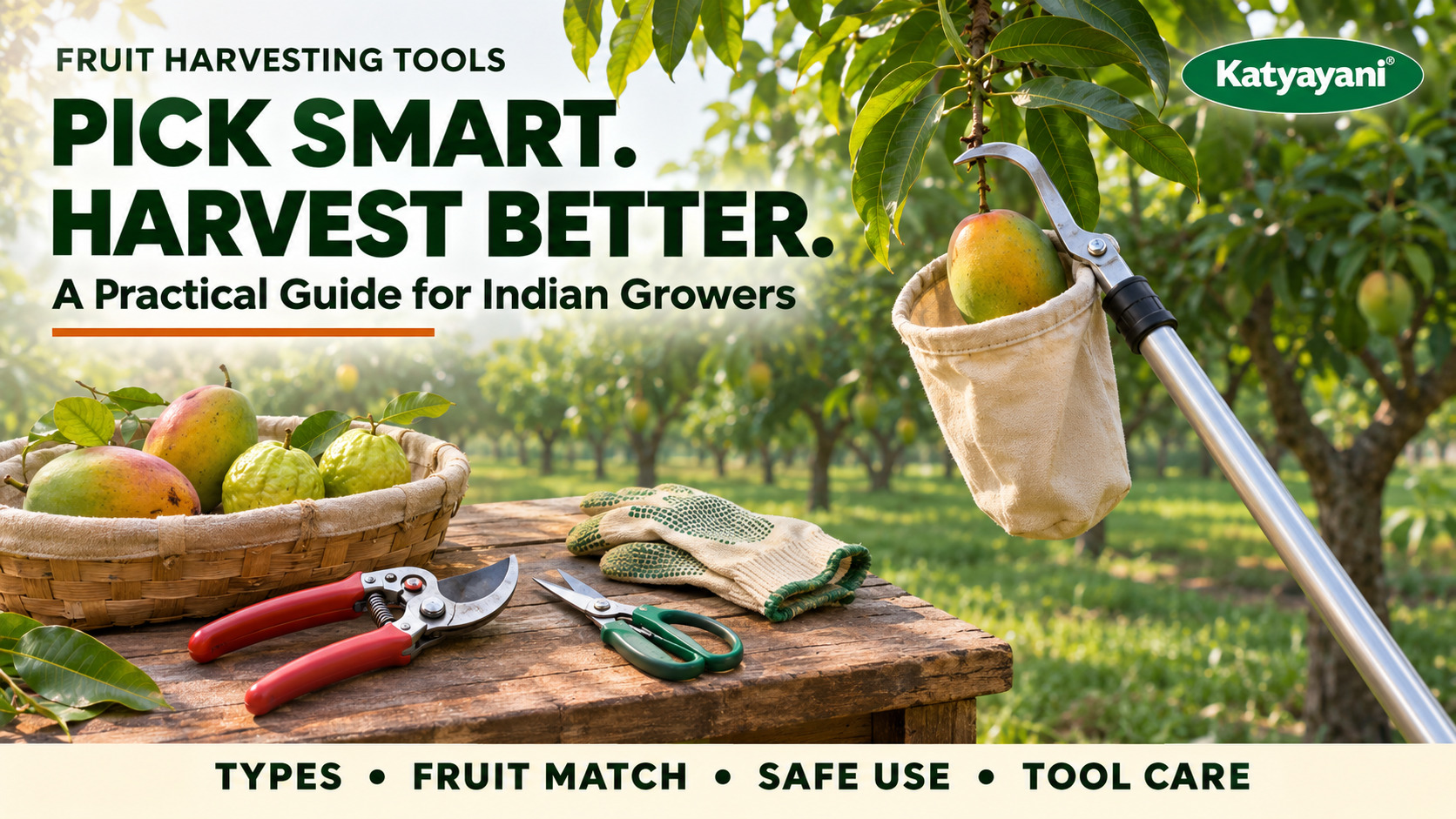
Pick the tool by the fruit and the tree. Use secateurs or long-nose scissors for pomegranate and grapes, a pole harvester with a net or chute for mango, sapota and guava, a twist-off jaw harvester for orange, peach and pear, a curved knife or pole knife for banana, and a climbing device for coconut. Cut with a sharp, thin blade, keep a short stalk on the fruit as NHB advises, and never let fruit drop to the ground. A TNAU study found that a lighter, better-fitted harvester cut energy use by 14 to 20 percent. Keep blades clean and sharp, and use a ladder only after checking it.
What are fruit harvesting tools, and why does the choice matter?
Fruit harvesting tools are the cutters, poles, nets, jaws, knives and climbing devices that take fruit off the plant without bruising it or hurting the worker. The choice matters because a rough pick starts rot that shows up days later in the market, and a poor tool leaves the worker sore.
The usual methods are blunt. A TNAU journal study describes shaking the tree by hand, climbing it to pluck fruit, or pushing fruit from below with a local pole. The fruit then lands on the ground, which the authors say causes internal injury and spoilage during ripening. Wrist, shoulder and neck pain were the main complaints of the workers. See the TNAU study in the Madras Agricultural Journal.
ICAR-CISH, Lucknow gives a number for mango. Shaking or beating the branches cracks and bruises fruit and causes about 8 to 10 percent loss at the farm level, as the Indian Horticulture paper reports. NHB puts total mango post-harvest loss, harvest to consumption, at 25 to 40 percent and says proper harvesting, transport and storage can reduce it (NHB mango post-harvest sheet).
| What goes wrong | What it costs you | Source |
|---|---|---|
| Shaking or beating branches | Cracked and bruised fruit; about 8 to 10 percent farm-level loss in mango | ICAR-CISH |
| Fruit dropped to the ground | Internal injury and spoilage during ripening | TNAU study |
| Fruit with no stalk (mango) | Sap oozes and stem-end rot follows, as the TNAU paper summarises earlier work | TNAU study |
| Heavy, badly fitted tools | Wrist, shoulder and neck pain; more energy used per hour | TNAU study |
| Poor harvest, transport and storage together | Mango losses of 25 to 40 percent from harvest to consumption | NHB |
What are the main types of fruit harvesting tools?
There are six families: hand-held cutters (secateurs, long-nose scissors, knives), pole tools with a blade and a catching net or chute, twist-off jaw harvesters, banana knives and pole knives, climbing devices for palms, and ladders or platforms. Each one solves a different problem of reach, cut and catch.
| Tool family | How it works | Fruit it is described for in our sources |
|---|---|---|
| Secateurs / clippers | Cut the stalk close to the fruit while one hand holds the fruit | Pomegranate (NHB); a general tool in FAO |
| Long-nose scissors | Reach between bunches without touching other berries | Grapes (NHB) |
| Pole with blade and catching net or chute | A telescopic pole puts a blade at the stalk; the fruit drops into a net or slides down a chute | Mango, sapota, guava (TNAU); mango and avocado (FAO) |
| Frame harvester for mango | A conical frame is pushed into the canopy; a blade shears the stalk; a net collects the fruit | Mango (ICAR-CISH) |
| Twist-off jaw harvester | Two spring-loaded jaws hold the fruit, a twist shears the stem, a cloth conveyor catches it | Peach, pear, orange (TNAU) |
| Banana knife / pole knife | A curved knife cuts the bunch stalk; a pole of 1.80 m with a knife at the tip is the second method | Banana (TNAU-linked paper) |
| Coconut climbing device | Lets one person climb the trunk and harvest nuts | Coconut (TNAU) |
| Ladder or platform | Gives the picker height | Tree fruit (PNASH) |
No single tool covers every fruit. A grape bunch needs a fine cut and a gentle hold. A banana bunch weighs 25 to 35 kg, and the TNAU-linked banana paper says Robusta and Poovan bunches can go past 55 to 60 kg. You cannot use the same tool for both.
How do you choose the right harvesting tool for your fruit and tree height?
Start with the fruit: does it hang on a stalk you can snip, a bunch, or a heavy single fruit high on a tall tree? Then check tree height and fruit weight. Choose a tool that cuts the stalk, catches the fruit and is light enough for a full day of work.
| If your fruit is... | Tool to look at | Why, per the sources |
|---|---|---|
| Pomegranate, within arm reach | Secateurs | NHB: cut with secateurs keeping 1 cm of stalk (NHB) |
| Grapes | Long-nose scissors, perforated trays | NHB: care not to injure other berries; avoid rubbing off the waxy coating (NHB) |
| Mango, sapota, guava on tall trees | Telescopic pole harvester with chute or net | TNAU designed it for these three fruits (TNAU) |
| Mango with a short stalk wanted | Frame harvester, or scissors for export fruit | ICAR-CISH harvester; NHB export cut at 1 cm (ICAR-CISH, NHB) |
| Orange, peach, pear | Twist-off jaw harvester | TNAU lists these three crops (TNAU) |
| Banana bunch | Curved knife, or pole knife with a second person to catch | TNAU-linked banana paper (paper) |
| Coconut on tall palms | Climbing device | TNAU coconut page (TNAU) |
| Papaya, dragon fruit, watermelon, avocado | Hand picking or a clean knife, chosen by maturity signs first | See the live crop posts: papaya, dragon fruit, watermelon, avocado |
Think about the worker too. The TNAU study used body-size data for Indian farm workers, such as vertical grip reach (mean 1,991 mm) and inside grip diameter (5th to 95th percentile 43 to 56 mm). A tool that fits a small hand is easier to hold all day.
How does a pole harvester with a net or chute work?
A long pole carries a cutting blade at the top. You push the blade to the stalk, pull or squeeze to cut, and the fruit drops into a net or slides down a chute to the ground. The picker stays on the ground, and the fruit never falls free.
The TNAU harvester in the Madras Agricultural Journal study has four parts: a telescopic pole, a lock pin, a chute and a cutting blade. The pole is two concentric aluminium tubes. It is 1,372 mm when closed and 2,743 mm when fully extended, and a spring-loaded lock pin fixes the height at five positions. Base diameter is 24 mm and the top tube is 22 mm. The whole tool weighs 1,620 g.
The chute is the clever part. It carries the fruit to the ground without damage and was designed so it does not snag on branches and does not add much weight. FAO says the same thing in simple words: picking poles suit hard-to-reach crops such as mangoes and avocados, the cutting edge must stay sharp, and the catching bag should be fairly small. FAO also says that cutting angle and bag shape affect fruit quality, so you should try a new tool on a few trees before using it across the orchard. See FAO Small-Scale Postharvest Handling Practices.
| Part | Job | What the TNAU design uses |
|---|---|---|
| Telescopic pole | Reach different fruit heights | Two aluminium tubes, 1,372 mm to 2,743 mm, five lock positions |
| Lock pin | Fix the height | Spring-loaded pin with a lever |
| Chute | Carry fruit down without a drop | Shape and material chosen from fruit weight, size and shape; does not snag on branches |
| Cutting blade | Cut the stalk | Off-the-shelf shears; 3 mm blade with a 30 degree bevel tested best |
| Handle | Hold and pull | Grip fixed at 30 mm from Indian worker body-size data |
What is a mango harvester, and how much fruit loss can it save?
A mango harvester is a pole tool with a frame, blade and net. The fruit sits inside the frame, the blade shears the stalk and the net holds the fruit. ICAR-CISH reports that its light harvester gave 40 percent less fruit loss than an older metal harvester.
The Indian Horticulture paper by A K Verma and colleagues at ICAR-CISH, Lucknow, describes the problem first: mango is usually harvested by shaking or beating branches, which cracks and bruises fruit. The new harvester is light and easy to use, and the abstract reports that fruit loss was 40 percent less than with the old metallic harvester.
The Principal Scientific Adviser portal lists the same ICAR-CISH harvester, developed by Dr T. Damodaran. It says the harvester picks 600 to 800 fruits an hour against 150 to 200 an hour by hand, and has a lightweight, unbreakable frame with sharp blades. It also says the harvester gives 4 to 5 percent less fruit loss than hand harvesting. See the PSA portal listing. Treat the hourly figures as the developer's trial numbers, not a promise for every orchard.
The TNAU paper also reviews older designs. In an earlier comparison, the UAS model had a weak net with more drops and harvested fruit without a stalk, and it pulled branches. The IIHR model was a little heavy and harder to use on high trees, but it harvested fruit with the stalk, which improved shelf life, and it suited export fruit best.
| Mango harvester model | What the sources say | Source |
|---|---|---|
| ICAR-CISH harvester | Light and easy to use; 40 percent less fruit loss than an old metal harvester; 600 to 800 fruits an hour per the PSA listing | ICAR-CISH paper, PSA portal |
| IIHR model | Harvests with the stalk, better shelf life, suits export fruit; a little heavy for high trees | TNAU paper (reviewing earlier work) |
| UAS model | Weak net with more drops, fruit without stalk, branches pulled | TNAU paper (reviewing earlier work) |
| Local pole tools | Fruit without stalk, sap flow, many drops to the ground | TNAU paper |
How should you cut mango fruit to avoid sap burn and stem-end rot?
Cut the stalk with a sharp blade and leave a short piece on the fruit. NHB says export mangoes are cut about 1 cm from the fruit with sharp scissors, then kept upside down for two hours so latex flows out, and that latex must never fall on the fruit.
Here is what that looks like on a picking day. A worker cuts the stalk, and the fruit goes stalk-down on a knitted pallet. After two hours the latex has drained, and the fruit can be packed. NHB says this is the export routine, and that the fruit is graded into three weight bands: 200 to 250 g, 251 to 300 g and 300 to 350 g (NHB).
The TNAU paper adds the reason. Fruit harvested without a stalk oozes sap, which shortens shelf life and invites stem-end rot. That is why the better harvesters cut instead of pulling. Pole harvesters that cut the stalk help here, and shaking does not. You can see this in the way the ICAR-CISH frame blade shears the stalk instead of tearing it.
NHB also warns that harvesting early to catch a high market price is common, and those premature fruits do not ripen evenly without a ripening aid. A good tool cannot fix a pick that is too early.
Which tool should you use for pomegranate?
Use secateurs. NHB says pomegranate fruits are harvested with secateurs keeping 1 cm of stalk on the fruit, and that all fruits should be picked in 2 to 3 pickings within a month. Do not pull the fruit off by hand.
Make the cut with the blade square to the stalk and measure the first few by eye against a 1 cm mark, such as the width of your little finger tip (our rule of thumb). After picking, NHB says the fruit is cured for a week in shade, which hardens the skin so it stands transport better (NHB pomegranate harvesting sheet).
Timing matters as much as the tool. NHB says delay in harvesting leads to fruit cracking, and fruit picked too early has poor keeping quality and is prone to damage in handling. The maturity signs (yellowish rind, metallic sound when tapped, flattened sides, shrunk beak) are in our pomegranate farming guide.
Which tool should you use for grapes?
Use long-nose scissors and perforated trays. NHB says local-market grapes are cut early in the morning with long-nose scissors, taking care not to injure other berries, and that the picker should hold the bunch by its stem so the waxy coating is not rubbed off.
For export, NHB gives a tighter routine. Harvest in the early hours and stop when berry temperature rises above 20 C. It adds that it is advisable to close harvest by 10 a.m., because otherwise precooling cannot bring berry temperature down to 4 C within the stipulated six hours. The cut is made just above the knot on the bunch stalk. Bunches then go gently into clean perforated plastic trays, in not more than two layers (NHB grape harvesting sheet).
| Step | What NHB says | Tool or item |
|---|---|---|
| Cut | Cut selected bunches; export bunches are cut just above the knot on the stalk | Long-nose scissors |
| Hold | Hold the bunch by its stem to protect the waxy coating | Your hand, not the berries |
| Place | Put bunches gently in clean perforated plastic trays, not more than two layers | Perforated tray |
| Trim | Remove decayed or defective berries before packing | The same scissors, kept clean |
| Stop | Export picking stops when berry temperature rises above 20 C; close by 10 a.m. | Your clock |
What does a twist-off jaw harvester do, and which fruits does it suit?
A twist-off jaw harvester grips one fruit between two jaws, and a twist shears the stem. TNAU lists a manual model for peach, pear and orange. It weighs 0.45 kg and harvests 65 kg an hour, which TNAU puts at 250 to 300 fruits per man-hour.
Look at the build, because it shows what a good tool needs. The TNAU page says the jaws are 14-gauge mild steel sheet, closed by a tension spring on a pivot fitted to a 10 mm mild steel rod. The inside of the jaws has 3 mm rubber padding to protect the fruit skin. A rope on one jaw opens it: pulling the cord releases the fruit. A cloth conveyor or net below the jaws catches the fruit and brings it to ground level without damage. The tool is 400 mm long and 290 mm wide. See the TNAU manual fruit harvester page.
| Feature | TNAU manual fruit harvester |
|---|---|
| Length x width | 400 mm x 290 mm |
| Weight | 0.45 kg |
| Power | Manual, one person |
| Capacity | 65 kg per hour; 250 to 300 fruits per man-hour |
| Fruit contact | 3 mm rubber padding inside the jaws |
| Catch | Cloth conveyor or net under the jaws |
| Crops named | Peach, pear, orange |
Which knife or tool should you use for banana bunches?
Use a curved knife with a cutter and a backer, or a knife on a 1.80 m pole with a second person to catch the bunch. A TNAU-linked paper says both methods are common, and that bunches weigh 25 to 35 kg, and over 55 kg for Robusta and Poovan.
The paper by Benjamin and Anantha Krishnan describes the two ways. In the first, the cutter cuts the plant with a machete while the backer waits to catch the cut stem on a thick cushion on his shoulder; the backer then carries the bunch to the shed or market, or loads it on a cart. In the second, the pole knife cuts the bunch without felling the plant, and one person cuts while another catches the falling bunch.
The study also checked local banana knives, which are made in village smithies without any design rule and vary a lot in size, shape and weight. It found 3 mm and 6 mm blades on the market and reported that 3 mm blades needed less cutting energy than 6 mm. For the handle it suggested 150 mm length and 35 mm diameter, from the Indian worker body-size book, and said a knife weighing above 400 g gave ergonomically good results. The authors also say all harvesting systems cause musculoskeletal problems, such as back and shoulder pain.
| Banana method | People needed | Tool |
|---|---|---|
| Cutter and backer | Two | Machete or curved knife; thick shoulder cushion for the backer |
| Pole knife | Two (one cuts, one catches); sometimes one | Knife on a wooden pole about 1.80 m long |
How does a coconut climbing device work, and who can use it?
A coconut climber lets one person go up the trunk to cut nuts and clean the crown without a bare-handed climb. The TNAU climber takes about 1.5 minutes to climb a 30 to 40 ft tree and can be used by unskilled people, including women.
The TNAU coconut implements page describes it as useful for climbing coconut trees for harvesting nuts, cleaning and other operations. It lists a capacity of 50 to 60 trees a day. That makes it a tool for farms where skilled climbers are scarce. The same page also lists a tractor-mounted coconut sprayer with telescopic pipes from 9 to 14 m, which reaches the crown from the ground; it sprays and does not harvest.
We did not use news reports on drone or robot coconut pluckers. They are in development and no official page we opened gives a working specification.
What about papaya, dragon fruit, avocado and watermelon?
For these fruits the live crop posts describe maturity first and a simple hand pick or clean knife second. No official source we opened names a special harvesting tool for any of them, so we do not invent one. Pick by the maturity signs, and use a clean, sharp blade where a cut is needed.
- Papaya. The papaya post says pick each fruit by hand to avoid injury, and names the maturity signs (full size, light green with a yellow tinge at the tip, latex turning watery). See papaya farming in India.
- Dragon fruit. The dragon fruit post cites a knife cut without damaging the fruit, then straight to shade. See dragon fruit farming in India.
- Avocado. The avocado post says fruit stays hard on the tree and softens only after harvest, so colour alone is unreliable; avoid harvest in rain or direct sun, and avoid bruises. See avocado farming in India.
- Watermelon. The watermelon post says to harvest only when the tendril near the fruit dries, the ground spot turns yellow and the fruit sounds dull. See watermelon farming package of practices.
In all four, the risk is picking too early or bruising, and a better tool does not solve either. Learn the signs, then pick.
What makes a good cutting blade for harvesting?
A thin, sharp blade with a low bevel angle. In TNAU tests a 3 mm blade needed less cutting force than 2 mm and 5 mm blades, and a 30 degree bevel on the 3 mm blade needed the least force. FAO adds that clippers and knives should stay sharp.
| Fruit | Minimum cutting force with a 3 mm blade at a 30 degree bevel (TNAU test) |
|---|---|
| Mango | 1240.35 N |
| Sapota | 340.00 N |
| Guava | 400.25 N |
In plain words, the mango stalk took far more force to cut than the sapota stalk, so the same blade works harder on mango. A dull blade makes it worse: you pull harder, the stalk tears, and the fruit shakes. FAO says to trim stems close so the fruit does not damage its neighbours in transport. The TNAU banana work found the same 3 mm result against 6 mm knives, so thinner was better in two separate studies, for two different fruits.
The study chose off-the-shelf shears for the blade, to avoid delay and design trouble. That is useful for a buyer: you can fit a good replacement shear and keep the tool in service. See the TNAU study.
How much strain does a better-designed harvester save?
A lot, per one TNAU study. Three ergo-refined fruit harvesters cut energy use by 20, 14 and 18 percent compared with common harvesters, and cut the rise in heart rate by 25, 12 and 14 percent. The best model, N1, was the lightest one.
The researchers tested five common harvesters (scissor type, V-knife with cotton net, V-knife with star wheel catcher and nylon basket, a rod collector, and a bottle-shaped collector) against three new models, using five workers. They measured heart rate, oxygen use, energy cost, the acceptable workload, discomfort rating and body-part discomfort. The body-part discomfort score fell by 12 to 23 percent with the new models.
| Measure | N1 | N2 | N3 |
|---|---|---|---|
| Energy expenditure reduced by | 20 percent | 14 percent | 18 percent |
| Oxygen use (as percent of VO2 max) reduced by | 21 percent | 9.4 percent | 12 percent |
| Heart rate rise (delta HR) reduced by | 25 percent | 12 percent | 14 percent |
| Overall discomfort rating reduced by | 11 percent | 15 percent | 17 percent |
Look at the conventional figures in the same study too. Two of the five old harvesters (H3 and H4) pushed the workers past the continuous-work limit of 40 beats a minute above resting rate, with delta HR of 45.8 and 45.4. N1 kept it at 24.8. That is the difference between a worker who finishes the day and one who stops at lunch. This is one study with five workers, so treat it as a strong pointer and not a guarantee.
How do you use a pole picker without bruising fruit?
Cut, catch and lower, never drop. FAO says fruit dropped from tall trees bruises badly. Use a catching bag or chute, or work in pairs: one cuts, the other holds a sack and lowers the far end so the fruit rolls safely to the ground.
- Pick the right height. Set the telescopic pole so you do not stretch your arms above your shoulders. Raising the arm above the shoulder is flagged as a strain point in the PNASH harvest safety flier.
- Place the blade on the stalk, not the fruit. The TNAU harvester cuts the pedicel, so the blade has to sit on it.
- Cut cleanly. A sharp edge, as FAO says, and a short stalk left on the fruit as NHB says for mango and pomegranate.
- Let the net or chute take the fruit. Keep the catching bag fairly small, as FAO advises.
- Empty gently. FAO says buckets protect fruit better than baskets because they do not collapse and squeeze it, and plastic crates nest when empty and stack when full.
- Use clean hands. FAO lists cotton gloves, trimmed fingernails and no rings or bracelets to reduce damage.
One more FAO point: a small single-wheel cart pushed along the row reduces bending and lifting for the picker.
How do you use ladders and harvest bags safely?
Inspect the ladder before you climb, set it at the correct angle, keep both hands on the rails and never step on the top step or top cap. Empty the picking bag often and avoid bending at the waist to do it. These points come from the University of Washington PNASH flier.
The PNASH flier came from a research project on apple orchards in Washington State, so it is a foreign source, but ladder and bag rules do not change with the country. Workers using a harvest-assist platform, instead of a ladder, had less reaching with arms above the shoulders and less repetitive motion, and less ladder use meant fewer ladder falls.
| Before you climb | While you pick | When you empty the bag |
|---|---|---|
| Inspect the ladder; set the correct angle; step firmly on the bottom rung to check it is stable | Both hands on the rails; toes toward the front; belt buckle between the rails; do not step on the top step or top cap | Empty the bag often; minimise bending at the waist |
| Wear shoes or boots with stiff soles and a heel; adjust the bag to the worker | Start with an empty bag at the top of the canopy; avoid stepping on branches or trellis wires | Keep the ground free of fruit and debris |
| Set the third leg of a tripod ladder at the centre on flat ground, and slightly downhill on a cross slope | Minimise raising the arm above the shoulder; take breaks in the workday | Rotate workers between ground and ladder work |
How do you clean, sharpen and store harvesting tools?
Wipe off sap and dirt after use, sharpen the edge, and disinfect blades when you move between trees or after cutting diseased fruit. Iowa State Extension says to remove sap and debris first, then wipe with 70 percent alcohol or soak in a 1 to 9 bleach solution for at least 10 minutes, and rinse.
The Iowa State advice is written for pruning shears and is a foreign source, but the same blades do the cutting in orchards. It says to disinfect between plants at a minimum when you cut diseased material, and ideally between every cut. Add bleach to the water, not water to the bleach, and use the mix within two hours. Alcohol does not need a long soak and needs no rinse. Iowa State says not to use alcohol on tools used on apple trees with fire blight; use bleach there.
| Step | What to do | Source |
|---|---|---|
| 1. Clean | Remove dirt, sap and debris from the blade first | Iowa State |
| 2. Disinfect (alcohol) | Wipe or dip in undiluted 70 percent isopropyl alcohol or ethanol; no rinse needed | Iowa State |
| 2. Disinfect (bleach) | One part bleach to nine parts water; soak at least 10 minutes; rinse to prevent corrosion | Iowa State |
| 3. Sharpen | Keep clippers and knives sharp | FAO |
| 4. Check the catch | Look for torn nets and cracked chutes; the TNAU manual harvester uses a cloth conveyor or net under the jaws | TNAU |
The Iowa page does not say anything about oiling tools after cleaning, so we leave that out.
What mistakes do growers make with harvesting tools?
The common ones are: shaking the tree, letting fruit fall, cutting with a dull or thick blade, pulling instead of cutting, and picking before maturity. Each one appears in the sources above, and each is fixed by a tool or a habit, not by a purchase alone.
- Shaking or beating branches. About 8 to 10 percent farm-level loss in mango, per ICAR-CISH.
- Fruit dropping to the ground. Internal injury and spoilage, per the TNAU study; FAO says fruit dropped from tall trees bruises badly.
- Cutting flush or leaving no stalk on mango. Sap flow and stem-end rot; NHB says to cut about 1 cm from the fruit for export.
- Leaving latex on the fruit. NHB says to take great care that latex does not drop on the fruit while cutting the stem.
- Rubbing the bloom off grapes. NHB says hold the bunch by its stem.
- Waiting too long on pomegranate. NHB says late harvest leads to cracking.
- Picking early for a quick sale. NHB says early mango does not ripen evenly without a ripening aid.
- Standing on the top ladder step. The PNASH flier says do not step on the top step or top cap.
- Using a heavy tool all day. The TNAU study ties heavier, badly fitted tools to higher energy cost and body pain.
What should you check before buying a harvesting tool?
Check six things: the fruit it is described for, pole reach, weight, handle fit, blade thickness and bevel, and what catches the fruit. A tool that fails on any of these costs you in bruised fruit or tired workers.
| Check | What to look for | Basis |
|---|---|---|
| Fruit named | Does the maker or source say the tool suits your fruit? | TNAU names peach, pear, orange for the jaw harvester and mango, sapota, guava for the pole harvester |
| Reach | Does the pole reach your fruit height? Telescopic poles give several heights | TNAU pole: 1,372 mm to 2,743 mm |
| Weight | Is it light enough for a day of work? Lighter models used less energy in the TNAU study | TNAU harvester 1,620 g; jaw harvester 0.45 kg |
| Handle | Does the grip fit the hand? TNAU fixed a 30 mm grip; the banana paper suggests 150 mm length and 35 mm diameter for a knife handle | Indian worker body-size book (CIAE) |
| Blade | Thin, sharp, with a low bevel; can you fit a replacement shear? | TNAU: 3 mm blade, 30 degree bevel |
| Catch | A net, chute or conveyor that keeps fruit off the ground | TNAU, ICAR-CISH, FAO |
The best test is cheap. Take the tool to five trees, pick fifty fruits and count the bruises and the number of times the blade slipped. FAO says to test new tools before using them across the orchard.
Is there a government scheme that helps with farm machinery and post-harvest machines?
Yes, for machinery in general. Our subsidy post describes the Sub-Mission on Agricultural Mechanization (SMAM) as a machinery subsidy with support for custom hiring centres, and the Spices Board post lists subsidised post-harvest machines. Neither page names hand harvesting tools, so do not assume they are covered.
The agriculture subsidy schemes post says rates and ceilings change each year and vary by state, so we do not print them here. The Spices Board schemes post covers post-harvest machines such as threshers, a turmeric boiler, a polisher and a drier. That is for processing after harvest and not for the picking tool itself. A custom hiring centre may be the practical route for a larger machine that one grower cannot justify alone.
Conclusion
The best fruit harvesting tool is the one that fits the fruit, the tree and the worker. Use secateurs for pomegranate, long-nose scissors for grapes, a telescopic pole harvester with a chute or net for mango, sapota and guava, a twist-off jaw harvester for orange, peach and pear, a pole knife or curved knife for banana, and a climbing device for coconut. Keep the blade thin, sharp and clean, leave a short stalk where NHB says so, catch every fruit before it reaches the ground, and treat the ladder with respect.



Leave a Comment