 9 min read
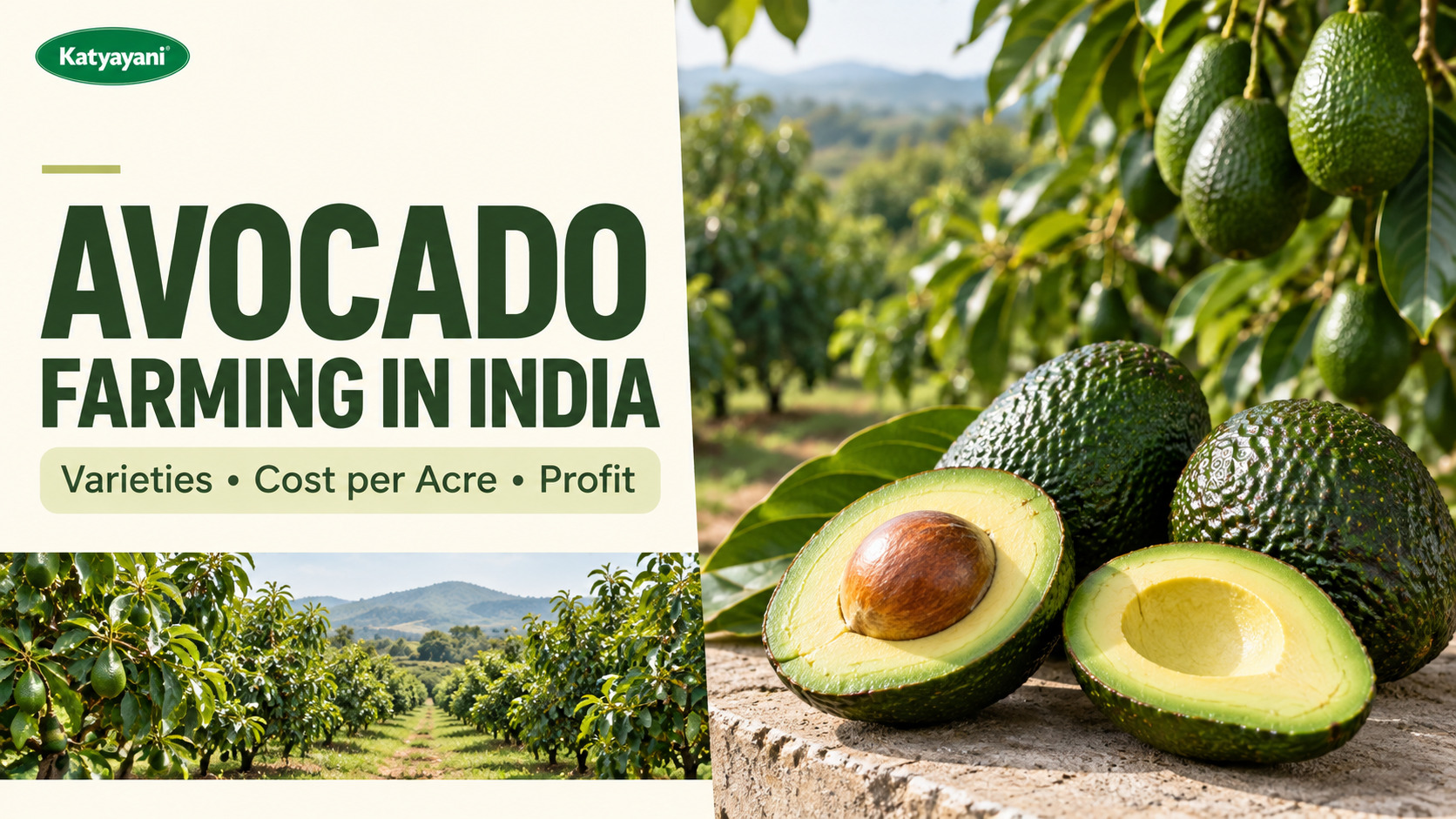
Avocado can be grown in India in cool, frost-free, well-drained hill and plateau areas, mainly Karnataka, Kerala, Tamil Nadu, Maharashtra, Sikkim and the North-East. Plant grafted trees 6 to 8 metres apart, which is about 63 to 112 plants per acre. Grafted trees start bearing in 3 to 4 years. A university table puts total cost at about Rs 5.36 lakh per hectare, around Rs 2.17 lakh per acre.
Can we grow avocado in India?
Yes, but not everywhere. Avocado likes a tropical to sub-tropical humid climate, with temperatures around 12 to 30 degrees Celsius, and it hates waterlogging and hot dry winds. According to ICAR material, it is grown on a limited, scattered scale in Tamil Nadu, Kerala, Maharashtra, Karnataka and Sikkim, and cultivation is growing in Maharashtra, Karnataka, Tamil Nadu and the North-East. Old hill-station pockets such as Kallar near the Nilgiris, Kodaikanal, Yercaud and Coorg have grown it for decades. The Dr YS Parmar University package of practices also reports promising plants in Himachal at 800 to 1,600 metres.
Who Should Not Plant: Do not plant avocado on heavy, waterlogged soil, in frost-prone or very hot dry plains, or if you cannot wait 3 to 6 years for the first crop. Soil pH should be roughly 5 to 7. Test first: see how to read your soil health card.
Is avocado farming profitable in India? What the market looks like
Interest is real. A Bihar agriculture official has projected that Indian avocado consumption could rise from about 10,000 tonnes in 2024 to about 40,000 tonnes by 2026-27, as reported by FreshPlaza. Treat that as a projection, not a forecast you can bank on. One trade report also shows imports rising year after year, which signals demand but also competition from imported fruit. Most Indian supply today still comes from scattered seedling orchards, not large uniform plantations.
So the business case is about being early and doing it right, not about guaranteed prices. I did not find a reliable farm-gate price per kg, so I am not going to quote one. Visit your nearest fruit market and a hotel or retail buyer and ask what they pay for graded fruit. Compare the risk with a similar long-gestation crop in our dragon fruit farming guide.
Avocado varieties in India: which to choose?
| Variety | Type | What the university and ICAR notes say |
|---|---|---|
| Hass | A-type flowering | Medium fruit (150-250 g), black pebbled skin, about 19% oil. Widely grown worldwide, best in cooler conditions |
| Fuerte | B-type | Hardy, medium pear-shaped fruit, wide spreading tree, needs wider spacing |
| Pinkerton | A-type | Large fruit, small seed, bears heavily |
| Zutano | B-type | Cold-hardy, light flavour, often used as a pollinator |
| Arka Supreme (ICAR-IIHR) | A-type | Regular, high-yielding hybrid selection; reported 175-200 kg per tree for a fully grown tree |
| Arka Coorg Ravi (ICAR) | - | ICAR reports an average of 80-100 kg per plant after eight years of planting |
Avocado flowers open as female in the morning and male in the afternoon, or the reverse, depending on the type. Mix A-type and B-type trees so pollination works. The university advises a ratio of 1:1 or 2:1 of A and B groups.
How many avocado trees in 1 acre? Spacing calculator
ICAR advises 6 to 12 metres depending on variety vigour. The Himachal university recommends 6 to 8 metres. One acre is about 4,047 sq m, so the plants per acre are as below (my calculation).
| Spacing | Area per tree | Trees per acre (approx) |
|---|---|---|
| 6 m x 6 m | 36 sq m | 112 |
| 6 m x 8 m | 48 sq m | 84 |
| 8 m x 8 m | 64 sq m | 63 |
| 10 m x 10 m | 100 sq m | 40 |
Closer spacing gives more early fruit but needs pruning later. Spreading types like Fuerte need wider spacing.
How long does an avocado tree take to fruit?
Grafted plants start yielding in 3 to 4 years. Seed-grown plants take 5 to 6 years and give variable fruit, so use grafted plants from a reliable nursery. This is the main reason avocado is a patient-money crop.
Planting, irrigation and care
- Pits: 1 cubic metre, filled with farmyard manure and top soil in a 1:1 ratio. Plant in June-July (or September) in the Himachal guidance. On waterlogging-prone ground, plant on mounds.
- Irrigation: every 3 to 4 weeks in dry months. Never flood, because flooding invites root rot.
- Weeds: avoid deep cultivation as roots are shallow. Mulch with dry grass.
- Pruning: light shaping early, then little.
Fertilizer for avocado: schedule and Katyayani options
Avocado is a heavy feeder, and nitrogen matters most. The university gives this schedule, in two split doses (March-April and September-October):
| Tree age (years) | N (g/plant) | P (g/plant) | K (g/plant) | FYM (kg/plant) |
|---|---|---|---|---|
| 1 | 100 | 30 | 60 | - |
| 2 | 200 | 60 | 120 | 10 |
| 3 | 300 | 90 | 180 | 20 |
| 4 | 400 | 120 | 240 | 30 |
| 5 | 500 | 150 | 300 | 40 |
| 6 | 600 | 180 | 360 | 50 |
| 7 and above | 800 | 210 | 400 | 60 |
Young trees need N, P and K in a 1:1:1 ratio and older trees in 2:1:2. In soils above pH 7, iron deficiency may appear and the university suggests iron chelate at about 35 g per tree. Zinc sulphate at 0.5% as a spray, and boron around flower-bud initiation, are also mentioned. Keep fertiliser at least 60 cm from the stem of young trees.
| Need | Katyayani option |
|---|---|
| Organic matter at planting | Enriched vermicompost |
| Potassium (higher share in older trees) | NPK 00:00:50 potassium sulphate |
| Iron deficiency at pH above 7 | Fe EDDHA iron chelate |
| Zinc | Zinc sulphate |
| Root-rot-prone, wet-season basins | Trichoderma harzianum bio-fungicide |
Use the dose on the pack, and confirm needs with a soil or leaf test. See why nutrients sometimes fail in soil pH and nutrient lock, and pick the right form with our water-soluble vs granular fertiliser guide. Browse the full NPK fertilizer collection.
Avocado cultivation cost per acre
The Himachal university lists the cost of establishing and running one hectare with 277 plants at 6 m x 6 m. I converted to per acre by dividing by 2.47. These are old Himachal rates, so treat them as a template to re-price with local quotes.
| Item | Per hectare (university) | Per acre (converted) |
|---|---|---|
| Establishment (plants, drip, pits, FYM and planting) | Rs 2,19,040 | about Rs 88,700 |
| Maintenance (inter-culture, fertiliser, pruning, irrigation and protection) | Rs 1,60,000 | about Rs 64,800 |
| Harvesting | Rs 40,000 | about Rs 16,200 |
| Watch and ward | Rs 25,000 | about Rs 10,100 |
| Packing | Rs 50,000 | about Rs 20,200 |
| Amortised cost | Rs 42,000 | about Rs 17,000 |
| Total | Rs 5,36,040 | about Rs 2.17 lakh |
The same document says the cost of production is higher than many traditional fruits, but returns after five years are higher than most fruit crops. It does not give a profit number, and neither will I. Work it out with your own yield and price. The ICAR yield note of 80 to 100 kg per plant after eight years for improved varieties is a planning guide, not a guarantee.
Pests, diseases and subsidy
Root rot in waterlogged soil is the biggest killer. Fruit flies, mealy bugs and leaf diseases can also appear. For orchard flowering-stage pest ideas that carry across, see our mango flower pests and diseases guide. Support for new orchards comes mainly through MIDH: see the official MIDH site and our agriculture subsidy schemes guide. For orchard finance, read the Kisan Credit Card guide.
Should you start avocado farming?
It suits farmers in suitable hill or plateau climates who have capital, patience for 3 to 6 years and a nearby buyer. It is a poor fit if you need quick returns, have waterlogged soil or cannot reach a market. Start with a small block of grafted trees from a registered nursery, and visit a working orchard first.
Conclusion
Avocado rewards patience and good site choice. Pick a variety that suits your climate, plant grafted trees on well-drained soil, and price your plan with real market quotes before you buy a single sapling.
Why trust this guide
Written by Team Katyayani, Editorial Team at Katyayani Organics. Cross-checked against published research and university extension programs.

Leave a Comment