 9 min read
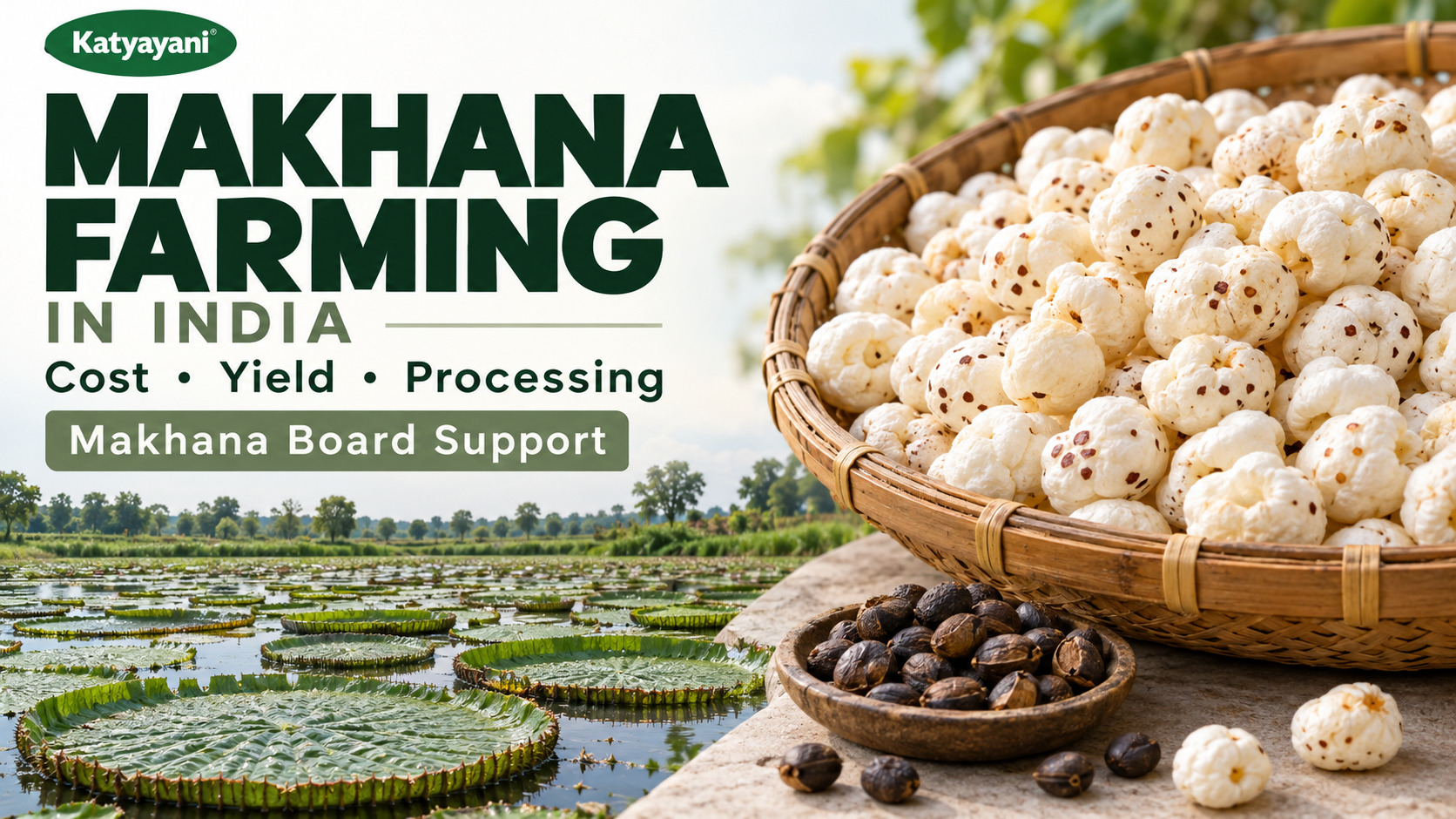
Makhana (fox nut, Euryale ferox) is an aquatic crop grown in ponds or shallow fields, mostly in Bihar. India produced about 63,910 tonnes in 2024-25 and the National Makhana Board was launched on 15 September 2025. A Darbhanga survey put cost at about Rs 25,600 per acre for pond farming and Rs 30,900 for field farming, with gross returns of about Rs 1.19 lakh and Rs 1.47 lakh.
What is makhana farming?
Makhana is the popped seed of the prickly water lily. The plant grows in still, shallow water. After harvest, the seeds are cleaned, dried, roasted and popped into the white puffs we eat as fox nuts. India is the largest producer in the world, and per PIB Bihar gives nearly three-fourths of the country's production and around 80-85% of global supply. The best-known quality brand is Mithila Makhana, which has a GI tag.
Makhana farming in India: pond system vs field system
| Point | Traditional pond system | New field system |
|---|---|---|
| Water depth | Deep, about 4 to 6 feet in ponds and wetlands | Shallow, about 1 to 2 feet in a levelled field |
| Crop duration | Often about a year, because the plant reseeds itself from fallen seed | About 4 to 6 months, as reported |
| Rotation | Mostly single use of the pond | Can be rotated with cereals or fodder, or paired with fish |
| Seed | Left-over seed from the earlier crop | Improved varieties such as Swarna Vaidehi and Sabour Makhana-1 |
The field system is how research centres are moving farmers away from deep ponds. It cuts risk and lets you use ordinary land, which is why cultivated area has grown. Trade press quoting Bihar data reports Bihar's area rising from about 13,000 hectares in 2012 to about 35,000 hectares in 2025. That number needs checking, but the direction is clear.
Makhana farming cost and profit per acre
There is no official per-acre cost sheet. The most useful public data is a 2021-22 survey of growers in Darbhanga district, Bihar, published in Plant Archives. It reports average cost and gross return per hectare. I converted them to one acre (1 hectare = 2.47 acres). These are survey averages, not promises.
| Per acre (converted) | Pond system | Field system |
|---|---|---|
| Average cost reported | about Rs 25,600 | about Rs 30,900 |
| Gross return reported | about Rs 1.19 lakh | about Rs 1.47 lakh |
| Gross return minus cost (my arithmetic) | about Rs 93,000 | about Rs 1.16 lakh |
Read The Fine Print: The survey is from 2021-22. Costs and prices have moved since. Labour for underwater harvest is the biggest cost, and many growers do not count their own family labour. Do your own budget with this year's local rates before you invest.
How much makhana do you get per acre?
The official numbers: the final 2024-25 estimate was 63,910 tonnes nationally at an average of 2.03 tonnes per hectare. The second advance estimate for 2025-26 is 80,590 tonnes at 2.34 tonnes per hectare. Bihar is shown at 60,000 tonnes and 2.00 tonnes per hectare. Per acre that is roughly 0.8 to 0.95 tonnes, or 8 to 9.5 quintals.
One honest caution: the PIB note does not say whether these are raw seed (gurri) or popped makhana. An older Bihar government model DPR said about 3 kg of raw seed gives about 1 kg of popped makhana. Always ask which one a number refers to, because the price is very different.
What is the price of 1 kg makhana?
Per PIB, the average price of popped makhana rose from about Rs 500 per kg during 2020-2022 to nearly Rs 1,250 per kg in 2025. Production grew only 4-5% over FY2022-25 while demand surged, so prices jumped. Retail packs, flavoured makhana and exports carry their own premiums, and farm-gate rates for raw seed are much lower. Check your local mandi rate today, not last year's.
How makhana is grown: step by step
- Choose the system. Pond (deep) or field (shallow, 1-2 ft).
- Prepare the water body or field. Level, bund, and make sure standing water will not dry out.
- Sow seed or transplant seedlings. Certified or research-centre seed gives more uniform plants.
- Manage the water level and weeds through the season.
- Harvest the seeds. In ponds this is done by hand, often underwater, which makes it very labour-heavy. Mechanisation is still limited.
- Clean and dry the raw seed (gurri).
- Roast and pop. High-temperature roasting, then popping. This is a skilled step.
- Grade, polish and pack. Larger puffs fetch higher prices.
National Makhana Board and government support for makhana farming
The Government announced the Board in Union Budget 2025-26 and it was formally launched in Bihar on 15 September 2025. Alongside it, a central sector scheme for makhana development has an outlay of Rs 476.03 crore for 2025-26 to 2030-31. Of that, Rs 30 crore was approved for 2025-26 and Rs 90 crore for 2026-27. PIB says it covers research, quality seed, farmer training, post-harvest upgrades, value addition, branding, exports and quality control.
- In 2025-26, about 1,010 hectares of additional area was brought under makhana, 73 hectares under seed production, and 89 front-line demonstrations were held.
- About 8,159 farmers were reported to have benefited in 2025-26 through training and demonstrations.
- The National Research Centre for Makhana develops varieties, field systems and popping machinery.
- India exported 7,264.89 tonnes of makhana products in 2025-26, per PIB. The US, Canada and the UAE take about 77% of exports.
For other support, see our agriculture subsidy schemes in India guide. Groups can pool seed, labour and popping machines: read SHG vs FPO and the FPO credit guarantee scheme.
Is makhana farming a good business? Pros and cons
| Pros | Cons |
|---|---|
| Strong, growing demand as a health snack; prices have risen sharply | Harvest and seed collection are labour-intensive and hard on workers |
| Can use ponds or waterlogged land that suits few other crops | Needs standing water; weather and water-level risk |
| Value addition (flavoured, flour, ready-to-eat) gives extra margin | Popping is skilled work; poor popping cuts value |
| Board and central scheme support is growing | Most trade is concentrated in Bihar; new regions lack buyers |
Thinking of a processing unit? The Bihar horticulture department's model DPR shows a sample project cost of Rs 170.76 lakh for a makhana processing unit. Use it only as a template. Your numbers will differ.
Should you start makhana farming?
It suits farmers who have standing water or a levelled field, family labour for harvest and a plan for popping and selling. It is a poor fit if you have no water, no buyer or no one skilled in popping. Start with a small plot and compare it with other low-land enterprises: our guides on oyster mushroom farming, dragon fruit farming and vanilla farming show cost, yield and realistic returns in the same format. New to agri business? Start with how to start an agriculture business in India.
Conclusion
Makhana is a real opportunity with real effort behind it. Start small, learn the water and harvest cycle, and plan how you will pop and sell, because that is where the money is made. Use the survey numbers only as a starting point and rebuild them with today's local prices.
Why trust this guide
Written by Team Katyayani, Editorial Team at Katyayani Organics. Cross-checked against published research and university extension programs.

Leave a Comment