 8 min read
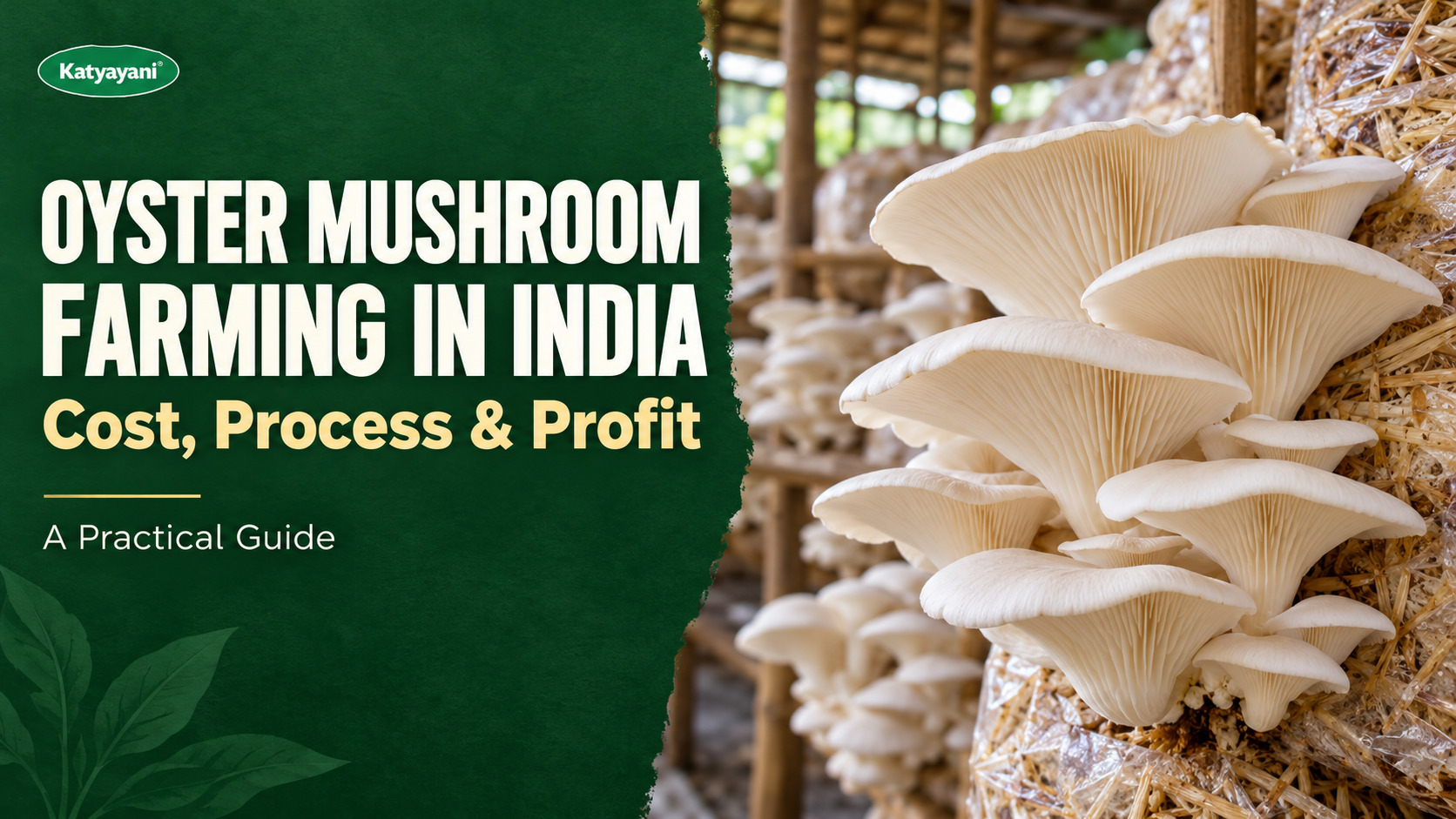
Oyster mushroom farming means growing Pleurotus mushrooms on pasteurized straw inside a clean room. A beginner room of 100-200 sq ft can start with ₹20,000-₹60,000 (guide estimate). One cycle takes 30-45 days, and sale prices of ₹120-₹250 per kg are commonly reported.
What is oyster mushroom farming?
Oyster mushroom (Pleurotus) is the easiest mushroom to grow in India. It grows on farm waste such as paddy straw, wheat straw and sugarcane bagasse, so you do not need soil or sunlight. It also grows at normal room temperatures of about 20-30°C, unlike the button mushroom that needs cooling. That is why small farmers, women self-help groups and unemployed youth often begin with it.
Is oyster mushroom farming profitable in India?
Yes, but profit depends on your scale, your selling price and how few bags get contaminated. Research on real growers shows a clear pattern: bigger units earn more per kg because the fixed cost is spread over more output.
| Source | What it reports | Type |
|---|---|---|
| Meghalaya study of 60 growers (2021) | Net return ₹58/kg (small), ₹76/kg (medium), ₹120/kg (large farms) | Research paper |
| Older Indian study (Phytojournal) | Production cost about ₹31.50/kg, net profit ₹56-₹68/kg | Research paper (older prices) |
| Practitioner guide (AgriWorldView) | 200 kg a month at ₹150/kg = ₹30,000 revenue, net profit about ₹12,000-₹20,000 | Guide estimate |
| Home-scale guide | 10 kg straw batch costs ₹220-₹250, gives about 8 kg; about ₹950 gross profit per batch before labour | Guide estimate |
Treat the research rows as the safer benchmark and the guide rows as a best case. Your own number will depend on your local mandi price, which you should check before you invest.
What do you need to start oyster mushroom farming?
- A room of 100-200 sq ft that is clean, shaded and has windows or vents for fresh air. A spare room, shed or hut works.
- Temperature of about 20-30°C and humidity of 85-90% in the growing room (the humidity figure is quoted from the Directorate of Mushroom Research in the AgriWorldView guide). Research on spawn run shows about 25°C works best.
- Substrate: clean, dry paddy straw, wheat straw, sugarcane bagasse or dry leaves.
- Spawn (mushroom seed): fresh, from a trusted government or ICAR-linked lab. Spawn is the most important input.
- Basic items: racks, polythene bags, a sprayer, a drum or tank for soaking, clean water.
- Training: a short course at your nearest Krishi Vigyan Kendra (KVK) or the ICAR-Directorate of Mushroom Research, Solan.
How to grow oyster mushrooms step by step
- Clean the room. Wash floor and walls and keep out stray animals, flies and dust. A dirty room is the top reason batches fail.
- Cut the straw into 2-4 inch pieces so it packs well.
- Soak for 6-8 hours, then pasteurize with hot water or steam. This kills competing moulds and bacteria but keeps useful ones.
- Drain and cool the straw on a clean surface until it feels moist but does not drip when squeezed.
- Spawning: mix or layer spawn at 3-5% of the dry straw weight into polythene bags. In a university study, 4% spawn on paddy straw gave the highest yield. In an ICAR-DMR study, a 30 x 25 cm bag holding 1,500 g of substrate gave better results for one oyster species.
- Spawn run (12-20 days): keep bags in a dim, closed, clean room at about 25°C until white thread-like growth covers the straw.
- Fruiting: open the bag or cut small slits, spray water lightly 2-3 times a day, and give fresh air. Tiny mushroom pins appear in a few days.
- Harvest when the cap edges are still slightly curled. Pins to harvest takes 4-7 days. Twist the mushroom off at the base. Bags usually give more than one flush.
A full crop cycle takes about 30-45 days. A guide reports 600 g to 1 kg of fresh mushroom from each 1 kg of dry straw, but that is a best-case figure; plan on less until you have your own data.
Oyster mushroom farming cost in India
| Item | Estimated cost | Note |
|---|---|---|
| Room cleaning and setup | ₹5,000-₹15,000 | One time |
| Racks and shelves | ₹8,000-₹30,000 | One time |
| Bags, sprayer, tools | ₹3,000-₹10,000 | One time |
| Straw and raw material | ₹3,000-₹10,000 | Per cycle |
| Mushroom spawn | ₹2,000-₹8,000 | Per cycle |
| Labour, electricity, water | ₹5,000-₹20,000 | Per month |
| Total to start | ₹20,000-₹60,000 (home) or ₹1 lakh-₹5 lakh+ (commercial) | Guide estimate |
These are estimates from one guide, not a price list. Get quotes for racks and spawn in your own district.
Common problems and how to avoid them
- Green or black mould in bags. Usually from weak pasteurization, dirty hands or old spawn. Remove and bury infected bags far from the room.
- Do not bring Trichoderma bio-products into the mushroom room. Trichoderma is great for crop soil, but it is also the green mould that destroys mushroom bags. Keep it away from your growing area.
- Mushrooms drying out. Humidity is too low. Mist walls and floor, not the mushrooms directly.
- Slimy, smelly patches. Too much water and poor airflow. Reduce spraying and add ventilation.
- Flies. Use fine nets on vents and sticky traps. Do not spray farm pesticides on mushrooms; ask your KVK before using any chemical in the room.
How and where to sell oyster mushrooms
Reported selling prices are ₹120-₹250 per kg, and some farmers report about ₹200 per kg. Fresh mushrooms spoil fast, so sell within a day or two. Good buyers are local hotels and restaurants, vegetable markets, housing societies and online groups. You can also dry them for longer shelf life. Always sell to 2-3 buyers so one cancellation does not hurt you.
What to do with leftover mushroom straw
After harvest, the used straw (spent substrate) can be turned into compost. Mix it with a compost activator to speed up decomposition, then blend with enriched vermicompost before using it in vegetable beds. This is a small extra income or a free input for your own field. Browse more options in our organic manure and soil fertilizer range.
Subsidy, loan and training for mushroom farming
Subsidy amounts for mushroom units differ by state and change often, so ask your state horticulture department or KVK for the current norm instead of trusting a number on a blog. The National Horticulture Board and MIDH websites list horticulture support schemes. For finance, read our guides on PMEGP loan for agriculture business, SHG loan for agriculture and the Kisan Credit Card (KCC) scheme. If you are planning a bigger unit, our how to start an agriculture business in India guide covers licences and planning, and the agriculture subsidy schemes in India list shows what else you can claim.
Get expert help and the right inputs on your phone
Two Katyayani apps help at different stages. Farmers can use the Katyayani Krishi Direct app: it has a free agri video call with a farming expert, a crop calendar, order tracking, and works in 9 languages (Hindi, English, Marathi, Kannada, Telugu, Tamil, Malayalam, Bengali, Odia). Retailers and dealers can use the Katyayani Partner (Retailer) app to see product details, place orders, track delivery and apply for credit with a simple KYC.
Conclusion
Oyster mushroom farming is a low-cost way to start an agri business: a small room, clean straw and good spawn are enough. Start with one or two racks, track your cost per kg, and fix contamination before you scale. Sell to more than one buyer, reuse the spent straw as compost, and use the free expert video call in the Katyayani Krishi Direct app for any crop questions on your farm.
Why trust this guide
Written by Team Katyayani, Editorial Team at Katyayani Organics. Cross-checked against published research and university extension programs.

Leave a Comment