Loading…
Loading…
Explore Rabi and horticulture crop guides with practical tips on cultivation, nutrition, pest control, disease management, and better crop growth.
69 articles
 17 min
Winter wheat is fed in three steps. Before winter, a thin stand gets a small dose of nitrogen (Purdue says 20 to 30 lb per acre) and phosphorus goes in at seeding. At spring green-up, nitrogen goes on once fields are fit, and Purdue calls Feekes 4 to 5 the best window. Stop around Feekes 6 (jointing). Total nitrogen is set by yield goal: Penn State uses about 1 lb per bushel, while the Tri-State guide gives 120 lb for 100 bushels. Check sulphur on light soils.
 16 min
Fog and dew do not make a disease from nothing. They put liquid water on the leaf, and most winter fungi and water moulds need that water to start an infection. PAU puts wheat yellow rust at 7 to 13 C nights with 85 to 100 percent humidity, mustard Alternaria blight at 15 to 25 C with humidity above 75 percent, and white rust at 13 to 25 C with humidity above 75 percent. Powdery mildew is the exception and does not need wet leaves. After a foggy night, wait until the fog clears and the dew dries before you spray, as the IMD and ICAR Mizoram bulletin of 6 November 2026 advises, and spray before the disease spreads, not after.
 17 min
Fodder sorghum is a fast-growing kharif green fodder. ICAR-IIMR gives 25 kg seed per hectare in 30 cm rows for single-cut types and 10 kg per hectare in 45 cm rows for multi-cut types. Cut single-cut sorghum at 50 percent flowering. For multi-cut types the first cut is at 55 to 60 days and later cuts every 35 to 45 days. Young sorghum carries prussic acid (HCN). IIMR says it is highest at 35 to 40 days and falls below the toxic level after about 40 days. More than 200 ppm in fresh forage is dangerous. Never feed or graze young shoots, drought-stressed crop or regrowth after frost.
 16 min
Pick the tool by the fruit and the tree. Use secateurs or long-nose scissors for pomegranate and grapes, a pole harvester with a net or chute for mango, sapota and guava, a twist-off jaw harvester for orange, peach and pear, a curved knife or pole knife for banana, and a climbing device for coconut. Cut with a sharp, thin blade, keep a short stalk on the fruit as NHB advises, and never let fruit drop to the ground. A TNAU study found that a lighter, better-fitted harvester cut energy use by 14 to 20 percent. Keep blades clean and sharp, and use a ladder only after checking it.
 16 min
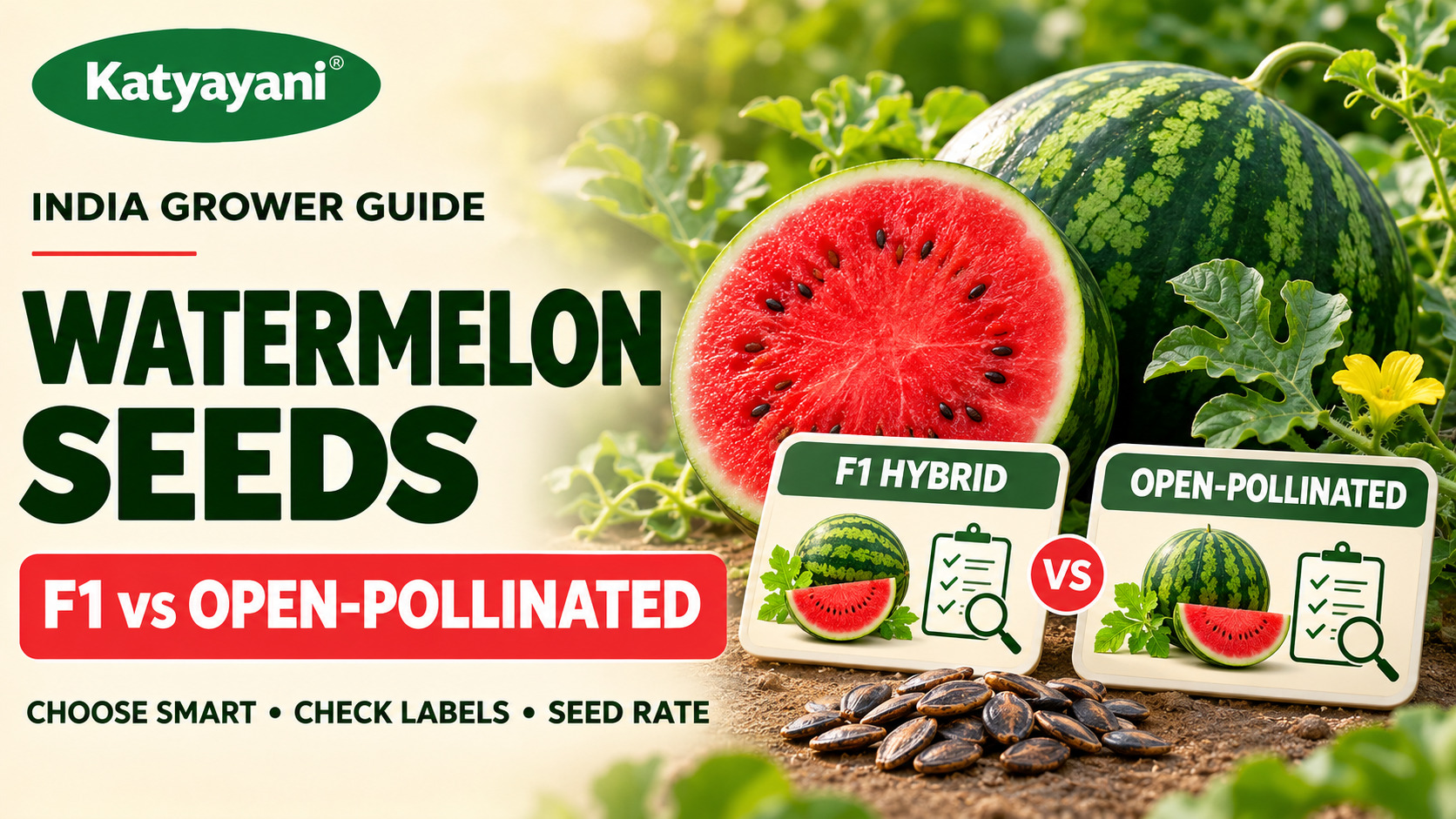
A hybrid (F1) watermelon seed is the first-generation seed from crossing two parent lines, so you buy fresh seed every season. Pick by buyer first: fruit weight, flesh colour, sweetness (TSS), shelf life, sowing season and disease record. ICAR-IIHR lists Arka Akash as an F1 hybrid at 75 to 80 tonnes per hectare. Nunhems India pages for MaxX, Force 9, Rehaan and Impact give 3 to 4.5 kg fruit and TSS 11 to 13% (company claim). Check the packet for lot number, test date, net weight and seller name. For certified hybrid seed the Indian standard sets 98% pure seed and 60% germination.
 16 min
Official data show a sharp rise and a slow fall. In Guntur, normal-variety dry chilli sold near Rs 10,100 to 13,100 per quintal in September to December 2021 and near Rs 22,900 to 24,300 in September to December 2022 (ANGRAU). From June 2023 to May 2024 the Guntur average was Rs 18,610 per quintal for normal varieties, and the monthly price slid from Rs 20,571 to Rs 13,262. In 2025-26 the Andhra Pradesh yearly average was Rs 15,240, from Rs 11,779 in July 2025 to Rs 19,321 in March 2026. India grew 24.6 lakh tonnes in 2025-26 (advance estimate, Spices Board) and exported 6.84 lakh tonnes worth Rs 10,396 crore. Chilli has no MSP, so the market sets the price. Always check today's rate on Agmarknet or e-NAM.
 17 min
Zinc, sulphur, boron and iron are the gaps that matter most for Indian sugarcane. The ICAR national soil survey found 58.6 percent of Indian soils short in sulphur, 51.2 percent in zinc, 44.7 percent in boron and 19.2 percent in iron. PAU, tabulating AICRP (Sugarcane) advice, lists 25 kg ferrous sulphate and 20 kg zinc sulphate per hectare where deficiencies exist, with a 1 to 2 percent ferrous sulphate spray for iron chlorosis. TNAU gives 37.5 kg zinc sulphate and 100 kg ferrous sulphate per hectare for Tamil Nadu soils. These are two state packages. Test the soil first, check pH, and treat yellowing early, especially in ratoon cane.
 16 min
Zinc, boron and sulphur shortages are common in Indian soils, and ICAR-DOGR reports that micronutrient application raised onion bulb yield by 7 to 15 percent over control. A national ICAR study of 242,827 soil samples found 58.6 percent of Indian soils short in sulphur, 51.2 percent in zinc and 44.7 percent in boron. ICAR-DOGR recommends 15 or 30 kg sulphur per hectare by soil sulphur status, 10 kg zinc sulphate and 10 kg borax per hectare only in deficient areas, and a foliar micronutrient mixture at 45 and 60 days after transplanting where several nutrients are short. Test the soil first, keep soil pH between 6.0 and 7.5, and correct a visible shortage straight away.
 15 min
India grows potato by several methods, and the right one depends on soil, water, season and altitude. Ridge and furrow is the standard in the plains: ICAR-CPRI plants 30 to 50 g seed tubers 20 cm apart on ridges 50 to 60 cm apart, 8 to 10 cm deep, and earths up at 20 to 25 days. In an ICAR-CPRI Gwalior trial, drip on raised beds gave 35.8 t per ha, sprinkler on raised beds 33.7 and ridge-furrow with furrow irrigation 30.8 (bed shape and irrigation method changed together). On rice fallows in the Sundarbans, zero tillage under paddy straw averaged 32.0 t per ha across six straw and fertiliser treatments against 21.4 for ridges. Hill growers plant against the slope. True potato seed needs only about 150 g per ha but is not ready for farmers, and aeroponics is for seed producers.
 16 min
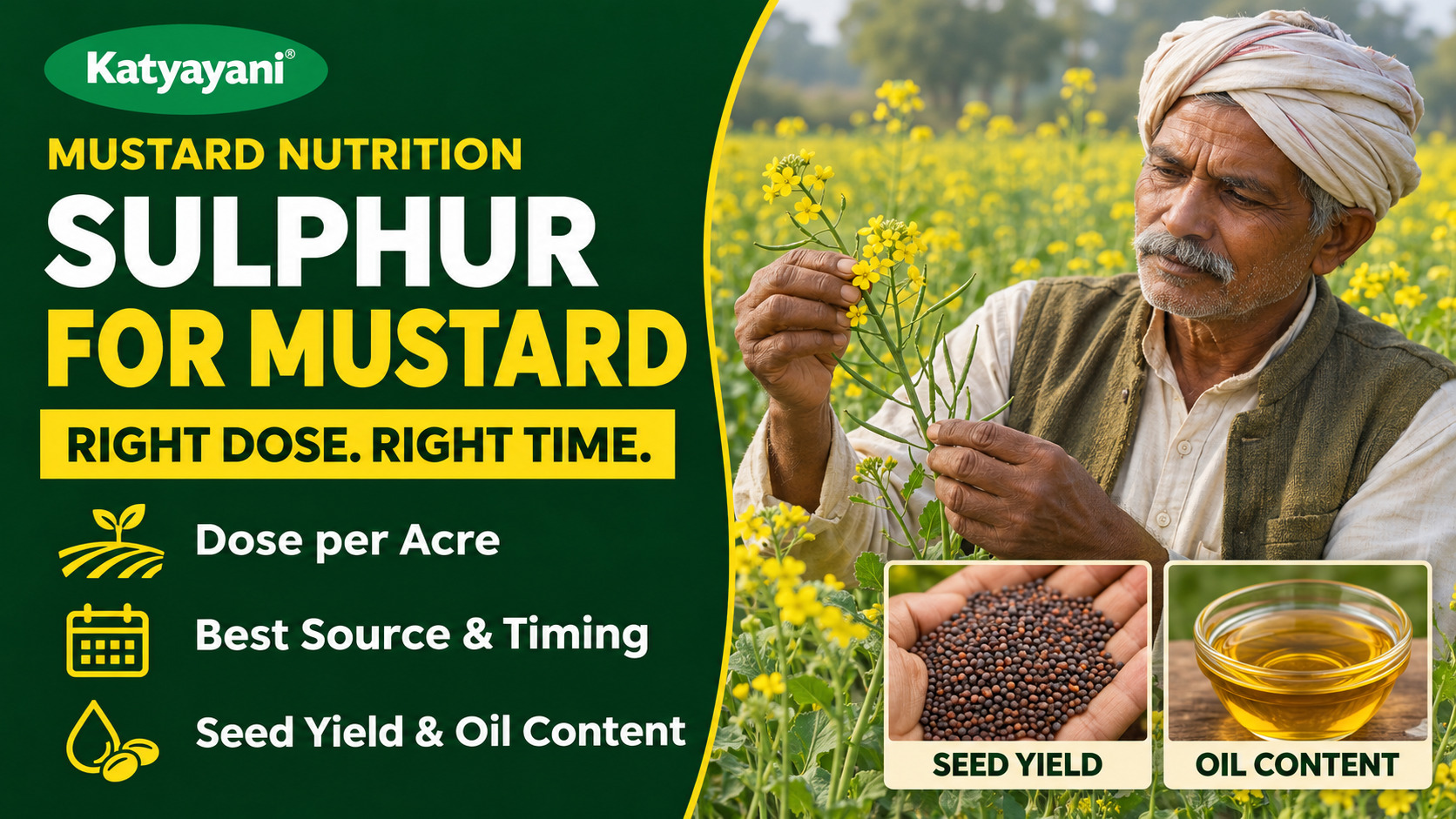
Sulphur builds the oil and protein in mustard seed, and urea and DAP carry none. ICAR-DRMR Bharatpur lists a basal 40 kg S per hectare (about 16 kg per acre) as raising seed oil by up to 2 percent and seed yield by up to 25 percent. A 2023 DRMR trial found 60 kg S per hectare gave the best irrigated yield (2.71 t per ha). Punjab Agricultural University states no sulphur dose for mustard; it tells growers to take phosphorus from single superphosphate or, where that is not used, to add 80 kg gypsum or 13 kg bentonite sulphur per acre at sowing. In a rainfed IARI trial on a sulphur-short soil, 45 kg S per hectare lifted oil from 38.3 to 41.1 percent and seed yield by 28 percent, but each extra kilo of sulphur gave less than the one before. Apply it at sowing, test the soil first, and do not treat a fungicide sulphur as a nutrient source.
 16 min
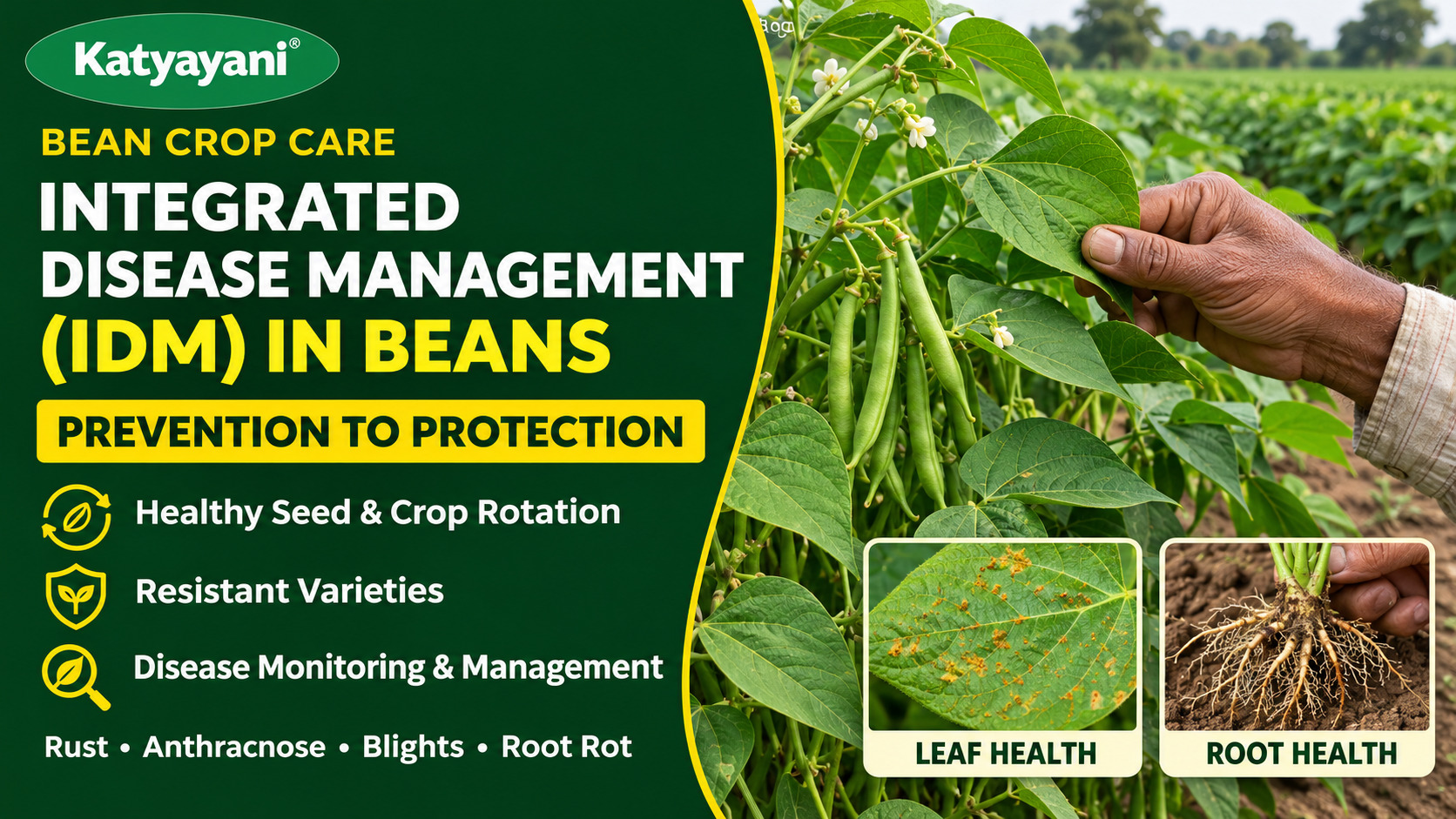
Integrated disease management (IDM) in beans means using several low-risk steps together, with sprays as the last tool. Start with clean, certified seed, because anthracnose, halo blight and common bacterial blight travel in seed. Add crop rotation, field sanitation, open spacing, careful irrigation and a rust-resistant variety where rust is the problem. Use biological seed and soil treatments such as Trichoderma for root rots, and spray fungicide or bactericide only when scouting shows disease and the label names your crop. In an ICAR-VPKAS French bean trial, a carbendazim seed treatment plus azoxystrobin and cartap foliar sprays cut rust from 35.58 to 3.50 percent and lifted pod yield from 3.65 to 9.48 t/ha, while four organic-only modules left rust at 17.89 to 20.95 percent. Always read the product label and follow your state advisory.
 16 min
The first irrigation in wheat is given at crown root initiation (CRI), the stage when permanent crown roots start to grow. Punjab Agricultural University advises a light first irrigation about three weeks after sowing for October-sown wheat and about four weeks for later sowing. Other sources differ by region: 21 to 25 days in the ICAR-IIWBR Karnal trial and 15 to 20 days at TNAU. PAU advises broadcasting urea before the first and second irrigation in its straw-management wheat package. In the Karnal trial, urea just before irrigation gave 2.70 to 5.21 quintal per hectare more grain than urea a week after, an average gain of 8.36 percent. Urea is 46 percent nitrogen, so 1 kg of nitrogen needs about 2.17 kg of urea. If water is short, one Indore trial found tillering the best single irrigation, so ask your KVK before skipping CRI.
