
 17 min read
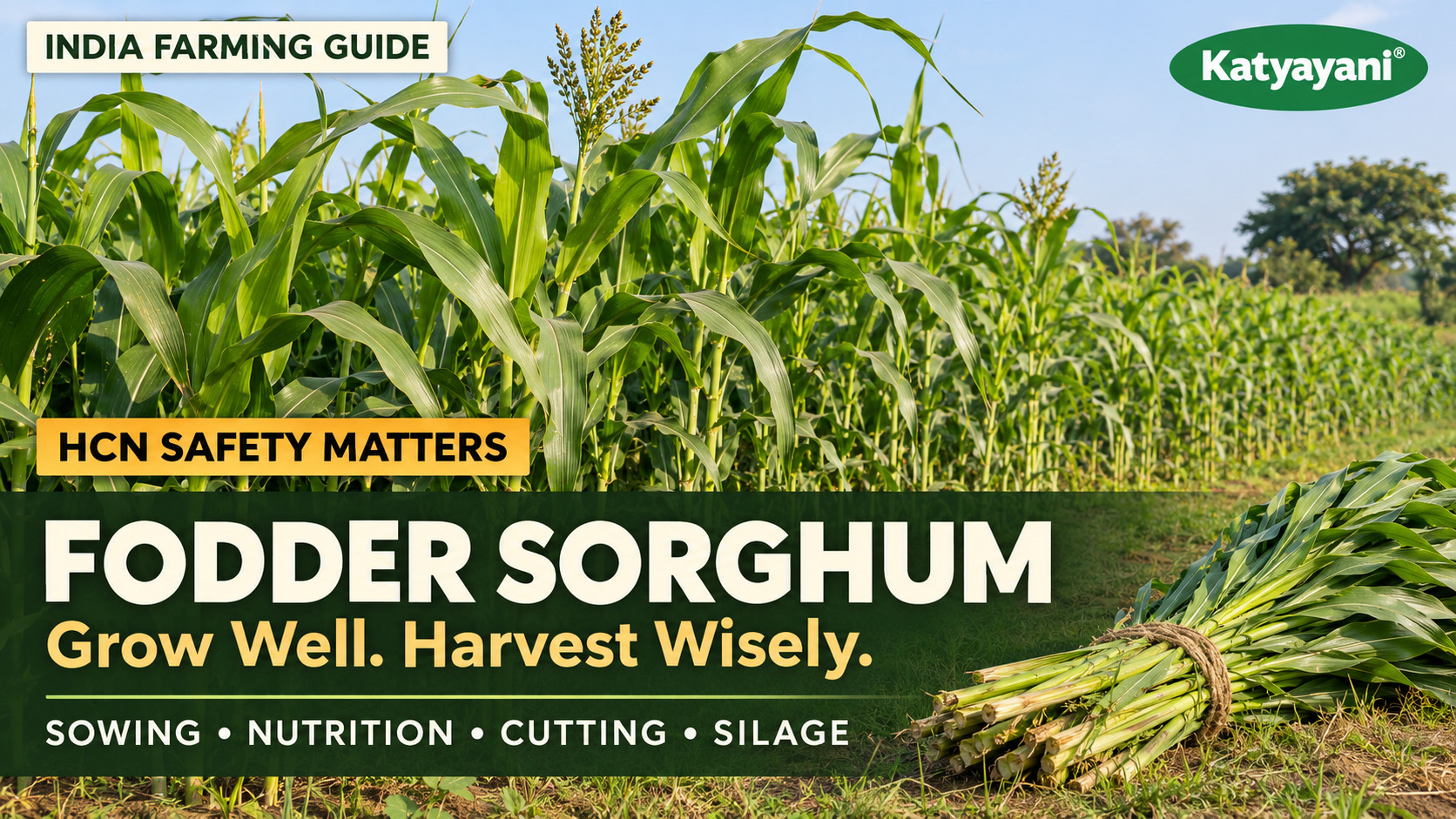
Fodder sorghum is a fast-growing kharif green fodder. ICAR-IIMR gives 25 kg seed per hectare in 30 cm rows for single-cut types and 10 kg per hectare in 45 cm rows for multi-cut types. Cut single-cut sorghum at 50 percent flowering. For multi-cut types the first cut is at 55 to 60 days and later cuts every 35 to 45 days. Young sorghum carries prussic acid (HCN). IIMR says it is highest at 35 to 40 days and falls below the toxic level after about 40 days. More than 200 ppm in fresh forage is dangerous. Never feed or graze young shoots, drought-stressed crop or regrowth after frost.
What is fodder sorghum, and how is it different from grain sorghum?
Fodder sorghum is sorghum (Sorghum bicolor) grown for its leaves and stalks, not for grain. In India it is called chari, jowar chara, jola or cholam. You cut the whole plant green and feed it fresh, or dry it as hay, or ferment it as silage. Grain sorghum is sown for the ear and gives the stalk as a by-product.
ICAR-IIMR lists the reasons farmers like it: quick growth, high dry matter, plenty of leaf, wide adaptability and drought tolerance. It can give good dry matter even in rainfed, low-fertility fields. Its fibrous roots go down to about 140 cm, so it pulls water and nutrients from deep soil. See the IIMR forage sorghum leaflet.
IIMR also says sorghum meets 60 to 70 percent of the total forage demand in kharif. That is why every dairy village in the sorghum belt has a few acres of chari in July. This post stays with annual sorghum and sudan grass types. The perennial hybrid Napier is a different crop with different planting and cutting rules, and has its own post (Napier grass farming in India, planned in this set).
Which types of forage sorghum can you grow?
IIMR groups forage sorghum into single-cut, multi-cut and dual-purpose types. The main kinds are sudan grass varieties, sudan grass x sudan grass hybrids, grain sorghum x sudan grass hybrids, grain x grain sorghum hybrids and dual-purpose varieties. In the northern belt, sudan grass types and grain sorghum x sudan grass hybrids are the popular ones.
| Type | How you use it | Source note |
|---|---|---|
| Single-cut | Sown once, cut once at about 50 percent flowering | IIMR leaflet; sown at 25 kg per hectare |
| Multi-cut | Cut 3 to 4 times, regrows after each cut | IIMR leaflet; 10 kg per hectare, 45 cm rows |
| Dual-purpose | Fodder plus grain from the same crop | IIMR leaflet |
| Sudan grass types and sorghum-sudan hybrids | Fine stems, regrow well, popular in the north | IIMR leaflet |
The type you pick sets the cutting plan, the seed rate and the HCN risk, so decide this first. The US sheet from North Dakota rates their prussic acid potential, and it matters here: Piper sudangrass is low, sudangrass x sudangrass hybrids are fairly low, sorgo-sudangrass hybrids are intermediate, sorghum-sudangrass hybrids are high, and grain types are high to very high (NDSU Extension). Kansas State agrees that grain sorghum and forage sorghum tend to be more toxic than sudangrass or sorghum-sudangrass (Kansas State).
Which fodder sorghum varieties are on the official lists?
ICAR-IIMR lists single-cut varieties such as Chari 3, HC 308, PCH 106, Pant Chari 5, CSV 30F and CSV 21F for all states, and multi-cut types such as CSH 20MF, CSH 24MF, CSV 33MF, SSG 59-3, Pusa Chari 6 and Pusa Chari 23. TNAU recommends CO (FS) 29 and CO 31 for Tamil Nadu. These are names from official lists, not a ranking.
| Region or list | Single-cut | Multi-cut | Source |
|---|---|---|---|
| All states (IIMR) | Chari 3, HC 308, PCH 106, Pant Chari 5, CSV 30F, CSV 21F | Hybrids CSH 20MF, CSH 24MF; varieties CSV 33MF, SSG 59-3, Pusa Chari 6, Pusa Chari 23 | IIMR leaflet |
| Haryana (IIMR) | HJ 513, HJ 541 | Not listed in the leaflet for this row | IIMR leaflet |
| Punjab (IIMR) | Not listed in the leaflet for this row | Punjab Sudex Chari 1 and Chari 4 (hybrids); SL 44 | IIMR leaflet |
| Tamil Nadu (IIMR) | K 1, K 7, CSV 32F | CO (FS) 29, CSV 33MF | IIMR leaflet |
| Tamil Nadu (TNAU) | CO 11, CO 27 (older list) | CO (FS) 29, CO 31 | TNAU expert system, TNAU varieties page |
TNAU gives the quality numbers for its two multi-cut types. CO (FS) 29 has 8.41 percent protein, 23.60 percent dry matter, 25.60 percent crude fibre and 50.30 percent in-vitro dry matter digestibility. CO 31 has 9.86 percent protein, 25.9 percent dry matter, 19.80 percent crude fibre and 52 percent digestibility. TNAU puts the green fodder yield at 160 to 170 t per hectare for CO (FS) 29 and 190 t for CO 31, in 6 to 7 cuts, and describes both as multi-cut types that stay productive for 3 years (TNAU).
CO 31 is a gamma-ray mutant of CO (FS) 29, and CO (FS) 29 comes from a cross between a TNS 30 derivative and Sorghum sudanense (TNAU). TNAU notes CO (FS) 29 was released as a state variety in 2001 and that it regrows fast and is moderately tolerant to drought (TNAU variety list). Seed availability differs by district, so choose from the varieties your state seed corporation or KVK lists for sale.
Which soil and climate suit fodder sorghum?
Sorghum likes warm weather, levelled land with good drainage, and a soil pH of 6.5 to 7.5. IIMR says loam, sandy loam, and light to medium black soils drain well enough. TNAU says it grows on any soil except very sandy ones, up to about 1,200 m altitude, and can manage on 300 to 350 mm of annual rainfall.
| Factor | What IIMR says | What TNAU says |
|---|---|---|
| Temperature | About 33 to 34 degrees C ideal in kharif; soil at 18 to 21 degrees C for good germination | 25 to 35 degrees C range |
| Rainfall | 500 to 750 mm average rainfall; relative humidity 80 to 85 percent suits kharif growth | 300 to 350 mm annual rainfall is enough |
| Soil | Loam, sandy loam, light and average black soil with drainage; pH 6.5 to 7.5 | Any soil except very sandy |
| Waterlogging | Avoid water stagnation | Not stated on the pages opened |
The NDDB Dairy Knowledge Portal adds that loam soils give higher yields and that waterlogging is a risk (NDDB). If you farm black soil, our soil types guide lists sorghum as a black soil crop and explains why a heavy clay field is sticky when wet and hard when dry, which is why seedbed timing matters.
Before you sow, look at the soil report. Our soil health card guide shows how to read nitrogen, phosphorus, potassium and pH, and if the pH is far from 7 the soil pH and nutrient lock post explains why fertiliser may not be reaching the plant.
When should you sow fodder sorghum?
Sow with the first monsoon showers for a rainfed crop, and in March to April if you can irrigate. IIMR says March 20 to April 10 is best for summer sowing, multi-cut types go in during the first fortnight of April (extendable to the first week of May), and single-cut types go in at monsoon onset or the second week of June.
| Season and situation | Sowing window | Source |
|---|---|---|
| Summer, irrigated | March 20 to April 10 (best period) | IIMR |
| Multi-cut types, irrigated | First fortnight of April; can stretch to first week of May | IIMR |
| Monsoon crop | At the first showers | IIMR |
| Single-cut and two-cut types | 15 to 30 June, with monsoon onset | IIMR |
| Tarai of Uttarakhand | Last week of May to first fortnight of June (avoids major pests) | IIMR |
| Tamil Nadu irrigated | January to February and April to May | TNAU |
| Tamil Nadu rainfed | June to July; September to October with K 7, CO 27, CO (FS) 29, K 10 | TNAU, TNAU expert system |
Think of your dairy calendar too. Silage and hay planning starts here. If you sow everything on one day, everything is ready on one day, and you cannot use it all. Split the area across two sowing dates 15 to 20 days apart so the cutting is staggered.
How much seed do you need and how do you sow it?
ICAR-IIMR gives 25 kg seed per hectare (10 kg per acre) for single-cut types in rows 30 cm apart, and 10 kg per hectare (4 kg per acre) for multi-cut types in rows 45 cm apart. Sow at a depth of 2.5 to 4.0 cm. If the land is not ready in time and you must broadcast, raise the seed rate by 15 to 20 percent.
| Type | Seed rate | Row spacing | Source |
|---|---|---|---|
| Single-cut | 25 kg per hectare (10 kg per acre) | 30 cm | IIMR |
| Multi-cut | 10 kg per hectare (4 kg per acre) | 45 cm | IIMR |
| CO (FS) 29 and CO 31 (Tamil Nadu) | 5 kg per hectare | 30 x 10 to 15 cm | TNAU, TNAU |
| Broadcast (late field) | 15 to 20 percent more than the drilled rate | None | IIMR |
TNAU adds two small points for CO (FS) 29. The seed has about one month of dormancy, so do not sow freshly harvested seed. And TNAU treats seed with Azospirillum and Phosphobacteria at 3 packets (600 g) per hectare of each, or 6 packets (1,200 g) of Azophos (TNAU nutrient page). For the ridge method TNAU describes ridges and furrows 60 cm apart with seed sown on both sides (TNAU).
Preparing the land is plain work. IIMR asks for one summer ploughing, then two to three harrowings and planking until the soil is powdery and free of clods. Level the field so water does not stand anywhere.
How much manure and fertiliser does fodder sorghum need?
IIMR recommends 80 kg nitrogen per hectare in two equal splits for irrigated single-cut sorghum, and 100 to 120 kg nitrogen in three splits for multi-cut types. In rainfed fields it prefers 40 kg nitrogen as a basal dose. Apply 8 to 10 t per hectare of compost or farmyard manure before sowing on poor, light soils.
For the manure part of the plan, organic manure is one option. Its page lists Jwar (sorghum) among the millets it is meant for. Work out the quantity from the sorghum figures above, not from a general pack dose.
| Crop and situation | Nitrogen plan | Source |
|---|---|---|
| Single-cut, irrigated | 80 kg N per hectare: half basal, half 35 to 40 days after sowing (when soil has moisture) | IIMR |
| Single-cut, rainfed | 40 kg N per hectare as basal | IIMR |
| Multi-cut | 100 to 120 kg N per hectare in three splits: one-third at sowing, one-third after the first cut, one-third after the second cut | IIMR |
| CO (FS) 29, irrigated | Basal 45:40:40 kg N, P, K per hectare; 45 kg N at 30 days; 45 kg N after every cut; after the 4th cut add 40 kg P and 40 kg K with the N | TNAU |
| TNAU rainfed cholam | 30:20:20 kg N, P, K per hectare on red soil; 40:20 kg N and P on black soil | TNAU |
TNAU also says Azospirillum (2,000 g per hectare) plus Phosphobacterium (2,000 g), or Azophos at 4,000 g, with 75 percent of the recommended N and P increased yield and saved 25 percent of the fertiliser in its CO (FS) 29 trials, and it spreads 12.5 t per hectare of farmyard manure with the bio-fertilisers on irrigated fields. Without a soil test TNAU gives 60:40:20 kg N, P, K for the older CO 27 type.
Why split the nitrogen? Part of the reason is the plant, part is safety. Kansas State says soils high in nitrogen and low in phosphorus and potassium tend to give plants with high cyanide, and that split nitrogen applications lower the risk (Kansas State). So do not throw all the urea in one go. If your crop turns pale and thin, read the nitrogen deficiency guide before adding more.
How often should you irrigate?
A monsoon-sown crop usually needs no irrigation, or one or two at 15 to 20 day gaps in a long dry spell. A March or April crop needs its first irrigation 15 to 20 days after sowing, then every 10 to 15 days. In summer, multi-cut types may need water every 7 to 10 days, and always right after each cut.
| Situation | Irrigation | Source |
|---|---|---|
| Rainy-season crop | None, or 1 to 2 at 15 to 20 day gaps in a dry spell | IIMR |
| Sown March to April | First at 15 to 20 days, then every 10 to 15 days | IIMR |
| Multi-cut, summer | Every 7 to 10 days; irrigate immediately after every cut | IIMR |
| CO (FS) 29 (TNAU) | Once in 7 to 10 days depending on soil | TNAU |
| Early sown (April to May), NDDB | About four irrigations may be needed | NDDB |
Water also decides safety. IIMR says in summer you should irrigate the crop 2 to 3 days before harvest, because a thirsty crop carries more HCN. The NDDB page gives a similar rule: harvest at about 50 percent flowering, or after an irrigation at the pre-flowering stage. More on that in the HCN sections below.
How do you control weeds in fodder sorghum?
Keep the field weed free for the first 25 to 30 days. IIMR says weeds are the main problem in early growth, and that good land preparation, the right seed rate and healthy seed usually suppress them. One or two hand weedings at 15 to 20 days help. A pre-emergence atrazine spray at 0.5 kg active ingredient per hectare, within 48 hours of sowing on moist soil, is the chemical option IIMR gives.
Common weeds named by IIMR are motha (Cyperus rotundus), doob (Cynodon dactylon) and broadleaf weeds. Summer ploughing, followed by 1 to 2 hand weedings and an optimum seed rate with good germination, is its integrated advice.
One caution from the Kansas State sheet. Crop injury from a herbicide, or a growth-regulator weedicide such as 2,4-D or dicamba, can raise the cyanide level in the plant. So do not spray those on a standing fodder sorghum crop, and keep spray drift off it from neighbouring fields.
Which pests and diseases attack fodder sorghum?
IIMR names shoot fly, stem borer and fall armyworm as the main insects, and rust, zonate leaf spot, anthracnose and downy mildew as the main diseases. Because the whole plant goes to the animal at cutting, IIMR advises avoiding foliar sprays and systemic chemicals on the fodder crop. Use field hygiene and timing instead.
| Problem | What you see | Cultural step in the IIMR leaflet |
|---|---|---|
| Shoot fly | Seedlings wilt, central leaf dries, typical dead heart; side tillers appear | Sow in the end of September to first week of October (rabi sowing) and release the egg parasite Trichogramma chilonis at 12.5 lakh per hectare |
| Stem borer | Shot holes and scratches on leaves from the 2nd week, dead heart in young plants | Uproot or burn stubbles and remove stalks to stop carryover |
| Fall armyworm | Young larvae scrape leaf; later ragged holes in the whorl | Deep ploughing, collect and destroy egg masses and larvae, 12 pheromone traps per hectare, 25 bird perches per hectare |
| Rust, zonate leaf spot, anthracnose | Red-brown pustules; circular banded lesions; brown lesions with black dots | Clean seed, crop rotation, destroy plant residue |
| Downy mildew | Green and white stripes on leaves | Deep ploughing, rogue out and burn infected plants, rotation |
Shoot fly is a seedling-stage pest, so the first month decides how much damage you see. Keep the stand healthy with the seed rate and weed control above, and keep fodder fields free of old stubble from the last crop.
What is prussic acid (HCN) in sorghum, and why is it dangerous?
Prussic acid, also called hydrocyanic acid or hydrogen cyanide (HCN), is a poison released in the animal when it eats sorghum plants that hold a compound called dhurrin. Dhurrin itself is harmless. When the plant is damaged or chewed, an enzyme turns it into HCN. Cyanide stops blood from carrying oxygen to the cells, and the animal can die within minutes.
Kansas State explains that the plant keeps dhurrin in its outer cells and the enzyme in cells below, and mixing happens when leaves are crushed, chewed, frozen, wilted or trampled. Ruminants are hit hardest, because cud chewing and rumen bacteria also release cyanide. Horses and pigs are more tolerant, since stomach acid destroys the plant enzyme (Kansas State).
The NDDB page says sorghum under 50 cm height holds cyanogenic glycosides, cattle and sheep are more susceptible than horses and pigs, and hungry animals are at greater risk. Signs appear about 15 to 20 minutes after eating, peracute deaths occur within 2 to 3 minutes of clinical signs, and acute deaths within 1 to 2 hours (NDDB).
| HCN level (fresh forage, as fed) | HCN level (dry matter basis) | What it means | Source |
|---|---|---|---|
| Below 200 ppm | 0 to 500 ppm | Should not cause poisoning | NDSU, Kansas State |
| 200 to 600 ppm | 500 to 1,000 ppm | Potentially toxic; feed only at a restricted rate | NDSU, Kansas State |
| Above 600 ppm | Above 1,000 ppm | Very dangerous to cattle; often fatal. Dry, ensile or let it mature, then test again | NDSU, Kansas State |
IIMR uses the same danger line: HCN above 200 ppm (mg per kg) is toxic. Kansas State says forage above 200 ppm on a wet weight basis is dangerous and, on a dry weight basis, more than 500 ppm is potentially toxic.
At what age or height is fodder sorghum safe to cut and feed?
IIMR says HCN is highest at 35 to 40 days after sowing and drops gradually. In most varieties it falls below the toxic level after about 40 days of growth. For single-cut types, harvest at 50 percent flowering. For multi-cut types, take the first cut at 55 to 60 days. US extension adds a height rule: let sorghum reach 18 to 24 inches (about 45 to 60 cm) before grazing.
| Rule | Number | Source |
|---|---|---|
| HCN highest | 35 to 40 days after sowing | IIMR |
| HCN below toxic level in most varieties | After about 40 days of growth | IIMR |
| Single-cut harvest | At 50 percent flowering; TNAU says 60 to 65 days after sowing | IIMR, TNAU expert system |
| Multi-cut first cut | 55 to 60 days after sowing (IIMR); 75 to 80 days for CO (FS) 29 (TNAU) | IIMR, TNAU |
| Later cuts | Every 35 to 45 days (IIMR); every 50 days for CO (FS) 29 (TNAU) | IIMR, TNAU |
| Do not graze below | 18 to 24 inches (NDSU); NDDB says sorghum under 50 cm holds cyanogenic glycosides | NDSU, NDDB |
| Cutting height for regrowth (multi-cut) | 5 to 8 cm above ground | IIMR |
A practical way to read this: a fodder crop at 40 days is not ready just because the calendar says so. Walk the field. If it is knee high and the leaves are dark green and soft, the crop is still young. Wait. A day or two of waiting costs you a little yield. Early cutting can cost you a cow.
Cutting height is a second safety point. K-State and NDSU both say regrowth shoots and tillers carry the highest cyanide. When you cut multi-cut sorghum 5 to 8 cm above the ground (IIMR) the plant regrows well, but that regrowth is exactly the young tissue that is dangerous, so apply the same age and height wait to every regrowth, not just the first crop.
What makes HCN higher: drought, frost, regrowth and fertiliser?
Anything that stunts the plant raises HCN. The big four are drought, frost, regrowth (suckers and tillers) and weedicide injury. IIMR says HCN increases under moisture stress. Kansas State says drought-stunted plants can hold toxic levels even at maturity, and frozen leaves release cyanide into the leaf tissue.
| Stress | What happens | What to do | Source |
|---|---|---|---|
| Drought | Plants stunted; cyanide builds up, can stay toxic at maturity | Irrigate 2 to 3 days before cutting in summer; after flowering is safer | IIMR, Kansas State |
| Rain after drought | Rapid new growth is rich in dhurrin | Wait; do not graze the flush | Kansas State |
| Light frost | Top dies, young shoots survive at base; they are grazed first | Wait 1 to 2 weeks (NDSU); or after a killing frost wait at least 5 days until leaves dry (Kansas State) | NDSU, Kansas State |
| Regrowth and tillers | Highest cyanide in suckers and new growth | Let it reach 18 to 24 inches again before grazing | NDSU, Kansas State |
| Heavy nitrogen, low P and K | Higher cyanide | Split nitrogen; keep P and K in balance | Kansas State |
| Herbicide injury (2,4-D, dicamba) | Cyanide can rise | Do not spray these on the fodder crop | Kansas State |
India has few frost issues in the main fodder belt, so for most readers the real risks are early cutting, drought and regrowth. But if you farm in the north or in hills where a cold snap hits a late sorghum crop, the frost rows apply to you.
How do you feed sorghum fodder safely?
Feed it when the crop is past the young stage, wilt it for a few hours if you are unsure, and never let hungry animals loose in a sorghum plot. Kansas State suggests giving hay or grain before turning animals out, since it slows intake. Chop and mix sorghum with other fodder rather than feeding it as the only green feed.
- Do not graze or green-chop young plants or new regrowth (Kansas State).
- Do not let hungry cattle graze where prussic acid may be a problem; feed hay or grain first (Kansas State).
- Do not graze after a light frost, or right after rain ends a drought (Kansas State).
- Hay or ensile plants that may be high in cyanide, since HCN is volatile and dissipates as forage dries or ensiles (Kansas State).
- IIMR notes cattle may also be fed as green chop, silage or hay, and that mixing with legumes improves quality (see the cropping system section).
- Animals do not become immune to cyanide, but they can detoxify low levels (NDSU).
A caution about drying. Kansas State warns that if the forage had extremely high cyanide before cutting, or if hay was not properly cured, hazardous levels could remain. In that case, have a sample tested before feeding. NDSU says silage and hay are generally safe because plants are normally past the minimum grazing height when cut, but poorly cured hay can still hold cyanide.
What are the signs of cyanide poisoning, and what can be done?
Signs are fast breathing, drooling and foaming at the mouth, blue-tinged gums, staggering, convulsions and collapse. The blood is bright red and clots slowly. Death follows within minutes to an hour or two. Because it moves so fast, prevention is the real answer. Kansas State says animals still alive 1 to 2 hours after signs start usually recover.
Kansas State describes a two-drug injection that binds the cyanide so the body can pass it out, but says symptoms are usually seen too late for treatment. NDSU says treatment is often not possible because signs progress so quickly, and that activated charcoal does not stop cyanide absorption and is not recommended. It also warns that opening the rumen of a dead animal can release cyanide gas.
Signs of cyanide poisoning look like nitrate poisoning, but nitrate-poisoned animals have dark chocolate-coloured blood and cyanide-poisoned animals have bright red blood. A smell of bitter almonds is often noted with cyanide (Kansas State). If many animals fall ill at once after a sorghum feed, stop the sorghum immediately for the whole herd.
How many cuts and how much green fodder can you expect?
ICAR-IIMR gives around 40 to 45 t per hectare of green fodder for improved single-cut varieties, and 60 to 90 t per hectare in 3 to 4 cuts for multi-cut types if sown from mid March to the first week of April. The NDDB page quotes 250 to 450 quintals per hectare on average and 50 to 100 t for multi-cut types.
| Type | Green fodder yield | Cuts | Source |
|---|---|---|---|
| Single-cut varieties | 40 to 45 t per hectare | 1 | IIMR |
| Multi-cut types sown mid March to early April | 60 to 90 t per hectare | 3 to 4 | IIMR |
| CO (FS) 29 | 160 to 170 t per hectare | 6 to 7 | TNAU |
| CO 31 | 190 t per hectare | 6 to 7 | TNAU |
| Sorghum fodder, general | 250 to 450 quintals per hectare (some varieties near 500) | 1 to 6 | NDDB |
The yield gap between IIMR and TNAU is large because TNAU counts a whole year of 6 to 7 cuts under irrigation in a long season, while IIMR counts a single crop cycle. Use the figure that matches how many cuts you will actually take.
For feeding value, NDDB lists typical protein of 4 to 5 percent (some varieties 8 to 10 percent), total digestible nutrients of 58 percent, calcium 0.5 percent and phosphorus 0.2 percent. Sorghum is a low-protein fodder, so it needs a legume or concentrate alongside. IIMR says the crop at flowering stage gives mostly bulk and energy for lean-season feeding.
Should you grow fodder sorghum with cowpea or in a rotation?
Yes, both help. IIMR says planting cowpea, guar, green gram, black gram or pigeon pea with fodder sorghum in a 2:1 ratio raises fodder yield and quality. In high-rainfall or irrigated areas, mixed cropping with cowpea gives a high green fodder yield, and the erect type of fodder cowpea is preferred.
Rotation matters too. IIMR says sorghum yields more after a legume such as berseem or lucerne, because that saves nitrogen. It lists these fodder rotations: fodder sorghum, berseem, maize plus cowpea (one year); fodder sorghum, oat, maize plus cowpea (one year); maize (grain), wheat, fodder sorghum plus cowpea (two years); and fodder sorghum, pea (grain), sugarcane (two years).
Our crop rotation guide has the general rules for alternating legumes and cereals, and notes that cereals leave more residue than pulses and fodder crops. NDDB mentions that sorghum is often sown mixed with legumes such as cowpea and moth at a 2:1 ratio, which matches IIMR.
How do you make sorghum silage?
Cut at 50 percent flowering to dough stage (TNAU), when moisture is 65 to 70 percent and dry matter 30 to 35 percent. Chop to 5 to 8 cm, fill the trench in at most two days, press hard, seal against air with straw, soil and polythene, and open after 45 days. The Indian Farming article from KVK Bathinda sets out the method.
| Step | What to do | Source |
|---|---|---|
| 1. Cutting stage | Cut at 50 percent flowering to dough stage; dry matter 30 to 35 percent | TNAU, Indian Farming |
| 2. Moisture | 65 to 70 percent; if wetter, dry the fodder for one day after cutting | Indian Farming, TNAU |
| 3. Chop | Chaff to 5 to 8 cm | Indian Farming |
| 4. Fill | Fill the trench in the shortest time (maximum 2 days), on dry days | Indian Farming |
| 5. Press | Press every half-metre layer thoroughly with a tractor or bullock; raise the heap 1 m above ground level | Indian Farming |
| 6. Seal | Cover with 10 to 15 cm of straw or residue, then soil, mud plaster; polythene sheet and 2 to 3 inches of soil; plug any crack at once | Indian Farming |
| 7. Wait | Ready in 45 days | Indian Farming |
Where to dig. Choose high, sloping ground near the animal shed, with no water stagnation. Keep depth at 1.5 to 2 m. In one cubic metre you can pack 5 to 6 quintals of chaffed green fodder. A trench 10 m long, 3 m wide and 2 m deep holds about 325 to 360 quintals, enough for 10 dairy animals for four months at 20 to 30 kg per head per day (Indian Farming).
Good silage is bright yellow with a vinegar-like smell and a pH of about 4.5. Brown colour means something went wrong. When you open the pit, open it from the width side where least air gets in, take out only the day feed, and cover the rest again.
If you have few animals, TNAU describes poly bag silage. Spread chopped fodder in 20 kg poly bags, compact it tightly with a vacuum machine, add molasses solution at 1 percent on fresh weight, seal for 45 days, and use the whole bag once opened to avoid fungus. TNAU gives a shelf life of 6 months (TNAU poly bag page).
Is HCN a problem in sorghum silage?
It is a smaller problem than in fresh green fodder, but not zero. Kansas State says HCN is greater in fresh forage than in silage or hay because it is volatile and escapes as the forage dries or ensiles. If the crop was very high in cyanide at cutting, dangerous levels can remain and the silage should be tested before feeding.
That is one more reason to cut for silage at 50 percent flowering or later. The KVK Bathinda article lists the cutting stage for sorghum silage as booting to milking stage, 55 to 65 days after sowing, while TNAU says 50 percent flowering to dough. Booting is earlier and closer to the young-plant HCN peak that IIMR describes (35 to 40 days). The later TNAU stage is the safer choice, and it also fits IIMR single-cut rule of 50 percent flowering.
The same article notes that fermentation reduces harmful nitrates that build up in plants during drought and in over-fertilised crops, which is another plus for silage over green feeding in a bad year.
How much silage should each animal get?
Start small. For the first 5 to 6 days add only 5 to 10 kg silage to green fodder because animals do not like it at first. Later you can feed 20 to 30 kg per animal per day mixed with other green fodder. The article gives daily amounts by animal class.
| Animal | Silage per day (kg) |
|---|---|
| Calves | 10 to 12 |
| Milch cow | 20 to 25 |
| Milch buffalo | 25 to 30 |
| Pregnant dairy animal | 15 to 20 |
| Bull | 20 to 25 |
Source: Indian Farming, February 2019. The article advises not feeding silage during milking, because the smell can pass to the milk. If you are planning a silage or fodder block unit as a business, our National Livestock Mission post notes that feed and fodder is one of the NLM areas and that silage making and fodder block making units are eligible.
TNAU also gives the amount of fodder an animal needs as a planning base on its cattle page, along with the seasons for different fodder crops (TNAU expert system).
What mistakes should you avoid with fodder sorghum?
The costly mistakes are cutting or grazing too young, feeding drought-stressed crop, pouring all nitrogen at once, spraying growth-regulator weedicides, and letting hungry animals into a sorghum plot. The yield mistakes are late sowing, wrong row spacing, and no irrigation after each cut in multi-cut types.
| Mistake | Why it hurts | Fix |
|---|---|---|
| Cutting before 40 days or below knee height | HCN is highest at 35 to 40 days (IIMR) | Wait for 50 percent flowering (single-cut) or 55 to 60 days (multi-cut first cut) |
| Grazing regrowth | Suckers and tillers carry the most cyanide (Kansas State) | Let regrowth reach 18 to 24 inches |
| Feeding after drought-breaking rain | Rapid new growth is high in dhurrin | Wait, and test if unsure |
| One big dose of urea | More cyanide, more loss | Split as per the IIMR or TNAU table |
| Spraying 2,4-D or dicamba | Can raise cyanide | Use hand weeding or pre-emergence atrazine |
| No water after a cut | Slow regrowth in multi-cut types | Irrigate immediately after every cut (IIMR) |
| Cutting too close to the ground | Poor regrowth | Cut 5 to 8 cm above ground (IIMR) |
| Broadcasting at the normal seed rate | Thin stand | Add 15 to 20 percent seed (IIMR) |
| Open silage pit left uncovered | Mould and loss | Take the day ration and cover the rest |
Conclusion
Fodder sorghum rewards a farmer who respects two numbers: 40 days and 200 ppm. Sow in the right window, use 25 kg seed per hectare for single-cut or 10 kg for multi-cut, split the nitrogen, and keep weeds out for the first month. Cut single-cut sorghum at 50 percent flowering and take multi-cut first cuts at 55 to 60 days, never earlier. Keep animals off young shoots, drought-stressed plots and regrowth after frost. Make silage when the crop is at flowering to dough stage, and open the pit after 45 days. Done this way, one hectare of sorghum feeds a dairy herd through the lean months without putting the herd at risk.


Leave a Comment