
 16 min read
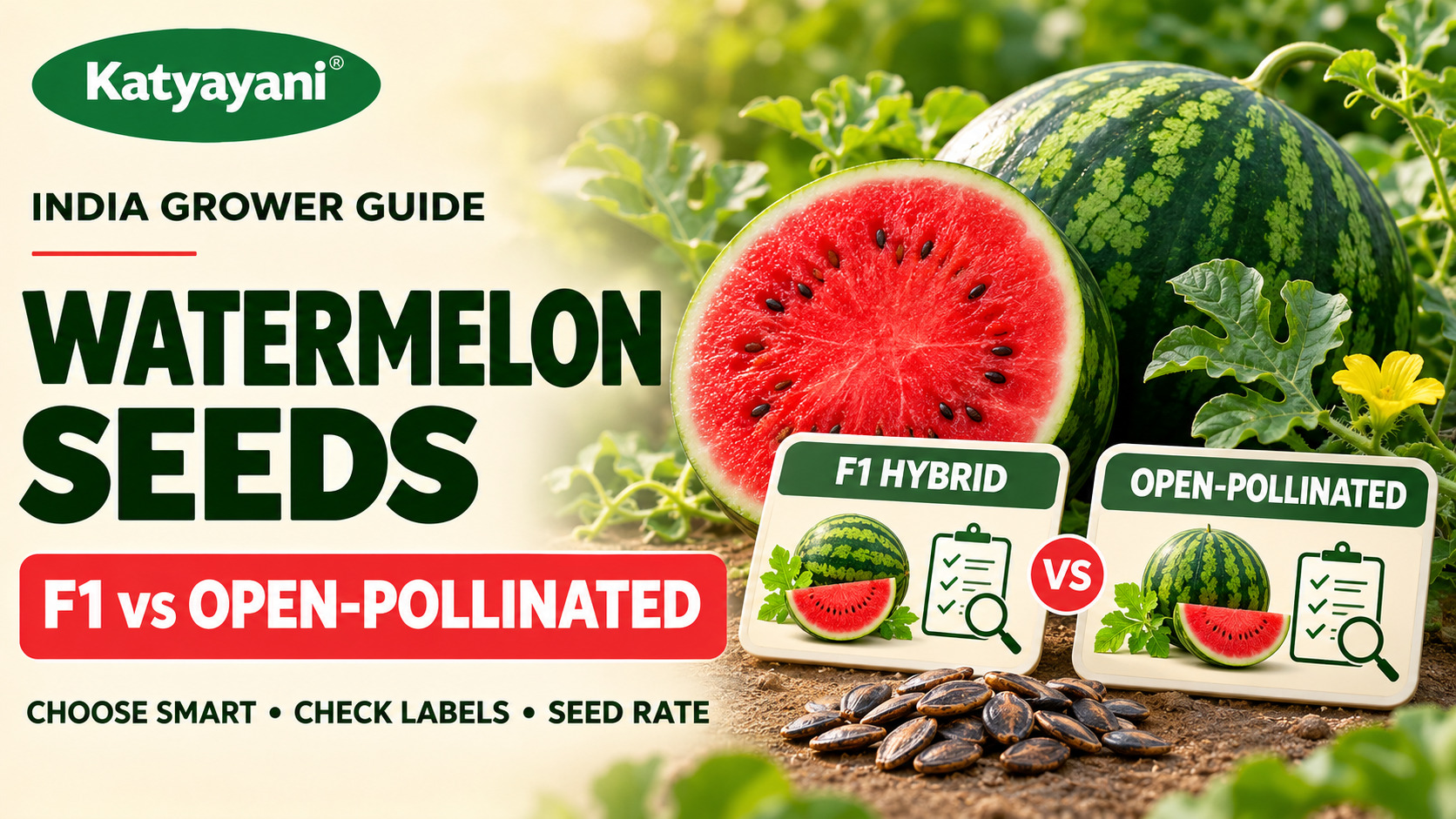
A hybrid (F1) watermelon seed is the first-generation seed from crossing two parent lines, so you buy fresh seed every season. Pick by buyer first: fruit weight, flesh colour, sweetness (TSS), shelf life, sowing season and disease record. ICAR-IIHR lists Arka Akash as an F1 hybrid at 75 to 80 tonnes per hectare. Nunhems India pages for MaxX, Force 9, Rehaan and Impact give 3 to 4.5 kg fruit and TSS 11 to 13% (company claim). Check the packet for lot number, test date, net weight and seller name. For certified hybrid seed the Indian standard sets 98% pure seed and 60% germination.
What are hybrid watermelon seeds, and what does F1 mean?
Hybrid watermelon seeds come from deliberately crossing two different parent lines. F1 means first filial generation, the first seed produced by that cross. The Indian certification standard describes hybrid seed as the progeny of two approved parental lines. The plants grown from it are uniform, and you buy fresh seed every season.
Think of two inbred parent lines, each chosen for something different, such as a firm rind in one and high sugar in the other. A seed company crosses them under controlled conditions and sells the resulting F1 seed. The Indian Minimum Seed Certification Standards say the same thing in rule language: the hybrid seed must be the progeny of two approved parental lines, and each parental line must be a relatively true-breeding strain.
An open-pollinated (OP) variety is different. Its seed is produced by ordinary pollination within the variety, so plants stay alike from one year to the next. Sugar Baby, Arka Manik and PKM 1 are the type of OP varieties listed in our watermelon farming guide, which holds the full variety table. This post does not repeat that table. It covers only the hybrid side: what to look for and what to check before you pay.
One more point on words. In day-to-day talk in Indian markets, the word hybrid is used loosely for any improved seed with a brand name. The TNAU Agritech page for watermelon, for example, lists Arka Jyoti, Pusa Bedana and Suvarnima as hybrids without calling them F1. Always ask the seller one plain question: is this an F1 hybrid or an open-pollinated variety? The answer should be on the packet.
Hybrid or open-pollinated watermelon: which one should you grow?
Grow a hybrid when your buyers pay for uniform fruit and a fixed harvest window and you can afford the seed. Choose an open-pollinated variety for low seed cost or seed saving. University of Georgia notes F1 yield gains of 20 to 40% but seed costing five to 10 times more (US figures).
| Point | F1 hybrid | Open-pollinated variety | Source |
|---|---|---|---|
| Fruit and harvest uniformity | More uniform fruit and more even harvest timing | More variation between plants and fruit | University of Georgia Extension (US source) |
| Yield | Can show 20 to 40% more yield than OP types grown under similar conditions | Baseline | University of Georgia Extension (US source) |
| Seed cost | Five to 10 times the cost of OP seed in the US bulletin; Indian prices differ, so compare packets in your own market | Lower | University of Georgia Extension (US source) |
| Saving your own seed | Not planned for. F1 seed is made fresh by crossing two parent lines each time | Saved seed keeps the same traits | University of Georgia Extension; Indian certification standard |
| Availability | Hybrids on sale change from year to year | Public varieties stay on lists for many years | University of Georgia Extension |
Do not read the 20 to 40% figure as a promise for your field. It comes from a US bulletin and from trials under similar conditions. In India, ICAR-IIHR gives yield for its own F1 hybrid Arka Akash at 75 to 80 tonnes per hectare and for the open-pollinated Arka Manik at 60 tonnes per hectare (each on its own IIHR page, tested under IIHR conditions). The two numbers fit the idea that a hybrid can yield more, but they are not a head-to-head trial.
A simple rule works for most farmers. If your fruit goes to a trader who asks for the same size and the same ripening date across the whole plot, test a hybrid on part of the field. If your fruit sells in a local market where size varies anyway, a good OP variety can be enough. Either way, keep a note of seed lot, sowing date and yield per plot so that next season you compare facts, not memory.
Which watermelon varieties are hybrids in India?
Hybrids whose official or company pages opened for this post are ICAR-IIHR Arka Akash (F1) and four Nunhems India hybrids: MaxX, Force 9, Rehaan and Impact. TNAU also lists Arka Jyoti, Pusa Bedana and Suvarnima as hybrids. Many more exist from other companies, but their figures were not confirmed on a company page, so they are not listed.
ICAR-IIHR describes Arka Akash as a high-yielding F1 hybrid with round to oval fruit, light green skin with dark green stripes and a red flush, and a yield of 75 to 80 tonnes per hectare. The page gives no fruit weight, flesh colour or maturity days, so we do not print any. Ask your state horticulture department or the seed supplier for the missing details before relying on it.
The four Nunhems India pages call MaxX, Force 9, Rehaan and Impact mini-seeded hybrids. Their fruit weights are in the next section. Everything on those pages is a company claim: it tells you what the seller wants to say, and it is not a result from an independent field trial.
Why not name ten more? Because many online lists copy figures from seller pages that disagree with each other. While preparing this post, retailer listings for the same hybrid gave different fruit weights on different sites. We dropped them. If a hybrid you like is not listed here, use the checklist at the end of this post on its packet and ask the company for a written data sheet.
What do company pages claim for hybrid watermelon fruit size, sugar and season?
The four Nunhems India hybrids claim 3 to 4.5 kg fruit with deep red crispy flesh and TSS of 11 to 13%. MaxX and Force 9 are listed for summer sowing. Rehaan and Impact are listed for round-the-year sowing. All four are listed for all states in India. These are company claims, not trial data.
| Hybrid | Fruit weight | TSS | Sowing season on page | Other claim on page | Source |
|---|---|---|---|---|---|
| MaxX (Nunhems) | 3 to 4 kg, uniform oval | 11 to 13% | Summer | Deep red crispy flesh; strong shipping and keeping quality | Nunhems MaxX page (company claim) |
| Force 9 (Nunhems) | 3.5 to 4.5 kg, uniform oval | 11 to 13% | Summer | Deep red crispy flesh; fruit is ready when it gives a dull sound on tapping | Nunhems Force 9 page (company claim) |
| Rehaan (Nunhems) | 3 to 4 kg, dark jubilee, oval elongated | 11 to 13% | Round the year | Deep red crispy flesh; fruit gives a dull sound on tapping when ready | Nunhems Rehaan page (company claim) |
| Impact (Nunhems) | 3 to 4 kg, uniform oval | 11 to 13% | Round the year | Early maturing; strong shipping and keeping quality; grows in winter and summer | Nunhems Impact page (company claim) |
| Arka Akash (ICAR-IIHR) | Not stated on page | Not stated clearly on page | Not stated on page | F1 hybrid; round to oval, light green with dark green stripes; 75 to 80 t/ha | ICAR-IIHR Arka Akash page |
Read what the table does not say. None of the four Nunhems pages gives days to maturity, and none says which diseases the hybrid resists. The pages list gummy stem blight, downy mildew, anthracnose, Fusarium wilt, powdery mildew, a virus, fruit fly, leaf miner and thrips as problems of the crop in general. The Rehaan page also says the plant has superior resistance without saying against what. So a farmer cannot learn disease tolerance from these pages alone.
That is normal for a marketing page, and it is the reason to ask. Before you buy any hybrid, ask the dealer for the company data sheet that lists maturity days, fruit weight range, TSS range, and the exact diseases the hybrid is said to tolerate, with the race or strain if the company has tested for it. If the dealer cannot give it, treat every disease claim as unproven.
How do you choose the right hybrid watermelon for your farm?
Start from your buyer and season, then compare hybrids on six points: fruit weight, flesh colour, sweetness (TSS), rind and shipping quality, days to harvest, and disease record. A small-fruit hybrid suits household and retail buyers, a large-fruit one suits wholesale trucks. No seed is best for every farm.
University of Georgia Extension gives the same advice for growers anywhere: choose varieties that suit your market, because market trends and available varieties change, and check current options with your seed dealer, buyers and extension office. Fruit is grouped by shape, rind colour or pattern and size, so match the group to what your buyers ask for.
| Your situation | What to look for | Why |
|---|---|---|
| Selling to a trader who loads trucks for far markets | Strong rind, long keeping, uniform fruit weight | Fruit must survive transport; two Nunhems pages make a shipping-and-keeping claim (company claim) |
| Selling at a local mandi or roadside to households | Small to medium fruit (3 to 5 kg), deep red flesh, good TSS | 3 to 4.5 kg is the fruit range claimed on the four Nunhems pages |
| Aiming for the early, high-price window | Early-maturing hybrid, suitable for your sowing month | Days to maturity decide the harvest date; get the figure in writing |
| Field with past wilt or blight | A hybrid with written tolerance to the disease you had, plus crop rotation | University of Georgia advises new land or at least 8 years between diseased crops for Fusarium wilt |
| Drip and plastic mulch with tight plant spacing | Hybrid suited to the spacing; ask the company | Spacing changes fruit size; see the guide linked below |
| Wanting seedless fruit | A seedless (triploid) hybrid and a pollenizer plan | Seedless types need extra care; see the seedless section below |
Walk the checklist with a real example. A farmer in a district with a big weekly mandi sells to two traders who ask for 4 to 6 kg fruit. A hybrid listed at 3 to 4 kg will not match them even if its sugar is excellent. A farmer selling to hotels and juice shops may want exactly that smaller size. The right seed is the one that fits the order your buyer gives you. For sowing months, spacing and the fertiliser schedule once you have picked a seed, go to our watermelon package of practices.
How sweet should a hybrid watermelon be, and what is TSS?
TSS means total soluble solids, mostly sugar, measured as percent or degrees Brix with a hand refractometer on the flesh juice. ICAR-IIHR gives Arka Manik 12 to 15% TSS. The four Nunhems hybrids claim 11 to 13%. A label figure is a ceiling for good conditions; your fruit will vary with ripeness, weather and nutrition.
A hand refractometer costs little and lets you test ripe fruit from your own plot. Cut a fruit, squeeze a few drops of juice from the centre onto the prism and read the scale. Test fruit from the first picking and from later pickings. If your plot reads two or three points below the company range, the cause is more often harvest too early, heavy rain before picking, low potassium or a stressed crop than the seed itself.
The ICAR-IIHR Arka Manik page shows how a public variety is described: about 6 kg fruit, 12 to 15% TSS, 60 t/ha yield, and triple resistance to powdery mildew, downy mildew and anthracnose. That is an open-pollinated type from a public institute and a useful yardstick. If a hybrid claims less sugar and less disease tolerance than Arka Manik, ask what it offers instead, such as earlier harvest, smaller size or better keeping.
Sweetness is also managed in the field. The University of Delaware reports that potassium plays an important role in sugar levels in watermelon, and lists watermelon among fruiting vegetables with high potassium needs. Its page gives no watermelon rate, so we print none. See the fertiliser answer further down and the fertiliser schedule in the hub post.
Which month should you sow hybrid watermelon in India?
It depends on your state and the hybrid. The Nunhems pages list MaxX and Force 9 for summer sowing and Rehaan and Impact for round-the-year sowing, all as company claims. For state-wise months from PAU, TNAU and VFPCK, use our watermelon guide. Match the hybrid's listed season to your sowing month, or ask the company in writing.
Our watermelon farming guide gives the sourced months for Punjab, Tamil Nadu and Kerala, so they are not repeated here. What matters for seed choice is this: a seed packet that says summer is built for warm weather and quick growth, while a round-the-year hybrid is claimed to cope with both cooler and hotter sowings. If you sow in a cool month, ask whether the hybrid has been tried in your area.
Cold at flowering also matters. UF/IFAS notes that watermelon flowers open early in the morning, are open for one day, are most receptive before 10 am, and that bees do not fly much below 55 °F (about 13 °C). A cold spell at first flowering can mean poor pollination whichever hybrid you chose. Plan your sowing so the first female flowers do not open in a cold, cloudy week.
If you grow under polyhouse or shade net, the structure changes temperature and bee access, so ask the seed company about protected cultivation. Our polyhouse and shade-net subsidy guide explains the subsidy norms, but it does not cover watermelon, so take crop advice from your horticulture officer.
How do you read disease tolerance claims on a hybrid watermelon packet?
Look for the named disease and, where possible, the race or strain, in writing. Words like resistant or superior resistance mean little without a name. University of Georgia notes that some varieties are only somewhat resistant to Fusarium wilt, and that where all three anthracnose races are present, no variety is resistant.
Three levels of protection work together. First, a hybrid with a written tolerance for the disease common in your area. Second, rotation: University of Georgia advises using new land or leaving at least 8 years between diseased crops on the same land for Fusarium wilt. Our crop rotation guide explains how to plan the sequence and why to ask a KVK about the gap for a particular disease. Third, seed treatment and timely sprays.
For seed treatment, the TNAU Agritech page gives per kg of seed: Trichoderma viride 4 g, or Pseudomonas fluorescens 10 g, or carbendazim 2 g. The Seeds Rules require the label to say whether the seed has been treated, and with which chemical. Read the label before adding anything of your own.
Do not buy a hybrid on a disease claim you cannot see in writing. If the plot has a record of wilt, test the hybrid on a small strip before committing the whole field. For spraying methods and timing, see our fungicide application methods guide.
What must a hybrid watermelon seed packet show under Indian rules?
Under the Seeds Rules 1968, every label must show the net content by weight, the date of testing, whether the seed is treated (with the chemical name), the seller’s name and address, and the notified name of the seed. The label must not carry false or misleading claims, and the seller cannot deny responsibility for it.
| What to find on the packet | Why it matters | Rule in the Seeds Rules 1968 |
|---|---|---|
| Name and address of the seller | You know who is responsible if the seed fails | Rule 8(v): the person who offers for sale and is responsible for quality |
| Net weight in metric units | You can check that the pack is full and compare cost per gram between brands | Rule 8(ii) |
| Date of testing | Germination is tested on a date; the older the test, the lower the chance it still holds | Rule 8(iii) |
| Treated or untreated, and the chemical name | You know what is already on the seed before you add anything | Rule 8(iv) |
| Notified name of the seed | Confirms the kind and variety | Rule 8(vi) |
| No false or misleading words, fancy names or claims | A label cannot promise what the seed does not do | Rule 10 |
| Seller cannot deny responsibility for the required statements | Phrases like "company not responsible" do not remove the duty | Rule 12 |
| Label readable on the innermost container and outer covering | Loose or repacked seed carries no label protection | Rule 9 |
Source: The Seeds Rules, 1968, Part V. Rule 7 adds a practical limit: the person named on the label is responsible for the accuracy of the information only while the seed is in the unopened original container, and not for the germination statement after the validity date on the label. So keep the unopened packet until the seed is sown, and do not accept seed that has been decanted into a plain bag.
These rules apply to seed of a notified kind or variety offered for sale. Whether a particular hybrid is notified is a question for the seed dealer or your state seed certification agency. Always take a printed bill with the lot number written on it, and keep the empty packet until the crop is harvested. If the crop fails, that packet and bill are your evidence.
What germination and purity does the Indian standard set for hybrid watermelon seed?
For certified hybrid watermelon seed, the Indian Minimum Seed Certification Standards set pure seed at 98% minimum, inert matter at 2% maximum, other distinguishable varieties at 10 per kg maximum, germination at 60% minimum and moisture at 7% maximum, or 6% in vapour-proof containers. Foundation seed has the same limits except 5 other varieties per kg.
| Seed standard (certified class) | Watermelon (open-pollinated) | Watermelon hybrid | Seedless watermelon hybrid |
|---|---|---|---|
| Pure seed, minimum | 98.0% | 98.0% | 98.0% |
| Inert matter, maximum | 2.0% | 2.0% | 2.0% |
| Other distinguishable varieties, maximum | 10 per kg | 10 per kg | 10 per kg |
| Germination, minimum | 60% | 60% | 60% |
| Moisture, maximum | 7.0% (6.0% in vapour-proof container) | 7.0% (6.0% in vapour-proof container) | 7.0% (6.0% in vapour-proof container) |
| Isolation of seed field from other varieties and commercial hybrids | 500 m | 1,000 m | 1,000 m |
| Off-types in seed parent, maximum | 0.20% | 0.050% | 0.050% |
| Off-types in pollinator, maximum | Not applicable | 0.050% | 0.050% |
| Field inspections, minimum | 3 | 4 | 4 |
Source: the watermelon, watermelon hybrids and seedless watermelon hybrids chapters of the Indian Minimum Seed Certification Standards. The hybrid chapters add that male flowers shedding pollen in the seed parent must not exceed 0.10%, and that wild watermelon (Indrayan, Citrullus colocynthis) is an objectionable weed with none permitted. A certified hybrid field is inspected at least four times: before flowering, twice at flowering and fruiting, and at mature fruit stage.
What this means for you. A minimum of 60% germination is a legal floor for certified seed, not a target. A packet that tests at 60% will leave four in ten seeds ungerminated, which hurts with costly hybrid seed. Ask for the actual tested figure on the label and compare brands on that number. University of Georgia advises certified seed with 85 to 90% germination for field seeding, which is a US benchmark you can use as a talking point with a dealer.
The table above is the certification standard. If a packet carries a certification tag, the Form II tag in the Seeds Rules shows kind, variety, lot number, germination percentage, date of test, validity, producer and class of seed.
How much hybrid watermelon seed do you need per acre?
There is no single national figure for hybrid seed. TNAU gives about 3.5 kg per hectare for watermelon (about 1.4 kg per acre), and University of Georgia gives 1 to 2 lb per acre (about 0.45 to 0.9 kg). Hybrid seed is sold by the packet, so work out seed count from plants per acre and germination.
Plants per acre in the live hub guide are about 3,600 (channels, 2.5 m by 0.9 m hills), about 4,500 (3.0 m beds, 60 cm plant gap) and about 5,400 (2.5 m beds, 60 cm gap). Those are PAU and TNAU spacing numbers worked out as plants per acre in our hub post. Use the spacing your region follows.
| Step | Worked example (our arithmetic, not a university figure) |
|---|---|
| 1. Plants you want per acre | 3,600 hills (spacing in the hub guide) |
| 2. Seeds per hill | Two in the field, thinned to two seedlings per hill as TNAU describes; one per cup if raising hybrid seedlings |
| 3. Seeds needed | 3,600 hills x 2 = 7,200 seeds in the field; 3,600 seeds if one seed per nursery cup |
| 4. Add a margin for germination below 100% | At 90% germination, divide by 0.9: 7,200 / 0.9 = 8,000 seeds; at 60%, 12,000 seeds |
| 5. Add 5 to 10% for gap filling | About 8,400 to 8,800 seeds in the first case |
| 6. Ask the dealer for seeds per packet | Divide your seeds needed by seeds per packet to get packets per acre |
The label states net content by weight, not seed count, because the Seeds Rules ask for weight. Seed size varies between hybrids, so ask the company how many seeds are in your packet. This is also why comparing the price of two packets only by weight misleads. Compare the price per 1,000 seeds that will germinate, using the tested germination figure on the label.
University of Georgia adds one point worth copying if you raise your own seedlings: use one seed per container for hybrids and one or two for open-pollinated varieties, because hybrid seed is costly and overseeding and thinning waste it.
How should you sow or raise hybrid watermelon seedlings?
Sow one seed per cup or hill spot where possible, keep the seed bed warm and moist, and transplant carefully when you raise seedlings. TNAU advises thinning field-sown hills to two seedlings. For seedless hybrids, University of Georgia says germination is inhibited below 80 °F (about 27 °C), the seed coat is thick, and direct seeding is not recommended.
Practical steps for a hybrid grower who buys seedlings or raises his own:
- Check the label first: lot number, test date, treated or untreated, net weight.
- Keep the packet closed and cool until sowing day. Do not leave it in a hot shed or on a vehicle dashboard.
- If the seed is untreated, treat it as TNAU lists: Trichoderma viride 4 g per kg, or Pseudomonas fluorescens 10 g per kg, or carbendazim 2 g per kg. If it is already treated, do not re-treat.
- Sow one seed per cup in a clean, light medium. Place cups in a warm, shaded spot.
- Count emerged seedlings after the expected days. Write the percentage next to the lot number, so you can compare it with the label germination.
- Transplant healthy seedlings with the root ball intact. Water them in at once.
- Fill gaps within a week from spare seedlings.
Why record the emergence count? If the lot germinates far below the label figure, you have the evidence to go back to the seller. A quick home test also works before the big sowing: sow 100 seeds in moist cocopeat or sand in cups, keep warm, and count how many emerge. Photograph the cups and keep the packet.
For nursery spacing, fertigation and the crop calendar after transplanting, follow the hub guide.
What is seedless hybrid watermelon, and what extra care does it need?
Seedless watermelon comes from a hybrid between a tetraploid seed parent and a normal diploid pollinator. Indian certification rules require a tetraploid seed parent for seedless hybrids. The plants need a seeded pollenizer for pollen, more bee visits, and transplanted seedlings. Expect about a third of the harvest to be seeded fruit.
The Indian certification standard states that hybrid seedless watermelon seed must be the progeny of two approved parental lines, one of which, the seed parent, is tetraploid (4x). That is why seedless seed costs so much: it takes a special seed production step. The standard sets the same 60% minimum germination as other watermelon seed, so check the tested figure on the packet.
| Point | What the source says | Source |
|---|---|---|
| Pollenizer | One pollenizer row for every two rows of seedless plants. About one-third of the harvested melons come from the seeded pollenizer | University of Georgia Extension (US source) |
| Bee visits per flower | Seeded types need eight or more visits; seedless types need 16 to 24, because their own pollen is not viable | UF/IFAS Hochmuth (US source) |
| Seeding method | Transplant container-grown plants; direct seeding is not recommended | University of Georgia Extension (US source) |
| Germination temperature | Inhibited below 80 °F (about 27 °C) | University of Georgia Extension (US source) |
| Seed count | Overseeding and thinning are not practical because seed is costly | University of Georgia Extension (US source) |
Our hub guide already covers hive numbers and the pollenizer plant count from a University of Delaware note. The row layout above and the plant ratio there describe the same thing: one in three plants is the pollenizer. For help with hives, the National Beekeeping and Honey Mission guide explains the central scheme, whose first mini mission is about crop productivity through bee pollination.
The Indian seedless hybrids sold by companies were not opened on company pages for this post, so we name none. If you want seedless, ask for a written data sheet that states the pollenizer variety and ratio the company recommends. Without a pollenizer, seedless fruit does not set properly.
Can you save seed from a hybrid watermelon?
Do not plan on it. University of Georgia says seed from open-pollinated varieties breeds true, while F1 hybrid seed is made fresh by crossing two parent lines and sold to growers each season. Fruit from saved F1 seed is expected to vary in size, shape and ripening. The yield and uniformity you paid for are in the first generation only.
The reason is simple. The F1 plant carries a mix of genes from two different parents, and the next generation reshuffles that mix, so plants differ from one another. This is general plant breeding, and it is why the certification standard treats the parent lines as the real seed source and the hybrid seed as a new cross each time.
If you want to save seed, grow an open-pollinated variety and keep it isolated from other watermelon. The certification standard asks seed fields of OP watermelon to be 500 m from other varieties and hybrid fields to be 1,000 m or more from other varieties and commercial hybrids. That distance tells you how easily watermelon crosses between fields, and why saved seed from a roadside plot is risky.
Seed that you save yourself carries no certification or label, and you are the only one responsible for it. Test germination before use and sow a small block first.
Which fertiliser makes hybrid watermelon bigger and sweeter?
No single fertiliser does it. Fruit size depends on plant spacing, full pollination, water and balanced feeding. Potassium supports sugar, according to the University of Delaware. University of Georgia says plants spaced farther apart give heavier melons. UF/IFAS says poor pollination, not excess nitrogen, is the main trigger of hollow heart.
| What you want | What the extension source says | What to do |
|---|---|---|
| Bigger fruit | To produce heavier melons, space plants farther apart (University of Georgia) | Choose spacing to match the fruit size your buyer wants; see hub guide for PAU and TNAU spacing |
| Sweeter fruit | Potassium plays an important role in sugar levels in watermelon; watermelon is among crops with high potassium needs (University of Delaware) | Do not cut potassium to save cost; follow the soil-test based dose in the hub guide |
| Even, full shape | At least 500 to 1,000 pollen grains must reach the stigma for a uniform fruit; a seeded flower needs eight or more bee visits (UF/IFAS) | Bring hives when the first female flowers open |
| Avoiding hollow heart | Poor or incomplete pollination is the primary trigger; excess nitrogen was never proven as a cause; hollow heart shows mainly in the first fruit set (UF/IFAS) | Do not over-correct with extra nitrogen; protect early flowering from cold, wet spells |
| Leaching in sandy soil | Rain and overhead irrigation can leach potassium, so apply fertiliser in several smaller amounts (University of Georgia) | Split the dose, or fertigate on drip |
For the dose by stage, the PAU, TNAU and VFPCK numbers are already in our hub guide. Do not copy a number from a seed packet or a social media post; check it against your soil test. Our soil testing guide explains how to read a Soil Health Card. If the soil is alkaline, nutrients such as iron and zinc can be locked even when present, which our soil pH and nutrient lock guide explains.
If you fertigate through drip, the water-soluble versus granular fertiliser guide compares both forms. Growers who run drip across many acres can also read the water-soluble fertiliser buying guide.
A hybrid that is capable of 4 kg fruit will not give 4 kg if the flowers were poorly pollinated or the plants were crowded. Fix the plot first; the seed cannot do it for you.
How do you protect a hybrid watermelon crop from fungus and sucking pests?
Scout the crop regularly, rotate fields, treat seed and use the sprays your KVK or label advises for the named problem. The Nunhems pages list gummy stem blight, downy mildew, anthracnose, Fusarium wilt, powdery mildew, fruit fly, leaf miner and thrips as crop problems. The hub guide covers each with sourced control steps.
Because a hybrid costs more per seed, a plant lost to wilt or blight costs more as well. This is why the order matters: choose a seed with a named tolerance, rotate, treat the seed, and spray on schedule instead of after the crop is already lost. Our hub guide has sourced steps for each insect and disease.
On the Katyayani site, the pages below are organised by the watermelon problem. Each collection is titled for the problem; the collection pages themselves do not describe the disease, so use the product label and your KVK for what to spray and when:
- Fungicide for watermelon gummy stem blight, a collection of three fungicides.
- Fungicide for watermelon Fusarium wilt, a collection of four products including two Trichoderma viride bio-fungicides.
- Fungicide for watermelon powdery mildew, a collection of four fungicides.
- Fungicide for watermelon anthracnose, a collection of five products.
- Insecticide for watermelon aphids, a collection of four products (two are the same bio-pesticide, Triple Attack).
For a ready-made set, the watermelon protection combo names watermelon on its page. It lists an imidacloprid insecticide described for sucking pests, a fungicide described for powdery mildew, rust and leaf spot, and a triacontanol growth product described for flowering and fruit setting. The page makes seller claims only and shows no trial data. Read each label and follow its dose.
Always read the label, match the product to the exact disease on your plot, and check the pre-harvest interval before you pick fruit for market.
What mistakes waste money when buying and growing hybrid watermelon seed?
The costly ones are buying without a label check, sowing a hybrid at the wrong season, expecting tolerance the packet never promised, saving seed from F1 fruit, and skipping bees. Each one can cost you the seed price and the season.
- Buying loose seed or a repacked bag with no label, no lot number and no test date. The Seeds Rules make the seller responsible only for the unopened original container.
- Choosing by a photo of a giant fruit. The pages we opened claim 3 to 4.5 kg for these hybrids, so match size to your buyer, not to an advertisement.
- Ignoring the sowing season printed for the hybrid. A summer hybrid sown in a cool month may flower in cold weather, and cold mornings hurt pollination.
- Paying a high price and then planting in a field with a wilt history. University of Georgia advises rotation of at least 8 years for Fusarium wilt and notes that some varieties are only somewhat resistant.
- Skipping hives. A seeded flower needs eight or more bee visits and a seedless one 16 to 24 (UF/IFAS).
- Over-using nitrogen to fix hollow heart. UF/IFAS could not create hollow heart with excess nitrogen; poor pollination is the main trigger.
- Saving F1 seed for the next season and expecting the same fruit.
- Comparing two packets only by price. Compare cost per 1,000 seeds that will germinate.
- Not recording the lot number, sowing date and plot yield, so there is no way to judge the hybrid next year.
Mulch and weed control also change what you get from costly seed. Our mulching guide covers plastic film and its limits: it advises using plastic only in beds with drip underneath, and removing the film after use. The guide does not mention watermelon, so apply its principles with your local advice.
Hybrid watermelon seed buying checklist: what to carry to the shop?
Take this list to the dealer and tick each line before paying. If more than two lines fail, go to another shop or ask the company directly. A good dealer will not mind questions; a reluctant one has told you something too.
- Name of the hybrid and whether it is F1 or open-pollinated, written on the packet.
- Company name and address, and the seller's name and address on the label (Rule 8).
- Lot number and date of testing; the test date should be recent.
- Net weight in grams, and the seed count per packet from the company or dealer.
- Tested germination percentage, not just the legal minimum of 60% for certified seed.
- Treated or untreated, and the chemical name if treated.
- Fruit weight range, TSS range, days to maturity and suitable sowing season, from the company data sheet.
- Named disease tolerances with race or strain, if the company claims any.
- Unopened original packet, sealed. Printed bill with the lot number, date and your name.
- Plan for pollination: bee hives, pollenizer for seedless, and weather at first flowering.
Keep photographs of the packet front and back, the bill, and the sowing date. If the crop fails, send a clear written complaint to the company and the dealer, and tell your district agriculture office. Your state agriculture department can tell you which seed inspector to approach.
Finally, pick one new hybrid at a time and grow it next to your usual seed on the same field. Seed is cheap compared to a lost season, and a side-by-side strip teaches you more than any list of best seeds. Write down fruit weight, TSS from a refractometer, days to first picking and any disease, and decide with your own numbers.
Conclusion
A hybrid watermelon seed is a first-generation cross that you buy new every season, so the choice should come from your buyer, season and field history, not from a best-seed list. Compare hybrids on fruit weight, TSS, shipping quality, days to harvest and written disease tolerance. Read the label under the Seeds Rules, look for the tested germination, and keep the packet and bill. Plan pollination, spacing and potassium for size and sugar. Test a new hybrid on a small strip first, and use our watermelon farming guide for sowing, spacing and the fertiliser schedule.

Leave a Comment