 11 min read
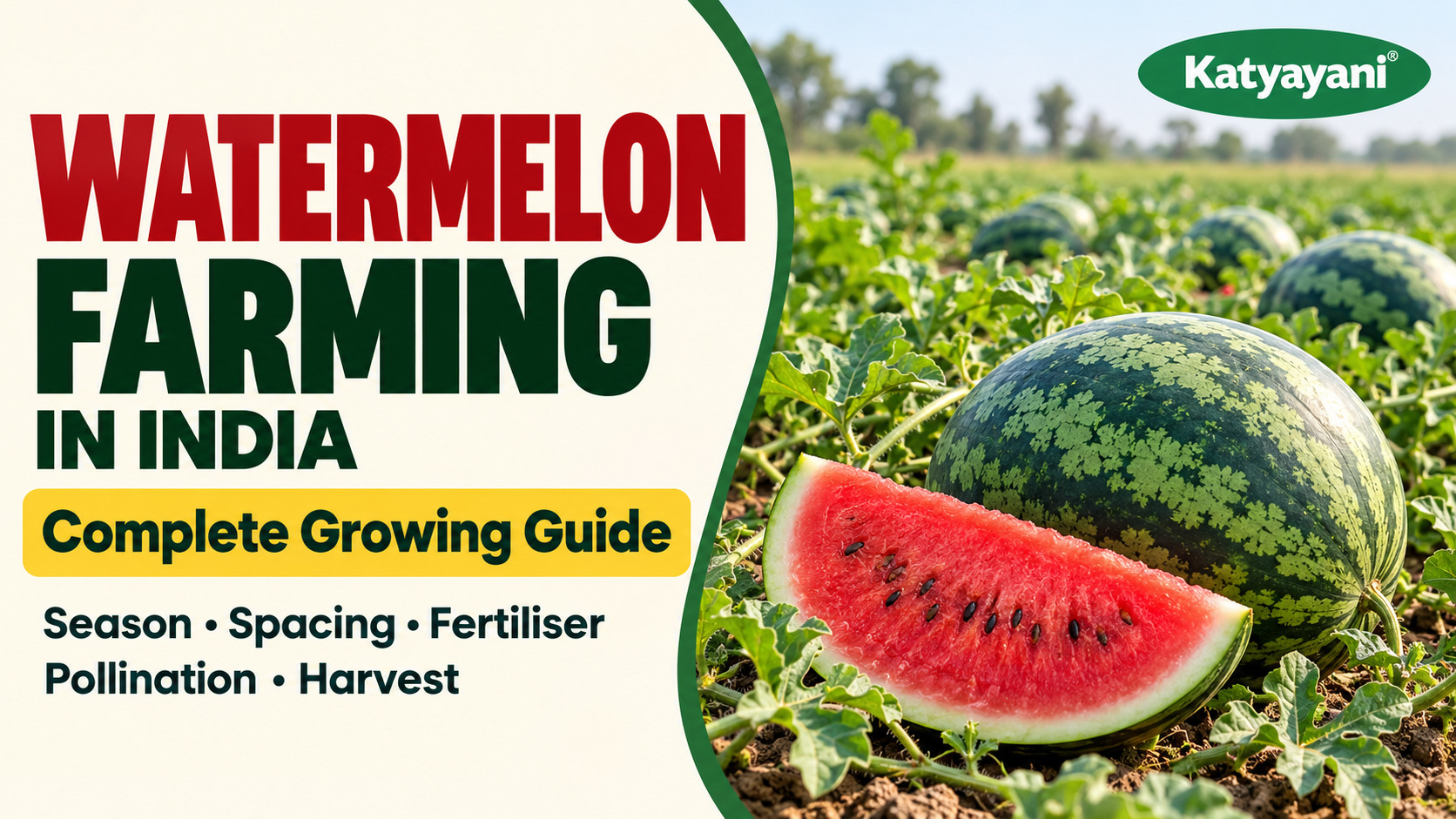
Watermelon needs warm weather and well-drained sandy loam with pH 6.5 to 7.5. TNAU suggests about 3.5 kg of seed per hectare, channels 2.5 m apart with hills 0.9 m apart, 20 t FYM per hectare and 200:100:100 kg NPK in splits. Bring honey bees at first flowering, irrigate often early and less near ripening, and harvest when the tendril near the fruit dries, the ground spot turns yellow and the sound is dull.
How is watermelon farmed in India? The short plan
Pick a variety for your market, sow in the warm season on prepared channels or raised beds, thin to two plants per hill, feed in splits, irrigate often at the start and ease off as fruit ripens, bring in honey bees when female flowers open, protect against fruit fly and mildews, and harvest when the ripeness signs agree. The sections below give the numbers and where sources disagree.
| Stage | TNAU | VFPCK (Kerala) |
|---|---|---|
| Season | Nov to Dec main; Jan to Feb for summer harvest | Nov to Jan |
| Seed per hectare | 3.5 kg | 3.5 to 5 kg |
| Basal manure | FYM 20 t, P 55 kg, K 55 kg | FYM 20 to 25 t |
| NPK per hectare | 200:100:100 in splits (fertigation) | 70:25:25 |
| Harvest sign | Dull sound or ground spot light yellow | Tendril dries, ground spot white to yellowish, dull sound |
| Yield per hectare | 25 to 30 t; PKM 1 36 to 38 t | 30 to 50 t |
Which soil and climate suit watermelon?
TNAU recommends sandy loam rich in organic matter, with good drainage and pH 6.5 to 7.5. The crop likes warm, dry weather. Rain at flowering hurts pollination and raises fruit rot and leaf disease. TNAU also warns that irrigating after a long dry spell causes fruit cracking, so keep moisture steady once fruits begin to size up.
What is the best season to plant watermelon in India?
It depends on your region. TNAU says the main sowing is November to December in Tamil Nadu, and that January to February sowing gives summer harvest at higher prices. VFPCK gives November to January for Kerala. A commercial reference page (BigHaat, not a university) lists February to March for north Indian plains, November to January for the north-east and west, and nearly year-round in the south and centre. I have not found an ICAR table for these, so the north India dates are marked VERIFY.
| Region | Window reported | Source |
|---|---|---|
| Tamil Nadu | Nov to Dec; Jan to Feb for summer crop | TNAU |
| Kerala | Nov to Jan (VFPCK); a commercial page says Dec to April | VFPCK; commercial page |
| North Indian plains | Feb to March | Commercial page, VERIFY with your state university |
| North-east and west India | Nov to Jan | Commercial page, VERIFY |
One more point from TNAU: fruit fly numbers peak in the rainy season and stay low in hot weather, so a sowing date that avoids the wet spell also helps with pests.
Which watermelon varieties are best for India?
TNAU names Sugar Baby and Arka Manik as varieties, with Arka Jyoti, Pusa Bedana and Suvarnima as hybrids. It also lists PKM 1 for large fruit, dark green rind and red flesh at 36 to 38 t/ha in 122 to 135 days. Market-preferred names it gives include Mithila, Suganthi, Kiran, Simran and Vishal. VFPCK names Arka Manik, Sugar Baby, Arka Jyothi and Pusa Bedana (seedless).
| Variety | Type | What the source says |
|---|---|---|
| Arka Manik | Variety (ICAR-IIHR) | About 110 to 115 days; average fruit about 6 kg; resistant to powdery mildew, downy mildew and anthracnose (IIHR summary). IIHR yield figure of 60 t/ha is VERIFY |
| Arka Muthu | Dwarf variety (ICAR-IIHR) | Early, 75 to 80 days; 2.5 to 3 kg fruit; TSS 12 to 14 degrees Brix; suits high-density planting. IIHR pages give two different yields, so no yield is shown |
| Sugar Baby | Variety | Listed by TNAU and VFPCK |
| Arka Jyoti | F1 hybrid | Listed by TNAU and VFPCK |
| Pusa Bedana | Seedless hybrid | Listed by TNAU and VFPCK; needs pollenizer plants |
| PKM 1 | Variety | Large fruit, red flesh; 36 to 38 t/ha in 122 to 135 days (TNAU) |
More on the dwarf type is on the IIHR Arka Muthu page. Seed rate and days to harvest on the seed packet beat any table for private hybrids.
How much seed does watermelon need per acre?
TNAU gives 3.5 kg per hectare. VFPCK gives 3.5 to 5 kg. Divide by 2.5 and you get about 1.4 kg and 1.4 to 2 kg per acre. Hybrids and seedless types often need less or come in counted packs, so read the packet. TNAU suggests treating seed with Trichoderma viride (4 g per kg), Pseudomonas fluorescens (10 g per kg) or carbendazim (2 g per kg). For the bio-agents, see the Trichoderma viride powder and Pseudomonas fluorescens powder pages for the product detail.
If you raise seedlings, TNAU suggests polybags (200 gauge, 10 cm by 15 cm, filled with red soil, sand and FYM at 1:1:1) or 98-cell protrays under protected conditions, and transplanting 12-day-old seedlings.
What is the right spacing for watermelon?
| System | Spacing | Source |
|---|---|---|
| Direct sowing on channels | Channels 2.5 m apart; hills 0.9 m apart; thin to 2 seedlings per hill at 15 days after sowing | TNAU |
| Drip on raised beds | Bed 1.2 m wide and 30 cm high; plant in holes 60 cm apart. Drip laterals 1.5 m apart with drippers at 60 cm (4 litres per hour) or 50 cm (3.5 litres per hour) | TNAU |
| Pit or hill methods | Other guides use wider pits or river-bed hills | Commercial reference; VERIFY |
VFPCK prints its row spacing as "2.5 to 3.5 cm", which is plainly a typo (it is a metre figure) and so I have left it out. It lists 90 to 120 cm between hills, which is the usable part.
Should I use plastic mulch on watermelon?
The TNAU page does not specify mulching, so I cannot give a university figure for it. Plastic mulch is widely used with drip to cut weeds, hold moisture and keep fruit cleaner. If you plan it, lay the drip line first, then the film, then punch planting holes. Our guide on types of mulch and how much to apply covers organic versus plastic. Check mulch thickness and colour with your KVK before you buy.
What fertiliser does watermelon need? (NPK schedule and fertigation)
Sources differ by a wide margin, so treat the numbers as ranges and let your soil test decide. TNAU recommends FYM 20 t per hectare, 55 kg P and 55 kg K as basal, and 55 kg N as top dressing at 30 days after sowing. TNAU also gives a full recommended dose of 200:100:100 kg NPK per hectare in splits. VFPCK shows FYM 20 to 25 t with NPK 70:25:25 kg per hectare.
TNAU also has a four-stage fertigation plan over 115 days. It uses grades such as 19:19:19, 12:61:0, 13:0:45 and urea. KO sells these grades: NPK 19:19:19 water-soluble, NPK 12:61:00 and NPK 13:00:45. Quantities are in the table; read each label before use.
| Stage (TNAU) | Days | Share of N / P / K |
|---|---|---|
| Crop establishment | 10 | 10% / 5% / 10% |
| Vegetative | 30 | 30% / 7.5% / 30% |
| Flower initiation to first picking | 30 | 30% / 7.5% / 20% |
| Harvesting | 45 | 30% / 5% / 40% |
The percentages in TNAU sum to 25% of P through fertigation because 75% of the recommended P is given as superphosphate at planting. If you use drip, our posts on water-soluble versus granular fertiliser and buying water-soluble fertiliser show what to compare.
How often should watermelon be irrigated?
TNAU says to irrigate before dibbling and then weekly. On drip, run it continuously for 8 to 12 hours per irrigation. VFPCK says to water often in the early stages and stop once fruits begin to ripen. Avoid big swings, because irrigation after a long dry spell causes cracking. Less water near ripening also tends to improve sweetness, but I did not find a source on that point, so treat it as a practical note and not a fact.
How do you control weeds in watermelon?
TNAU suggests a pre-emergence spray of pendimethalin at 1 kg active ingredient per hectare just before planting and three hand weedings. Do the first at around 20 to 25 days after sowing, before the vines cover the ground. Once vines spread, avoid walking through and turning them, which damages flowers.
TNAU also lists Ethrel (250 ppm, 2.5 ml per 10 litres) sprayed four times at weekly intervals from 15 days after sowing, which is a growth regulator practice used to change flowering. Use it only on the advice of your KVK or university.
How is watermelon pollinated and how do you improve fruit set?
Watermelon has separate male and female flowers and needs insects to carry pollen. The University of Delaware advises at least one strong honey bee hive per acre, two for early-planted fields, spread in groups of 4 to 8 across the field instead of on one edge. Set hives out when the first female flowers appear, before 10% of plants are in bloom.
- Female flowers open early and are most receptive before 10 a.m., and close in the afternoon.
- Bees fly less in rain, cloud, wind of 15 mph or more, and below about 55 degrees F.
- Seeded melons need at least 8 bee visits per flower; seedless need 16 to 24 because the pollen is a mix of viable and non-viable.
- For seedless crops, plant one pollenizer for every three seedless plants.
These are US numbers (hives per acre apply anywhere; the temperature is in Fahrenheit in the source). No Indian trial was opened, so check with your KVK for local hive hire. Avoid spraying insecticide in the morning while bees are working. A fruit fly lure should not harm bees, but read the label.
Which pests attack watermelon and how to control them?
TNAU names beetles (malathion 50 EC at 1 ml per litre weekly) and fruit fly. For fruit fly, TNAU suggests collecting and destroying affected fruit, ploughing to expose pupae, adjusting the sowing time, and fish meal traps (50 per hectare). It also lists neem oil at 3% as a need-based spray, and says not to use DDT, copper or sulphur dust because they harm the crop. VFPCK names red pumpkin beetle and epilachna beetle, with carbaryl at 0.2%. Pesticide use must match what is registered in India today, so check the label and your state office; I am not endorsing those doses.
Below are the KO pages for each pest. Each page lists the products KO offers for that problem. Check the crop and the dose on the product page.
| Problem | KO page |
|---|---|
| Fruit fly | Melon fly lure |
| Aphids | Insecticide for watermelon aphids |
| Red mite | Insecticide for watermelon red mite |
| Leaf miner | Insecticide for watermelon leaf miner |
| Nematodes | Best solutions for watermelon nematodes |
Neem oil is a common bio option. See our post on biopesticides before you decide where neem fits in your plan.
Which diseases attack watermelon and how to manage them?
TNAU lists no disease control beyond seed treatment. VFPCK names downy mildew (mancozeb at 0.2%) and powdery mildew. The IIHR note on Arka Manik says it resists powdery mildew, downy mildew and anthracnose, which is a good reason to choose that variety in wet areas. Rotation, drainage, clean seed and resistant varieties are the base of control. Use a spray only after identifying the disease, and see our fungicide application methods guide.
| Disease | KO collection |
|---|---|
| Powdery mildew | Fungicide for watermelon powdery mildew |
| Downy mildew | Fungicide for watermelon downy mildew |
| Fusarium wilt | Fungicide for watermelon fusarium wilt |
| Anthracnose | Fungicide for watermelon anthracnose |
| Gummy stem blight | Fungicide for watermelon gummy stem blight |
| Fruit rot | Fungicide for watermelon fruit rot |
There are also KO pages for watermelon bacterial wilt, Alternaria leaf spot, mosaic virus and bud necrosis if you see those symptoms. The Watermelon Suraksha combo is one product page worth opening to see what is in the pack; I have not verified its contents.
How do you know when a watermelon is ripe? (harvest signs)
TNAU says to harvest when the fruit gives a dull sound when tapped or when the ground contact area turns light yellow. VFPCK adds that the tendrils at the fruit stem should wither. UGA Extension also stresses the dried curly tendril nearest the stem, a cream or yellow ground spot, and a dull rind. A white or pale green ground spot means the fruit was picked early. No single sign is reliable by itself, since drought can dry a tendril, and the thump test is the least reliable of the four.
| Sign | Ripe | Not ripe |
|---|---|---|
| Tendril near fruit | Dried, brown | Still green |
| Ground spot | Cream or yellow | White or pale green |
| Sound | Dull, hollow | High-pitched |
| Rind | Dull | Shiny |
Harvest by cutting the stem, leaving a short piece on the fruit. TNAU says grade fruit for uniform, symmetrical shape and a bright waxy surface, free of scars, sunburn and abrasions. Days to harvest run 75 to 100 for fast types and 120 or more for large types such as PKM 1.
What yield can you expect from watermelon per acre?
| Source | Per hectare | About per acre |
|---|---|---|
| TNAU general | 25 to 30 t in about 120 days | 10 to 12 t |
| TNAU PKM 1 | 36 to 38 t in 122 to 135 days | 14.4 to 15.2 t |
| VFPCK | 30 to 50 t | 12 to 20 t |
Per-acre values are my own division by 2.5. Your result depends on variety, spacing, pollination and how many fruits you let each plant carry.
Watermelon crop calendar at a glance
| Days after sowing (TNAU) | Job |
|---|---|
| Before sowing | Soil test, FYM, basal P and K, pre-emergence weed spray if used |
| 0 | Sow on channel or plant seedlings |
| About 15 | Thin to 2 seedlings per hill |
| 20 to 25 | First weeding |
| 30 | Nitrogen top dressing (TNAU) |
| First female flowers | Bring honey bee hives |
| Fruit set to ripening | Scout fruit fly and mildew; steady irrigation, then less |
| 75 to 135 | Harvest as per variety and ripeness signs |
Conclusion
Watermelon is simple to plan and easy to spoil. Choose a variety for your market and season, follow one set of spacing and fertiliser numbers from your state university, and bring bees in when female flowers open. Watch for fruit fly and mildew from fruit set, ease off water as fruits ripen, and use more than one sign before cutting. Your KVK can fix the local numbers.
Why trust this guide
Written by Team Katyayani, Editorial Team at Katyayani Organics. Cross-checked against published research and university extension programs.

Leave a Comment