 17 min read
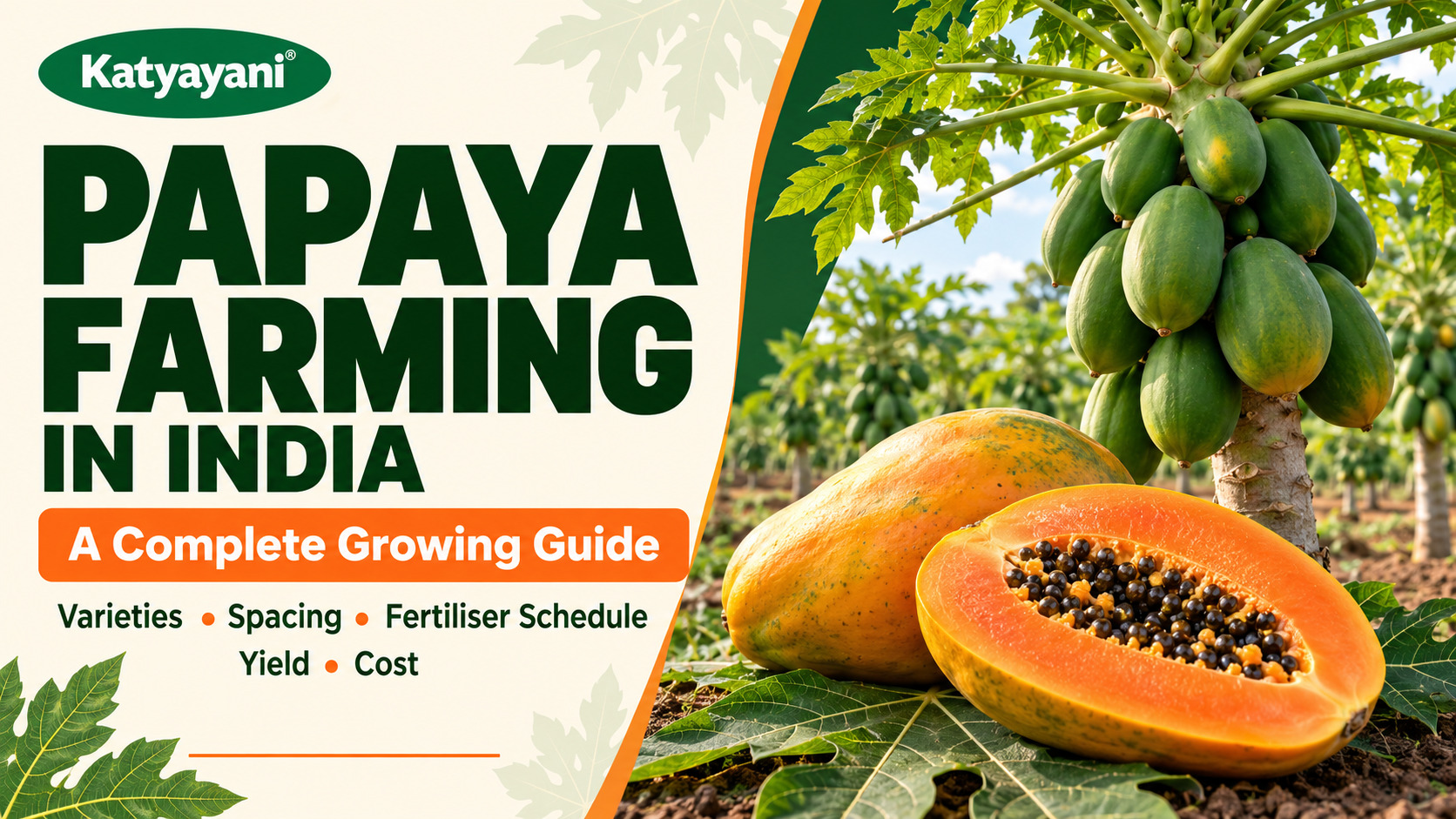
Papaya is a fast fruit crop that gives its first harvest in about 8 to 14 months, depending on variety and place, and keeps bearing for 2 to 3 years in practice. It needs warm weather, a well drained sandy loam soil and no standing water. Red Lady 786 (Taiwan) is the most talked about hybrid; government varieties include CO 2 to CO 8, Pusa Delicious, Pusa Nanha, Coorg Honey Dew and ICAR-IIHR Arka Surya and Arka Prabhath. Spacing is 1.8 m by 1.8 m for normal planting (about 1,250 plants per acre by our arithmetic) and 1.5 m by 1.5 m for higher density. Feed with 10 kg farmyard manure per plant plus split NPK, and spray zinc and boron. Yield claims range from about 12 tonnes to 22 tonnes per acre across sources, so work out your profit from your own cost and market rate.
Why grow papaya? Quick facts on area, production and demand
Papaya (Carica papaya) is a tropical fruit rich in vitamins A and C. The National Horticulture Board says India leads the world in papaya production. The same page names Andhra Pradesh, Karnataka, Gujarat, Orissa, West Bengal, Assam, Kerala, Madhya Pradesh and Maharashtra as the main growing states, and says fruit reaches markets all year round from the big producing states. Delhi and Mumbai are the two main markets, with Jaipur, Bangalore, Chennai, Kolkata and Hyderabad next.
Papaya is also a source of papain, an enzyme dried from the latex of raw fruit. NHB lists uses in meat tenderising, chewing gum, cosmetics, silk degumming, textile and pharma work. That gives the grower two markets: fruit and latex.
| Fact | What the source says | Source / note |
|---|---|---|
| World rank | India leads world papaya production | NHB papaya model page |
| India output | About 3 million tonnes (NHB, old figure); about 5.88 million tonnes on 1.48 lakh ha (BigHaat, 2023, unofficial) | Figures differ by source and year. VERIFY with the latest NHB or Ministry of Agriculture horticulture statistics before quoting |
| Main states (NHB) | Andhra Pradesh, Karnataka, Gujarat, Orissa, West Bengal, Assam, Kerala, Madhya Pradesh, Maharashtra, Jharkhand | NHB growing belts list |
| Perishability | Fruit keeps 1 to 3 weeks at 10 to 13 degrees C and 85 to 90 percent humidity | NHB |
| Crop life | Economic life of the plant is 3 to 4 years; TNAU gives crop duration of 24 to 30 months | NHB, TNAU |
Which state is famous for papaya farming?
NHB lists the main papaya belts by state. Andhra Pradesh, Karnataka, Gujarat, Maharashtra, West Bengal, Odisha, Assam, Kerala, Madhya Pradesh and Jharkhand all grow it commercially. Which state is first in production today could not be confirmed from an official page in this research, so check the latest NHB horticulture statistics.
| State | Growing belts named by NHB | Varieties named by NHB |
|---|---|---|
| Andhra Pradesh | Cuddapah, Medak, Kurnool, Rangareddy | Honey Dew, Coorg Honey Dew, Washington, Solo, CO 1 to CO 3, Sunrise Solo, Taiwan |
| Karnataka and Kerala | Karnataka: Bellary, Bidar, Bangalore, Mandya, Shimoga, Chitradurga, Mysore, Belgaum, Hassan | Coorg Honey Dew, Coorg Green, Pusa Delicious, Pusa Nanha |
| Gujarat | Kheda, Ahmedabad, Jamnagar | Not listed by NHB |
| Maharashtra | Sangli, Satara, Pune, Nasik, Sholapur, Nagpur, Amravati | Not listed by NHB |
| West Bengal | North and South 24 Parganas, Hooghly, Nadia, Midnapur | Ranchi selection, Honey Dew, Washington, Coorg Green |
| Odisha | Not listed | Pusa Delicious, Pusa Nanha, Ranchi selection, Honey Dew, Washington, Coorg Green |
| Jharkhand | Simdega, Ranchi, Lohardaga, Hazaribagh, Chatra | Ranchi selection, Honey Dew, Pusa Delicious, Pusa Nanha |
| Madhya Pradesh | Dhar, Khandwa, Bilaspur, Ratlam, Guna | Not listed by NHB |
| Assam | Nagaon, Darrang, Karbi Anglong | Not listed by NHB |
The NHB varieties column is from an older page. Many farmers now use hybrids such as Red Lady 786, so always ask your local horticulture office which varieties do well in your block.
What climate and soil does papaya need?
Papaya needs a warm, frost free climate and a deep, well drained sandy loam soil. NHB says it grows in mild subtropical regions up to 1,000 m above sea level, and that it is very sensitive to frost, strong wind and water stagnation. Cold nights below 12 to 14 degrees C for several hours in winter damage growth and fruit set.
| Factor | Requirement | Source |
|---|---|---|
| Temperature | Summer 35 to 38 degrees C is fine (TNAU). Night temperature below 12 to 14 degrees C for hours hurts (NHB). BigHaat gives 25 to 30 degrees C as ideal | NHB, TNAU, BigHaat (unofficial) |
| Altitude | Up to 1,000 m (NHB); up to 1,200 m (TNAU) | NHB, TNAU |
| Soil type | Deep, well drained sandy loam; avoid heavy or very sandy soil | NHB, Apni Kheti |
| Soil pH | 6.0 to 6.5 (BigHaat) or 6.5 to 7.0 (Apni Kheti). Treat 6.0 to 7.0 as a working range and confirm with a soil test | Unofficial. VERIFY with your state horticulture university |
| Water | Sensitive to waterlogging. BigHaat says 24 to 48 hours of standing water can kill plants | NHB, BigHaat |
| Wind | Plant a windbreak on the orchard boundary | NHB |
Choose upland or raised ground with good slope. TNAU links poorly drained soil to collar rot. Before you plant, get a soil test and read it with our guide on how to read a soil health card. If pH is far outside the range, read how soil pH locks nutrients first, because fertiliser will not work well in the wrong pH.
Which papaya varieties are best? Red Lady 786, Taiwan, Pusa and others
Red Lady 786 is a hybrid with self-fruiting plants, which means every plant bears fruit, so no male plants are needed. It is the most popular commercial choice. Government and university varieties include the TNAU CO series, the IARI Pusa series and the IIHR Arka hybrids. Pick on three points: sex type, local disease pressure and market taste.
| Variety | Type and key features | Yield noted | Source |
|---|---|---|---|
| Red Lady 786 (Taiwan Red Lady) | Hybrid, self-fruitful (every plant bears), reddish orange flesh, medium oblong to oval fruit. Described as pest and disease resistant on Apni Kheti, but IIHR trial notes call Arka lines PRSV susceptible and Red Lady highest yielding in a screen house | 50 kg per plant (Apni Kheti); 18 to 22 tonnes per acre claimed (Agro Potli) | Apni Kheti, IIHR extract, Agro Potli (unofficial). VERIFY |
| Arka Prabhath (IIHR) | Gynodioecious hybrid, fruit 900 to 1,200 g, TSS 13 to 14 Brix | 90 to 100 kg per plant | ICAR-IIHR |
| Arka Surya (IIHR) | Gynodioecious, no male plants, Sunrise Solo x Pink Flesh Sweet | 55 to 65 kg per plant | ICAR-IIHR (page also shows a conflicting per-acre figure; VERIFY) |
| Pusa Delicious | Hermaphrodite, medium to large oblong fruit, deep orange flesh, TSS 8 to 10 percent | 46 kg per plant | Apni Kheti |
| Pusa Nanha / Pusa Dwarf | Dwarf. NHB: close spacing of 1.2 m x 1.2 m for high density with Pusa Nanha | 35 kg per plant (Pusa Dwarf) | NHB, Apni Kheti |
| Punjab Sweet | Dioecious, large oblong fruit, TSS 9 to 10.5 percent | 50 kg per plant | Apni Kheti |
| Coorg Honey Dew | Common in Karnataka, Kerala and Andhra Pradesh | Not stated | NHB |
| CO 3, CO 7, Surya (TNAU) | Gynodioecious (bisexual plus female), good for table fruit | CO 3: 100 to 120 t/ha; CO 7: 200 to 225 t/ha | TNAU |
| CO 2, CO 5, CO 6 (TNAU) | Dual purpose: table fruit and papain | CO 2: 200 to 250 t/ha; CO 5: 200 to 250 t/ha; CO 6: 120 to 160 t/ha | TNAU |
Do not compare these yield figures directly. They come from different places, years and management levels, and TNAU gives tonnes per hectare while others give kg per plant. Use them to rank varieties, not to promise income. The ICAR-IIHR Arka Prabhath page gives the breeder figures for that hybrid.
What is the difference between Red Lady, Taiwan 786 and Red Lady 786? These names are used for the same Taiwan bred hybrid in the Indian market. Brand and seed company names vary, so check the packet for the seed company, lot number and test date. Our guide on spotting fake farm inputs shows the label checks that apply to seed packets too.
How to raise papaya seedlings: seed rate, treatment and nursery
Raise seedlings in polythene bags or raised nursery beds and transplant when they are 15 to 20 cm tall, about 45 to 60 days after sowing. Sow seed 1 cm deep, treat seed against fungus first, and keep the bags in partial shade. Seed rate varies a lot by source, so use the table to compare.
| Item | Figure | Source |
|---|---|---|
| Seed rate | NHB: 250 to 300 g per ha. TNAU: 500 g per ha. Apni Kheti: 150 to 200 g per acre. BigHaat: 200 g per acre for varieties, 100 g per acre for hybrids | Conflicting. Hybrid seed is sold by the packet, so follow the seed company pack and ask your KVK. VERIFY |
| Seed treatment | Captan 2 g per kg of seed (TNAU). NHB suggests a fungicide treatment at 0.1 percent | TNAU, NHB |
| Germination aid | Soak seed in gibberellic acid (GA3) 100 ppm for 16 hours | TNAU |
| Sowing | Four seeds per polythene bag, depth not more than 1 cm; water with a rose can | TNAU |
| Nursery bed (NHB) | 3 m long, 1 m wide, 10 cm high; rows 10 cm apart; cover with straw or polythene | NHB |
| Seedling age | About 60 days (TNAU); 15 to 20 cm tall in about two months (NHB); 45 to 60 days (BigHaat) | NHB, TNAU, BigHaat |
| Nematodes in nursery | Carbofuran 3G, 1 g per bag after germination (TNAU). Check that this is allowed on your label today | TNAU. VERIFY registration |
Healthy, virus free seedlings are the first defence against ring spot virus. Buy from a reliable nursery, throw out any seedling with mottled or distorted leaves, and do not plant near old papaya or cucurbit fields.
When is the best time to plant papaya?
NHB lists three planting seasons: spring (February to March), monsoon (June to July) and autumn (October to November). TNAU recommends June to September in Tamil Nadu and says to avoid planting in heavy rain. Choose the window that avoids winter cold at flowering and standing water at the young stage.
| Season | Plus | Risk |
|---|---|---|
| Feb-Mar (spring) | Warm weather helps quick growth | Needs regular irrigation in summer heat |
| Jun-Jul (monsoon) | Natural moisture | Waterlogging and root rot if drainage is poor; TNAU says avoid rainy season planting |
| Oct-Nov (autumn) | Plants establish before summer | Cold nights in north India can slow growth (NHB: below 12 to 14 degrees C) |
In cold pockets protect young plants as shown in our guide on frost protection in crops.
What is the correct spacing for papaya? How many plants per acre?
The usual spacing is 1.8 m x 1.8 m, which is about 1,250 plants per acre. NHB recommends 1.5 m x 1.5 m (about 1,800 plants per acre) for better returns. Red Lady 786 growers often use 6 x 6 feet (about 1,200 plants per acre). Plants per acre in the table below are our own arithmetic (1 acre = 4,047 square metres).
| Spacing | Plants per acre (our arithmetic) | Where it is advised |
|---|---|---|
| 1.8 m x 1.8 m | About 1,250 | NHB and TNAU normal spacing; BigHaat says about 1,200 |
| 1.5 m x 1.5 m | About 1,800 | NHB recommends for higher return; NHB cost model uses 1,700 plants per acre |
| 1.25 m x 1.25 m | About 2,590 | BigHaat high density |
| 1.2 m x 1.2 m | About 2,810 | NHB high density for Pusa Nanha (NHB gives 6,400 per ha, which we could not match; VERIFY) |
| 6 x 6 feet (1.83 m) | About 1,200 | Agro Potli for Red Lady 786 (1,100 to 1,200 plants) |
| 5 x 5 feet (1.52 m) | About 1,740 | Agro Potli for fertile soil |
NHB says tall and strong varieties need more space, and dwarf types can be planted closer. Closer planting needs a higher fertiliser and water budget and good airflow, otherwise disease spreads faster.
How to prepare the field and plant papaya?
Dig pits, fill them with soil and manure, and transplant on a cloudy day or in the evening. NHB advises pits of 60 x 60 x 60 cm; TNAU gives 45 x 45 x 45 cm. In summer, dig pits about a fortnight before planting.
- Pit mix (NHB): top soil plus 20 kg farmyard manure, 1 kg neem cake and 1 kg bone meal per pit.
- Biofertiliser (TNAU): 20 g each of Azospirillum and Phosphobacterium at planting, and again six months later. See our bio fertilisers collection.
- Windbreak: plant a windbreak on the boundary (NHB).
- Drainage: earth up before or after the monsoon so water does not stand near the stem (NHB).
- One plant per pit: if you planted several seedlings in a pit, keep only one strong plant. TNAU says keep one hermaphrodite or female in each pit.
Mulching around young plants cuts weeds and holds moisture. Read how much to apply in our guide to mulching types and depth, and keep the mulch a hand width away from the stem to avoid collar rot.
Why remove male papaya plants? How many to keep?
Papaya plants can be male, female or hermaphrodite, and the sex shows only at flowering. In dioecious varieties, male plants give no fruit but are needed for pollination. NHB says keep about 10 percent males and uproot extra males as soon as flowers show. TNAU says keep 1 male tree for every 20 female trees.
| Variety type | What to do | Source |
|---|---|---|
| Dioecious (separate male and female) | Keep about 10 percent males (NHB) or 1 male per 20 females (TNAU). Remove the rest after flowering starts | NHB, TNAU |
| Gynodioecious (hermaphrodite plus female, e.g. CO 3, CO 7) | Keep one hermaphrodite plant per pit; remove female plants | TNAU |
| Self-fruitful hybrid (e.g. Red Lady 786) | Every plant bears fruit; remove weak or off-type plants only | Apni Kheti, Agro Potli |
Planting 2 to 3 seedlings per pit and thinning at flowering is a common way to end up with the right sex ratio, but it also means more seedlings to buy. Count that in your cost.
What is the fertiliser schedule for papaya?
Papaya is a heavy feeder. NHB recommends 10 kg manure per plant plus 200 to 250 g each of N, P2O5 and K2O per plant per year in split doses. The TNAU Agritech papaya page gives a different, lower split schedule for Tamil Nadu. Sources disagree, so use the table as a range and match it to your soil test.
| Source | Organic | Chemical NPK | Notes |
|---|---|---|---|
| NHB | 10 kg per plant (in pit, plus 20 kg FYM, 1 kg neem cake, 1 kg bone meal per pit) | 200 to 250 g each of N, P2O5, K2O per plant per year | Papain yield rises with N up to 300 g; fruit yield best at 200 g N |
| TNAU (soil) | FYM 10 kg per plant at planting | 50 g each N, P, K per plant every 2 months from month 3 | After removing unwanted sex forms. Azospirillum and Phosphobacterium 20 g at planting and at 6 months |
| TNAU (drip fertigation) | Not stated | 13.5 g urea and 10.5 g muriate of potash per plant per week through drip, plus 300 g single superphosphate per plant every 2 months from month 3 to 4 | With 10 litres water per day per plant |
| BigHaat (unofficial) | FYM 10 kg, neem cake 1 kg per plant | 200 g N, 200 g P, 400 g K per plant per year, split every 60 days | Apply in a trench 20 to 30 cm from the stem. VERIFY |
| Apni Kheti (Punjab) | Not stated | No basal dose; 19:19:19 at 1 kg applied twice in February (page does not say per plant or per acre) | VERIFY before using |
Split the dose into several small applications rather than one big one. Papaya roots are shallow, and a heavy single dose is easily washed out or burns roots. If you use drip, a water-soluble programme gives you the most control; read when water-soluble beats granular. The papaya slow growth fertiliser collection covers the early growth stage and the papaya fruit size and weight collection covers fruit filling. Match any product to your soil test and read the label for dose.
Do papaya plants need boron and zinc? When to spray?
Yes. TNAU recommends spraying zinc sulphate 0.5 percent plus boric acid 0.1 percent at the 4th and 8th month after planting to improve growth and yield. NHB gives the same two sprays. Boron is the nutrient most linked to lumpy, deformed papaya fruit.
| Sign in the field | Likely cause | What sources say |
|---|---|---|
| Lumpy, bumpy or deformed fruit; hard latex on fruit | Boron shortage | A University of Hawaii extension sheet (read as a search extract) links lumpy fruit to boron deficiency and says boron moves poorly in the plant. Older research used 0.25 percent borax or boric acid foliar spray. VERIFY with your state horticulture university |
| Distorted, claw-like young leaves | Boron shortage | Same Hawaii sheet |
| Small, bunched leaves and slow growth | Often zinc shortage | Zinc is a common papaya need; confirm with soil or leaf test |
Do not overdose boron, because the gap between enough and too much is small. Use the label dose of a boron fertiliser, spray in the cool part of the day, and confirm the problem with a leaf or soil test. Our soil pH guide explains why high pH can lock out micronutrients even when the soil has enough. A flowering-stage plant growth regulator is sometimes used when flowering is poor; see the papaya flowering PGR collection and use only as per label.
How much and how often to irrigate papaya? Is drip worth it?
Papaya needs regular but light irrigation and cannot take standing water. NHB says give protective irrigation in the first year. In the second year, irrigate every 10 days in summer and every fortnight in winter. TNAU says irrigate heavily after planting and then once a week. Drip is advised in low-rainfall areas.
| Source | Schedule | Method |
|---|---|---|
| NHB | Year 1: protective irrigation. Year 2: every 10 days in summer, every 15 days in winter | Basin method mostly; drip or sprinkler in low rainfall |
| TNAU | Irrigate heavily after planting, then once a week. Drip: 10 litres of water per plant per day | Basin or drip with fertigation |
| BigHaat (unofficial) | Summer every 7 days, winter every 10 to 15 days | Basin, ring or drip |
NHB says a model with improved seedlings and drip irrigation lifts average productivity by more than 60 percent over the usual method, and gives better synchronised growth, flowering and harvest. That figure is from the NHB model project, which is old, so treat it as a direction not a promise. Keep water away from the stem, and never let water stand around the root zone. Check soil with your hand before each irrigation rather than on a fixed calendar.
How to manage weeds and intercrops in papaya?
Keep the area around plants weed free, especially in the first year. NHB recommends deep hoeing in year one and regular weeding around plants. It also lists pre-emergence herbicides two months after transplanting. Check any herbicide against the current label and registration before use, since the NHB list is old.
- Intercrops (NHB): grow legumes after non-legumes and shallow-rooted crops after deep-rooted ones. Take no intercrop after flowering starts.
- Earthing up: do it before or after the monsoon so plants stand firm and water drains away (NHB).
- Staking and thinning: BigHaat lists bamboo support to prevent lodging and thinning extra fruit in a cluster for bigger fruit (unofficial).
- Maize as catch crop: TNAU suggests maize around the field to trap virus carrying insects (see ring spot below).
What are the main pests of papaya?
NHB lists fruit flies, aphids, red spider mite, stem borer, grey weevil and the akk grasshopper as the main insect pests. Aphids and whiteflies also spread virus. Remove and destroy damaged parts, scout every week, and spray only when the pest count justifies it.
| Pest | Damage | Where to look for products |
|---|---|---|
| Aphids | Suck sap; carry papaya ring spot virus | Papaya aphid collection |
| Mealybug | Cottony white clusters on leaves, stems and fruit. Not in the NHB list; widely reported as a problem in many states. VERIFY with your state horticulture department | Papaya mealybug collection |
| Fruit fly | Maggots in ripening fruit | Papaya fruit fly collection |
| Red spider mite | Yellow speckled leaves, webbing | Choose a miticide registered for papaya |
| Stem borer and grey weevil | Tunnels in stem; leaf notching | Remove damaged parts (NHB) |
Always use products registered for papaya in India, follow label dose and waiting period, and rotate chemistry. For a comparison of options, read where bio and chemical inputs each win.
What are the main papaya diseases? A short overview
The main papaya diseases are papaya ring spot virus, root and stem rot (collar rot), powdery mildew, anthracnose, damping off in the nursery and leaf curl. TNAU lists stem or foot rot, powdery mildew, ring spot, leaf curl and anthracnose. This is only a quick map. A full integrated disease management guide is planned.
| Disease | What you see | First action (as per source) |
|---|---|---|
| Papaya ring spot virus (PRSV) | Mosaic on leaves, ring marks on fruit, stunting | No cure. Remove infected plants, control aphids, grow maize as a catch crop, use virus free seedlings (TNAU) |
| Root rot, wilt, collar rot | Plants collapse in wet soil | Improve drainage. TNAU: soil drench with Bordeaux mixture 1 percent or metalaxyl 0.2 percent at fortnightly intervals. Check current registration |
| Powdery mildew | White powder on leaves | Wettable sulphur 1 g per litre (NHB) |
| Anthracnose | Dark sunken spots on fruit | Carbendazim or thiophanate methyl 1 g per litre, or mancozeb 2 g per litre (NHB) |
| Damping off | Seedlings fall in nursery | Seed treatment, well drained bags, light watering |
| Leaf curl | Curled, thick leaves; spread by whitefly | Control whitefly, remove infected plants |
For field problems you can also browse collections such as papaya root rot and papaya ring virus vector control. The TNAU diseases page has photos to help you identify what you see.
When is papaya ready for harvest? How many months does it take?
Harvest papaya when the fruit is full size and light green with a yellow tinge at the tip, or at colour break. NHB adds that when the latex turns from milky to watery the fruit is ready. Time to first harvest is about 8 to 11 months for most hybrids and up to 14 to 15 months in cooler places.
| Source | Flowering | First harvest |
|---|---|---|
| BigHaat (unofficial) | 6 to 7 months after planting | 10 to 11 months (FAQ says 8 to 11) |
| Agro Potli (Red Lady 786) | Not stated | 8 to 10 months after transplanting |
| Apni Kheti (Punjab) | Not stated | First picking 14 to 15 months after planting; 4 to 5 pickings per season |
| TNAU | Not stated | Pick at colour break; crop duration 24 to 30 months |
Pick with a sharp knife or twist gently, and keep the fruit off the soil to avoid latex stains and disease. NHB says grade by weight, size and colour, pack in lined baskets and store at 10 to 13 degrees C with 85 to 90 percent humidity for 1 to 3 weeks. For distant markets pick at colour break and pack carefully.
What is the papaya yield per acre?
Reported papaya yield per acre ranges from about 12 tonnes to over 30 tonnes depending on variety, care and the source. Under NHB model, yield is 30 tonnes in the second year and 25 tonnes in the third. BigHaat gives 12 to 16 tonnes in year 1. These cannot be added or compared; they come from different years and assumptions.
| Source | Yield figure | Note |
|---|---|---|
| NHB one acre model | 30 tonnes (year 2), 25 tonnes (year 3) per acre. Also 75 to 100 tonnes per ha in a season | Old model; valued then at Rs 4,500 per tonne. Per ha and per acre figures are not consistent |
| TNAU | CO 2: 200 to 250 t/ha; CO 3: 100 to 120; CO 5: 200 to 250; CO 6: 120 to 160; CO 7: 200 to 225; CO 8: 220 to 230 | Station figures, tonnes per hectare |
| IIHR | Arka Prabhath: 90 to 100 kg per plant; Arka Surya: 55 to 65 kg per plant | Per plant, from ICAR-IIHR |
| BigHaat (unofficial) | 12 to 16 t per acre (year 1); 6 to 8 t (year 2); 30 to 50 kg per plant | Commercial site |
| Agro Potli (unofficial) | 18 to 22 t per acre for Red Lady 786 over a crop cycle | Commercial site. VERIFY |
| Apni Kheti | Red Lady 50 kg per plant, Pusa Delicious 46, Pusa Dwarf 35 | Per plant |
A check you can do yourself: yield per acre equals plants per acre times kg per plant. For example, 1,200 plants times 20 kg a plant is 24,000 kg (24 tonnes). That is an example of the arithmetic, not a forecast. Real orchards lose plants to virus, wind and waterlogging, so use a lower survival rate when you plan.
How much does papaya farming cost per acre and what can you earn?
There is no single official cost. The NHB model costed a one acre orchard at about Rs 1.25 lakh in total project cost, but that model is old. A 2026 commercial source quotes Rs 85,000 to Rs 1,10,000 per acre for seedlings, drip, fertiliser, protection and labour, and net profit of Rs 2.5 to 5.5 lakh per acre for Red Lady 786. Treat the commercial range as unverified.
| Cost head | NHB model (old, per acre) | What to do now |
|---|---|---|
| Planting material | Rs 3,400 for 1,700 plants at Rs 2 each | Get a current seedling quote |
| Manures and fertiliser | Rs 6,600 | Rework from your soil test and price list |
| Pesticides | Rs 500 | Rework for your pest pressure |
| Labour | Rs 8,400 (at Rs 70 per day) | Use local wage |
| Power | Rs 3,600 | Use your electricity or diesel cost |
| Drip and fertigation | Rs 25,000 | Get a current quote; check subsidy |
| Irrigation source, fencing, land levelling, shed | Rs 45,000, Rs 20,000, Rs 4,000, Rs 5,000 | Only if you need to build them |
Profit = (total fruit sold in kg x your selling price per kg) minus total cost. Fill in your own price from your local mandi using Agmarknet or e-NAM, because a 1 kg price changes with city, season and grade, and no single price is valid. Also count the loss from plants that die or are culled, fruits that are rejected for deformity, and the time to get the first income. The NHB model estimated break-even in the third year and payback in about 2.45 years, again on old numbers.
For loans see the Kisan Credit Card scheme and for horticulture support read the agriculture subsidy schemes overview. NHB notes in its model that a capital subsidy was part of the financing plan, so ask your district horticulture office what applies today.
Can you grow papaya in a net house or polyhouse?
Yes. A research paper listed on Google (ARCC Agricultural Science Digest) compared Red Lady 786 in a net house and in the open field, and an IIHR screen house trial noted that Red Lady gave the highest yield among cultivars compared. Protected cultivation keeps out aphid carriers of virus but raises cost. Read the costs in our greenhouse farming guide before you decide.
The paper and IIHR trial were read only as search extracts, so confirm the details before quoting them.
How is papain extracted from papaya and how much can you get?
Papain is dried latex from raw papaya fruits. TNAU says tap 75 to 90 day old fruits early in the morning, finish before 10 am, make four shallow cuts (not more than 0.3 cm deep) from stalk to tip, and repeat the tapping four times at three day intervals on new spots. Dry the latex quickly at 50 to 55 degrees C.
| Step | TNAU instruction |
|---|---|
| Fruit age | 75 to 90 days old, immature fruit |
| Cuts | Razor blade or stainless steel knife; four cuts, depth not more than 0.3 cm, stalk to tip |
| Timing | Tap early morning, finish before 10 am; repeat four times, three days apart, on uncut areas |
| Drying | Shade dry or dry quickly at 50 to 55 degrees C; add potassium metabisulphite 0.5 percent for colour and keeping quality; stop when it comes off as porous flakes |
| Sieving and packing | Powder, sieve through 10 mesh, pack in airtight polythene and seal in a tin |
| Yield | Crude papain: CO 2 about 600 kg per ha; CO 5 about 800 kg per ha |
| After tapping | Fruits can be used for pectin or tutti frutti, or allowed to ripen |
TNAU says CO 2 and CO 5 are best for papain. NHB adds that papain output rises with nitrogen up to 300 g per plant, while fruit yield is best at 200 g. Papain prices and buyers were not researched, so check with a buyer before planning it as a business.
Papaya farming compared with other fruit crops
Papaya gives the quickest return among tree-type fruit crops because it fruits within a year, but it lives only a few years and is easily hit by virus and waterlogging. For long cycle options see our guides to dragon fruit farming, avocado farming and G9 banana farming, which also gives a per acre cost view.
Conclusion
Papaya rewards a farmer who gets four things right: a virus free seedling, well drained land, split feeding with zinc and boron, and a market plan before planting. Use the ranges in this guide to plan, not to promise income, and run every figure through your own soil test, local cost and mandi price.
Why trust this guide
Written by Team Katyayani, Editorial Team at Katyayani Organics. Cross-checked against published research and university extension programs.




Leave a Comment