 11 min read
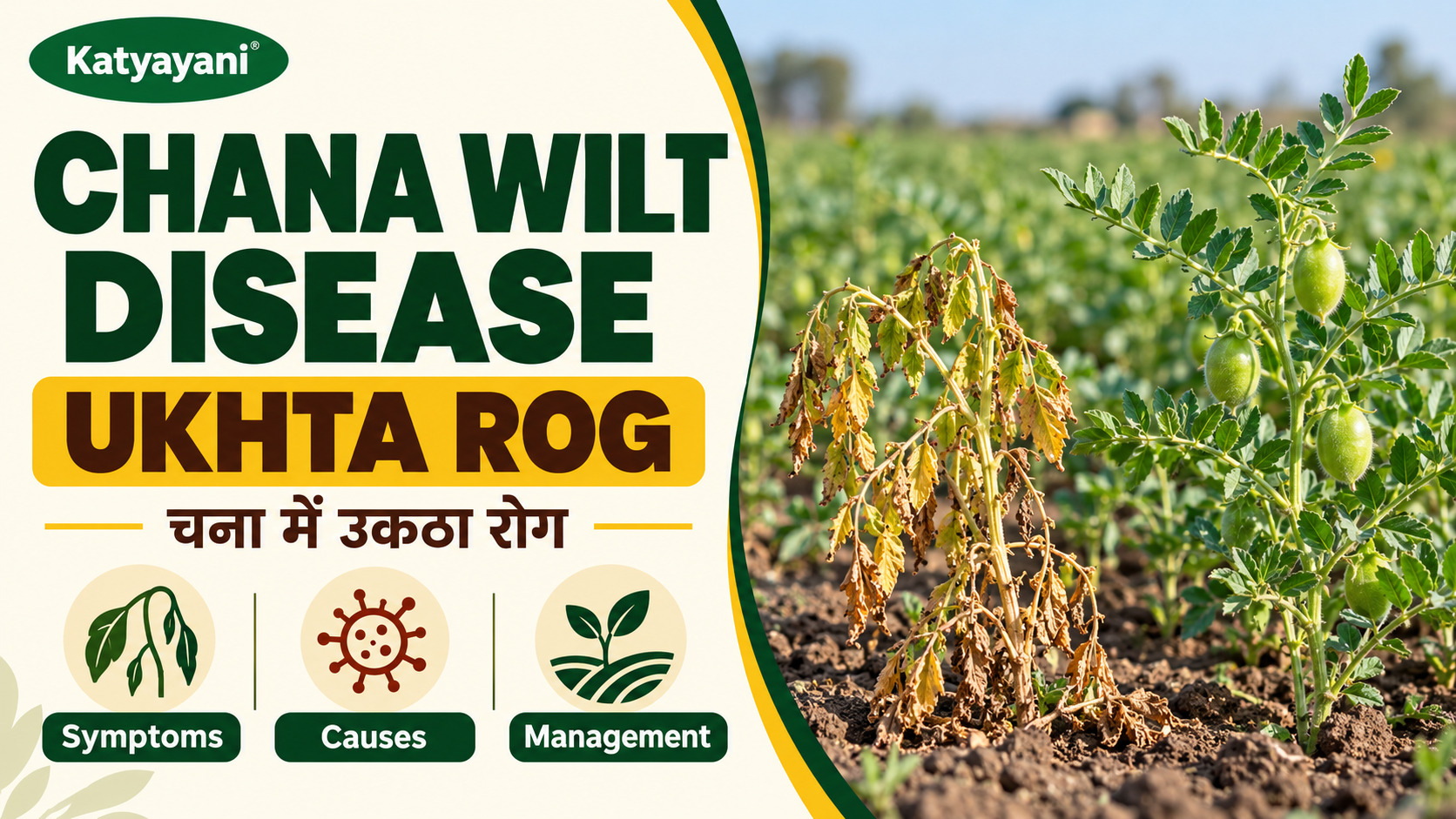
Chana wilt (ukhta rog) is caused by a soil and seed borne fungus, Fusarium oxysporum f. sp. ciceris. It blocks the water vessels, so leaves droop, turn yellow and the plant dries, often in patches. Cutting the stem near the base shows brown to black streaks inside. The fungus can stay alive in soil or crop residue for up to 6 years, so there is no cure for a plant that has already wilted. Control is prevention: a wilt resistant variety, clean treated seed, a 3 to 4 year gap before chana returns to the same field, deep sowing in light soil and no moisture stress. Always check that it is not dry root rot or collar rot first.
What is chana wilt and what causes it?
Chana wilt is a fungal disease. The fungus is Fusarium oxysporum f. sp. ciceris. It lives in the soil and on crop residue, and it can also ride on the seed. After it enters the root, it grows inside the plant and clogs the vessels that carry water. The plant is not short of water in the soil, but it cannot lift that water up, so it wilts.
An ICAR-IARI paper in Frontiers in Plant Science says the fungus can survive in soil or debris for up to 6 years. The same paper puts average yearly loss at 10 to 15 percent, and up to 100 percent under severe conditions. That is why a field that had wilt once will usually show it again if chana is grown back to back.
In plain words, three things must meet for wilt to happen: the fungus in the soil or seed, a susceptible variety and conditions that stress the plant. Remove or weaken any one of the three and the loss drops.
How do you recognise wilt in chana? (Symptoms)
- Drooping: petioles, the leaf stalk and leaflets droop first, then the whole plant sags.
- Yellowing: leaves turn yellow and dry, usually from the base upward.
- Patches: affected plants appear in patches, not evenly across the field.
- Stem test: split the lower stem or root with a blade. Wilt gives dark brown to black streaks in the inner wood. The outside of the root usually looks normal.
- Seedlings: in a badly infested field, seedlings can collapse and lie flat.
The IARI paper describes dropping petioles and leaflets, no external root rot and a dark brown discoloration inside the stem. Do not judge only by the leaves. Many problems make leaves yellow, so always do the stem test.
What is the difference between early wilt and late wilt?
The timing tells you how heavy the fungus load is in your field. The table below uses a standard plant pathology teaching description. The IARI paper tracked wilting at 30, 45 and 60 days after sowing, which also shows that the disease builds up over the first two months.
| Type | When it appears | What it usually means |
|---|---|---|
| Early wilt | Seedlings wilt within about 25 days of sowing (VERIFY exact days) | Heavy fungus in soil or seed and a very susceptible variety. Loss is higher than with late wilt. |
| Late wilt | Plants wilt around flowering and pod stage | Lower fungus load or a partly tolerant variety. Seed from late wilted plants is lighter and duller (VERIFY). |
Note: Some search summaries quote percentage loss splits for early and late wilt. They come from a single review that was not checked against the original papers, so they are not used here.
Is it wilt, dry root rot or collar rot? How to tell them apart
This is the most useful check in the whole post. The three diseases are all soil borne, all show dead plants, and need different handling.
| Disease | Fungus | What you see | Quick test |
|---|---|---|---|
| Fusarium wilt | Fusarium oxysporum f. sp. ciceris | Drooping, yellowing, patches of dying plants from seedling to flowering | Brown to black streaks inside the stem. Root outside looks normal. |
| Dry root rot | Rhizoctonia bataticola (Macrophomina phaseolina) | Scattered dried plants from flowering to podding. Leaves and stems turn straw coloured (TNAU) | Roots are brittle and dry. Plant pulls out easily with a broken root. |
| Collar rot | Sclerotium rolfsii | Young seedlings turn yellow and the stem near soil level softens and rots (VERIFY, from TNAU search summary) | Look for tiny round mustard-seed-like sclerotia and white thread near the stem base. |
The TNAU page on dry root rot says affected roots become brittle and plants are scattered in the field. Dry root rot is also worse when the crop faces heat and drought stress near flowering. If your crop fits that picture, wilt advice alone will not help. Katyayani has separate collections for chickpea root rot and chickpea collar rot. Confirm the disease with your KVK or agriculture officer before you buy anything.
How to do the stem test in the field, step by step
You need only a sharp blade or knife. This takes five minutes and saves money, because it tells you whether wilt advice applies to your field at all.
- Walk into the patch, not the edge. Pick two or three plants that are just starting to droop, and one or two that are fully dry.
- Pull the plant out gently and shake off the soil. Look at the root. Is it black, brittle and easy to snap, or is it white to light brown and firm?
- Cut the lower stem lengthwise from just above the root up about 5 cm.
- Look at the inner wood. Brown to black streaks running up the stem point to wilt. A clean, pale stem with a dry, brittle root points to dry root rot.
- Check the soil line. A soft, rotten stem base with white thread and tiny round brown balls points to collar rot.
- Check the pattern in the field. Wilt tends to come in patches and spread along the row over weeks. Waterlogged or drought-hit spots look the same all at once.
- Take a photo of the cut stem and send it to your KVK or agriculture officer if you are not sure.
If the streaks are present in plants from different corners of the field, assume the whole field carries the fungus. Plan rotation for next year even if only one patch has died so far.
How does wilt spread in a field?
- Infected soil and residue: the fungus survives for years without a host, so it is already there when you sow.
- Infected seed: seed from a wilted field can carry the fungus into a clean field.
- Water and machines: run-off water, boots and tractor tyres can carry infected soil from one field to another. This is common sense field hygiene, not a point from a single paper.
- Stress: the open textbook on chickpea diseases lists crop rotation, deep sowing and avoiding late sowing as practices that reduce wilt, which suggests that how the crop is grown changes how bad wilt gets.
Which chana varieties resist wilt?
A resistant variety is the most practical and cheapest control. Here is what could be confirmed from fetched or searched sources:
| Variety or line | What the source says | Source and status |
|---|---|---|
| Pusa Chickpea 20211 (Pusa Manav) | Released in January 2021 for Madhya Pradesh, Gujarat and Maharashtra. A wilt resistance region from the line WR 315 was moved into Pusa 391. Mean yield 2392 kg per ha against 1877 for Pusa 391. | CGIAR news item, fetched. OK |
| WR 315 | Used as the wilt resistance donor line | CGIAR news item, fetched. OK |
| JG 315 | Described as highly resistant in a Jabalpur study, with JG 62 as the susceptible check | Search summary only. VERIFY |
| HC 5, BCP 60, PG 8108, WR 315 | Listed as resistant in a field screening of 21 varieties at Lovely Professional University. Digvijay, Vijay and Vishal were moderately resistant. | Search summary of one small trial. VERIFY |
Resistance can break in some regions because the fungus has races. Ask your state agricultural university, KVK or seed dealer which wilt resistant varieties are recommended for your district, and buy certified seed. Our post on Rhizobium, PSB and KMB for chana covers what else to put on the seed after the fungicide step.
How to prevent chana wilt: field steps in order
- Choose a resistant, certified variety that your KVK recommends for your area.
- Rotate. The open textbook advises a gap of three to four years before chana returns to the same field. See crop rotation plans for Indian farms for options with cereals and oilseeds.
- Plough deep after the last crop. TNAU advises deep summer ploughing for dry root rot. It also helps bury residue.
- Sow at the recommended time. The textbook says avoid late sowing for wilt. For dry root rot TNAU and the textbook say early sowing helps the crop escape it. The two ideas pull in different directions, so follow the sowing window set by your state university (VERIFY).
- Sow deep in light soil. The textbook says planting about 8 to 10 cm deep in light soil reduces wilt.
- Use clean, treated seed (see the next section).
- Avoid moisture stress at flowering and pod fill, and avoid heavy irrigation that waterlogs seedlings.
- Remove and destroy wilted plants you find early, and do not carry soil on tools to clean fields.
Check the pH and nutrient status as well, because weak plants wilt sooner. Our guide on how to read your soil health card shows what to look for before rabi sowing.
What seed treatment works for chana wilt, and what are the doses?
Seed treatment protects the seedling in its first weeks and stops the seed from carrying the fungus into the field. It cannot clean a soil that is already full of fungus. The doses below are taken from public sources and are for understanding only. Use the dose printed on the label of the product you buy.
| Option | Dose in source | Source and status |
|---|---|---|
| Carbendazim | 2.5 g per kg seed | Open textbook, IPM for wilt. VERIFY against label and KVK |
| Carboxin plus thiram (1:2) | 3 g per kg seed | Open textbook, IPM for wilt. VERIFY against label and KVK |
| Trichoderma harzianum or T. viride | Seed treatment and soil application recommended, no dose given in that source | Open textbook. Dose: follow the product label |
| Trichoderma viride (dry root rot, not wilt) | 4 g per kg seed, with P. fluorescens at 10 g and carbendazim or thiram at 2 g per kg | TNAU dry root rot page. Shown for reference only |
In the IARI trial, a Trichoderma viride powder at the recommended dose cut wilting at 60 days from 50 percent in untreated plots to 12.5 percent, and it was compared with carbendazim 50 WP. That is one trial in one variety (Pusa 372, moderately susceptible), so treat it as a guide, not a promise.
Do not mix chemical and bio products at random. Chemical fungicides can harm Trichoderma and Rhizobium. The step by step method, the right order and the jaggery slurry are covered in our post on chana seed treatment to prevent wilt. For a plain explanation of dip, drench and seed dressing see fungicide application methods. If you want a bio option, Katyayani lists Trichoderma viride bio-fungicide powder. Its page names wilt among the soil borne diseases it controls but does not list a chana dose, so follow the pack label.
Why does chana wilt even after seed treatment? Common mistakes
Many farmers say they treated the seed and still lost plants. There are usually clear reasons, and most can be fixed next season.
- Susceptible variety. Treatment helps a little but cannot fully protect a variety that has no resistance in a heavily infected field. In the IARI trial the best treatment still left 12.5 percent of plants wilted at 60 days.
- Wrong disease. Seed treatment aimed at wilt does little against dry root rot at flowering or against termites. Use the stem test first.
- Wrong dose or uneven coating. If the powder or liquid does not coat every seed, the uncovered seeds are not protected. Use the label dose and mix until the coat is even.
- Mixing products without checking. Some chemical fungicides can harm Trichoderma and Rhizobium. Check the label or read our seed treatment post before you combine anything.
- Same field again. If chana follows chana, the soil already holds the fungus from last season. Seed treatment cannot clean that soil.
- Stress. Late sowing, drought or waterlogging make any variety wilt sooner.
- Treated seed stored too long. Bio products are living organisms and lose strength with heat and time. Treat seed close to sowing time and keep products in a cool, shaded place, as the label says.
If you have done all of this right and wilt still appears in a few plants, that is normal in a field with a known history. The goal is to bring the loss down. The IARI trial shows that treatment can do that, but not that it brings it to zero.
Can you save a standing chana crop once wilt has started?
No treatment brings a wilted plant back, because the vessels inside are already blocked. What you can do in a standing crop is limit the spread and protect healthy plants:
- Confirm first. Do the stem test on five or six plants from the patch.
- Uproot wilted plants carefully and burn or bury them away from the field edge.
- Do not water from the infected patch to the healthy part of the field.
- Keep the crop free of stress. Even moisture and balanced nutrition help the healthy plants.
- Spot drench is a research option. Carbendazim at 1 g per litre is given for spot drenching of dry root rot by TNAU. For wilt there is no confirmed standing-crop dose in the sources read, so ask the KVK before using it (VERIFY).
Field Rule: Do not grow chana, or save seed, from a field that had heavy wilt. Rotate for at least three to four years and keep the seed for sowing from a healthy field only.
Chana wilt season plan: what to do at each stage
| Stage | What to do | Why |
|---|---|---|
| After the last crop (summer) | Deep ploughing, remove crop residue from a wilt-hit field, decide the next crop | TNAU advises deep summer ploughing for soil borne root rots. Rotation breaks the fungus cycle. |
| Before sowing | Choose a recommended, certified, wilt resistant variety. Buy seed from a healthy crop. Read soil test results. | A resistant variety is the most practical control. Weak soils make plants more stress-prone. |
| At sowing | Treat seed with the product and dose from the label, sow at the recommended time, sow deep in light soil | Seed treatment protects the young seedling. Deep sowing in light soil reduces wilt (textbook). |
| First 30 days | Check rows twice a week for seedlings that collapse. Do the stem test on any suspect plant. | Early wilt shows in the first weeks and tells you the field is heavily infected. |
| 30 to 60 days | Remove wilted plants early. Avoid both drought and waterlogging. | The IARI trial recorded wilting at 30, 45 and 60 days, so this is when patches grow. |
| Flowering and pods | Keep soil moisture even. Watch for late wilt and dry root rot. | Stress near flowering favours dry root rot (TNAU) and late wilt. |
| After harvest | Do not leave wilted stubble. Record which fields had wilt so you can rotate them. | The fungus survives in residue and soil for years. |
Does soil solarisation or summer ploughing help?
Deep summer ploughing is advised by TNAU for dry root rot, as it exposes soil to heat and buries residue. For wilt the textbook relies on rotation, deep sowing and resistant varieties. Soil solarisation with plastic sheet is a known method for some soil borne fungi, but no wilt specific number was found in the sources read, so this post does not give temperatures or days for it (VERIFY with the state university).
Which other chana problems are often mistaken for wilt?
| Problem | How it differs from wilt |
|---|---|
| Termite damage | Roots are eaten or hollow and soil is packed at the base. Plants break easily. See the chickpea termite collection if confirmed. |
| Cutworm | Seedlings cut at ground level overnight. No internal streaks. |
| Nematodes | Stunted patches with galls or knots on roots. See chickpea nematode collection if confirmed. |
| Waterlogging or drought | Whole low or high spots of the field show yellowing and drooping. Stem test is clean. |
| Ascochyta blight | Spots on leaves and stems that merge and can dry the plant suddenly (TNAU). Brown spots, not vascular streaks. |
Pod borer is a later problem and a different one. For that stage read our guide on chana pod borer control.
What should a dealer ask when a farmer says chane mein ukhta lag gaya?
Dealers and counter staff are often the first people a farmer asks. A few quick questions change the advice completely.
| Question to ask | Why it matters |
|---|---|
| At what age did the plants start drying? | Within the first month suggests early wilt and a heavily infected field. Near flowering suggests late wilt or dry root rot. |
| Is it in patches or the whole field? | Patches fit wilt. Whole-field drying at once fits water or heat stress. |
| What is inside the stem and root? | Brown streaks inside with a normal root means wilt. A brittle, dry root means dry root rot. |
| What was grown here last year? | Chana after chana increases the chance of wilt. Ask about the field history. |
| Which variety and was the seed treated? | A susceptible variety and untreated seed explain most early wilt. |
| How was the field irrigated? | Waterlogging and moisture stress both make losses worse. |
The honest advice is: confirm the disease, remove affected plants, keep moisture even, and plan variety, rotation and seed treatment for the next season. A shop should not promise that a spray will bring wilted plants back.
Conclusion
Chana wilt cannot be cured once the plant has wilted, so the work is done before and at sowing. Choose a resistant variety, keep chana out of the same field for three to four years, sow deep in light soil at the recommended time and treat the seed. Check the stem before you spray, because dry root rot and collar rot need a different plan. When you do buy a product, follow the label and your KVK advice.
Why trust this guide
Written by Team Katyayani, Editorial Team at Katyayani Organics. Cross-checked against published research and university extension programs.



Leave a Comment