 12 min read
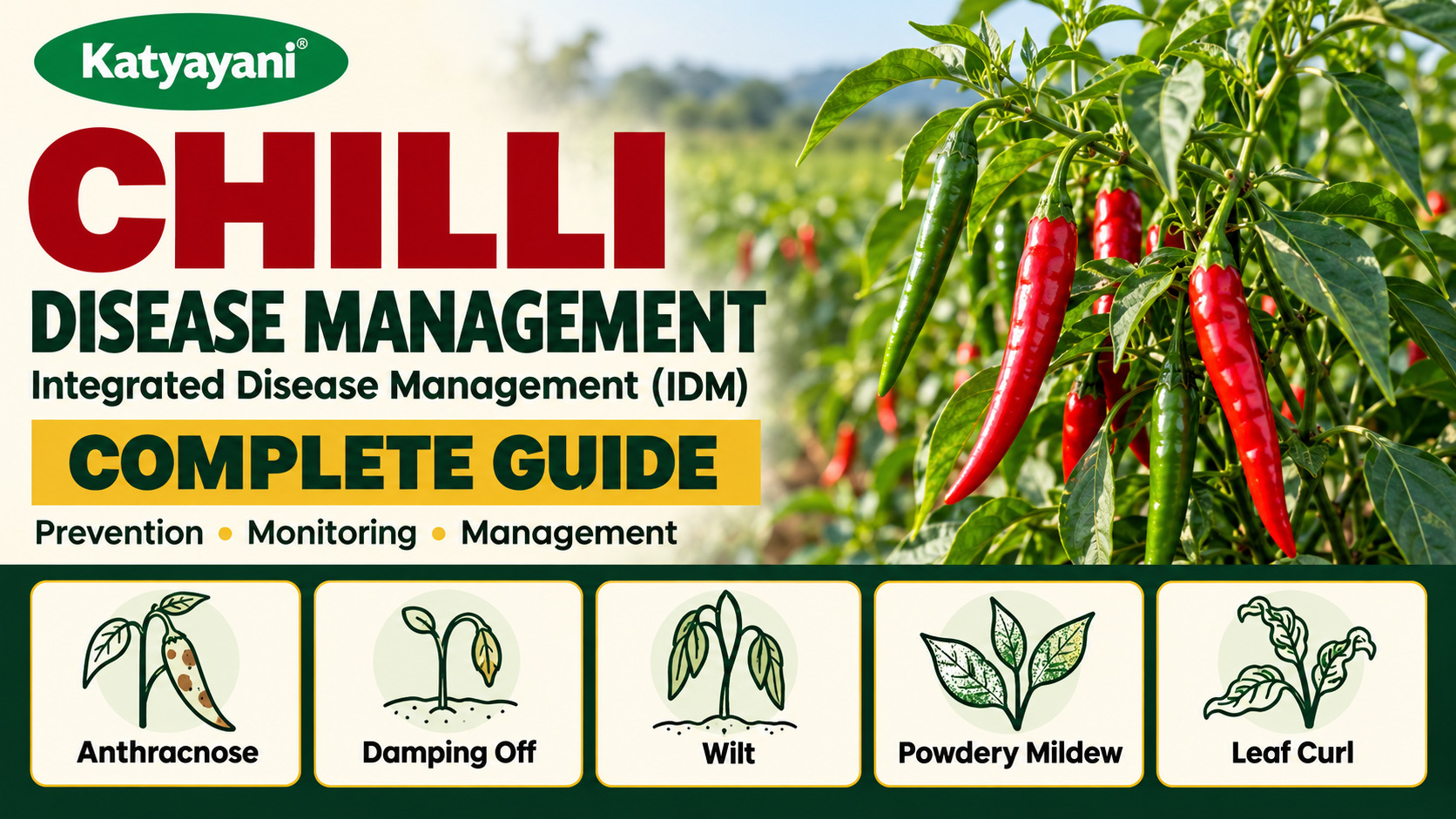
Integrated disease management (IDM) in chilli means using several steps together instead of relying on one spray. Start with healthy seed and a clean, well-drained nursery, treat seed with Trichoderma or Pseudomonas, use tolerant varieties, remove sick plants, control whiteflies against leaf curl, and spray a registered fungicide only when symptoms start, following TNAU timings. Anthracnose, damping off, powdery mildew, Cercospora spot, Fusarium wilt, bacterial wilt and leaf curl each need a different mix of these steps.
What is integrated disease management (IDM) in chilli?
IDM is a plan that stacks several small protections so that no single spray has to do all the work. In chilli the steps run in this order: clean seed and nursery, field hygiene and rotation, tolerant varieties, biological treatments, and then need-based chemical sprays. A fungicide used alone often fails, because many chilli diseases start in the seed or the soil, or are carried by insects.
The aim is to lower disease pressure early and keep chemical use to the cases where it is needed. That also protects pickers and keeps residue risk low on fresh green chilli.
Major chilli diseases and how to identify them
| Disease | Cause | What you see | Where it starts |
|---|---|---|---|
| Damping off | Pythium aphanidermatum | Seedlings fail to emerge, or stems turn water-soaked and shrivel | Seed and nursery soil |
| Fruit rot, die back and anthracnose | Colletotrichum capsici | Twigs die from the tip back, heavy flower drop, rotting fruit with small dark spots | Seed, crop residue; wet weather |
| Powdery mildew | Leveillula taurica | White powdery growth under leaves; leaves drop | Air-borne; dry, warm spells with humid nights |
| Cercospora leaf spot | Cercospora capsici | Leaf spots, leaf fall | Infected leaves and residue |
| Fusarium wilt | Fusarium oxysporum f.sp. capsici | Leaves roll up and in, turn yellow and die; plants fail in patches | Soil |
| Bacterial wilt | Ralstonia solanacearum | Sudden wilting of green plants | Soil, water |
| Leaf curl virus complex | Begomoviruses carried by whitefly | Leaves curl upward, pucker and shrink; severe plants stay stunted with no fruit | Whitefly from weeds and nearby crops |
Symptoms are as described on the TNAU pages for each disease, except bacterial wilt (which is the standard Solanaceae wilt) and leaf curl (from the ICAR paper).
Step 1: Seed, nursery and cultural practices
- Use disease-free seed. Anthracnose and bacterial spots can ride on seed.
- Choose a well-drained nursery site that is not shaded, and avoid flood irrigation. TNAU specifically advises against flooding and shaded nursery sites and says to keep optimum moisture.
- Use the recommended seed rate. Thick sowing holds humidity and invites damping off.
- Rotate. Do not follow chilli with chilli, tomato, brinjal or potato in the same field when wilt is present. Rotation is the main tool against soil diseases.
- Drain well. Waterlogged patches are where wilt shows first.
- Remove and destroy diseased plants, fallen leaves and rotten fruit. This lowers the source of anthracnose and Cercospora spores.
- Keep the field and bunds free of weeds. Weeds can host whitefly, which carries leaf curl.
For a small home or terrace crop, the same ideas apply on a smaller scale. See growing chillies in pots from seed to first harvest.
Step 2: Seed and soil treatment (damping off and wilt)
Damping off is the first disease a grower meets. TNAU gives this plan (TNAU damping off page):
- Seed treatment, 24 hours before sowing: Trichoderma asperellum at 4 g per kg of seed, or Pseudomonas fluorescens at 10 g per kg.
- Soil: apply Pseudomonas fluorescens at 2.5 kg per hectare mixed with 50 kg of farmyard manure.
- Drench: copper oxychloride at 2.5 g per litre, using 4 litres per square metre of nursery bed.
- Chemical seed treatment (if not using bio-agents): Thiram or Captan at 4 g per kg of seed.
For Fusarium wilt, TNAU advises (TNAU wilt page): grow wilt-resistant varieties, treat seed with Trichoderma viride at 4 g or carbendazim at 2 g per kg, and drench the soil with 1 percent Bordeaux mixture or Fytolan at 0.25 percent. It also gives a Trichoderma compost method: mix 2 kg of Trichoderma viride with 50 kg of FYM, keep it moist and covered with a thin polythene sheet for 15 days until you see fungal growth, then apply it along the chilli rows for one acre.
Bio-agent products used for this include Trichoderma viride powder and Pseudomonas fluorescens powder. Copper fungicides are available as copper oxychloride 50 WP. Use the dose on the product label, which may differ from the TNAU figures. Our guide on bio-agents explains how they work, and bio versus chemical inputs helps you decide where each fits.
Step 3: Biological control in the field
Bio-agents work best as prevention, not as a rescue. Put Trichoderma and Pseudomonas in the nursery bed and on the transplant roots, then repeat in the soil near the root zone. They protect roots and slow soil fungi. They do not cure a leaf already covered in anthracnose or a plant with leaf curl. Browse the bio-fungicide range and the chilli crop products collection to see what is available.
TNAU also lists Pseudomonas fluorescens in powdery mildew control in coriander, but its chilli powdery mildew page lists only sulphur, carbendazim and dinocap. So treat Pseudomonas as a nursery and soil tool for chilli, not a powdery mildew cure.
How to control anthracnose, fruit rot and die back in chilli
This is the fungal problem that rots fruit. TNAU describes twigs dying from the tip backward, heavy flower drop and few, poor-quality fruit on surviving plants. Seed treatment with Thiram or Captan at 4 g per kg removes seed-borne spores. Then spray three times (TNAU fruit rot page):
| Spray | When | Options listed by TNAU |
|---|---|---|
| First | Just before flowering | Ziram 0.25 percent, Captan 0.2 percent or Miltox 0.2 percent |
| Second | At fruit formation | Same choices |
| Third | About two weeks after the second | Same choices |
| Alternatives | As above | Wettable sulphur 0.2 percent, copper oxychloride 0.25 percent or Zineb 0.15 percent |
Because the sprays are timed to the plant stage and not only to symptoms, anthracnose is one disease where a calendar helps. In wet weather, shorten your scouting gap. Pick and remove rotten fruit often, and do not leave it in the field. If you use thiophanate methyl or another systemic, read our note on fungicide application methods and rotate between chemical groups on the label.
How to control powdery mildew in chilli
Look for leaf drop and a white powdery growth on the underside of leaves. TNAU lists wettable sulphur at 3 g per litre or carbendazim at 1 g per litre, with three sprays at 15-day intervals starting when symptoms first appear. A second option is wettable sulphur at 0.25 percent or dinocap at 0.05 percent (TNAU powdery mildew page). Sulphur can burn leaves in hot weather, so follow label cautions. Sulphur-based products such as sulphur 80 WDG are the type of product used.
Cercospora leaf spot in chilli
TNAU lists mancozeb at 0.25 percent or chlorothalonil at 0.1 percent, as two sprays 10 to 15 days apart (TNAU Cercospora page). Remove fallen infected leaves and avoid dense planting so leaves dry quickly after rain or dew.
Bacterial wilt and bacterial spots in chilli
Bacterial wilt (Ralstonia) kills green plants quickly and there is no spray cure. I did not find a chilli-specific TNAU page for it. The TNAU tomato page, for the same plant family, lists crop rotation, disease-free seedlings, restricting irrigation, drenching with bleaching powder at 4 kg per acre and soil application of neem cake at 100 kg per acre (TNAU bacterial wilt page). Treat these as a starting point and confirm with your KVK for chilli. Do not move soil, water or tools from a wilt patch to clean blocks.
Leaf curl virus complex: what works and what does not
Leaf curl is caused by a group of begomoviruses carried by the whitefly Bemisia tabaci. A 2019 ICAR paper says losses of up to 80 percent have been reported in many parts of northern India, and in severe cases plants stay stunted and give no fruit. It also states that systemic insecticides, nylon net over the nursery, mulches and barrier crops such as maize may reduce infection only marginally, and complete control is not possible by these methods alone (Mathur et al. 2019).
So the plan is to stack small steps:
- Raise seedlings under fine insect-proof net so they leave the nursery virus-free.
- Pull out and destroy plants with curling symptoms early, before whitefly spread them.
- Keep weeds down around the field, because whitefly lives on them.
- Grow a barrier crop such as maize around the field (the paper mentions maize), understanding that its effect is limited.
- Choose tolerant varieties (next section).
- Use sticky traps and a registered insecticide label for whitefly, as your KVK advises. I did not find a chilli whitefly dose in the sources I read, so none is given here.
Resistant and tolerant chilli varieties from ICAR-IIVR
| Variety | Type and notification | Disease trait as listed | States |
|---|---|---|---|
| Kashi Garima | Hybrid, 2024 (UP SVRC) | Tolerant to chilli leaf curl virus, thrips and mites | Uttar Pradesh |
| Kashi Ratna | Hybrid, 2019 (UP SVRC) | Moderately tolerant to leaf curl virus in field | Uttar Pradesh |
| Kashi Sinduri | Paprika type, 2012 (AICRP-VC) | Moderately resistant to anthracnose | Karnataka, Kerala, Puducherry, Tamil Nadu |
| Kashi Gaurav | Open-pollinated, 2012 | Tolerant to thrips and mites | West Bengal, Assam |
| Kashi Anmol | Open-pollinated, 2006 | No disease trait stated | Bihar, Jharkhand, Punjab, Uttar Pradesh |
| Kashi Surkh | Hybrid, 2006 | No disease trait stated | Many states incl. Bihar, Punjab, UP, Andhra Pradesh, Telangana |
Source: ICAR-IIVR chilli page. No variety there is listed as powdery mildew tolerant. TNAU says to grow wilt-resistant varieties but names none on the page I read. Hybrids from private seed companies make their own claims, which I could not verify. Ask the company for trial data for your state. The ICAR paper also mentions WBC-Sel-5 as a leaf curl resistance source, but that is a research line, not a variety you can buy.
Scouting: how to check your chilli field for disease
This routine is general good practice, not a sourced threshold, so adjust it with your KVK.
- Nursery: look every day for the first 3 weeks. Check for seedlings falling over at the base and for white or yellow patches.
- Field: walk a zig-zag path once a week and look at 20 plants spread across the plot. Check the underside of leaves, growing tips and fruit.
- Note the date, the disease and the number of plants affected. This tells you whether your control is working.
- After rain or heavy dew, check again within 3 to 4 days for fruit rot and leaf spots.
- Look for whitefly on the underside of young leaves and on yellow sticky cards.
- Take a photo of any strange symptom and show it to a KVK or plant doctor before spraying.
Spray safely: resistance, labels and waiting periods
- Check that the active ingredient is registered for chilli on the product label. Some actives in older TNAU lists may no longer carry a chilli label.
- Rotate groups. Do not use the same chemical for every spray.
- Follow the waiting period on the label before picking, especially for green chilli sold fresh.
- Do not mix products unless the label allows it.
- Wear gloves, mask and full-sleeve clothes, and spray in the cooler part of the day.
- Where a Katyayani product fits, see the chilli farming combos and read the label for crop, dose and stage.
Conclusion
IDM in chilli is a chain of small steps: clean seed and nursery, treated seed and soil, tolerant varieties, early removal of sick plants, whitefly control and a few well-timed sprays. Leaf curl cannot be cured, so prevention matters most. Anthracnose, powdery mildew and Cercospora respond to timed sprays. Wilt needs rotation and soil care. Use the TNAU doses as a guide, but always follow the product label and your local KVK.
Why trust this guide
Written by Team Katyayani, Editorial Team at Katyayani Organics. Cross-checked against published research and university extension programs.


Leave a Comment