

 8 min read
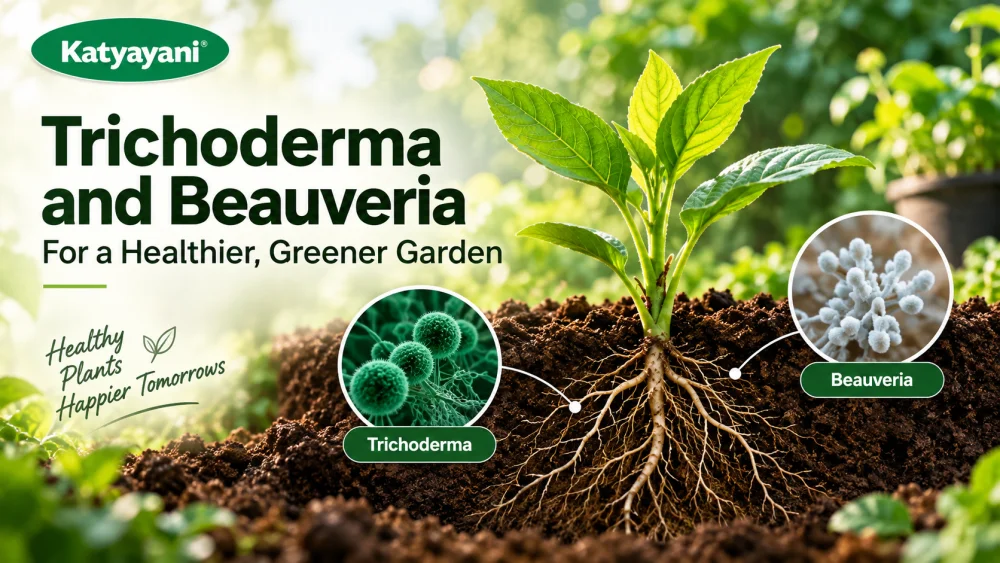
Trichoderma protects roots from soil disease and goes into the potting mix at planting. Beauveria bassiana kills soft-bodied insects and is sprayed on leaves. Both are living fungi, so they need cool storage, evening application, and a gap of at least a week from any chemical fungicide.
These products behave nothing like a bottle of insecticide, and treating them as if they do is why so many gardeners try them once and give up. You are not applying a chemical. You are introducing a population of organisms and giving them conditions to establish. Get that right and they work for weeks. Get it wrong and nothing happens at all.
What each organism does
The split matters. A Trichoderma spray on leaves does very little. A Beauveria drench into soil is largely wasted. Match the organism to where its target lives.
Using Trichoderma
Trichoderma is preventive. It colonises the root surface and occupies the space a pathogen would otherwise take. Once root rot has started, it slows the spread but will not revive dead roots. Apply it before you have a problem.
In potting mix
Mix a Trichoderma viride powder or Trichoderma harzianum powder into your potting medium at planting, roughly 5 g per kilogram of mix. Moisten the mix first. Dry powder sitting in dry medium does nothing.
As a drench
For plants already in pots, use a liquid Trichoderma harzianum at about 2 to 3 ml per litre and water it into the root zone. Repeat every four to six weeks during the growing season. Water the pot lightly first so the drench spreads rather than running down the sides.
As a seed treatment
Dust seed lightly with the powder before sowing, or soak seed briefly in a dilute suspension and dry it in shade. This is the cheapest disease protection available to a gardener and it prevents most damping off in seed trays.
Using Beauveria and the other insect fungi
These are sprays. Beauveria bassiana at 2 to 3 ml per litre, applied to cover leaf undersides thoroughly, is the standard rate for a home garden. Verticillium lecanii is used the same way and is stronger on aphids, whitefly and scale specifically.
For soil-dwelling larvae and grubs, Metarhizium anisopliae goes in as a drench rather than a spray. Where several pest types are present at once, a combined formulation carrying all three organisms saves separate applications.
Spray in the evening. Repeat after seven days. Expect the insect count to fall over one to two weeks rather than overnight; the fungus has to germinate on the insect and grow through its body before it kills.
Cornell's fact sheet on Beauveria describes the infection process and the humidity it needs, which explains why results vary so much between a humid monsoon and a dry summer. It is worth reading once.
The four handling mistakes
Almost every reported failure comes from one of these.
Storing it in heat
These are live cultures. A bottle left in a hot cupboard or a car boot loses most of its viable spores. Store below about 25 degrees Celsius, away from sunlight, and check the manufacturing date rather than only the expiry.
Spraying in the middle of the day
Ultraviolet light kills spores on the leaf surface within hours. Evening application gives them the whole night to germinate in cooler, more humid conditions.
Tank mixing with a fungicide
A chemical fungicide kills Trichoderma and Beauveria as efficiently as it kills the pathogen you were targeting. Keep at least seven days between them. The same caution applies to neem oil, which coats spores and reduces germination.
Applying once and stopping
A single application establishes a small population that heavy rain or irrigation will wash out. Repeat every four to six weeks for soil applications and every seven days for foliar sprays during active pest pressure.
Where mycorrhiza fits
Mycorrhizal fungi are not pest controls. They form a partnership with roots, extending far beyond the root system to gather phosphorus and water in exchange for sugars. In a container, that translates to better drought tolerance and better phosphorus use. A VAM biofertilizer applied once at planting keeps working for the life of the plant, provided you do not apply a systemic fungicide afterwards.
Heavy phosphorus fertilisation suppresses mycorrhizal colonisation. If you are using mycorrhiza, ease back on high-phosphorus feeds.
A simple year-round routine
- At sowing: dust seed with Trichoderma powder.
- At planting or repotting: mix Trichoderma and mycorrhiza into the medium.
- Every 4 to 6 weeks: Trichoderma or Pseudomonas drench for root protection.
- Weekly inspection: check leaf undersides for early pest signs.
- At the first insects: Beauveria or Verticillium spray in the evening, repeated after 7 days.
- After heavy rain or repotting: reapply the soil organisms, since much of the population will have been lost.
A Pseudomonas fluorescens drench is a good alternative to Trichoderma if you are rotating, and it establishes quickly on young roots.
What to expect realistically
Bio-agents reduce problems; they do not eliminate them. A garden running on biologicals will still see occasional pest outbreaks, and you will still lose the odd plant to disease. What changes is that the baseline pressure drops season by season as beneficial populations establish, rather than rising as it does under repeated broad-spectrum spraying.
Give it a full season before judging. The first month tells you very little.
Cornell maintains an index of the biocontrol organisms in commercial use and what each is suited to. It is a useful reference when you are choosing between products.
Frequently asked questions
1. How do I use Trichoderma in a home garden?
Mix the powder into potting medium at planting, at roughly 5 g per kilogram of moist mix, or apply the liquid form as a soil drench at 2 to 3 ml per litre every four to six weeks. You can also dust seed with it before sowing.
2. Can Trichoderma cure root rot that has already started?
It slows the spread but will not bring dead roots back. Cut away the rotted tissue and repot into fresh medium first, then apply Trichoderma to protect the remaining healthy roots.
3. What is the difference between Trichoderma and Beauveria?
Trichoderma is a soil fungus that protects roots from disease and goes into the growing medium. Beauveria is an insect-killing fungus that is sprayed on leaves. They target completely different problems.
4. How should bio-agent products be stored?
Below about 25 degrees Celsius, out of sunlight, with the cap sealed. These are living cultures and heat kills them. Check the manufacturing date, because viability falls well before the printed expiry if storage has been poor.
5. Can I mix Trichoderma with chemical fungicide?
No. Chemical fungicides kill Trichoderma. Leave at least seven days between the two, and reapply the Trichoderma after the fungicide rather than before.
6. Does neem oil affect Beauveria?
Yes, it coats the spores and reduces germination. If you use both, separate the applications by at least five to seven days rather than mixing them in one tank.
7. How long does Beauveria take to kill insects?
Five to fourteen days. The spore has to attach, germinate and grow through the insect cuticle. Insects usually stop feeding before they die, so damage slows sooner than the population drops.
8. What does CFU mean on the label?
Colony forming units, the count of living spores per millilitre or gram. It is the real measure of product strength. Two products naming the same organism can differ substantially in CFU count.
9. Do bio-agents work indoors?
Yes, and indoor conditions often suit them because temperature is stable and there is no ultraviolet exposure. Humidity is the limiting factor, so results are better in a bathroom or kitchen than in a dry air-conditioned room.
10. Are these products safe around children and pets?
They are among the safest garden inputs available and carry no pre-harvest interval. Normal handling precautions still apply: wear gloves, avoid inhaling the powder, and keep containers out of reach.
SOURCES CITED
Cornell University IPM — Beauveria bassiana Fact Sheet — https://cals.cornell.edu/integrated-pest-management/outreach-education/fact-sheets/beauveria-bassiana
Cornell University IPM — Biocontrol Agents — https://cals.cornell.edu/integrated-pest-management/eco-resilience/biocontrol/biocontrol-agents
| Category | Global Garden |
|---|---|
| URL slug | /blog/gardening/trichoderma-beauveria-for-gardeners |
| Primary keyword | how to use Trichoderma at home |
| Secondary keywords | Beauveria bassiana home garden, bio agents for plants, Trichoderma application rate, biological pest control for gardeners, live spore products storage, Trichoderma seed treatment |
| Search intent | How-to — gardener has heard of biological agents and wants to know exactly how to apply and store them. |
| Meta title | Trichoderma and Beauveria: A Gardener's Guide (45 chars) |
| Meta description | How to apply living bio-agents in a home garden: rates, timing, storage, and the four handling mistakes that make them fail. (124 chars) |
| Word count | ~1,800 |
| Internal links | Hattrick Trichoderma harzianum | Tyson Trichoderma viride powder | Bhasam Beauveria bassiana | Veer Chakra Verticillium | Meta Power Metarhizium | Triple Attack | Striker Pseudomonas | VAM-G Mycorrhiza |
| External sources | Cornell IPM (Beauveria bassiana fact sheet) | Cornell IPM (biocontrol agents) |
| Organism | Target | Where it goes |
|---|---|---|
| Trichoderma harzianum / viride | Soil fungi: root rot, wilt, damping off, collar rot | Into the growing medium |
| Beauveria bassiana | Aphids, whitefly, thrips, mealybug, borers | Sprayed on foliage |
| Verticillium lecanii | Aphids, whitefly, scale | Sprayed on foliage |
| Metarhizium anisopliae | Soil grubs, termites, root-feeding larvae | Drenched into soil |
| Pseudomonas fluorescens | Root-zone bacterial and fungal disease | Drenched into soil |
| Mycorrhiza (VAM) | Not a pest control; extends root reach for phosphorus and water | Mixed in at planting |
| Check the label for CFU count, not just the organism name. CFU stands for colony forming units and it is the measure of how many living spores are in the product. A low-count product applied at the same rate delivers fewer organisms and gives a weaker result. |
|---|



Leave a Comment