 11 min read
Control mustard aphid in this order. First sow on time with a tolerant variety. Then check the field every week from the start of December. Look at the top 10 cm of the main shoot, not only the leaves. Remove small infested patches by hand, and keep ladybirds and hover flies alive. Use neem oil 2 percent or neem seed kernel extract 5 percent while numbers are low. Spray an insecticide only when aphids cross the local threshold and natural enemies cannot keep up, use the label dose, and spray in the evening when bees are not active.
What is mustard aphid and how much damage does it cause?
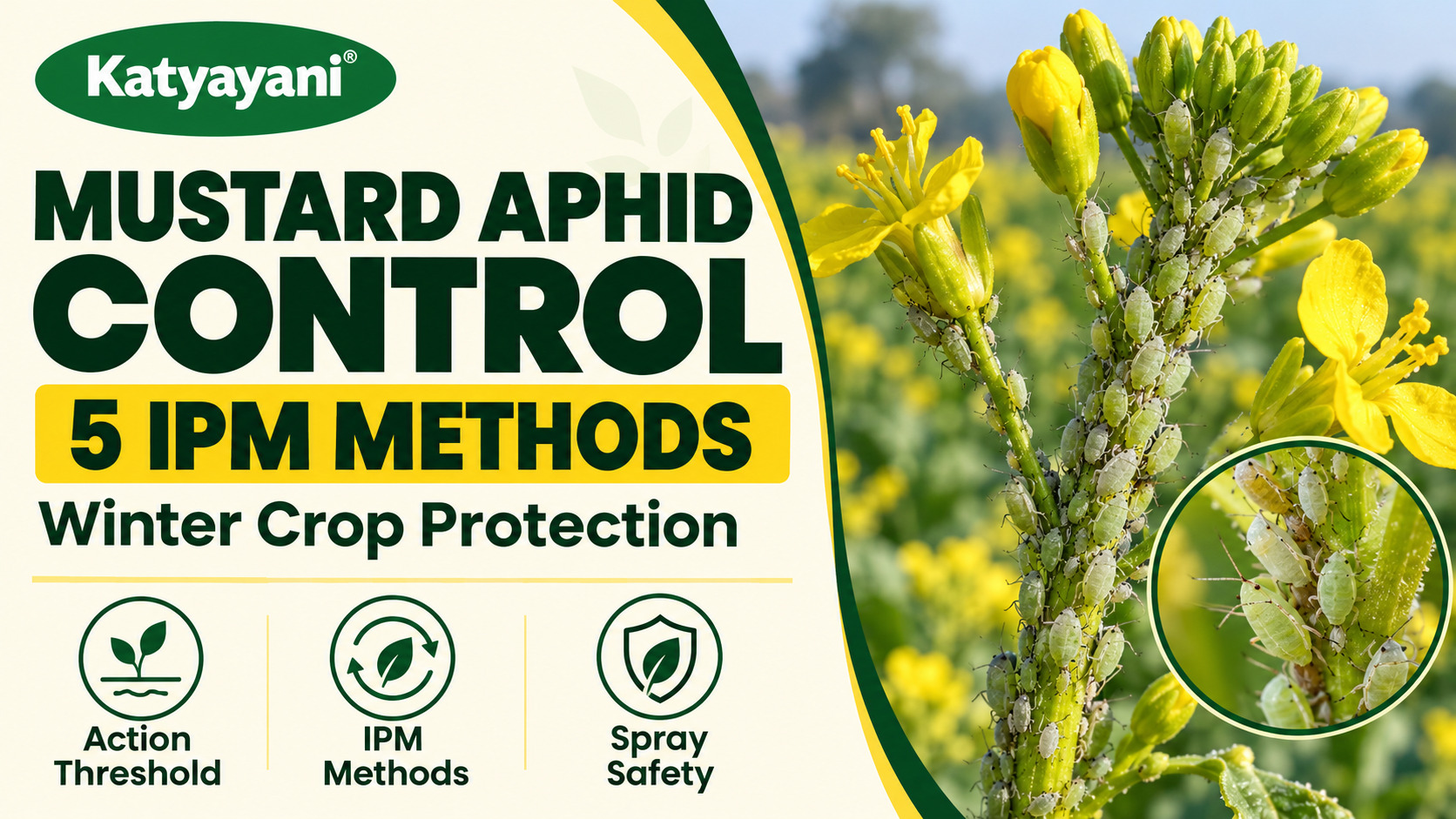
Mustard aphid is a tiny, soft, pear-shaped insect, Lipaphis erysimi. Farmers call it mahu, chepa or lahi in different states. It is mostly yellowish green or grey green, with a light waxy bloom. Some aphids have wings and some do not. Winged ones fly to new plants when a colony gets crowded.
The aphid sucks sap from leaves, flower buds and young pods. An ICAR review on the mustard aphid calls it the most destructive pest of Indian mustard. It also lists honeydew, which grows sooty mould, and the spread of viruses such as turnip mosaic virus. The NIPHM IPM package for mustard adds that infested leaves curl, plants stay stunted, and in a bad attack plants wither and die.
Yield loss depends on how early the attack starts and how thick it gets. Research papers report losses from about 35 percent to as high as 90 percent in bad seasons, so the range is wide and your own field may see less. What matters for you is that a late December or January attack on flowering shoots hits the seed directly.
| Item | What the sources say |
|---|---|
| Insect | Lipaphis erysimi (Hemiptera: Aphididae), NIPHM |
| Colour | Yellowish green, grey green or olive green with a waxy bloom, NIPHM |
| Nymph stages | Four stages, lasting 1 to 2, 2, 2 and 3 days, NIPHM |
| Main attack window | Second and third week of December till March, NIPHM |
| Weather that helps it | Cold, rainy, overcast days, ICAR review |
| Damage signs | Curled leaves, stunted plants, honeydew and black sooty mould, NIPHM |
How do you spot mustard aphid early in the field?
Most farmers notice aphids only when the plant top looks sticky or black. By then the colony is already big. Start earlier with a simple weekly routine.
- Walk the field once a week from the first week of December. Start soon after the crop is established, as the NIPHM package advises for all pests.
- Pick five spots: four near the corners (at least 5 feet inside the border) and one in the centre.
- Check five plants at each spot. Look at the top of the main shoot, flower buds, the underside of upper leaves and young pods.
- Count what you see. Write the number of aphids on the top 10 cm of the shoot for each plant. Note ladybirds, hover fly larvae and grey, puffed up "mummy" aphids as well.
- Use yellow traps for early warning. NIPHM suggests yellow water pan or sticky traps 15 cm above the crop, 4 to 5 per acre, to watch for winged aphids.
Ants walking up the stem and shiny, sticky leaves are also clues. Ants feed on honeydew, so they often show up where aphids are. Mark the dates of your counts in a notebook. Two weekly counts in a row tell you if the colony is growing or if natural enemies are holding it down.
When should you spray? The economic threshold for mustard aphid
An economic threshold is the pest number at which the cost of a spray is lower than the loss it prevents. Below it, spraying wastes money and kills the insects that help you.
Here is the honest position. The NIPHM package for mustard does not give a single number. It says to scout and look at the balance between pests and natural enemies, and to use insecticides only as a last step. Research papers give different figures for different places and ways of counting:
| Study or source | Place | Figure | How it is counted |
|---|---|---|---|
| ICAR journal study, rabi 2020-21 and 2021-22 | Jaipur, Rajasthan | Economic threshold 10.38 aphids; injury level 14.50 aphids | Per plant |
| Figure quoted in many advisories | North India | 26 to 28 aphids on 10 percent of plants | Per 10 cm of central shoot (needs local confirmation) |
| NIPHM AESA package | India | No fixed number; compare pests with natural enemies | Weekly scouting |
The Jaipur trial also found that aphid number and seed yield move in opposite directions very strongly. Its best net return came where aphids were held to about 8 per five plants with timed sprays. The key point is that the figures use different units, so do not mix them. Ask your KVK or state agriculture university which count they use for your zone and use that one.
Rule Of Thumb: If aphids are present but you also see many ladybirds, hover fly larvae or mummified aphids, wait a few days and count again. Spray only if the count keeps climbing past your local threshold.
Method 1: Can early sowing and tolerant varieties reduce aphid attack?
Yes. This is the first control step in the NIPHM package: sow early to avoid the damage, and use tolerant varieties. A crop that is already in flower and setting pods when the aphid peak comes in is far more exposed than one that has crossed the sensitive stage earlier. A study from an agricultural university thesis database also found fewer aphids in the earliest sown plots, but that is a single study and local dates differ.
NIPHM lists these varieties as tolerant or resistant to aphids:
| Variety | Tolerance noted by NIPHM |
|---|---|
| RH 7846, RH 7847, RH 9020, RWAR 842 | Aphids |
| Coral 432, NRCHB 5-6, NPJ 112 (Pusa Mustard 25), NRCDR 601, RYSKS 2, DMH 1 | Alternaria blight and aphids |
NIPHM adds that the nearest KVK, state agricultural university or ICAR institute should be asked for updates, because variety lists change. Pick a variety that is approved for your zone first, then look at its aphid tolerance. For the right sowing date, seed rate and fertiliser plan, read our mustard sowing and fertiliser schedule.
Method 2: What field care keeps aphid numbers down?
These steps cost little and work with the other methods.
- Remove the first infested tips. NIPHM says to destroy the affected part along with the aphids in the initial stage. Cut small patches near the field border, put them in a bag and bury or burn them. Do not drop them in the field.
- Use yellow sticky traps before flowering. NIPHM says to set them before the crop starts flowering. They catch winged aphids and tell you when numbers are rising.
- Do not overdo nitrogen. An ICAR review lists recommended fertiliser doses and irrigation as part of cultural control. Soft, lush growth from extra urea is easy food for aphids. Use your soil test as the guide. See how to read your soil health card for how to turn the report into a dose.
- Keep field borders clean. Cruciferous weeds and volunteer plants can hold aphids before and after the crop.
- Try a companion crop where it suits your area. One research paper found fewer aphids in mustard grown with coriander. This is a single trial and is not an official package, so treat it as an option to test on a small area first.
Method 3: Which natural enemies eat mustard aphids?
Many farmers do not notice that nature is already working for them. The NIPHM package lists several insects that attack mustard aphid. Sprays that kill them can make an aphid problem worse, because aphids multiply faster than their enemies come back.
| Helper | What it does | Source detail |
|---|---|---|
| Ladybird beetles (Coccinella septempunctata and others) | Adults and grubs eat aphids | Adult can eat about 50 aphids a day (NIPHM); 10 to 15 a day in another NIPHM line |
| Hover flies (syrphids) | Larvae eat aphids | Third stage larva eats 80 to 90 a day; around 400 in its life (NIPHM) |
| Green lacewing | Larvae eat aphids and other soft insects | About 100 aphids per larva (NIPHM) |
| Diaeretiella rapae | Tiny wasp that lays eggs inside aphids; aphid turns into a hard tan "mummy" | Parasitoid listed by NIPHM |
| Aphid fungi | Fungi such as Verticillium lecanii infect aphids in humid weather | Listed by NIPHM |
The numbers above are feeding rates from the NIPHM table. Real field numbers will be lower, but the message is clear: a few ladybirds and hover fly larvae in your field are worth more than an unneeded spray. Spare them by waiting for the threshold and by choosing a spray that fits the label for your situation. The seasonal rise and fall of ladybirds also matters. One university study recorded ladybird numbers from about the sixth standard week and a peak around the tenth, so natural help often arrives after the aphids do. That is another reason to remove early patches by hand.
Method 4: Do neem oil and bio agents work on mustard aphid?
They help, mainly when aphid numbers are low to moderate and you start early. NIPHM names 2 percent neem oil and 5 percent neem seed kernel extract (NSKE) as effective against the mustard aphid. It also lists entomogenous fungi such as Verticillium lecanii that infect aphids.
An ICAR journal trial on a bio-intensive module compared three plans. One used dimethoate twice, 10 days apart. The other two used azadirachtin first, followed by Verticillium lecanii or Beauveria bassiana. The trial abstract reports the three plans as at par, with 4.43, 6.73 and 9.16 aphids per 10 cm twig. So the neem and fungus plans did nearly as well as the chemical plan in that trial, though counts were a little higher.
- Neem: spray in the evening and wet the shoot tips and the underside of leaves well. Aphids sit where the spray often does not reach.
- NSKE 5 percent: can be made on the farm, but use fresh extract and filter it so the nozzle does not block.
- Fungal bio agents: they need humid weather and time. Start early, spray in the evening, and do not mix them with a fungicide in the same tank unless the label allows it. Read our guide to biopesticides, their limits and how to use them.
- Check the product page: Katyayani sells activated neem oil insecticide. Its page lists aphids as a target pest and shows a label dose. It does not name mustard, so read the label for crop, dose and waiting period before use.
Do not expect a quick knock-down from neem or fungi. Think of them as brakes that slow the colony while natural enemies do the rest.
Method 5: What insecticides are used and how do you spray safely?
Chemical spray is the last step. Use it only when the count crosses your local threshold and the other steps are not enough. NIPHM itself says insecticides should be a last resort and used at the label rate.
The NIPHM package lists chemicals for mustard aphid by name. These include chlorpyrifos, dimethoate, malathion, methyl parathion, monocrotophos, oxydemeton-methyl, phorate, phosphamidon and thiamethoxam. That list was published in 2014 and it is old. Some of these chemicals have since been banned or restricted in India, and a product must be registered for mustard aphid on the CIB and RC label to be used legally. This post therefore gives NO dose. Ask your KVK or state agriculture department for the current advised product, then read the label on the pack for dose, water volume and waiting period.
If you want background on one of the commonly asked options, see our guide to thiamethoxam 25 WG, its uses and safety. For a plain explanation of how a systemic spray reaches aphids on the shoot tip, the label of any product will describe coverage and water volume.
How do you spray so that aphids and bees are both handled?
- Spray in the evening or late afternoon. Mustard flowers are full of bees in winter. Spraying when bees are inactive lowers harm to them. Never spray open flowers at midday.
- Cover the shoot tip. Aphids hide in curled leaves, so use enough water volume and a good nozzle. NIPHM notes its spray volumes are based on high volume spraying.
- Do not exceed the label dose and do not mix many chemicals without advice. More is not better.
- Rotate groups. The NIPHM package warns that repeated use of one insecticide leads to resistance. A product that worked last year may fail this year if it was sprayed again and again.
- Keep the waiting period. The pre-harvest interval is on the label. Mustard leaves and seed are eaten and pressed for oil, so never harvest before it ends.
- Wear protection. Use gloves, mask and full sleeves, and wash after spraying.
Warning: Buy sprays only from a licensed dealer and check the batch number, manufacture date and CIB and RC registration on the pack. Fake or expired products fail and waste a season. See how to identify fake pesticides.
Which method should you use at each aphid level?
| What you see | What to do | Why |
|---|---|---|
| No aphids yet, crop in early growth | Sow on time, use a tolerant variety, keep borders clean, set yellow traps before flowering | Prevention costs least |
| A few aphids on a few shoot tips | Cut and bury the tips, scout again in 3 to 4 days, spare ladybirds | Small patches can be removed by hand |
| More aphids, but ladybirds and hover fly larvae are present | Spray neem oil 2 percent or NSKE 5 percent in the evening; recount after a week | Soft options protect helpers |
| Count at or above the local threshold and rising for two weeks | Use a registered insecticide at the label dose, in the evening, covering the shoot tip | Last step in IPM |
| Many aphids and the crop is near pod filling | Ask your KVK first; check the waiting period before any spray | Late sprays can leave residue in seed |
What does the winter calendar look like for aphid management?
| Crop stage and time | Aphid action |
|---|---|
| Before sowing (October) | Choose a tolerant, locally approved variety; plan early sowing; clean field borders |
| Seedling to branching (late October to November) | Weekly scouting begins; keep nitrogen in check; remove cruciferous weeds |
| Before flowering (late November to early December) | Put up yellow sticky traps, 4 to 5 per acre (NIPHM) |
| Flowering (December to January) | Peak risk window. Aphid attack mostly starts in the 2nd and 3rd week of December (NIPHM). Count the top 10 cm of the shoot weekly |
| Pod formation (January to February) | Keep scouting; same steps as at sowing stage (NIPHM). Follow the waiting period on any label |
| Maturity (February to March) | Aphids can continue till March (NIPHM); stop sprays well before harvest per label |
The months above are typical for north India and move by a couple of weeks in the east and in cold hill areas. Match them to your sowing date.
What mistakes make aphid control fail?
- Spraying on a fixed date without counting first. This kills helpers and builds resistance.
- Waiting too long. A colony on the shoot tip curls the leaves around itself, and a spray then cannot reach it.
- Spraying at midday on open flowers. This harms bees and wastes product.
- Using the same chemical again and again. NIPHM lists this as the main cause of resistance.
- Copying doses from old websites or videos. Doses change with the product and the label.
- Ignoring the waiting period. Mustard is pressed for oil and its leaves are eaten, so residue matters.
- Mistaking other problems for aphids. Painted bug, sawfly and leaf miner are also pests of mustard in the NIPHM list. Look closely for the small soft aphid bodies before you treat.
Good mustard rotation also lowers the pest and disease load over the years. Our post on what dealers stock for the rabi season may help you plan purchases early, before shelves run out in December.
Conclusion
Mustard aphid is easiest to handle when you start before it shows. Sow on time with a tolerant variety, count aphids on the top of the shoot every week from December, and remove the first patches by hand. Let ladybirds and hover flies do their work, use neem while numbers are low, and keep chemical spray for the day the count crosses your local threshold. Always follow the label, spray in the evening, and keep the waiting period. For a combined view with chickpea pod borer, see our guide on chana pod borer and mustard aphid warning signs.
Why trust this guide
Written by Team Katyayani, Editorial Team at Katyayani Organics. Cross-checked against published research and university extension programs.



Leave a Comment