 11 min read
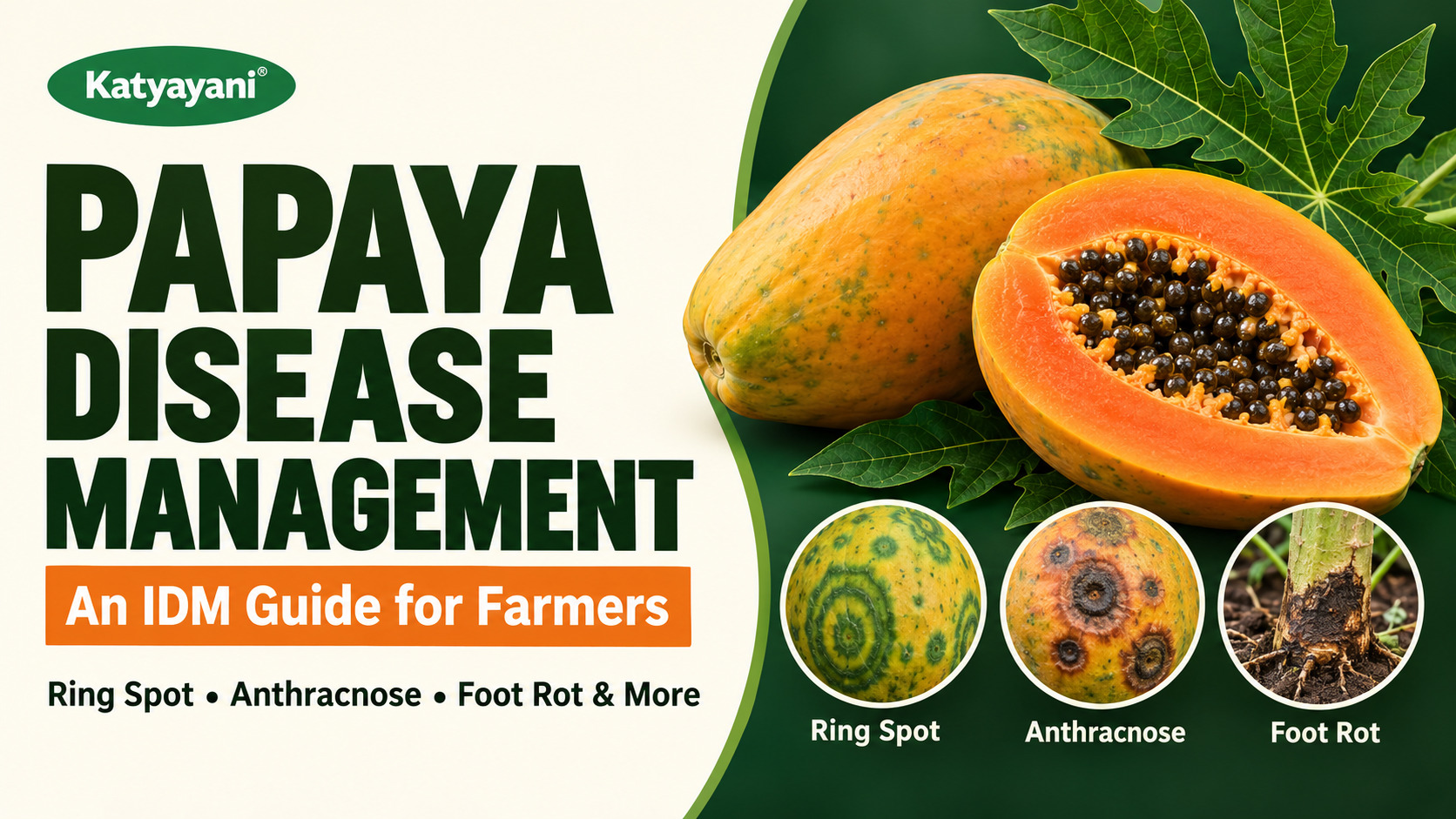
Papaya has no cure for its two worst diseases, ring spot virus and leaf curl virus. For these, management means clean seedlings, removing sick plants early and keeping aphids and whiteflies away. Foot rot and damping off come from wet soil and are best stopped by drainage, ring irrigation and seed or soil treatment before planting. Anthracnose and powdery mildew show on fruit and leaves and need clean orchards plus timely sprays. Integrated Disease Management (IDM) means doing all of these together, so you spray less and lose fewer plants. Use only products registered for papaya on the label (check CIB&RC), and confirm any dose with your horticulture officer.
What is IDM in papaya and why does it work better than spraying alone?
IDM means using several steps together: healthy seedlings, good drainage, clean field, insect control and a few well-timed sprays. It works better than spraying alone because the biggest papaya diseases cannot be sprayed away. Viruses have no cure, and root rots start in the soil. Spray only supports the other steps.
In plain words, IDM for papaya has four parts. First, keep disease out: clean seedlings and well-drained land. Second, stop the carriers: aphids, whitefly and mealybug. Third, remove what is already sick: infected plants, fallen fruit, diseased leaves. Fourth, protect what is healthy with the right product at the right time. The sections below follow this order.
How do you tell papaya diseases apart in the field?
Look at where the problem starts. Stem base trouble is a rot. Leaf distortion is usually a virus. White powder is mildew. Spots and soft patches on fruit point to anthracnose or another fruit rot. The table below uses the symptoms described by TNAU.
| What you see | Likely cause | Where it starts | Cure possible? |
|---|---|---|---|
| Water-soaked patch at the stem base, bark turns brown or black, top leaves yellow and droop, plant topples | Foot rot (Pythium aphanidermatum, per TNAU) | Stem at ground level | Only if caught very early; prevention is the main tool |
| Seedlings fall over in the nursery | Damping off | Seedling base | Prevent; affected seedlings are lost |
| Mosaic mottling, puckered leaves, narrow "shoestring" leaves, concentric rings on fruit | Papaya ring spot virus (PRSV) | Young leaves and fruit | No |
| Leaves curl inward or downward, thick veins, leathery brittle leaves, no flowers or fruit | Papaya leaf curl virus (whitefly spread) | Growing tip and young leaves | No |
| White powdery growth on upper leaf surface, flower stalks and fruit; leaves yellow and shrivel | Powdery mildew (Oidium caricae) | Upper leaf surface | Yes, with timely sprays |
| Brown, circular, slightly sunken spots on fruit; salmon-pink spore mass in humid weather; fruit mummifies | Anthracnose (Colletotrichum gloeosporioides) | Fruit, also leaf and stem | Prevent and protect fruit |
Ring spot and leaf curl can look alike to a new grower because both distort leaves. A quick clue: ring spot shows rings and streaks on fruit and stalks, while leaf curl rolls and thickens the leaf and often gives no fruit at all. If you are not sure, ask a KVK or horticulture officer before you pull or spray.
Can papaya ring spot virus be cured or controlled?
It cannot be cured. The Queensland Government states plainly that there is no cure and that it is very hard to control once established. TNAU lists the symptoms and the control steps. The aim is to keep the virus out and slow its spread.
How does ring spot spread?
Aphids carry it from plant to plant. TNAU names Aphis gossypii and Aphis craccivora as the vectors, and says the virus also spreads to cucurbits and does not pass through seed. So a clean seed is not the problem; a visiting aphid is. This is why vector control and removing sick plants come first.
What does the TNAU recommendation say to do?
- Raise papaya seedlings under insect-proof conditions.
- Plant disease-free seedlings only.
- Raise sorghum or maize as a barrier crop before planting papaya.
- Rogue out (pull and destroy) affected plants as soon as symptoms show.
- Do not grow cucurbits around the field.
Is there a tested integrated recipe?
Yes, one trial. A Madras Agricultural Journal paper describes an integrated plan: seedlings raised under a nylon net of 40 to 60 mesh, acephate at 1.5 g per litre sprayed 3 days before planting, two border rows of maize sown 15 days before planting, and sprays of urea (10 g per litre) with zinc sulphate (1.5 g) and boron (1.0 g) per litre. At 150 days after planting, ring spot was 42.7 percent in the integrated plot and 95.6 percent in the untreated plot. Average yield was 49.68 kg per tree against 23.76 kg. This is one trial from one study; read the full paper and check that acephate is registered for papaya under CIB&RC before using it (VERIFY). The abstract also says rouging, cross protection and vector control alone are not very effective.
Field Rule: Do not spray a fungicide for a virus. Fungicides do nothing against ring spot or leaf curl. Money is better spent on nets, border crops, vector control and replacing sick plants early.
How do you control papaya leaf curl and the whitefly that spreads it?
Leaf curl also has no cure. TNAU says the virus is spread by the whitefly Bemisia tabaci and that affected plants do not produce flowers or fruit. Its advice: uproot affected plants, avoid growing tomato and tobacco near papaya, and spray systemic insecticides to control the vector.
Check the underside of young leaves for small white flying insects when you shake a branch. Yellow sticky traps help you see how many there are. Use only insecticides registered for papaya, follow the label for waiting period, and rotate chemistry so whitefly does not become resistant. For a range of whitefly products see whitefly solutions for papaya. For virus-related pages see papaya mosaic virus products. These lists are for vector control, not for curing the virus.
What about aphids and papaya mealybug as disease carriers and pests?
Aphids carry ring spot, so a few aphids matter more in papaya than the damage they do by feeding. Look on the underside of young leaves and the growing tip. The aphid collection for papaya lists the range; check each label for papaya and the waiting period.
Papaya mealybug (Paracoccus marginatus) is a separate sucking pest, not a virus carrier in the sources read here. An ICAR paper notes that its waxy coating makes it very hard to kill with sprays, and an ICAR note on a national programme says chemical control is ineffective and costly (both seen as search extracts, VERIFY). Indian studies point to the parasitoid Acerophagus papayae as a key control (Indian Journal of Entomology extract, VERIFY). So scout early, remove infested tips, protect natural enemies and avoid repeat broad-spectrum sprays. The papaya mealybug collection shows what is available.
How do you prevent foot rot and damping off in papaya?
Prevent them with drainage. Both are wet-soil diseases. Raise nursery beds on well-drained soil, treat seed before sowing, plant on raised or well-drained spots and keep irrigation water from touching the stem. Once a plant has collapsed, it cannot be saved.
What does TNAU recommend for foot rot?
TNAU describes foot rot (Pythium aphanidermatum) as a water-soaked spot at ground level that rings the stem, turns brown or black, and ends in the plant falling over. Management listed: seed treatment with thiram or captan at 4 g per kg, or chlorothalonil; drenching with copper oxychloride 0.25 percent, Bordeaux mixture 1 percent or metalaxyl 0.1 percent. The page is old and does not say which are registered today. Check CIB&RC and the label (VERIFY).
What works for damping off in the nursery?
Lecture-note extracts from CAT Theni list seed treatment with captan at 2 g per kg or Trichoderma viride at 4 g per kg, plus a well-drained nursery (VERIFY: seen as a search extract only). A Queensland DPI study extract found propamocarb most effective on papaya damping off in seedlings, and a journal extract (Gaurav Publications) reports metalaxyl plus mancozeb drench gave 93 percent control of root rot in one trial (both VERIFY, not read in full, and registration for papaya in India is not confirmed).
Biological options are an easy first step because they go in before disease appears. Katyayani lists a Trichoderma viride bio fungicide; its page names damping off but gives no dose on the page, so follow the pack. For how Trichoderma works at a small scale, see Trichoderma and Beauveria for gardeners. Papaya-specific lists are at damping off fungicides for papaya and papaya root rot fungicides.
How do you manage papaya anthracnose and fruit rot?
Keep the orchard clean, protect fruit and spray only on the label. Anthracnose spreads from infected fruit and by rain splash. TNAU pages describe it as brown, circular, slightly sunken spots that join, with salmon-pink spores in humid weather, leaving fruit mummified and deformed.
- Sanitation: collect and burn infected leaves, twigs and fallen fruit instead of leaving them in the rows (BigHaat guide, practice widely advised; VERIFY with a university source).
- Harvest at the right maturity and handle fruit gently (BigHaat; VERIFY).
- Paper bags on fruit about 15 days before harvest are suggested by BigHaat (VERIFY, no official source found).
- Bordeaux mixture 0.4 percent sprayed on fruit at 21 to 30 day intervals from fruit set appears in CAT Theni lecture notes (search extract, VERIFY).
- Copper caution: an Infonet Biovision extract says papaya fruit is very sensitive to copper. Read the label before using copper on fruit.
For label-registered fungicides, see fungicides for papaya anthracnose and papaya fruit rot fungicides. Do not pick a product from a collection without checking that the label lists papaya.
How do you treat powdery mildew on papaya?
Spray early, when the first white patches show. TNAU lists wettable sulphur 0.25 percent, dinocap 0.05 percent, chinomethionate 0.1 percent and tridemorph 0.1 percent for papaya powdery mildew. The page is old; some of these may no longer be sold or registered, so check CIB&RC (VERIFY). An NHB extract mentions sulphur dust at 30 g per 10 litres of water, and a systemic fungicide at 15-day intervals (VERIFY; the PDF would not open in the browser).
The Katyayani KTM thiophanate methyl 70% WP page names papaya and powdery mildew among its uses but gives no dose or waiting period, so the pack label is the only source for those. A competitor page quotes a per-acre dose; it is not backed by an official page and is not used here. Our guide to thiophanate methyl uses explains the active ingredient. See also papaya powdery mildew fungicides.
Do not use the same fungicide over and over. Rotate between groups, and use contact and systemic types in turn, as explained in fungicide application methods.
What should the stage-wise IDM plan for papaya look like?
Use this calendar as a checklist. Every action comes from the sources above; chemical doses are left to the label.
| Stage | Main risk | IDM action |
|---|---|---|
| Before sowing and in the nursery | Damping off, virus entry | Well-drained nursery bed; seed treatment (captan, thiram, or Trichoderma viride per label); seedlings under insect-proof net (TNAU suggests insect-proof conditions; MAJ trial used 40 to 60 mesh) |
| Before planting | Aphid entry, soil disease | Border rows of maize or sorghum sown ahead of planting (MAJ trial: 15 days before); choose a raised or well-drained spot; no cucurbits, tomato or tobacco nearby (TNAU) |
| Young plants in the field | Foot rot, early virus | Keep water off the stem (ring irrigation); inspect weekly; rogue out sick plants at once; check leaf undersides for aphids and whitefly |
| Vegetative growth | Leaf curl, ring spot, powdery mildew, mealybug | Control vectors with registered products; remove infested tips; spray mildew at first sign; rotate products |
| Flowering and fruit set | Anthracnose, fruit rot, mildew on fruit | Remove fallen fruit and diseased leaves; consider fruit protection; check label before copper on fruit |
| Harvest and after | Anthracnose rot on stored fruit | Harvest at correct maturity; handle gently; burn or bury infected fruit; respect the waiting period on every product used |
How do you spray safely and avoid wasted money?
- Spray only after you have confirmed the problem. Fungicides do nothing for viruses.
- Use only products whose label lists papaya. CIB&RC registration is what decides this, not a collection page or a blog.
- Follow the label for dose, interval and waiting period. Papaya fruit is eaten fresh, so the waiting period is a food safety rule.
- Rotate chemistry. Repeating one product invites resistance.
- Wear gloves, mask and full clothing; do not spray in strong wind or in the afternoon heat.
- Keep a notebook: date, plant stage, what you saw, what you used. After a season it shows what worked.
For when bio and chemical products each make sense, read where bio and chemical inputs win and the overview of biopesticides.
Conclusion
The best papaya disease plan starts before the first spray: clean seedlings, dry stem bases, no aphid or whitefly build-up, and quick removal of sick plants. Use a registered product only for what a spray can fix, and confirm every dose with the label and your horticulture officer.
Why trust this guide
Written by Team Katyayani, Editorial Team at Katyayani Organics. Cross-checked against published research and university extension programs.

Leave a Comment