
 16 min read
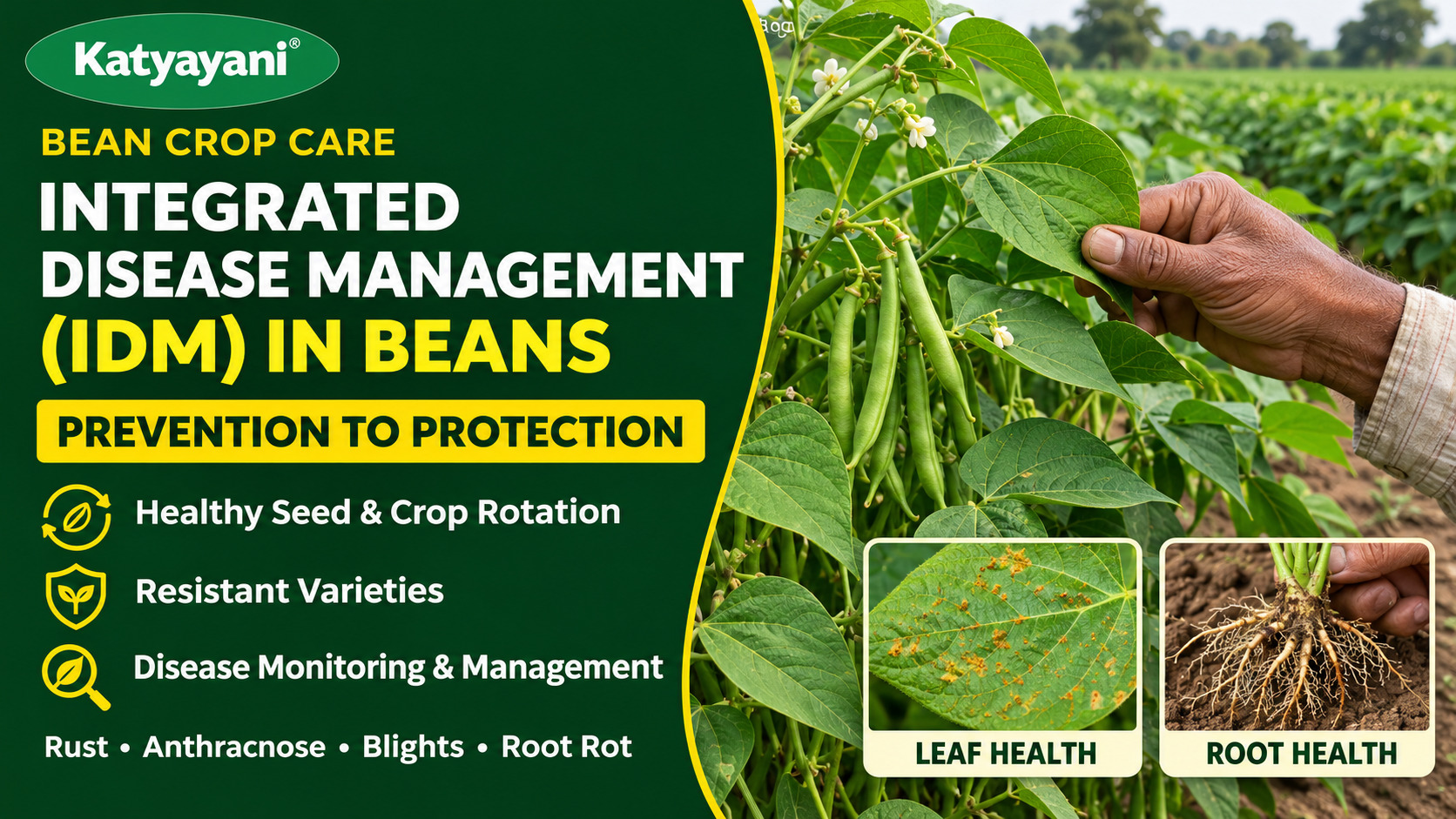
Integrated disease management (IDM) in beans means using several low-risk steps together, with sprays as the last tool. Start with clean, certified seed, because anthracnose, halo blight and common bacterial blight travel in seed. Add crop rotation, field sanitation, open spacing, careful irrigation and a rust-resistant variety where rust is the problem. Use biological seed and soil treatments such as Trichoderma for root rots, and spray fungicide or bactericide only when scouting shows disease and the label names your crop. In an ICAR-VPKAS French bean trial, a carbendazim seed treatment plus azoxystrobin and cartap foliar sprays cut rust from 35.58 to 3.50 percent and lifted pod yield from 3.65 to 9.48 t/ha, while four organic-only modules left rust at 17.89 to 20.95 percent. Always read the product label and follow your state advisory.
What is integrated disease management (IDM) in beans?
IDM is a plan that stacks several measures against bean diseases so that no single one has to do all the work. It combines clean seed, rotation, field hygiene, a suitable variety, biological agents, and sprays only when needed. The aim is to keep losses low and cut unnecessary chemical use.
The ICAR-VPKAS Almora study on French bean says root rot, rust, bacterial blight, angular leaf spot and sucking bugs have become major constraints in the north-western Himalayan region, and that combining bio-agents and botanicals with chemicals is a sensible integrated option. The same idea runs through the NIPHM lablab package, which lays out pre-sowing, sowing, vegetative, flowering and fruiting stages and puts cultural and mechanical steps first. The NIPHM rajmash (kidney bean) package, published on the Government of India Vikaspedia portal, follows the same stage-wise layout.
If you already follow the IDM guide for chilli, IDM in pomegranate or papaya disease management, the logic is the same here. What changes is the disease list and the fact that bean diseases lean heavily on seed.
Which diseases matter most in beans in India?
The main ones are anthracnose, rust, angular leaf spot, bacterial blights (common blight and halo blight), root rots and damping off, powdery mildew and mosaic viruses. The ICAR-VPKAS paper names root rot, rust, bacterial blight and angular leaf spot for French bean. The NIPHM lablab list adds anthracnose, ashy stem blight, powdery mildew and mosaic.
| Disease | Cause | Crop named in the source | Source |
|---|---|---|---|
| Anthracnose | Colletotrichum lindemuthianum | French bean, rajmash, lablab | TNAU, Vikaspedia (NIPHM), NIPHM |
| Rust | Uromyces phaseoli (French bean); Uromyces fabae (NIPHM lablab list) | French bean, rajmash, lablab | ICAR-IIHR, Vikaspedia, NIPHM |
| Angular leaf spot | Phaeoisariopsis griseola | French bean, rajmash | TNAU, Vikaspedia |
| Rhizoctonia bean blight | Rhizoctonia solani | French bean | TNAU |
| Root rots | Rhizoctonia solani, Pythium, Fusarium solani, Macrophomina phaseolina | Rajmash | Vikaspedia (NIPHM) |
| Common blight | Xanthomonas campestris pv. phaseoli | Lablab, beans | NIPHM, UC IPM |
| Halo blight | Pseudomonas syringae pv. phaseolicola | Lablab, beans | NIPHM, Cornell |
| Powdery mildew | Erysiphe polygoni | Lablab (NIPHM says it affects all beans) | NIPHM |
| Ashy stem blight | Macrophomina phaseolina | Lablab | NIPHM |
| White mold (watery soft rot) | Sclerotinia sclerotiorum | Rajmash (India), dry beans (California) | Vikaspedia, UC IPM |
| Mosaic viruses | Bean common mosaic virus and others; cannot be told apart by symptoms | Rajmash, lablab | Vikaspedia, NIPHM |
Which of these hits your field depends on season and place. ICAR-IIHR notes that rust is serious in the rabi season and lighter in kharif, because the rust fungus likes moderate temperature and very humid air.
How do I tell the common bean diseases apart in the field?
Look at the lesion shape, colour and position. Black sunken pod lesions point to anthracnose, rust-coloured pustules on the underside of leaves point to rust, water-soaked spots with a yellow-green halo point to halo blight, and red-brown sunken spots at soil level point to Rhizoctonia. Patchy colour on young leaves points to mosaic.
| What you see | Likely disease | Detail from the source |
|---|---|---|
| Black, sunken lesions on pods, stems and seedling leaves, salmon-coloured ooze, black veins under the leaf | Anthracnose | NIPHM lablab package: lesions about half an inch across, most prominent on pods. Vikaspedia rajmash page: pink spore mass in damp weather |
| Rust-coloured spots on the lower leaf surface; leaves yellow, wilt and drop | Rust | NIPHM and Vikaspedia; stems and pods can also be infected |
| Angular red-brown spots on leaves | Angular leaf spot | TNAU French bean page |
| Light greenish-yellow circles (halos) around a brown spot; long reddish spots on stems | Halo blight | NIPHM; Cornell adds that halos are very small or absent above 80 F (about 27 C) |
| Large irregular brown lesions with a lemon-coloured border about a quarter inch wide | Common bacterial blight | UC IPM; NIPHM: leaves turn brown and drop quickly, and pods lack the halo |
| Red-brown sunken spots on the stem close to the ground | Rhizoctonia bean blight | TNAU French bean page |
| Seedlings that do not emerge, or stunted plants with watery soft rot at the soil line and yellow leaves | Root rot or damping off | Vikaspedia rajmash page (NIPHM) |
| White to grey powdery patches; new growth curled or dwarfed | Powdery mildew | NIPHM lablab package |
| Sharply defined patches of unusual colour on leaves | Mosaic virus (or nutrient imbalance or herbicide injury) | NIPHM: laboratory (ELISA) tests are needed to confirm a virus |
Cornell adds a useful warning: common blight and halo blight pod symptoms look alike, so leaf symptoms or lab identification are needed to tell them apart. If the field is important, such as a seed crop, ask your KVK or plant clinic to confirm before you spend on sprays.
Why is clean, certified seed the first step in bean IDM?
Because several bean pathogens ride inside or on the seed and start the disease in a clean field. The University of Vermont guide lists anthracnose, Rhizoctonia web blight and white mold as true seedborne fungi, and common blight, halo blight and brown spot as bacteria spread mainly through infected seed. Clean seed is the cheapest control.
- Anthracnose: NIPHM says the fungus survives the winter mainly in bean seed, and the rajmash page on Vikaspedia calls it seed-borne. UVM calls it truly seedborne, meaning it lives inside the seed and embryo.
- Halo blight: UVM says it spreads mainly through infected seed. Cornell reports that the bacteria can survive more than 4 years in seed and that one contaminated seed in 16,000 can start a severe epidemic.
- Common blight: UC IPM says survival and spread with seed is more important than debris, and infected pods pass the bacteria to the seeds inside, which then shrivel and germinate poorly.
- Mosaic virus and angular leaf spot: the Vikaspedia rajmash page says both are seed borne, and the virus is also carried by several aphid species. UVM advises against saving seed from symptomatic plants.
Practical steps: buy certified seed from a reliable source, check the packet date and lot, do not keep seed from a field that showed spots, and do not mix a saved seed lot into a clean one. UVM warns that you should avoid saving seed from symptomatic plants. Cornell adds that seed grown in dry regions is less likely to carry bacteria, which is why certified seed lots are often produced in arid areas. In the United States, streptomycin seed treatment is done by licensed seed treaters and lowers surface contamination only, not infection inside the seed.
Which seed and soil treatments are used against seed- and soil-borne bean diseases?
Two kinds are used: protective fungicide seed treatments and biological treatments with Trichoderma or Pseudomonas. NIPHM advises Trichoderma viride, Trichoderma harzianum and Pseudomonas fluorescens for seed, seedling and field application, and says to check the label and expiry date if you buy a commercial product.
In the ICAR-VPKAS Almora trials, seed treatment and drenching with Trichoderma harzianum strain 11, followed by fortified farmyard manure, gave the lowest root rot among the Trichoderma-compost treatments (16.07 percent, with a thiram-treated check statistically at par on 16.45 percent) and the highest seedling emergence (87.02 percent). Across treatments, root rot incidence fell by 13 to 47 percent. The best overall module in the same paper started with a carbendazim seed treatment.
UVM notes that Trichoderma or Bacillus subtilis seed treatments can be used where chemical seed treatments are limited, but that efficacy can vary, and that hot water or steam treatments are used for seedborne fungi in organic systems. If you buy a product, browse the bio fungicides collection and choose only one whose label names beans, with crop, rate and timing printed on the pack. The chana seed treatment guide and the biopesticides guide explain the handling rules that also apply to beans.
How does crop rotation and field sanitation cut bean diseases?
Rotation starves pathogens that live in crop residue and soil, and sanitation removes what is left. Cornell advises at least 2 years out of beans in fields with a bacterial disease history. UVM suggests 2 to 3 years. TNAU gives 2 years for angular leaf spot in French bean.
| Practice | What the source says | Source |
|---|---|---|
| Rotation for bacterial blights | At least 2 years out of beans in fields with a history (Cornell); 2 to 3 years with a non-legume crop for common blight (UC IPM) | Cornell, UC IPM |
| Rotation for angular leaf spot | 2-year rotation in infected fields | TNAU French bean |
| Rotation for seedborne fungi (anthracnose, web blight) | Avoid beans and other susceptible hosts for 2 to 3 years; deep plowing can reduce inoculum near the soil surface | UVM |
| Rotation for white mold | Non-hosts such as small grains and corn may reduce soil inoculum, but airborne spores can still blow in | UC IPM |
| Residue | Bury or incorporate infested residue shortly after harvest (Cornell); deep plough infested debris (UC IPM); incorporate crop residue in soil right after harvest (NIPHM rajmash) | Cornell, UC IPM, NIPHM rajmash |
| Pre-sowing | Deep summer ploughing and soil solarisation, destroy alternate hosts, rogue diseased plants, use disease-free certified seed, rotate with non-leguminous crops especially cereals | NIPHM lablab and rajmash packages |
| Wet crops | Avoid pesticide applications or cultivating when leaves are wet | Cornell |
For a farm-level plan on what to rotate with, see our crop rotation guide. Cereals are the usual non-host choice; NIPHM names non-leguminous crops, especially cereals, for both lablab and rajmash.
How do sowing, spacing, irrigation and fertiliser change bean disease pressure?
Dense canopies and wet leaves feed most bean diseases. Sow on time, give plants room, irrigate at the critical stages without waterlogging, and avoid wetting the leaves late in the day. The sources agree on these points even though they come from different countries.
- Timely sowing, line sowing, proper spacing and no dense sowing are listed in the NIPHM packages. For rajmash, NIPHM also asks for healthy, disease-free seed, well-drained soil and an optimum sowing depth of 5 to 7 cm against root rots, anthracnose and bean common mosaic virus.
- Irrigation timing: NIPHM advises avoiding irrigation at the flowering stage in bacterial leaf spot situations, when symptoms are most likely to appear, and avoiding water stress and stagnation.
- Avoid overhead watering: UC IPM advises avoiding sprinklers for common blight, especially in seed crops, because they supply the moisture and humidity the disease needs, and UVM advises avoiding overhead irrigation to limit leaf infections.
- Mulch: NIPHM notes that mulching with pine needles or eucalyptus leaves reduces angular leaf spot in rajmash.
- Nitrogen: UC IPM advises against heavy nitrogen for white mold because it produces thick canopies and humidity; wider rows increase airflow.
- Balanced manure: NIPHM lists balanced use of manures and fertilisers, and FYM at 5 tonnes per acre as a soil amendment for lablab.
Cornell advises avoiding spraying or cultivating when leaves are wet, because people and equipment spread the bacteria. Schedule scouting, tying and picking for when the foliage is dry.
Which French bean varieties resist rust?
Arka Anoop is the clearest documented one. ICAR-IIHR developed it from a cross of Arka Bold (rust resistant) and Arka Komal (high yield, rust susceptible). In three rabi seasons it had a rust index of 1.91 against 40.40 for Arka Komal and 57.01 for Contender, and the paper reports complete rust resistance.
| Variety | Rust reaction (ICAR-IIHR paper) | Rabi pod yield, 2003-2005 mean (t/ha) | Kharif pod yield, 2003-2005 mean (t/ha) |
|---|---|---|---|
| Arka Anoop | Resistant; rust index 1.91 | 19.78 | 19.95 |
| Arka Bold (resistant parent) | Resistant; rust index 2.22 | 14.83 | 14.90 |
| Arka Komal | Susceptible; rust index 40.40 | 14.29 | 17.90 |
| Contender (check) | Susceptible; rust index 57.01 | 8.24 | 11.81 |
The ICAR-IIHR paper also lists Pant Anupama, Pusa Parvathi and Arka Suvidha as susceptible to rust. It found that resistance in Arka Bold is controlled by a single dominant gene. Rust was much lower in kharif, so Arka Anoop gave 15.85 percent more than Arka Komal in kharif but 38.42 percent more in rabi, where rust pressure is high.
For anthracnose in lablab, the NIPHM package lists Kapasi, JNP-4 and Katargam as resistant. NIPHM also says to check with the nearest KVK, state agricultural university or ICAR institute for current varieties. I did not find an ICAR source that rates a French bean variety as resistant to both rust and anthracnose, so do not assume one variety covers both.
How do I manage anthracnose in beans?
Plant certified seed, rotate, remove infected plants and pods, avoid working in wet fields, and spray a labelled fungicide when the first pod lesions appear. The fungus is carried in seed, and its survival in soil and residue varies with conditions, so seed and field hygiene matter more than any single spray.
NIPHM describes black, sunken lesions about half an inch across on stems, pods and seedling leaves, salmon-coloured ooze, and black veins under the leaf. Infection needs wet leaves: NIPHM says the disease is favoured by 20 to 24 degrees C and that leaves must stay wet for 18 to 24 hours. Spores move in wind-blown rain and on people and machinery in wet fields. That is why a dry week, wide spacing and avoiding sprinklers all lower pressure. For rajmash, the NIPHM and DPPQS description on Vikaspedia says the disease is seed-borne, can persist in soil, and is favoured by frequent showers, heavy dews, 20 to 30 degrees C and crowded plants.
- Seed: certified, disease-free seed (TNAU, NIPHM, UVM). The TNAU French bean page also advises a fungicide seed treatment and, in infected fields, foliar sprays repeated at short intervals; follow your state advisory and the product label for doses.
- Field: remove affected plants and pods, avoid overhead watering and avoid splashing soil onto plants.
- Variety: use anthracnose-tolerant varieties where available, as in the NIPHM lablab list.
- Sibling reading: soybean has its own anthracnose and pod blight problem; the planned post on anthracnose and pod blight in soybean covers that crop separately.
How do I manage rust in French bean?
Grow a rust-resistant variety, avoid susceptible varieties in rabi, clear debris and spray a labelled fungicide at the first pustules. ICAR-IIHR says sulphur fungicides and propiconazole are the recommended chemical control, but that genetic resistance is the better long-term answer.
ICAR-IIHR gives the yield loss from rust as 78 to 90 percent in the cited work and says the pathogen is most active at 17 to 27 degrees C with relative humidity above 95 percent. For lablab, NIPHM gives day temperature of 25.5 to 30.5 degrees C with 86 to 92 percent humidity. The two crops and fungi differ, so treat each as a guide for its own crop. For lablab, NIPHM says the rust fungus survives in volunteer plants and infected debris, so clear both after harvest. For rajmash, the Vikaspedia page says rust advances fastest near 27 degrees C with high humidity and frequent dews.
In the ICAR-VPKAS Almora fungicide work, a foliar spray of azoxystrobin and difenoconazole reduced angular leaf spot and rust severity by 93 and 90 percent. Three azoxystrobin sprays at 10-day intervals gave rust of 3.33 percent and a pod yield of 10.12 t/ha, and two sprays gave a result that was statistically at par. These are trial results on one susceptible variety, not label advice. For fungicide choice and spray method, read our fungicide application methods post, and browse the fungicides collection, checking that the label names beans and rust.
How do I manage bacterial blights (halo blight and common blight) in beans?
Prevention is everything: certified seed, a 2-year rotation, no sprinkler irrigation and no work in wet fields. Sprays play a small role. UC IPM says pesticide sprays are generally not effective against common bacterial blight, and Cornell says copper is only preventive and cannot eradicate the bacteria from infected plants.
| Feature | Halo blight | Common blight |
|---|---|---|
| Pathogen | Pseudomonas syringae pv. phaseolicola | Xanthomonas campestris pv. phaseoli |
| Weather | Cool: NIPHM says halo blight occurs mainly in cool weather; Cornell says it develops quickly between 60 and 80 F (about 16 to 27 C) and halos are very small or absent above 80 F | Warm: NIPHM gives 24 to 30 C with sprinkler irrigation or heavy rain |
| Leaf sign | Light greenish-yellow circles (halos) around a brown spot; long reddish stem spots (NIPHM) | Large irregular lesions with a lemon-coloured border (UC IPM); leaves turn brown and drop quickly (NIPHM) |
| Main source | Infected seed (UVM) | Infected seed, which UC IPM rates more important than debris; bacteria can also overwinter in debris |
| Rotation | At least 2 years (Cornell) | 2 to 3 years with a non-legume (UC IPM) |
UC IPM says there are no commercially available varieties resistant to common bacterial blight, though some are tolerant. NIPHM adds that the bacteria are weak pathogens that need a natural opening or an injury to enter, and that splashing water and workers or implements in wet fields spread them. So scout after the first rain or damp spell, and keep people and tools out of the crop while leaves are wet.
The Katyayani page for KMYCIN streptomycin and tetracycline bactericide lists beans and halo blight among its crops. Treat it as a protective tool, check the label, and do not expect it to replace clean seed.
How do I manage root rot and damping off in beans?
Sow in well-drained soil, avoid water stagnation, rotate, and protect seed and soil with a labelled fungicide or Trichoderma. Root rot is a complex of Rhizoctonia, Pythium, Fusarium and Macrophomina, and the Vikaspedia rajmash page (NIPHM source) says these organisms survive in soil and seed for a long period.
The Vikaspedia rajmash page describes seedlings that fail to emerge, stunted plants and a watery soft rot just above or below the soil line, with yellow leaves and rotting roots. It says the diseases are prevalent in cool, wet conditions that keep soil temperature below 13 degrees C, and that Rhizoctonia root rot is most damaging when cool, wet weather is followed by hot (25 to 29 degrees C), dry conditions.
- Drainage: sow in well-drained soil and avoid water stagnation (NIPHM).
- Soil amendments: the NIPHM rajmash package lists FYM, neem cake or mahua cake and Trichoderma seed treatment against root rot, stem rot and nematodes. In the ICAR-VPKAS organic-amendment trial, neem oil cake cut root rot by 45 percent and raised pod yield from 3.32 to 5.88 t/ha against the control.
- Biological: Trichoderma harzianum seed treatment and drench plus fortified FYM gave the lowest root rot in the ICAR-VPKAS compost trial, at par with a thiram-treated check. NIPHM advises Trichoderma harzianum or viride and Pseudomonas fluorescens for seed, seedling and field use, and says to check the label if you buy a commercial product.
For a cousin problem in another legume, the chana wilt guide shows how seed treatment and soil health work together.
What about angular leaf spot, powdery mildew, Rhizoctonia blight and white mold?
These are managed with clean seed, spacing, debris removal and timely labelled sprays. Angular leaf spot responds to healthy seed and a 2-year rotation, and white mold to wide rows and light nitrogen. Each has a different weather trigger, so scout for the one that fits your season.
| Disease | Cultural steps from the sources | Notes |
|---|---|---|
| Angular leaf spot | Use healthy seed; 2-year rotation in infected fields (TNAU); mulching with pine needles or eucalyptus leaves (NIPHM rajmash) | Seed-borne and favoured by high moisture and 20 to 25 C (Vikaspedia). In the ICAR-VPKAS trial the azoxystrobin plus difenoconazole spray cut severity by 93 percent; cow dung extract (50 percent) cut it by 51 percent |
| Rhizoctonia bean blight | Seed treatment; spray when symptoms appear in dry, humid weather (TNAU French bean) | Red-brown sunken spots near ground |
| Powdery mildew | Follow the common cultural practices in the NIPHM package (irrigation at critical stages, avoiding water stress, removing infected plant parts); check the label for any spray | Spread is by wind and rain, and NIPHM says the disease is more under dry conditions at the end of the winter months |
| White mold (watery soft rot) | Rotation with non-hosts, avoid heavy nitrogen, wide row spacing (UC IPM) | Vikaspedia (rajmash): soil-borne, sclerotia are the main survival form, spreads fast in low-lying, moist, cool areas under furrow irrigation. UC IPM: sclerotia survive in soil for several years, fastest growth at 20 to 25 C, senescing flower petals are very susceptible. The control steps are from California; the Indian page covers biology only |
| Ashy stem blight (lablab) | Common cultural practices; seed can carry the fungus in the seed coat (NIPHM) | Microsclerotia in soil germinate between 28 and 35 C (NIPHM) |
For fungicide options, see the fungicides collection; always check that the product page and label name beans and the disease before use.
How do I manage mosaic virus in beans?
Prevent it with clean seed, early removal of infected plants, control of weeds that harbour the virus, and management of aphids. NIPHM advises removing and destroying infected plants, and its rajmash package says to control the vector with its aphid practices. No spray is listed for the virus itself in the NIPHM packages.
Symptoms are sharply defined patches of unusual colour on leaves, but NIPHM warns that nutrient imbalance or herbicide injury can look similar and that laboratory (ELISA) tests are required to confirm a virus. NIPHM names weed hosts as natural reservoirs and says a long, continuous dry spell raises incidence. The Vikaspedia rajmash page says bean common mosaic virus is seed borne and carried by several aphid species, while the lablab package names thrips as the carrier, so the vector depends on the crop and virus. For aphids, the NIPHM rajmash package lists yellow sticky traps, reflective mulches and a strong jet of water; for pest-side detail, read the bio pesticides collection pages carefully for crop and pest.
Do organic and biological options work against bean diseases?
Partly. Biological and botanical options reduce disease and are useful as part of a plan, but in the ICAR-VPKAS trial they did not match the fungicide module on rust. Cow dung extract (50 percent) cut rust severity by 69 percent, and panchgavya (3 percent) and batain seed extract (30 percent) cut it by 14 and 55 percent.
| Bioproduct (ICAR-VPKAS trial) | Rust reduction | Angular leaf spot reduction | Bacterial blight reduction |
|---|---|---|---|
| Cow dung extract, 50 percent | 69 percent | 51 percent | 25 percent |
| Panchgavya, 3 percent | 14 percent | 52 percent | 26 percent |
| Batain (Melia azedarach) seed kernel extract, 30 percent | 55 percent | 19 percent | 29 percent |
The paper reports that across all bioproducts the range was 7 to 78 percent for rust, 5 to 65 percent for angular leaf spot and 25 to 54 percent for bacterial blight, and that cow dung extract was at par with a mancozeb spray for rust severity. The wide ranges tell you these tools are variable, so scout and compare. Our bio vs chemical inputs post discusses where each type earns its place. Rhizobium is a different case: it feeds the crop with nitrogen and does not control disease, and the Rhizobium bio fertilizer page lists beans and Rajma among its crops. The NIPHM rajmash package also lists Rhizobium culture as a seed treatment. The Rhizobium, PSB and KMB guide explains the principle.
What did the ICAR-VPKAS integrated trial show about combining methods?
The module with a carbendazim seed treatment plus azoxystrobin and cartap hydrochloride foliar sprays gave the lowest disease and pest levels. Pod yield was 9.48 t/ha against 3.65 t/ha in the untreated control, with two Trichoderma-plus-azoxystrobin modules (9.66 and 9.55 t/ha) statistically at par. Organic-only modules left rust at 17.89 to 20.95 percent and yielded 5.5 to 6.6 t/ha.
| Module | Root rot (%) | Rust (%) | Angular leaf spot (%) | Bacterial blight (%) | Pod yield (t/ha) |
|---|---|---|---|---|---|
| T7: carbendazim seed treatment + azoxystrobin + cartap | 8.63 | 3.50 | 2.50 | 2.17 | 9.48 |
| T4: Trichoderma seed treatment + Parthenium + azoxystrobin + cartap | 9.53 | 3.53 | 2.20 | 1.33 | 9.66 |
| T2: Trichoderma seed treatment + Lantana + azoxystrobin + cartap | 12.97 | 3.66 | 2.92 | 2.40 | 9.55 |
| T5: Trichoderma + Parthenium + cow dung extract + batain extract | 10.87 | 17.89 | 12.42 | 4.27 | 6.53 |
| T1: Trichoderma + Lantana + cow dung extract + batain extract | 12.63 | 19.83 | 12.28 | 6.60 | 5.5 |
| T8: untreated control | 29.00 | 35.58 | 19.00 | 12.13 | 3.65 |
Read this table carefully. All Trichoderma-based modules cut root rot to roughly a third to a half of the control, whichever foliar tools followed. But rust and leaf spot only dropped sharply where azoxystrobin was in the module. Cartap hydrochloride in these modules was aimed at sucking bugs, not disease. The trial used one susceptible variety (VL Bauni Bean-2) on a hill site, and the paper does not report a benefit-cost ratio, so treat the numbers as direction, not a schedule for your farm. The full paper lists the treatment codes. Its abstract mentions six modules while its table lists seven plus an untreated control, and its text quotes yield percentages that do not match the table, so this article uses the table values only.
When should I spray, and how do I avoid wasting sprays?
Spray when scouting shows disease, the label names your crop and disease, and the weather favours spread. Spraying on a calendar or without a diagnosis wastes money and speeds resistance. Rotate chemical groups, keep to the label dose and pre-harvest interval, and spray with good coverage in dry weather.
- Scout first: walk the field weekly from emergence, looking at the underside of leaves and at pods. Early detection beats a big spray later.
- Match the product to the disease: a fungicide does nothing against bacteria or virus. Bacterial blights need prevention, mosaic needs removal, and rust and anthracnose need a labelled fungicide.
- Read the label for beans: many Katyayani pages list cluster bean, pea or cowpea rather than French bean or lablab. Do not assume a crop is covered unless the label names it.
- Check current registration: the CIB&RC list of major uses of pesticides is updated, so check the current edition on the Plant Protection Adviser site and the pack label before buying.
- Rotation of groups: repeating one fungicide group invites resistance. Cornell warns that copper resistance can develop.
- Keep records: note date, product and weather, so you can see what worked.
The sprayer guide and formulation types explained help you choose equipment and read labels.
What does a stage-wise IDM calendar for beans look like?
Plan by stage: before sowing, at sowing, in the vegetative stage, at flowering and during pod filling. The NIPHM package for lablab uses this structure, and the table below combines it with the other opened sources. Adjust to your region and always follow the state advisory.
| Stage | IDM actions | Source |
|---|---|---|
| Before sowing | Deep summer ploughing and solarisation; destroy alternate hosts; choose a certified seed lot and a variety suited to your main disease; avoid fields with beans in the last 2 years; use well-decomposed FYM, treated with Trichoderma where crop is grown in pits (NIPHM) | NIPHM, Cornell, UVM |
| At sowing | Seed treatment (fungicide or biological as per label); well-drained soil; line sowing with proper spacing; timely sowing at 5 to 7 cm depth | NIPHM, ICAR-VPKAS |
| Emergence to vegetative | Weekly scouting; remove and destroy mosaic-infected plants early; keep weeds down; water at critical stages and avoid stagnation; stay out of the crop when leaves are wet | NIPHM, Cornell |
| Flowering | Avoid irrigating when bacterial spot symptoms are most likely; spray a labelled fungicide for rust, anthracnose or powdery mildew only when symptoms are seen; avoid heavy nitrogen | NIPHM, UC IPM, ICAR-IIHR |
| Pod filling to harvest | Remove infected pods and plants; avoid working in the crop when leaves are wet; keep checking for pod anthracnose | NIPHM, Cornell |
| After harvest | Incorporate or deeply bury residue; plan the next crop as a cereal or other non-host | Cornell, NIPHM |
What common mistakes make bean diseases worse?
The usual ones are saving seed, replanting beans in the same field, overhead irrigation, working in wet crops, and spraying the wrong product. Each one is tied directly to how these pathogens spread, as the sources above explain in detail.
- Saving seed from a diseased crop. Seed carries anthracnose, halo blight, common blight and some viruses.
- Beans after beans. Sources advise 2 to 3 years out of beans where disease has been seen.
- Late, heavy irrigation on foliage. Wet leaves are what bacteria and anthracnose spores need.
- Picking or tying plants when wet. People and tools carry spores and bacteria.
- Using a rust variety that is not resistant in the rabi season. ICAR-IIHR reports the worst losses in rabi.
- Spraying bacteria or virus with a fungicide. It cannot work.
- Leaving residue in the field. Cornell notes bacteria survive best on the soil surface, so bury residue soon after harvest.
Is IDM in beans worth the extra effort?
Yes, because the losses are large and most of the steps cost little. ICAR-IIHR cites rust losses of 78 to 90 percent (quoted from earlier work), and the ICAR-VPKAS trial lifted pod yield from 3.65 to 9.48 t/ha with an integrated module on a hill research farm. Treat both as research-station figures, not a promise for your field.
A fair caution: the yield figures come from research stations, not farm surveys, and the VPKAS trial used a susceptible variety. Your gain depends on your disease pressure and season. Start with the cheap steps (seed, rotation, spacing, scouting) and add inputs only where scouting shows a need. For the other crop guides in the series, see chilli IDM, pomegranate IDM and papaya IDM.
Conclusion
Bean disease control works when you treat seed, field, variety and weather as one plan. Begin with certified seed, because anthracnose, halo blight, common blight and some viruses arrive on it. Rotate out of beans for at least 2 years where disease has been seen, bury residue, give plants room and keep leaves dry. Where rust is the problem, choose a documented resistant variety such as Arka Anoop. Use Trichoderma-based seed and soil treatments for root rots, remove virus-infected plants early and keep aphids in check. Spray only when scouting shows disease and the label names beans and that disease, and rotate groups. The ICAR-VPKAS trial is a reminder that the best results came from combining a seed treatment with a well-timed foliar spray, while organic-only modules helped but left rust high. Confirm doses, intervals and waiting periods on the pack, and ask your KVK or state horticulture department when the label and the advice differ.

Leave a Comment