 26 min read
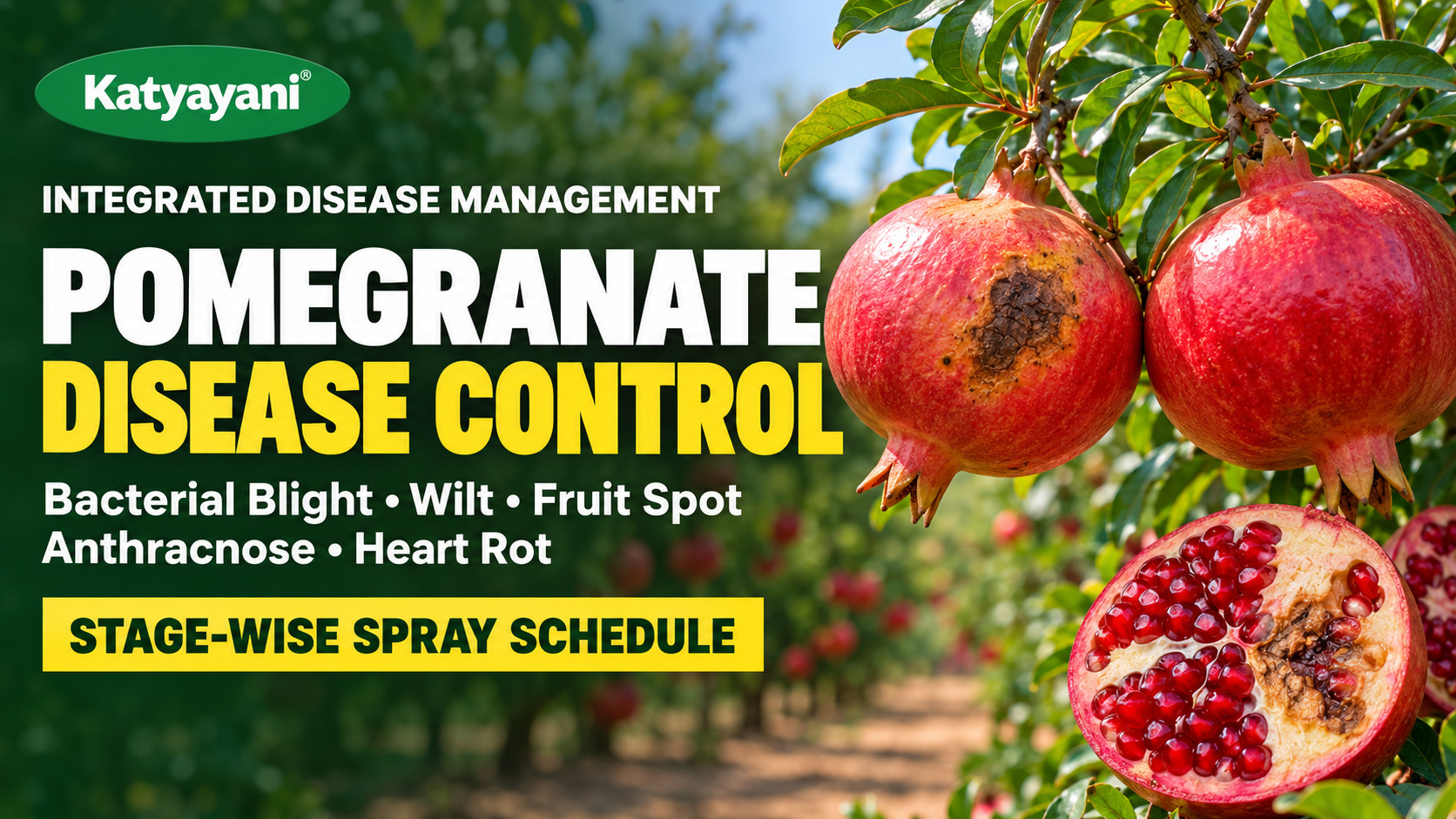
Pomegranate disease management is a package, not a single spray. ICAR-NRCP says no chemical and no variety gives complete control of bacterial blight (telya), so you combine clean planting material, a 3 to 4 month rest period, hard pruning with Bordeaux paste, orchard sanitation, balanced feeding, bio-agents and need-based sprays every 7 to 15 days by stage. A Karnataka KVK demonstration of this package cut fruit disease incidence from 38.95 to 26.35 percent and lifted yield from 9.75 to 13.5 tonne per hectare. Wilt needs soil drenches right after harvest; fruit spots, anthracnose and rots need preventive sprays from flowering.
What is IDM in pomegranate, and why does one spray not solve it?
IDM means Integrated Disease Management: you stop treating disease as something that begins when you see it, and manage the whole year instead. In pomegranate that means planting clean, pruning on time, resting the tree, feeding it in balance, keeping the orchard clean, helping the soil with good microbes, and spraying the right product at the right stage. ICAR-NRCP, Solapur, calls its version the IDIPM schedule (disease and insect pest management).
The reason for the package is blunt. The NRCP farmers' FAQ says no single chemical can check bacterial blight completely, and that NRCP screened more than 375 germplasm lines, seedlings and hybrids without finding a resistant one. Disease losses are real: the KVK Bagalkote paper reports blight losses of 30 to 50 percent depending on pathogen load and weather, up to 80 percent in an epidemic, and about 40 percent in the orchards of Bagalkote district.
Which diseases attack pomegranate, and how do you tell them apart?
Six problems cause most of the damage: bacterial blight (telya), wilt, Cercospora leaf and fruit spot, Alternaria leaf and fruit spot, anthracnose, and fruit rots including heart rot. Look at the spot, the feel and the weather. A sticky, oily, cracked spot is blight. A dry spot with no stickiness is fungal. A tree dying branch by branch is wilt.
| Disease | What you see | Weather and trigger (NRCP) | Quick test |
|---|---|---|---|
| Bacterial blight (telya, oily spot) | Water-soaked spots under the leaf that turn blackish brown with a yellow halo; oily dark spots on fruit; fruit cracks open; black, cracked cankers at the nodes of stems | 25 to 30 degrees C and humidity above 50 percent, rain, wind, too much nitrogen, too many unwanted sprays | Hold the leaf against the light. The spot feels sticky after rain or dew, and dries to a white shiny crust |
| Wilt (mostly Ceratocystis fimbriata) | Some branches yellow, droop and dry; plants die one after another in a row | Spreads through soil, water, tools, planting material; the fungus survives 5 to 7 years in soil and debris | Split a root. Brown, grey or black wood, sometimes a smell like alcohol, points to Ceratocystis |
| Fusarium wilt (minor cause) | Wilting with a brown or red centre in the wood | Heavy, wet soil | Brown or red pith when the stem is cut |
| Cercospora leaf and fruit spot | Reddish brown spots, 1 to 4 mm, on leaves; dark brown to black round or angular spots on fruit with a diffused yellow halo | 20 to 30 degrees C with humidity above 60 percent for long spells | Spots do not crack and are not sticky, unlike blight |
| Alternaria leaf and fruit spot | Dark spots on leaves and fruit skin; some fruit show spots with mild rind rot | Warm, humid weather; the fungus waits on plant surfaces in latent form | Dry, dark, sporulating spot; no ooze |
| Anthracnose (Colletotrichum) | Hard, dark black to brownish black spots of no fixed shape; rot often starts at the calyx end and runs half to full fruit within a week | 25 to 30 degrees C and high humidity | Brown hard rot, no spores on the surface |
| Phytophthora fruit rot | Light brown, tan, mushy rot, first on fruit near the ground, white growth later | Warm, rainy season | Soft and mushy; covers the fruit in 2 to 3 days |
| Alternaria heart rot | No outside sign. Fruit may feel soft or light. Arils inside turn brown to black | Infection at flowering; 25 to 30 degrees C favours it | Cut the fruit open |
These descriptions come from the NRCP chapter in the MANAGE high-tech pomegranate ebook and the NRCP FAQ. Fruit scab (Elsinoe punicae), Aspergillus, Penicillium, Phomopsis and Rhizopus rots also occur. Most rots can only be named after the fungus sporulates, so do not spend money on a guess; send a sample to your KVK if the pattern is unclear.
What is bacterial blight (telya) in pomegranate, and how does it spread?
Bacterial blight, called telya or oily spot, is caused by the bacterium Xanthomonas axonopodis pv. punicae. It lives in stems, nodes, buds and fallen debris, and a plant grown from a blight orchard can carry it hidden. Rain splash, wind, tools, people and contact spread it. It needs water, so wet weather decides the outbreak.
- Early signs. Small oily spots under the leaf, oily skin spots on young fruit, and grey water-soaked tissue around nodes of young twigs. Cut stems later show dark cankers.
- Speed. In an infected orchard, new infection shows within 4 to 7 days of the bacteria entering the leaf or fruit, when rain or spray water is available.
- Weather. It grows fast at 25 to 35 degrees C and above 50 percent humidity, needs only 0.1 mm of rain, and spreads further when wind reaches about 3.5 m per second with rain. It slows when temperatures stay below 20 or above 35 degrees C, or when humidity stays under 30 percent.
- Nutrition. Excess nitrogen raises blight. Balanced calcium, magnesium, iron, manganese, zinc and copper reduce it. NRCP also notes that varieties with more potassium in the fruit were more susceptible.
- Planting material. In a new orchard, hidden infection in cuttings or air layers usually shows as blackened nodes just above ground at 5 to 7 months of age. Nursery plants show nothing for at least 5 to 8 months, so buyers cannot see it.
A useful point from the same FAQ: the blight bacterium cannot live in soil without pomegranate tissue for more than about 30 days. After a badly infected orchard is removed and the plant parts have rotted, the soil itself is not the long-term problem. Remove all stems and fruit (they rot slowly), rake the soil in the hottest months, grow a green manure like dhaincha, and replant after the rains.
What are the six steps to manage bacterial blight, as ICAR-NRCP recommends?
NRCP's six-step schedule is meant for mrig bahar and late mrig bahar orchards that suffer from blight. Prune hard after harvest, give a 3 to 4 month rest with sprays, stress the trees to full leaf fall, expose bare stems to the sun for 15 to 20 days, prune lightly, then follow the crop-season spray schedule. Everyone in the locality should do it together.
| Step | What to do (NRCP) | Detail worth knowing |
|---|---|---|
| 1. Main pruning | End of December to mid February, soon after harvest. Cut crowded, damaged and dry branches | Cut cankered branches 2 to 4 inches below the canker. Paste cut ends with 10 percent Bordeaux paste. Paste the stem up to 1.5 to 2 feet above ground. Burn or bury all infected stems and fruit |
| 2. Rest period | Rest the orchard for 2 to 4 months (3 to 4 months in the Chapter 4 advice) with rest-period manures and sprays | Manure 20 kg FYM per plant (2 years and older), plus recommended N, P and K. Light irrigation only. Spray every 15 days |
| 3. Stress for leaf fall | Stop irrigation from mid or end March until 100 percent natural leaf fall | After leaf fall, cut visible cankers 2 to 4 inches below and burn them outside the orchard |
| 4. Sun exposure | Leave the bare stems in the sun for 15 to 20 days before crop initiation | NRCP calls this the key new step to kill bacteria in nodes. Irrigate as soon as 1 to 2 cm of tip drying shows; do not wait the full 20 days |
| 5. Light pruning and feeding | Cut the top 8 to 10 inches of branches, remove any cankers, repaste with 10 percent Bordeaux | Apply crop-season fertiliser |
| 6. Crop-season IDIPM sprays | Follow the spray schedule at 7 to 10 day intervals | Humic acid plus sulphur 80 percent at 20 to 30 g per plant (30 g if soil pH is above 8); four monthly sprays of micronutrient mix 2 g/L plus salicylic acid 300 ppm from pre-flowering |
Two cautions from NRCP. This works as a community programme: if your neighbour's trees keep blight, your clean orchard will catch it again. And nitrogen goes in split doses after the lemon-size fruit stage, not heavily before flowering. For the soil test behind the feeding, see our guide to reading your soil health card.
Which sprays control bacterial blight?
NRCP lists copper hydroxide 53.8 percent WP at 1.5 to 2 g/L, copper oxychloride 50 percent WP at 2.5 to 3 g/L, and freshly made Bordeaux mixture at 0.5 to 1 percent. It also lists bronopol at 0.5 g/L. Rotate them. Use Bordeaux 1 percent just after pruning, 0.5 percent after that.
| Spray | Dose (NRCP) | How NRCP uses it | Label note |
|---|---|---|---|
| Bordeaux mixture, freshly made | 0.5 to 1 percent (1 percent after pruning) | Alternate with the copper or bactericide sprays; best broad-spectrum bactericide and fungicide. No spreader sticker with Bordeaux. Make it fresh and use it the same day | No Bordeaux row for pomegranate in the CIB&RC fungicide list (30.09.2026) |
| Copper oxychloride 50 WP | 2.5 to 3 g/L | Rest-period and crop-season sprays; also a rainy-season protective spray | No copper oxychloride-alone pomegranate row; the combination of kasugamycin 5 percent plus copper oxychloride 45 WP does have one (1 g/L, 10 day waiting period) |
| Copper hydroxide 53.8 WP | 1.5 to 2 g/L (2 g/L in several NRCP passages) | Same as copper oxychloride | No pomegranate row in the CIB&RC list |
| Copper sulphate pentahydrate 6 SC | 2.5 ml/L (CIB&RC) | Registered for pomegranate bacterial blight | CIB&RC pomegranate bacterial blight row, 33 day waiting period |
| Bronopol (2-bromo-2-nitropropane-1,3-diol) | 0.5 g/L | Alternate with copper, mixed with a fungicide like captan 2.5 to 3 g/L | Used with copper in the NRCP rotation |
NRCP gives these rules for every spray round, and farmers break most of them:
- Spray only when needed and at the full dose. Too many sprays, or low doses, make blight worse because water without enough bactericide only feeds the bacterium.
- Remove and destroy blight-affected or rotting fruit before you start the round. Do not dump it in or near the orchard; bury it in a pit and cover with soil.
- Keep a 7 to 14 day interval depending on weather, and 10 to 15 days if rain has not come for long or blight is not rising.
- In affected plots, add a bactericide spray after rain, as soon as the plant surface dries.
- Add a good non-ionic spreader sticker to every spray except Bordeaux.
- Mix dilute solutions of each chemical separately, then combine. If a precipitate forms, the mix is incompatible. Keep the final spray at pH 6.5 to 7.0.
- Read the active ingredient on the pack. NRCP warns against products that do not print the percent active ingredient.
For an emergency, when 5 to 10 percent of fruit shows blight, NRCP suggests one or two sprays at 4 day intervals with a bactericide plus copper hydroxide (2 g/L) or carbendazim (1 g/L) and a spreader. How you apply matters as much as what you apply; our guide on fungicide application methods and the note on choosing the right sprayer cover nozzle, volume and coverage.
Does IDM actually work? Results from a farmer demonstration in Karnataka
Yes. ICAR-KVK Bagalkote ran the UAS Dharwad IDM schedule in ten farmers' orchards (about 4 ha) at Kaladagi village over two seasons, on Kesar and Bhagwa. Fruit blight incidence was 26.35 percent against 38.95 percent in farmers' own practice, and yield was 13.5 against 9.75 tonne per hectare.
| Measure | IDM orchards | Farmers' practice | Source |
|---|---|---|---|
| Disease incidence, 2016-17 | 30.30 percent | 41.35 percent | Sudha et al. 2021 |
| Disease incidence, 2017-18 | 22.49 percent | 37.70 percent | Same |
| Pooled disease incidence | 26.35 percent | 38.95 percent | Same (32.34 percent reduction) |
| Pooled yield | 13.50 tonne per hectare | 9.75 tonne per hectare | Same (38.46 percent more) |
The paper's 15-spray schedule is useful because it shows what rotation looks like on a calendar. Doses are per litre of water.
| Spray | When | What was sprayed |
|---|---|---|
| 1 | Immediately after pruning | Bordeaux mixture 1 percent |
| 2 | 7 days later | Pseudomonas fluorescens talc formulation, 5 g/L |
| 3 | 8 days later, at new flush | Copper oxychloride 50 WP 3 g + bronopol 0.5 g, with spreader sticker |
| 4 | 15 days later, flower bud initiation | Carbendazim 50 WP 2 g, with spreader sticker |
| 5 | 15 days later | Captan 50 WP 2.5 g + bronopol 0.5 g, with spreader sticker |
| 6 | 15 days later, start of fruit setting | Thiophanate methyl 70 WP 1 g |
| 7 | 7 days later | Pseudomonas fluorescens 5 g |
| 8 | 7 days later | Bordeaux mixture 1 percent |
| 9 | 15 days later, 50 percent fruit set | Carbendazim 2 g + neem seed kernel extract 50 g |
| 10 | 15 days later, 100 percent fruit set | Bordeaux mixture 1 percent |
| 11 | 15 days later | Captan 2.5 g + bronopol 0.5 g |
| 12 | 15 days later | Thiophanate methyl 1 g |
| 13 | 15 days later | Bordeaux mixture 1 percent |
| 14 | 15 days later | Copper oxychloride 3 g + neem seed kernel extract 50 g |
| 15 | 15 days later | Pseudomonas fluorescens 5 g |
What is the calendar-wise IDM schedule for pomegranate, stage by stage?
The IDM year starts after harvest, not at flowering. For a mrig bahar crop the cycle runs from harvest in December to February, pruning, a rest period, stress, bare-stem sun exposure, crop initiation around May to June, and flowering and fruiting through the rains. Bahars shift every date. Anchor the table to your flower regulation date.
| Stage (mrig bahar example) | Typical timing | Disease actions |
|---|---|---|
| Harvest and main pruning | Dec to mid Feb | Prune, paste cuts with 10 percent Bordeaux, burn infected stems and fruit. Drench for wilt now if needed |
| Rest period | 3 to 4 months after pruning | Rest-period manure and fertiliser. Bio-agents 20 to 30 days after chemical fertiliser. Spray every 15 days: Bordeaux 1 percent alternating with copper oxychloride or hydroxide. Azadirachtin 3 ml/L once a month as preventive |
| Stress to leaf fall | Mid or end March until 100 percent leaf fall | Stop irrigation. Cut and burn visible cankers |
| Sun exposure | 15 to 20 days before crop initiation | Leave bare stems in the sun; irrigate at 1 to 2 cm tip drying |
| Light pruning and crop initiation | May to June for mrig bahar (flower regulation window) | Light prune, paste with Bordeaux, crop-season feed, second bio-agent dose |
| Pre-flowering to flowering | From pre-flowering | Start four monthly sprays of micronutrient mix 2 g/L plus salicylic acid. Start 7 to 14 day preventive fungicide sprays for spots and rots. One systemic plus one contact fungicide per month against anthracnose |
| Fruit set to fruit growth (rains) | Rainy months | Bactericide round every 7 to 10 days with copper alternating; extra spray after rain once leaves dry; remove infected fruit before each round; emergency sprays at 4 day gaps if 5 to 10 percent of fruit shows blight |
| Before harvest | Last spray to harvest gap | Respect the pre-harvest interval from the label; for export, the NRCP interval (see products section) |
Hasta bahar (flower regulation in September to October) and ambia bahar (January to February) follow the same logic with shifted dates. The NRCP FAQ puts mrig bahar flower regulation at May to June. In blight areas NRCP advises hasta or late hasta only, and prefers hasta for at least 2 to 3 years once blight appears, because the crop meets less rain. The KVK paper notes more blight in mrig bahar than in ambia or hasta.
How do you manage wilt in pomegranate?
Treat wilt in the rest period, right after harvest, and prevent it with soil bio-agents every 6 months. NRCP's drench protocols use propiconazole 25 EC at 2 ml/L plus chlorpyrifos 20 EC at 2 ml/L, followed by Aspergillus niger and mycorrhiza drenches, or fosetyl-Al and tebuconazole drenches. If more than 25 to 30 percent of the canopy is gone, chemicals rarely save the tree.
| Option | Protocol (NRCP, use only one) | Note |
|---|---|---|
| A | 1st drench propiconazole 25 EC 2 ml/L + chlorpyriphos 20 EC 2 ml/L. After 30 days, drench Aspergillus niger AN 27 at 5 g per plant with 2 kg FYM. After another 30 days, drench mycorrhiza (Rhizophagus irregularis) at 25 g per plant with 2 kg FYM | Two chemical and two biological steps |
| B | Three drenches at 20 day intervals of propiconazole 2 ml/L + chlorpyriphos 2 ml/L; 5 to 10 litres of solution per plant | All chemical |
| C | 1st and 3rd drench fosetyl-Al 80 WP, 6 g per plant; 2nd and 4th drench tebuconazole 25.9 EC, 3 ml per plant; 10 litres of water per drench | Four drenches |
| D | Metalaxyl 8 percent + mancozeb 64 percent at 2 to 2.5 g/L, if Phytophthora is the cause | Only for Phytophthora |
- Find the cause first. Split the root. Brown to black wood with an alcohol smell is Ceratocystis; a brown or red pith is Fusarium; knots and galls on roots are root-knot nematode; pin holes in the wood are shot hole borer, which likes weak and wilting plants.
- Drench at the right time. Irrigate well a day before, drench immediately after harvest in the rest period to avoid fruit residues, and stop irrigation for 2 days afterwards. Also drench the plants in a ring around a diseased tree: two to three plants on each side.
- Remove dead plants carefully. Plants with more than 25 percent dry branches or fully dead plants should be taken out and burnt, not stacked as firewood. Cover the root zone with a gunny bag while removing so soil does not spill and carry the fungus. NRCP also says to dig a 3 to 4 feet trench between healthy and wilted plants.
- Treat the pit. NRCP describes disinfecting the pit with formalin solution or by solarisation. Formalin is poisonous; if you do it, follow the NRCP method with a mask, gloves and eye protection.
- Shot hole borer. Paste the stem up to 2 feet from the base with a mix of 4 kg red soil, 20 ml chlorpyrifos 20 EC and 25 g copper oxychloride 50 WP in 10 litres, twice a year (after harvest and at defoliation).
- Prevent. Plant wilt-free saplings in sterilised potting mix, solarise the planting site for 6 weeks in April to May under 50 to 75 micron LLDPE sheet, plant on raised beds, grow dhaincha or sunhemp as green manure, and apply bio-agents (Aspergillus niger AN27, mycorrhiza, Trichoderma, Pseudomonas, Paecilomyces) at 1 kg per acre every 6 months.
How do you control Cercospora and Alternaria fruit spot and anthracnose?
These are fungal, so the sprays are preventive: start at flowering, repeat every 7 to 14 days depending on weather, and pair one systemic with one contact fungicide. NRCP lists azoxystrobin plus propiconazole, azoxystrobin plus difenoconazole, mandipropamid, hexaconazole plus zineb and tricyclazole plus mancozeb, among others. Remove infected fruit first.
These fungi wait on the plant surface and attack when the weather suits them, so waiting for symptoms is too late. If spots and rots return every year, NRCP says to move flower regulation from the rainy to the winter season. Here are the options from the NRCP chapter and the NRCP ad hoc list:
| Spray | Dose | Target |
|---|---|---|
| Azoxystrobin 23 SC | 0.5 to 1 ml/L | Leaf and fruit spots, rots (also Phytophthora) |
| Azoxystrobin 20 SC + difenoconazole 12.5 SC | 1 to 2 ml/L | Leaf and fruit spots, rots |
| Propiconazole 25 EC + azoxystrobin 23 SC | 1 ml/L + 1 ml/L | Leaf and fruit spots, rots |
| Difenoconazole 25 EC | 0.5 to 1 ml/L | Leaf and fruit spots, rots |
| Hexaconazole 4 + zineb 68 WP | 2.5 g/L | Leaf and fruit spots, rots |
| Tricyclazole 18 + mancozeb 62 WP | 2.5 g/L | Anthracnose and calyx-end rot (a systemic plus contact combination) |
| Chlorothalonil 75 WP | 2 g/L | Leaf and fruit spots, rots |
| Mandipropamid 23.4 SC | 1 ml/L | Leaf and fruit spots, rots |
| Propineb 70 WP | 3 g/L | Leaf and fruit spots |
For Colletotrichum, the NRCP FAQ asks for sprays at 7 day intervals of tricyclazole plus mancozeb (2.5 to 3 g/L) or propiconazole (1 ml/L) plus chlorothalonil (2 g/L), and one systemic plus one contact fungicide each month from pre-flowering. If rot starts around pin-prick holes, the cause is fruit-sucking moth, not a fungus.
Rotate modes of action.
What is heart rot in pomegranate, and can it be controlled?
Heart rot is caused by Alternaria alternata. The fungus enters the flower, sits inside the crown, and rots the arils from within while the rind looks normal. NRCP gives no separate heart-rot spray. The practical answer is flowering-stage protection, orchard sanitation, and sorting fruit by weight and feel.
Per NRCP, infection takes place at flowering and the rot develops later, at 25 to 30 degrees C. Fruit may feel soft under light pressure and, later, light in weight. Cut it open and the arils are brown to black, sometimes with grey-black spores. Aspergillus rot is a different, softer rot that can also grow inside with no outside sign.
- Do the flowering-stage sprays on time. The NRCP spot and rot programme starts at flowering for exactly this reason: most of these fungi enter early and show late.
- Cut down the entry points. Control sucking pests and fruit borers, avoid cracking from uneven irrigation, and keep dead branches and old mummified fruit out of the orchard.
- Sort at harvest. Cut a few doubtful fruits, and weigh by hand; light, soft fruit should not go to the market or cold chain.
How do you tell anthracnose rot from Phytophthora rot on fruit?
Press the fruit and look at the colour. Anthracnose rot is brown, hard and dry, with no spores on the surface. Phytophthora rot is tan, mushy and spreads over the whole fruit in 2 to 3 days, with white growth later. The two need different sprays.
| Feature | Anthracnose (Colletotrichum) | Phytophthora rot |
|---|---|---|
| Colour and feel | Brown to black, hard, dry | Light brown to tan, mushy |
| Where it starts | Calyx end, or round spots on the skin | Fruit near the ground first |
| Speed | Half to full fruit in about a week | Whole fruit in 2 to 3 days |
| Spray (NRCP) | Tricyclazole + mancozeb 2.5 to 3 g/L; propiconazole 1 ml/L + chlorothalonil 2 g/L | Metalaxyl + mancozeb 2.5 g/L, then fosetyl-Al 2 g/L or cymoxanil + mancozeb 2 g/L |
Do not bag fruit in the rainy season or in orchards with blight, fruit rot or mealybug; bagged fruit becomes more prone to these, says the NRCP FAQ.
Which biological and organic steps help, and what is proven?
NRCP backs soil bio-agents for wilt and growth, and some foliar bio-agents for leaf diseases. Aspergillus niger AN27, mycorrhiza (Rhizophagus irregularis), Trichoderma viride, T. harzianum, Paecilomyces and Verticillium go to the soil. Bacillus subtilis, Pseudomonas fluorescens and Trichoderma sp. go on the foliage. They support the package; they do not replace the copper sprays.
NRCP's method: mix 1 kg of bioformulation with 1 tonne of well-rotted manure, keep the heap at 50 to 60 percent moisture under shade, turn it every 2 to 3 days, incubate 10 to 15 days, then apply 1 kg per acre of plants with the rest of the manure, twice a year (rest period and crop regulation). Buy a tested brand and store it properly. Never mix bio-products with chemicals; apply them 20 to 30 days after chemical fertiliser.
On the foliar side, a 2024 field study by NRCP scientists, Manjunatha et al. in Frontiers in Microbiology, tested three native Bacillus strains (B. haynesii, B. subtilis, B. tequilensis) against blight on 5-year-old Bhagwa trees at Solapur over two mrig bahar seasons. Five foliar sprays at 5 day intervals cut the disease index by 47 to 68 percent against untreated trees, and the authors report this was higher than the reduction from a bronopol product. These were NRCP's own strains, not commercial products, so do not read it as a promise for any bottle.
Katyayani stocks Pseudomonas fluorescens (Striker), Trichoderma harzianum (Hattrick) and a VAM mycorrhiza bio-fertiliser. Match the species on the pack and follow its dose. See the full range under bio fungicides. For the bigger question of when bio inputs are enough and when chemicals are needed, see our note on where bio and chemical inputs each win and the overview of biopesticide types.
What cultural steps cut disease before you spray anything?
Start with planting material and end with sanitation. NRCP's list of steps to keep an orchard free of blight is mostly cultural. Use disease-free saplings, plant just after the rains, let the plants grow two to three years before the first crop, take one crop a year with a rest, and keep strangers' tools and boots out.
- Buy clean. Check mother plants in June to October, take 2 to 3 month air layers or 5 to 6 month bagged plants, prefer bio-hardened material, and check that the nursery used sterilised potting soil. Tissue-culture plants are not safer by themselves; they catch blight from a nearby infected orchard.
- Plant at the right time. Plant just after the rainy season, never just before it, because tender new twigs catch blight in the rains. NRCP advises 2 feet wide beds, 1 foot high, and pits where soil depth is under 3 feet. Shallow, sandy loam is best; avoid black soil or reclaim it.
- Feed in balance. Avoid heavy nitrogen, and give micronutrients and organics. Use humic acid and sulphur to bring down soil pH if it is high (NRCP: 10 to 30 g per plant, by pH).
- Sanitise. Collect fallen leaves and fruit in a pit and cover with FYM and soil, or burn. Disinfect pruning tools after every plant. NRCP also describes wetting the upper soil below the canopy with bleaching powder solution (25 kg in 1,000 litres per hectare) every 3 to 4 months, especially after pruning.
- Keep weeds and cover management tight. A clean floor and a healthy mulch layer lower humidity at the base; our note on mulching types and depth helps you choose a mulch that does not hold water against the stem.
- Rotate crops before replanting. In a replant, take a crop of marigold, sunhemp, dhaincha, sorghum or wheat first (NRCP). Our guide to crop rotation shows how to fit it.
Other crops follow the same preventive logic: see mango flower pests and diseases, the papaya IDM guide and the IDM in chilli guide.
Which fungicides are registered for pomegranate in India?
The CIB&RC fungicide list up to 30 September 2026 has pomegranate rows for azoxystrobin 23 SC, difenoconazole 25 EC, propineb 70 WP, metiram 70 WG, copper sulphate pentahydrate 6 SC, kasugamycin plus copper oxychloride, metalaxyl-M plus mancozeb and several mixtures. It has no pomegranate row for copper oxychloride alone, Bordeaux mixture, mancozeb alone or bio-fungicides.
| Active (CIB&RC list) | Pomegranate use on the list | Formulation rate | Waiting period |
|---|---|---|---|
| Azoxystrobin 23 SC | Leaf and fruit spot | 0.1 percent (about 1 ml/L) | 5 days |
| Difenoconazole 25 EC | Fruit rot | 0.1 percent (about 1 ml/L) | 7 days |
| Propineb 70 WP | Leaf and fruit spots | 0.30 percent (3 g/L) | 10 days |
| Metiram 70 WG | Alternaria fruit spot and anthracnose | 200 g per hectare in 500 L | 10 days |
| Copper sulphate pentahydrate 6 SC | Bacterial blight | 2.5 ml/L | 33 days |
| Kasugamycin 5 + copper oxychloride 45 WP | Bacterial blight, leaf spot, fruit rot, anthracnose | 0.1 percent (1 g/L) | 10 days |
| Metalaxyl-M 4 + mancozeb 64 WP | Leaf spot and fruit spot | 0.25 percent (2.5 g/L) | 5 days |
| Tebuconazole 38.39 SC | Leaf and fruit spot, anthracnose | 425 ml per hectare in 500 L | 59 days |
| Metiram 55 + pyraclostrobin 5 WG | Fruit spot | 1,500 to 1,750 g per hectare in 500 L | 67 days |
This table is a selection of pomegranate rows from the CIB&RC list. Always follow your pack label.
Notice how different the waiting periods are from the export advice. The NRCP list gives pre-harvest intervals of 60 to 100 days for many of the same actives (azoxystrobin 75, difenoconazole 60, propineb 100, copper compounds 60), set around EU residue limits. The NRCP document itself says these are advisory and not legal. If you sell to an exporter or a cold chain, follow the buyer's residue protocol; otherwise follow the label, and give more gap than the minimum.
Where Katyayani stocks the same active, you can find it here. Concor (difenoconazole 25 EC) lists pomegranate among its crops. Azoxy (azoxystrobin 23 SC) is the same active as the CIB&RC pomegranate leaf and fruit spot row. Propineb 70 WP is the same active as the CIB&RC propineb row. For the copper step, copper oxychloride 50 WP is the active NRCP lists at 2.5 to 3 g/L. The Bordeaux mixture product is a ready-to-use solution, which is different from the freshly prepared 0.5 to 1 percent mix NRCP specifies. The full range sits under fungicides.
If EC, SC, WP and WG on the pack confuse you, see our explainer on pesticide formulation types.
What mistakes make pomegranate disease worse?
Most disease seasons go wrong in the same few ways. NRCP's own FAQ lists them, and they cost more than any missing product.
- Spraying anything and everything. Too many sprays, daily or on alternate days, increased blight in NRCP's experience.
- Spraying below the dose. Low-dose bactericide does not kill the bacterium, and the water helps it multiply.
- Leaving infected fruit on the tree or in the field. Remove it before every spray. NRCP answers the old claim that removing fruit increases blight: it only looks that way because you now see the new cases.
- Dumping diseased fruit in the orchard or channel. It becomes the next outbreak.
- Planting just before the rains, or using cuttings from a blight orchard.
- Over-feeding nitrogen, or loading potash heavily where blight is present.
- Removing a wilted plant carelessly. Spilled root-zone soil can spread the wilt fungus to neighbours.
Wear gloves, a mask and full clothing when spraying, avoid strong wind, and keep a written record of each spray (date, product, dose, weather).
Conclusion
Pomegranate disease management pays when it starts at pruning, not at the first spot. Clean planting material, a proper rest, Bordeaux paste on every cut, sanitation, balanced feeding, bio-agents in the soil and need-based sprays at full dose gave a Karnataka demonstration about 3.75 tonne per hectare more fruit with a third less blight. Match each spray to its label and to your buyer's residue rules, and time every step to your bahar.
Questions Farmers Ask
What are the main diseases of pomegranate?
How do you control bacterial blight (telya) in pomegranate?
Can I replant pomegranate where plants died of wilt or blight?
What is the best fungicide for pomegranate fruit spot and anthracnose?
What is the treatment for wilt in pomegranate?
Why do pomegranate fruits rot from inside (heart rot)?
Which bahar has the least disease in pomegranate?
How often should I spray pomegranate for disease?
How do I tell bacterial blight from Cercospora leaf spot?
Can organic or bio-agents control pomegranate diseases?
How do I prepare Bordeaux mixture for pomegranate?
When should I start spraying for pomegranate diseases?

Microbiologist
Microbiologist at Katyayani Organics. MSc in Microbiology, 2.6 years of experience.
View all authorsRead Next in Rabi & Horticulture Crop Guides
Integrated Pest Management (IPM) in Banana: Weevils, Aphids, Thrips, Nematodes, Sigatoka and Panama Wilt, Stage by Stage

Beetroot Farming in India: Sowing Time, Varieties, Seed Rate, Fertiliser, Diseases, Yield, Cost and Profit per Acre

Leave a Comment