 13 min read
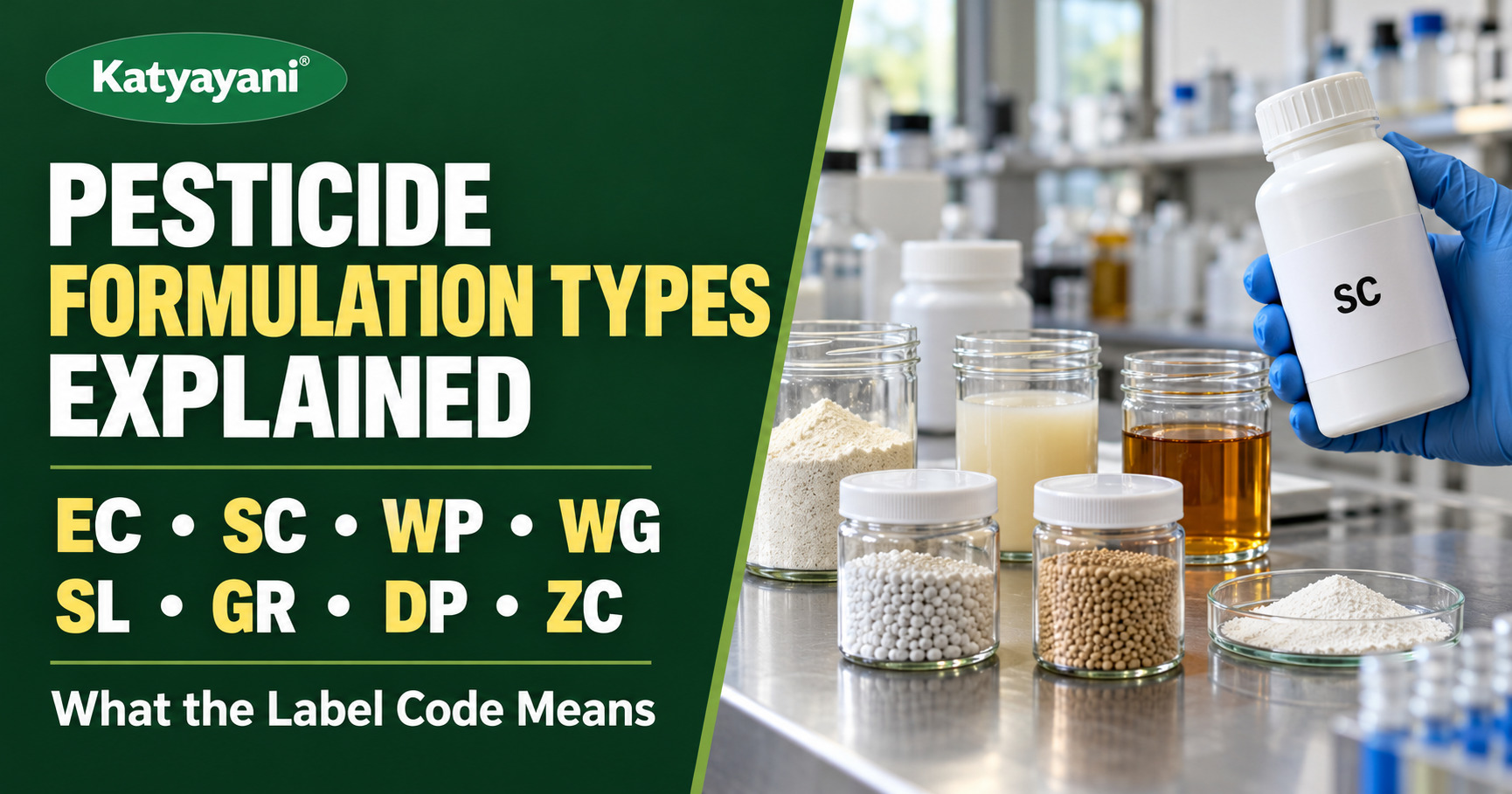
A formulation code is the short letter pair on a pesticide pack that tells you what physical form the product is in. EC is a liquid that turns milky in water, SC is fine solid particles floating in liquid, WP is a powder you mix into a slurry, WG is dry granules that break up in water, SL is a clear liquid that dissolves, GR is ready-to-scatter granules and DP is a dust. The code says how the product is made and handled. It does not say how strong or how safe the product is. Strength is the percent number before the code, and the dose always comes from the label. Shake or stir SC, WP and WG well, add dry products to the tank first and liquids after, and test a small jar mix before any new combination.
What are the types of pesticide formulations?
A pesticide formulation is the active ingredient mixed with other materials so it can be stored, measured, mixed with water and sprayed safely. The main groups are liquids (EC, SC, SL), powders (WP, DP), granules (WG, GR), seed treatments (FS, WS, DS) and baits (RB). Each group has a two-letter code on the pack.
The same active ingredient can be sold in different forms. Thiamethoxam, for example, appears on KO product pages as a 25 percent WG, a 75 percent SG and, mixed with lambda-cyhalothrin, as a ZC. The active is the same chemical family, but the way you mix, shake, store and measure each pack is different. That is why reading the code matters as much as reading the percent.
What do EC, SC, WP, WG, SL, GR, DP and ZC stand for?
EC is emulsifiable concentrate, SC is suspension concentrate, WP is wettable powder, WG is water dispersible granule, SL is soluble concentrate, GR is granule, DP is dustable powder and ZC is a mixed formulation of CS and SC. These names are taken from the CIPAC formulation code list, which follows the CropLife International catalogue.
| Code | Full name (as the code list prints it) | Plain meaning |
|---|---|---|
| EC | Emulsifiable concentrate | Liquid concentrate. Turns milky (an emulsion) when poured into water |
| SC | Suspension concentrate (= flowable concentrate) | Very fine solid particles floating in a liquid. Pours like thick paint. Also sold as "flowable" |
| WP | Wettable powder | Fine powder you stir into water to make a slurry that is then sprayed |
| WG | Water dispersible granule | Small dry granules that break up and spread in water. Also called WDG |
| SL | Soluble concentrate (Wikipedia writes "soluble liquid concentrate") | Clear liquid that dissolves fully in water |
| GR | Granule | Ready-to-scatter dry granules, applied as they are |
| DP | Dustable powder | Fine dust applied dry. Wikipedia notes dusts have largely been replaced by microgranules for safety |
| ZC | A mixed formulation of CS and SC | A capsule suspension and a suspension concentrate packed together, used for two actives in one pack |
| CS | Capsule suspension | Active inside tiny capsules in a liquid |
| OD | Oil dispersion | Active spread in an oil base |
| ME | Micro emulsion | Clear or near clear liquid emulsion |
| FS | Flowable concentrate for seed treatment | Liquid suspension put on seed |
| WS | Water dispersible powder for slurry treatment | Powder made into a slurry to coat seed |
| DS | Powder for dry seed treatment | Dry dressing mixed with seed |
| SP | Water soluble powder | Powder that dissolves in water |
| RB | Bait (ready for use) | Bait laid out as it is, with nothing to mix |
| UL | Ultralow volume liquid | Liquid for special low-volume sprayers |
The CIPAC list I read did not show "SG". One KO product page writes "Thiamethoxam 75% w/w SG", so check that code on the pack or with the manufacturer before explaining it to a customer. The Wikipedia page on pesticide formulation counts 65 current and 29 retired codes in the CropLife catalogue, so a code you do not know may be a rarely used one, or a retired one.
What is EC formulation in pesticides?
EC means emulsifiable concentrate. The active ingredient is dissolved in a solvent with emulsifiers. When you pour it into water it turns milky white and the spray droplets stay mixed for a while. Because it is solvent based, many EC labels carry stronger smell and handling warnings than water-based forms.
Use an EC when the active dissolves well in solvent and you want a quick, uniform mix. Measure carefully, because a liquid concentrate is dosed in millilitres. Moderate agitation is still needed, since Virginia Tech Extension lists EC among the products that can settle out over time.
What is SC formulation in pesticides?
SC means suspension concentrate, also called flowable. Very fine solid particles of the active are spread in a liquid, usually water based. The pack can thicken or separate on standing, so shake or roll it before opening and measure after it is uniform. Several industry pages say SC uses less solvent than EC, which is why it is often described as easier on the applicator.
The KO Fantasy page describes itself as Fipronil 5% SC "in suspension concentrate formulation". The live Fipronil 5% SC guide explains that SC means a liquid suspension, not a soluble liquid.
Which is better, EC or SC?
Neither is better in every case. EC suits actives that dissolve well in solvent. SC suits actives that do not dissolve and need to be milled into fine particles. Compare products by what the label says for your crop, not by the code. Several trade pages say SC leads on handling safety, and EC keeps its place for solvent-soluble actives.
| Point | EC | SC |
|---|---|---|
| Physical form | Clear or amber liquid in solvent | Opaque liquid with fine solid particles |
| In water | Forms a milky emulsion | Forms a suspension |
| Before use | Mix well, measure by volume | Shake or roll the pack first because particles can settle |
| In the tank | Can separate if left standing (Virginia Tech Extension) | Can settle if left standing (Virginia Tech Extension) |
| Solvent | Solvent based (industry pages) | Mostly water based, lower solvent (industry pages) |
| Strength comparison | Check the unit before you compare. "10 percent EC" and "10 percent SC" cannot be compared without w/w or w/v and the label dose | Same |
About crop-burn risk: no source I could read gave a trustworthy ranking of EC against SC against WP on plant injury, so this post does not rank them. Follow the crop, stage and weather warnings on the label, and do a small trial spray before treating a new crop or variety.
What is WP formulation in pesticides?
WP means wettable powder. It is a fine dry powder that does not dissolve but spreads in water when stirred, giving a milky slurry. It needs thorough mixing and can make dust while pouring, so wear a mask and gloves. Keep the pack dry.
On the KO site, Thiophanate Methyl 70% WP is described as a "wettable powder formulation". The live Thiophanate Methyl 70% WP guide says the foliar dose is about 250 to 600 g per acre, seed treatment is 2 to 3 g per kg of seed and the nursery drench is 2 to 4 g per litre. It also says to follow the product label and to run a small test mix before combining with other products.
What is WG formulation, and how is it different from WP?
WG means water dispersible granule, also written WDG. It is a dry granule that breaks apart and spreads in water to make a spray suspension. It is made to do the job of a WP with less dust, because granules are heavier than powder. You still stir it well and keep it dry.
The KO Thioxam page lists "Thiamethoxam 25% WG". The live Thiamethoxam 25% WG guide says "25% WG" means the granule holds 25 percent active ingredient and gives a common foliar dose of 40 to 80 g per acre in 150 to 200 litres of water, to be checked on the pack.
What are SL, GR, DP and ZC formulations used for?
- SL (soluble concentrate): a clear liquid that dissolves in water. It does not settle, so it is the easiest to mix. It only works for actives that dissolve in water.
- GR (granule): ready to scatter, so no tank mixing. It is applied as per the product, for example to soil or around the plant, and the rate must be followed closely. Fungicide use of granules is covered in the fungicide application methods guide.
- DP (dustable powder): a dry dust applied without water. Wikipedia notes that dusts have largely been replaced by microgranules because of safer handling.
- ZC (CS and SC mixed): two actives in one pack. The KO Chakrawarti page lists "Thiamethoxam 12.6% + Lambda Cyhalothrin 9.5% ZC". Read the label for the shaking and mixing steps, because the pack holds two different physical forms.
Which formulation suits which job?
Pick the form for the job the label allows, not for the code. Foliar sprays are normally liquids, powders or dispersible granules. Soil jobs use granules or a drench. Seed jobs use FS, WS or DS. Baits are laid out as they are. The table lists the job, the usual codes and the one thing to watch.
| Job | Usual codes | Watch out for |
|---|---|---|
| Foliar spray on standing crop | EC, SC, WP, WG, SL, ZC | Agitation in the tank and the water volume the label gives |
| Soil application at sowing or in the furrow | GR | Even spreading and the exact rate. Granules do not need a tank |
| Soil drench or nursery drench | WP, SC, EC, SL (as the label allows) | Dose per litre of water and a uniform mix |
| Seed treatment | FS, WS, DS (and some WP products as the label allows) | Treat just before sowing and wear gloves. Treated seed is not food |
| Bait | RB | Keep away from children, pets and livestock |
| Dust application | DP | Drift and dust inhalation. Choose calm conditions |
The thiophanate post shows a WP used three ways: foliar, seed and nursery drench. This is why the label for each pack, not the code alone, decides the use.
How do you read the percent on a pesticide label?
The number before the code is the active ingredient content. "25% WG" means 25 percent active in the granule. The unit behind the percent is either weight in weight (w/w, grams per 100 grams) or weight in volume (w/v, grams per 100 millilitres). Liquid packs may also state grams per litre. Do not compare two products unless the unit and the label dose are the same.
| What you see | What it usually means | Check |
|---|---|---|
| Thiamethoxam 25% WG | Granule with 25 percent active | Dose in grams per acre or per litre of water |
| Fipronil 5% SC | Suspension with 5 percent active | Unit (w/w or w/v) and dose in mL per litre or per acre |
| Thiamethoxam 75% w/w SG | The page states weight in weight | Confirm what SG means from the manufacturer |
| Thiamethoxam 12.6% + Lambda Cyhalothrin 9.5% ZC | Two actives, listed together | Both actives and the mixing steps on the label |
I found no source in my searches that gives a direct conversion between "10 percent EC" and "10 percent SC". So the safe rule is simple: never replace one with the other by percent alone. Use the dose written on the pack you hold.
How do you mix different formulations in a spray tank?
If the label gives a mixing order, follow it. If it does not, extension guidance uses WALES: wettable powders (and other dry products) first, then agitate, then liquid flowables (SC), then emulsifiable concentrates, and finally surfactants or adjuvants. Fill at least half the tank with water first and stir between each product.
The numbers below come from the Virginia Tech Extension tank mixing guide, which summarises Purdue Extension work. They are US guidance, so your product label and your state agriculture office come first.
- Fill the tank with at least 50 percent of the water before adding any product.
- Agitate between each product and allow 3 to 5 minutes for it to mix.
- Moderate agitation is right. If the tank looks like boiling water the agitation is too hard and can cause foam or clumps.
- WP, WDG, SC and EC can settle with time, so keep the agitator running during spraying.
- Cold water makes some products dissolve poorly. The guide says most dissolve more easily in water of at least 50 degrees Fahrenheit (about 10 degrees Celsius).
The sources differ on where soluble liquids (SL) go. Hawaii extension adds a separate step for them, while Arizona extension lists solubles after EC. So I do not give a fixed place for SL here. Ask the manufacturer, or test it in a jar.
How do you do a jar test for compatibility?
A jar test is a small trial mix done before the real tank. It shows if products separate, clump or give off heat. Fill a clear jar half full with water, add products in the label order or WALES order in the same proportion as your tank, shake after each, let it stand 10 to 15 minutes, and look for layers, clumps, foam or heat.
- Fill a jar half full with the same water you will use in the tank.
- Add each product in proportion to the tank mix, one at a time, in the right order.
- Shake the jar after each addition.
- Let it stand for 10 to 15 minutes.
- Look for layers, clumps, foam, heat or sludge. If you see them, do not use that combination.
The live KO posts give the same advice. The thiamethoxam post says to do a compatibility (jar) test before using it with fungicides, and the fipronil post says the same for mixing with common fungicides.
How should pesticide formulations be stored?
Store pesticides in their original container, tightly closed, in a cool, dry, locked place away from food, feed, children and animals. Dry products (WP, WG, GR) must stay dry because moisture can cause caking. Liquids may separate or form crystals if frozen. The label's storage and disposal lines are the final word.
Montana State Extension, in its cold weather storage guide, says wettable powders and granules are not affected by cold but need a dry place because moisture may promote caking or chemical changes. For liquids it says freezing often separates active ingredient and carrier, and that if crystals remain after thawing the product should not be used. That guide is from a cold US state. For hot Indian stores, the same logic applies to heat and humidity, but I did not find an official Indian storage-temperature rule, so check your label.
What should dealers and bulk buyers check about shelf life and caking?
Check the manufacturing date, expiry date and batch number on every lot, open one sample pack to see if powders or granules have turned into lumps, and shake liquid packs to check for hard sediment. Ask the supplier how many months of shelf life remain on delivery. Keep dry products off the floor and away from damp walls.
| Check | Why it matters | Source |
|---|---|---|
| Manufacturing and expiry date on the label | Fixes how long the lot can be sold | KO manufacturer checklist: labels must show them |
| Batch number matches the COA | Lets you trace and complain about a lot | KO manufacturer checklist |
| Shelf life left on delivery | Near-expiry stock is hard to sell | KO manufacturer checklist: ask the supplier |
| Lumps in WP, WG or GR packs | Moisture can cause caking and reduce effectiveness | Montana State Extension |
| Crystals or sediment in liquid packs that will not mix back | Frozen or old liquids may not return to a uniform mix | Montana State Extension |
| Pack intact and sealed | Damaged packs take in moisture | General storage rule; check label |
No source I found gives a standard shelf-life figure by formulation type, so I do not give one. Use the expiry on the pack. Our agrochemical manufacturer checklist covers batch numbers, certificates of analysis and the tests (suspensibility, pH, wet sieve, emulsion stability, moisture) that apply to these forms. For quantity buying, see the bulk pesticide buying guide for FPOs.
Which KO products show these formulation codes?
The table lists six KO product pages and the code each one states. The form is quoted from the product page. Doses are not on those pages in the text I could read, so use the pack label and the live blog posts for doses.
| KO product page | Code on the page | What it shows |
|---|---|---|
| Thioxam, Thiamethoxam 25% WG | 25% WG | A water dispersible granule. Keep dry, stir into water |
| Fantasy, Fipronil 5% SC | 5% SC | A suspension concentrate. Shake before measuring |
| KTM, Thiophanate Methyl 70% WP | 70% WP | A wettable powder. Page calls it a wettable powder formulation |
| Hexa 5 Plus, Hexaconazole 5% SC | 5% SC | A fungicide in suspension concentrate form |
| Chakrawarti, Thiamethoxam 12.6% + Lambda Cyhalothrin 9.5% ZC | ZC | Two actives in a ZC pack |
| Thioxam 75, Thiamethoxam 75% w/w SG | 75% w/w SG | The page states w/w and SG |
Note how the same active, thiamethoxam, appears as a 25 WG, a 75 SG and a ZC mix. That is a good example for a dealer: when a farmer asks for "thiamethoxam", ask which pack and show the code.
The same logic applies beyond chemicals. Whether a fertiliser is a soluble or a granular form changes how you apply it, as explained in our post on water-soluble vs granular fertiliser.
What mistakes do people make with formulation types?
- Reading the code as strength. The code is the form. The percent is the strength.
- Swapping EC and SC by percent. Check w/w or w/v and the label dose.
- Skipping the shake. SC and some ZC packs need shaking before measuring.
- Adding liquids before powders. Extension guidance adds dry products first.
- Leaving the tank to stand. WP, WDG, SC and EC can settle.
- Storing dry packs on damp floors. Moisture can cake WP, WG and GR.
- Buying near-expiry lots. Ask for shelf life left on delivery.
- Trusting the code over the label. The FAO specification manual itself makes the point that product quality is judged through defined requirements and test methods, not by the name alone.
For a deeper look at what FAO specifications set out, see the FAO manual introduction. Biological products follow their own rules, so see our guide to biopesticide types if you stock both.
Conclusion
The code on a pesticide pack tells you the physical form, and that form decides how you shake, mix, measure and store it. Read the percent and the unit, follow the label for dose and mixing order, test new mixes in a jar, and as a dealer check dates, batch numbers and caking on every lot.
Why trust this guide
Written by Team Katyayani, Editorial Team at Katyayani Organics. Cross-checked against published research and university extension programs.
Questions Farmers Ask
What are the types of pesticide formulations?
What does EC SC WP WG stand for?
What is EC formulation in pesticides?
What is SC formulation in pesticides?
Which is better, EC or SC?
Can we mix EC and SC formulations?
What is WG formulation in pesticides?
What is the difference between WP and WG?
What does SL mean on a pesticide label?
What is ZC formulation in pesticides?
What is the correct order to mix pesticides in a tank?
Does 10% EC mean the same as 10% SC?
Read Next in Bulk & Dealer Buying Guides
Technical Grade vs Formulation Grade Pesticide: What Bulk Buyers Must Know Before Comparing Quotes
Agrochemical Manufacturer Quality Checklist for Buyers: Licences, COA, Lab Tests and Red Flags


Leave a Comment