 11 min read
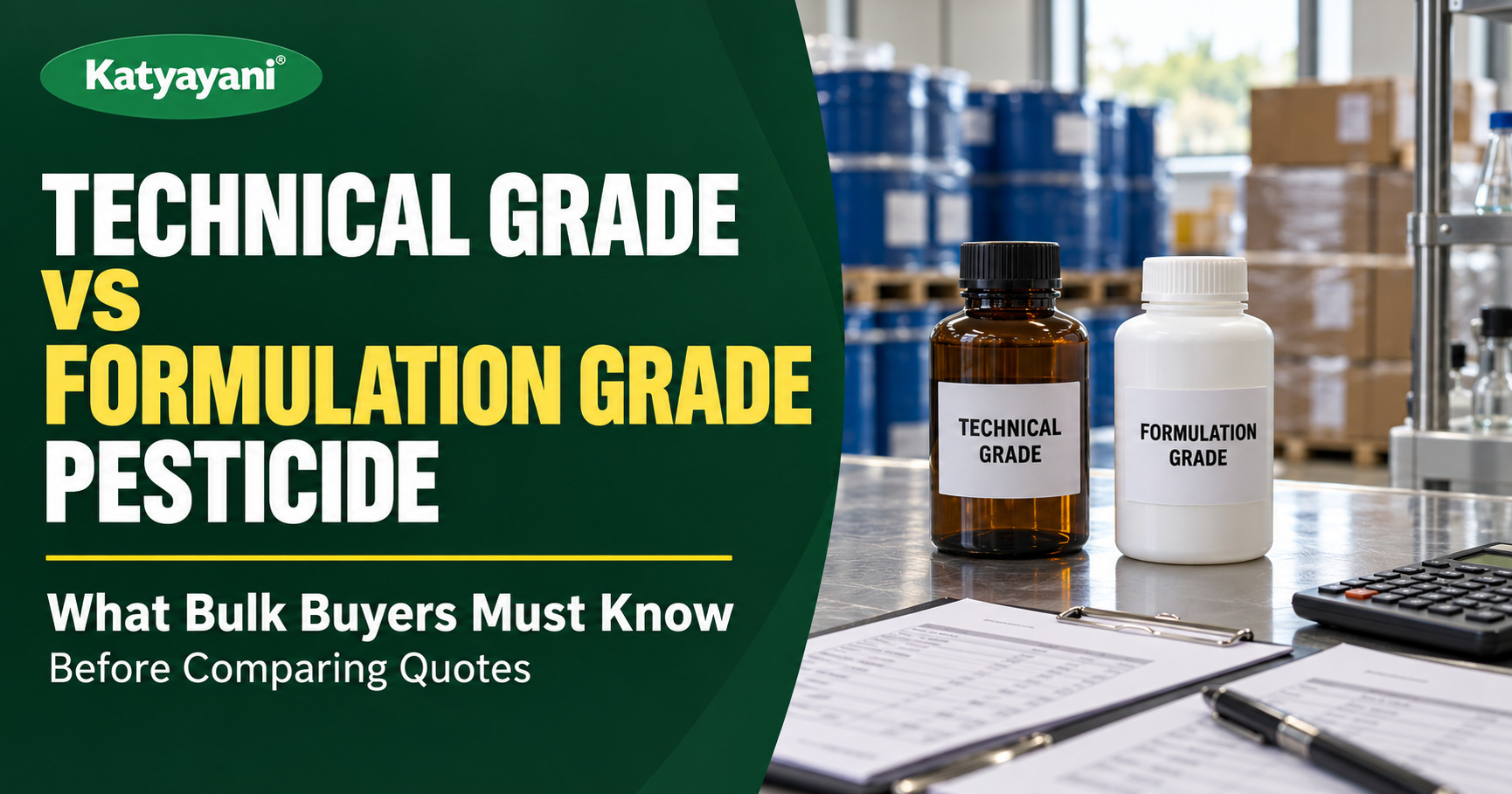
A technical grade product (TC, or technical material) is the pure-ish active ingredient straight from the factory, usually in the range of 90 percent or more active, with some manufacturing impurities. It is a raw material for formulators, not a pack for farmers. A formulated product (EC, SC, WP, WG, SL, GR and others) is the technical mixed with solvents, carriers and other additives to a stated percent, so it can be diluted and sprayed. Because the active is diluted, never compare two quotes by price per litre or kg. Compare the price per gram of active ingredient: divide the price by the grams of active in the pack. In India the label percent, the registration number and the batch details must match the registration, and technical and formulation each have their own CIB&RC registration route.
What is technical grade in pesticides?
Technical grade means the active ingredient as it comes out of the manufacturing plant, before any formulation. It is called TC (technical material) in specifications. It contains the active at a high percent plus small amounts of by-products from the process, called impurities. It is sold in bulk to formulators and exporters, not in small packs to farmers.
One competitor page says technical actives are typically 90 percent or more and many are specified at 95 to 99 percent. That matches the range most buyers see on quotations, but the exact minimum depends on the molecule and the manufacturer. Always read the number on the specification or certificate of analysis, not a general range.
The FAO/WHO manual gives a useful rule about technicals. TC has no upper limit on content, because the purer the material the better. More active means fewer impurities. So a quote of "95 percent min" means not less than 95 percent, not exactly 95.
What is a formulated pesticide?
A formulated pesticide is a ready-to-use or ready-to-dilute product made by mixing the technical with solvents, carriers, emulsifiers, wetters, stabilisers or fillers. The aim is to make it safe to handle, easy to measure, able to mix with water and able to stick to or enter the plant. The label shows the active percent, such as 25 percent in a water dispersible granule.
You can see real formulations in our single-active posts. For example, thiamethoxam 25 percent WG is a granule that disperses in water, and fipronil 5 percent SC is a liquid suspension. Thiophanate methyl 70 percent WP is a wettable powder. Same family of products, three different physical forms.
Technical grade vs formulation grade: side by side
| Point | Technical grade (TC) | Formulated product |
|---|---|---|
| What it is | Active ingredient from the plant, with process impurities | Technical mixed with additives to a label percent |
| Active content | High, often 90 percent or more (check the specification) | Low to medium, for example 5, 25, 50 or 70 percent |
| Typical buyer | Formulators, importers, exporters, contract manufacturers | Dealers, distributors, FPOs, retailers, farmers |
| Pack | Drums, bags, bulk containers | Retail packs in ml, litre, gram or kg |
| Used directly on crop? | No | Yes, as per label dose |
| Quality focus | Purity, impurity profile, certificate of analysis | Active content within tolerance, physical stability, label claims |
| Registration route in India | 9(3) technical import or technical manufacture, later 9(4) for new source or manufacture | 9(3) formulation import or formulation manufacture, as per CIB&RC guideline |
| Price comparison | Per kg of technical, adjusted for purity | Per gram of active in the pack |
What do EC, SC, WP, WG, SL and GR mean?
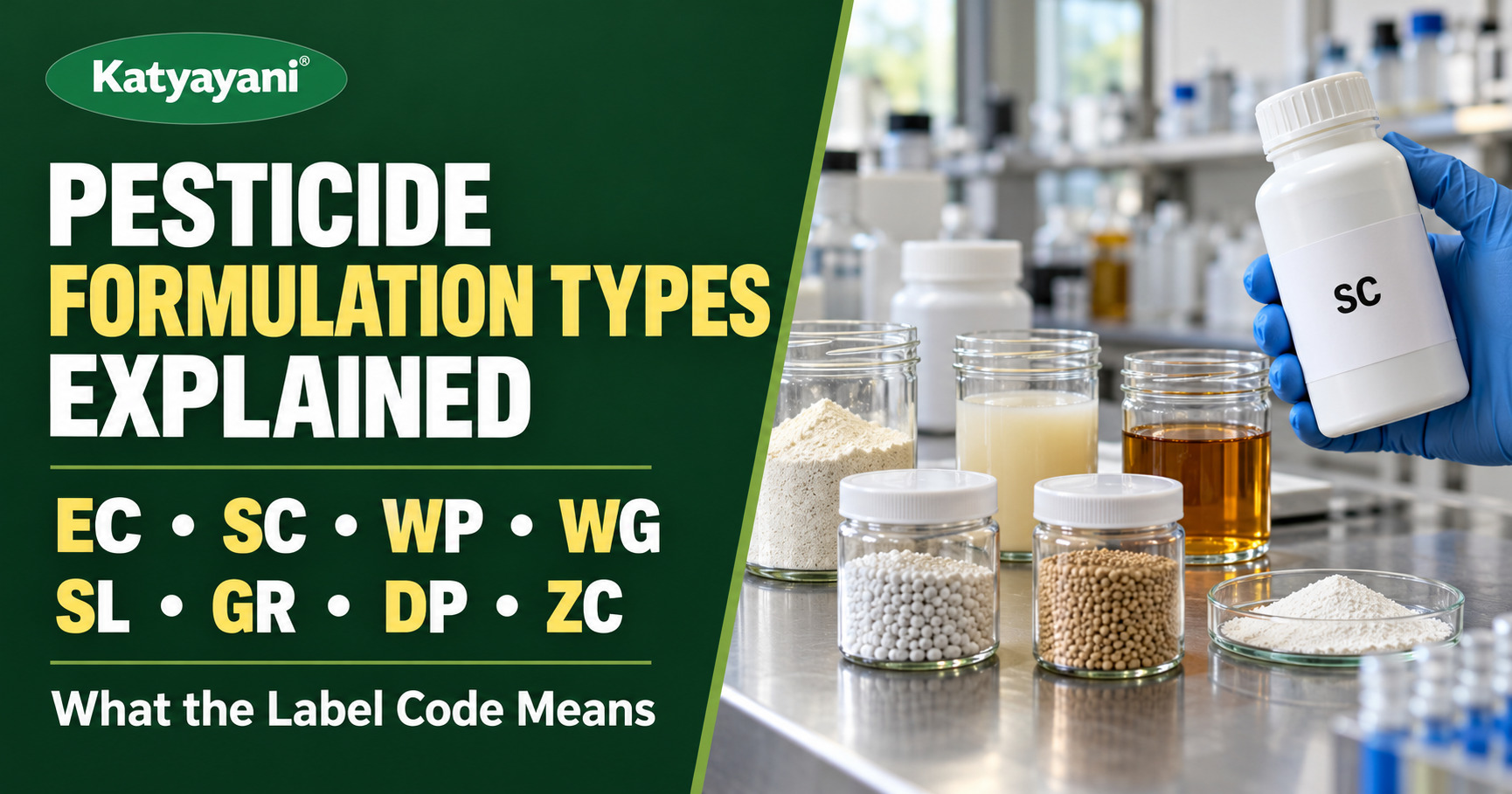
These are short codes for the physical form of a formulation. The code tells you how the active is carried and how it mixes with water, which is why the same active at the same percent can have a different price in a different form.
| Code | Full name | Plain meaning |
|---|---|---|
| EC | Emulsifiable concentrate | Active dissolved in solvent. Turns milky when mixed with water |
| SC | Suspension concentrate | Fine solid active suspended in a thick liquid. Poured and mixed in water |
| WP | Wettable powder | Fine powder that forms a suspension in water |
| WG or WDG | Water dispersible granules | Small granules that break up in water. Less dust than a powder |
| SL | Soluble liquid | Dissolves fully in water and gives a clear solution |
| GR | Granules | Ready granules spread on soil or water, no mixing |
The FAO/WHO manual treats EC, SC and SL as homogeneous formulations and WG and GR as heterogeneous ones, which matters for the tolerance on the label (see the section on label percent).
How does the label percent work: w/w, w/v and g/l?
The label percent shows how much active is in the product. It can be by weight (w/w, grams in 100 grams) or by weight per volume (w/v, grams in 100 ml). Many liquids are shown as g/l. A 25 percent w/w and a 25 percent w/v product are not the same, so check the unit and the density before comparing.
The FAO/WHO specifications manual says solids, liquid technicals, volatile liquids and very viscous liquids are declared in g/kg. Other liquids may be declared in g/kg or in g/l at 20 degrees C. Indian labels often show a percent, so you may need to convert. As a simple rule:
- w/w percent to grams per kg: multiply by 10. A 25 percent w/w product has 250 g of active in 1 kg.
- w/v percent to grams per litre: multiply by 10. A 25 percent w/v product has 250 g of active in 1 litre.
- w/w liquid to grams per litre: you also need the density. If the density is 0.95 kg per litre, then 25 percent w/w gives 250 x 0.95 = 237.5 g per litre (example only, check the real density on the product data sheet).
The same manual allows some difference between what is printed and what a lab finds in a formulation. The table below shows the FAO/WHO tolerance on declared content for formulations. It is a specification rule, not an Indian legal limit, so use it as a guide for what is normal.
| Declared content (g/kg or g/l at 20 C) | Allowed difference from the declared content (FAO/WHO) |
|---|---|
| Up to 25 | Plus or minus 15 percent for EC, SC, SL type; plus or minus 25 percent for GR, WG type |
| Above 25 up to 100 | Plus or minus 10 percent |
| Above 100 up to 250 | Plus or minus 6 percent |
| Above 250 up to 500 | Plus or minus 5 percent |
| Above 500 | Plus or minus 25 g/kg or g/l |
Why do prices of technical and formulated products differ?
Technical is priced per kg of mostly active ingredient. A formulation is priced per litre or kg of a diluted product, and its price also carries the cost of solvents, additives, milling or granulation, packing, labelling, registration, quality testing, freight and the dealer margin. So a formulation is not the technical price divided by the dilution.
- Active content: the main driver. A product with more active per litre costs more per litre.
- Formulation type: SC and WG need special mills and wetting agents. A simple EC may be cheaper to make.
- Source and purity of technical: a higher purity or a better impurity profile costs more.
- Packing and label: small retail packs cost more per gram than bulk.
- Registration and testing: every registered product needs data, batch testing and a licence.
- Exchange rate and freight: for imported technicals, both move the landed price.
We have not quoted any market price here, because technical and formulation prices change with the season, the source and the exchange rate. Always ask for a current written quotation.
How to compare two quotes: cost per gram of active ingredient
To compare two quotes, work out how many grams of active ingredient you get in the pack and divide the price by that number. The lower cost per gram of active is the better value, if the quality and the label are equal. This avoids the common mistake of comparing price per litre or per kg.
Steps: (1) note the label percent and its unit; (2) convert to grams of active per litre or per kg; (3) multiply by the pack size; (4) divide the pack price by the total grams of active.
Example Only: The numbers below are made-up round numbers to show the method. They are not market prices, and no real brand or product is meant. Supplier A offers a 25 percent w/v EC at Rs 800 per litre. Supplier B offers a 20 percent w/v EC of the same active at Rs 700 per litre. A has 250 g of active per litre, so Rs 800 / 250 g = Rs 3.20 per gram of active. B has 200 g of active per litre, so Rs 700 / 200 g = Rs 3.50 per gram of active. B looks cheaper per litre but costs more per gram of active.
| Item (example only) | Supplier A | Supplier B |
|---|---|---|
| Label percent (w/v) | 25 | 20 |
| Active per litre | 250 g | 200 g |
| Price per litre (made up) | Rs 800 | Rs 700 |
| Cost per gram of active | Rs 3.20 | Rs 3.50 |
| Cheaper per gram of active | A |
Two more checks make the comparison fair. First, the dose on the label: if one product needs a higher dose, the real cost per acre changes. Second, the formulation type and the quality: a poorly made SC can settle in the drum or a WP can clog nozzles, so a cheaper gram of active is not always better. For a bulk order, use the checks in our FPO bulk buying guide for MOQ, GST invoice and sampling.
You can also compare a technical quote with a finished product, but only for a rough idea. Technical is cheaper per gram of active, but it needs formulating, testing, registration and packing. Those costs are not in the technical price.
Who buys technical grade and who buys formulations?
| Buyer | What they usually buy | Why |
|---|---|---|
| Formulators and contract manufacturers | Technical (TC) and additives | They make EC, SC, WP or WG themselves under their own licence and registration |
| Importers and exporters | Technical or formulation, depending on the registration | See the import and export guides on this blog |
| Distributors and wholesalers | Formulated products in bulk packs | They sell to retail dealers |
| Retail dealers and agri-input shops | Formulated retail packs | Sold to farmers with a dealer licence |
| FPOs and cooperatives | Formulated products | Bought for member farmers, often in bulk |
| Farmers | Formulated products only | Technical is not made for field use |
If you are a dealer or FPO, you will almost always buy formulations. If you want to build your own brand without owning a plant, read how private label manufacturing works, where a licensed manufacturer makes to your specification. For fertilisers, the same idea applies in a simpler form: the grade printed on a bag is the nutrient percent, and you compare price per kg of nutrient, not per bag.
What are the Indian regulatory rules for technical and formulation?
In India, pesticides are controlled by the Insecticides Act 1968 and its rules. The Central Insecticides Board and Registration Committee (CIB&RC) registers each pesticide. The CIB&RC guideline sets separate data requirements for technical import (TI), technical indigenous manufacture (TIM), formulation import (FI) and formulation indigenous manufacture (FIM), under Section 9(3), with 9(4) covering later registration of technical manufacture.
Points in the guideline that matter to a buyer:
- A firm that holds a registration for indigenous manufacture of a pesticide technical or formulation cannot also register the same pesticide under an import category.
- If a technical is registered for indigenous manufacture to any firm, an application for formulation import of that same molecule will not be considered.
- For a new-source technical import, only the same or a higher minimum purity than the already registered purity is considered.
- A label and leaflet is required for all the registration categories (TI, TIM, FI and FIM).
- Data on impurities is required for technical import and technical manufacture; the guideline marks it as not required for formulation import.
There is also an open policy question on importing a formulation without registering the technical. The 281st Registration Committee minutes show that a decision on this was kept in abeyance for review under the Act. We did not find the final outcome, so check the latest CIB&RC position or ask your regulatory consultant before you plan an import.
This post is not legal advice. For the full import steps, HS codes and the registration papers, read our guide to importing pesticides from India. If you plan to ship out, see the exporters guide.
What must the label and pack show?
Every pack, technical or formulated, must carry a label approved by CIB&RC, because a label and leaflet is part of the registration file. For retail packs, the Insecticides Rules list the particulars to be printed. We could not open the full text of Rule 19, so the list below is from a consultancy page and should be checked against the Rules.
- Name of the manufacturer and the registrant (if different).
- Name of the insecticide, brand name allowed.
- CIB&RC registration number.
- Active ingredient and other ingredients with percentages.
- Net content in metric units.
- Batch number and expiry date.
- Antidote statement, and the signal word and colour band that show toxicity.
A 2023 amendment to the Insecticides Rules is reported to require a QR code on the retail pack that carries a unique identifier, batch number, date of manufacture, date of expiry and a web link, per a summary of the amendment. Confirm the final text and the date it starts for your product type. For a technical drum, ask the supplier for the batch number, date of manufacture, certificate of analysis and the registration number on the document or label.
What quality markers matter in a technical grade?
The most important marker is the minimum active content on a certificate of analysis for your batch, next to the impurity profile. Impurities are by-products of manufacture. FAO/WHO calls an impurity relevant when it is toxic, harms the crop, spoils stability or has another adverse effect, and these are limited in the specification.
- Minimum active content: shown in g/kg. The average measured content should not be lower than the declared minimum.
- Relevant impurities: each has a maximum limit in the FAO/WHO specification. Water and insoluble material can also be relevant, because they can ruin a formulation or block spray nozzles.
- Same source: FAO/WHO specifications apply to the manufacturer whose technical was evaluated. Another source must show it is equivalent.
- Physical form and appearance: colour, odour and solid or liquid state should match the specification.
- Batch records: batch number, date of manufacture and retest date on every drum.
For a formulation, the quality markers move to the declared content within tolerance, how stable it is in storage, how well it mixes (suspensibility or emulsion stability) and whether the pack and label match the registration. The manufacturer checklist explains how to audit these before you sign.
Common mistakes bulk buyers make
- Comparing price per litre or per kg. Always compare per gram of active.
- Mixing up w/w and w/v. A 25 percent w/w liquid has less active per litre than a 25 percent w/v liquid if its density is under 1.
- Buying a "technical" for direct sale. It is not a farm product. If a supplier offers it for field use, ask for the registration and the formulated label.
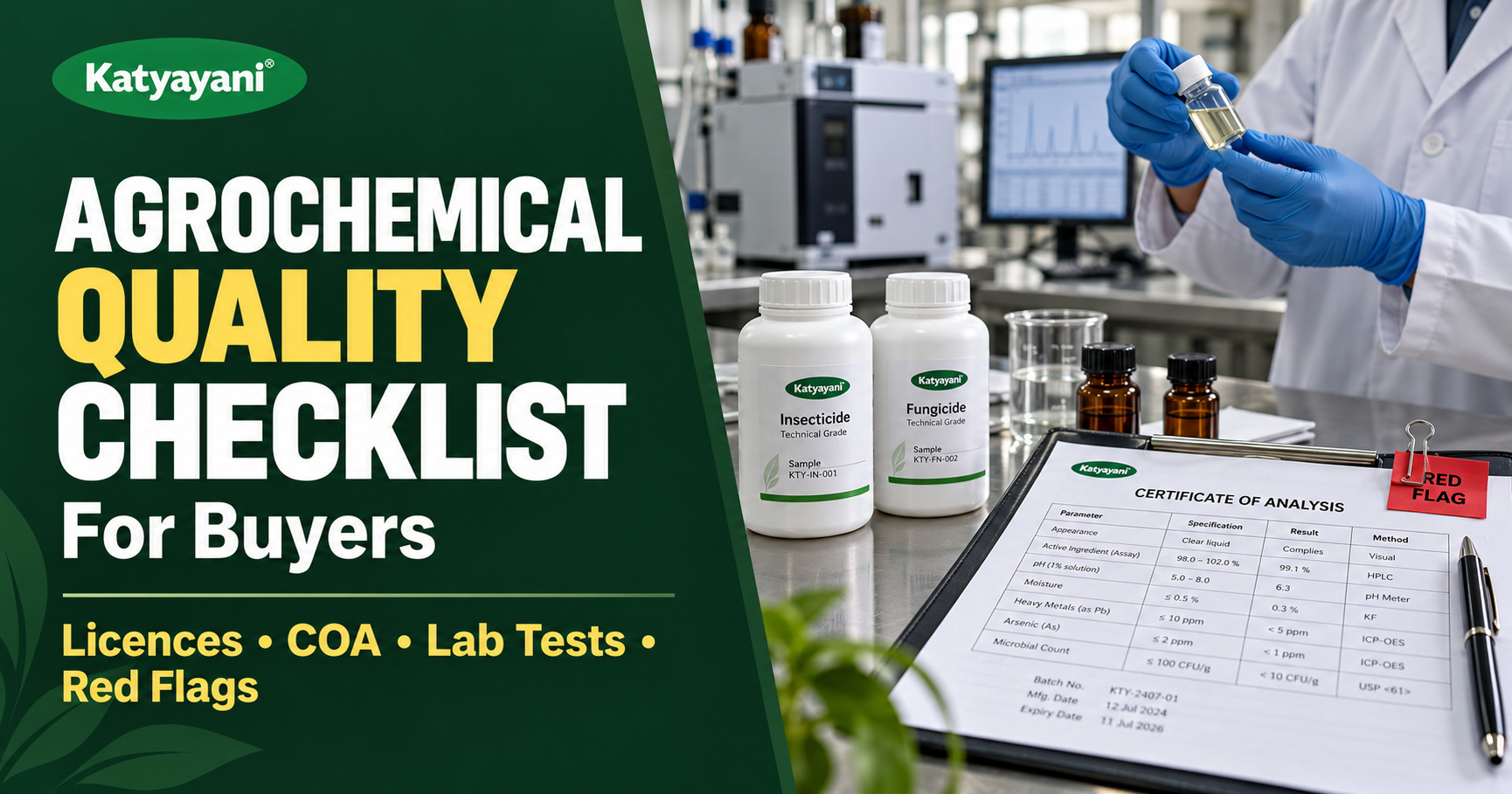
- Not asking for a certificate of analysis for each batch. Last month's COA says nothing about this lot.
- Ignoring tolerance. A small gap between your lab and the label can be within the allowed range. A large gap is not.
- Accepting a quote with no registration number. An unregistered product cannot be sold legally, whatever its price.
- Forgetting the licence. Selling pesticide needs a dealer licence. See our dealer licence guide.
- Ignoring the formulation type. Same active and percent, different form, different handling and storage.
Quick checklist before you accept a quote
- Ask: technical or formulation? Which code (EC, SC, WP, WG, SL, GR)?
- Write down the label percent and its unit (w/w, w/v, g/l).
- Calculate grams of active per pack and the cost per gram of active.
- Ask for the CIB&RC registration number and a copy of the approved label.
- Ask for a batch-wise certificate of analysis and the batch number and expiry.
- Check packing, shelf life and storage conditions.
- Test a sample from your first lot at an approved lab before a bulk order.
- Agree in writing on payment terms, GST invoice and return of off-spec lots.
Conclusion
Technical grade is a factory raw material, and a formulation is the product that reaches the farm. Compare quotes by cost per gram of active ingredient, check the label unit and tolerance, and ask for the registration number and batch certificate every time.
Why trust this guide
Written by Team Katyayani, Editorial Team at Katyayani Organics. Cross-checked against published research and university extension programs.
Questions Farmers Ask
What is the difference between technical grade and formulation grade pesticide?
What is technical grade in pesticide?
Can farmers use technical grade pesticide directly?
What are the different types of pesticide formulations?
What is the difference between EC and SC formulation?
Can we mix EC and SC formulations?
How do I compare the price of two pesticide quotes?
What is the difference between w/w and w/v on a pesticide label?
Is the label percent of active ingredient exact?
Who registers technical and formulated pesticides in India?
What documents should I ask for when buying pesticide in bulk?
Why is technical grade cheaper than a formulated pesticide per gram of active?
Read Next in Bulk & Dealer Buying Guides
Pesticide Formulation Types Explained: EC, SC, WP, WG, SL, GR, DP, ZC and What the Label Code Means
Agrochemical Manufacturer Quality Checklist for Buyers: Licences, COA, Lab Tests and Red Flags

Leave a Comment