 11 min read
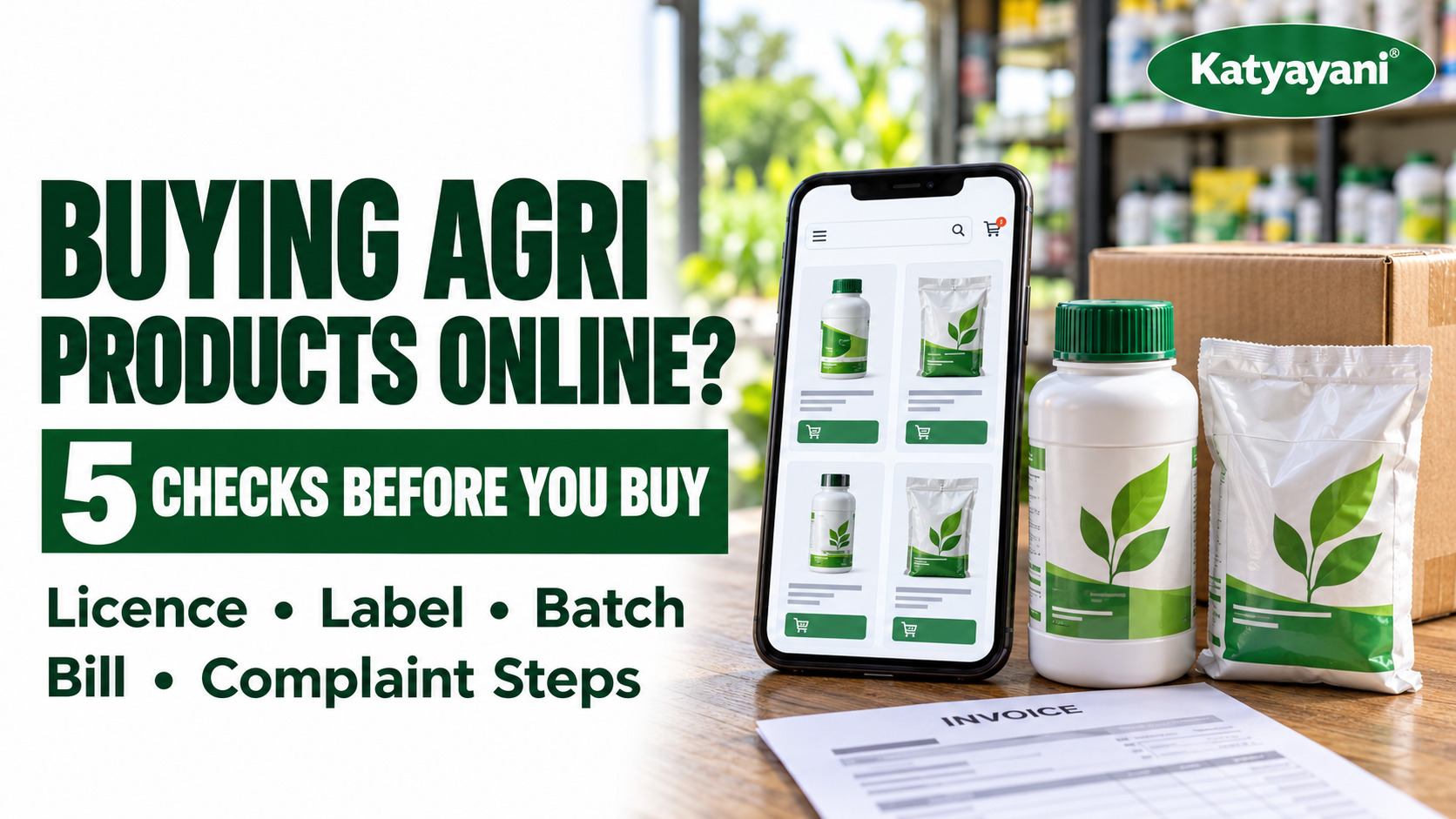
Before you pay, check six things: the seller holds a valid state licence that covers that exact product; the product is registered (pesticides) or meets fertiliser and seed rules; the label shows batch number, manufacturing and expiry dates; the pack is sealed; the price is not above the printed MRP; and you will get a proper bill with batch details. If any of these is missing, do not buy.
Is it safe to buy pesticides, fertiliser and seeds online in India?
It can be, if you buy from a seller who is properly licensed and gives full proof. The risk is not that the product is online. The risk is that some online sellers are not licensed for the product they list, or that the pack is old, repacked or unregistered.
In January 2026, CropLife India, an association of 17 crop-protection companies, raised concerns at a conference in New Delhi about the unchecked sale of unauthorised crop protection products on e-commerce platforms. It said platforms are not currently required to hold pesticide-law licences, and that inventory-based models may store pesticides in warehouses not licensed under the Insecticides Rules (Agro Spectrum India). The Agriculture Commissioner was quoted as saying that basic checks such as a seller's GST papers may not be enough for hazardous agri-inputs sold online. That is why the buyer's own checks matter.
What is the quick checklist before I place an order?
| Check | What to look for | Red flag |
|---|---|---|
| Seller licence | A state-issued licence number, covering that product, valid for your area | Seller will not show a licence, or only shows a GST number |
| Registration | Pesticide registered under the Insecticides Act; label shows registration number | No registration number on label |
| Batch number | Printed on the pack and repeated on your bill | Missing, smudged or different from the bill |
| Dates | Manufacturing and expiry dates clear and in future | Expired or very near expiry |
| MRP | Price at or below printed maximum retail price | Price above MRP or no MRP |
| Label and leaflet | Name, contents, directions, cautions, manufacturer address in a language you can read | Missing leaflet, spelling errors, blurry print |
| Pack seal | Factory-sealed and untampered | Loose cap, reused bottle, re-stitched bag |
| Bill | Invoice with seller name, product, batch, date and amount | Seller offers only a screenshot or no bill |
| Return policy | Clear written policy for damaged or wrong goods | No returns for any reason |
| Payment | Pay through the platform, UPI to a named business or card | Pressure to pay to a personal account |
How do I check the seller's licence?
Under the Insecticides Act, 1968, section 13 says any person who wants to sell, stock or exhibit an insecticide for sale or distribute it must apply to the licensing officer for a licence. Section 29 makes selling or distributing an insecticide without a licence an offence. CropLife India adds that a licence is product-specific: the product must be endorsed on it, and the sale is limited to an approved area (CropLife India report).
Fertiliser sellers need registration or authorisation too. The Fertiliser (Control) Order, 1985 says in clause 7 that no person shall sell or offer fertiliser as a wholesale or retail dealer except as clause 8 provides. A dealer's registration certificate must be displayed prominently in the part of the premises open to the public.
What can you do online? Ask the seller to send a photo of the licence showing licence number, issuing state, validity date and the list of products. Then check three things: the licence is not expired, the product you want is on the list, and the licence belongs to the same business name that issues your bill. If you want to know how a real dealer gets this, read our dealer licence guide, state-wise.
One honest limit: I could not find a single national page where a buyer types a licence number and gets a result. Licences are issued by state licensing officers. If the seller's papers look doubtful, ask your district agriculture office.
What does the 2022 online-sale rule actually allow?
In 2022 the Insecticides (Second Amendment) Rules introduced a provision for selling insecticides through an e-commerce entity. According to a summary on SCC Online, a licensee may sell any insecticide through an e-commerce entity during the licence period to supply farmers at their doorstep. Before engaging the licensee, the e-commerce operator must verify the licence issued by the State Licensing Officer, and both must follow the Consumer Protection (E-commerce) Rules, 2020. CropLife India refers to this as Rule 10E and says it does not remove the need for licences, principal certificates, approved premises or geographic limits.
In plain words: online selling is allowed, but only by a licensed seller, and the platform is meant to check the licence. It is not a loophole.
Is the pesticide registered? What to check on the label
The Insecticides Act, section 18, says no person shall sell, stock or exhibit for sale any insecticide that is not registered under the Act. Section 3(k) lists when a product is "misbranded": for example, a false or misleading label, an imitation sold under another insecticide's name, a missing warning or caution, a product not packed or labelled as required, or one not registered as required. It also says a label that mentions registration must give only the registration number.
Registration is done centrally by the Central Insecticides Board and Registration Committee (CIB&RC). I tried to open the CIB&RC website to check registered-product lists, but the domain did not load from here, so I cannot describe its search page. Ask the seller for the registration number from the label and match it to the official list when the page is available to you, or ask your state agriculture office.
- Product name and active ingredient with percentage printed clearly.
- Registration number and manufacturer name and address.
- Batch number, manufacturing date and expiry date.
- Warning and caution statements and antidote information.
- Directions and leaflet inside the pack.
- Colour of the toxicity triangle on the label (check the label and leaflet for what it means).
For the quick signs that separate genuine from fake, read our 12 checks to identify fake pesticides and fertilisers.
Batch number, expiry date and MRP: why each matters
- Batch number ties the pack to one production lot. If a product fails, the company and the inspector can trace that lot. Your bill should show the same batch number as the pack.
- Manufacturing and expiry dates matter because active ingredients and living organisms lose strength. Do not buy near-expiry stock unless you will use it at once. For living products such as bio-fertilisers and bio-pesticides, viability falls with time and heat, which is why shelf life is a known concern in the biopesticide sector (see our biopesticides guide).
- MRP is the maximum price printed on the pack. For fertiliser, the Order lets the Central Government fix maximum prices, and clause 3 says no dealer shall sell above the notified maximum price. Dealers must also display stock and the price list in the shop (clause 4). Online, compare the price with the MRP on the pack photo. A price above it is a complaint.
- Weight or volume: check that the pack size on the photo matches what you ordered.
What should the bill or invoice show?
The Fertiliser (Control) Order, clause 5, says every dealer shall issue a cash or credit memorandum to a purchaser of a fertiliser in the prescribed form. For pesticides and seeds, ask for the same. A good invoice shows:
- Seller's name, address, licence number and GST number.
- Your name and delivery address.
- Product name, pack size, quantity, batch number and expiry date.
- Price, GST and total, with date of sale.
- For seeds: variety name and lot or label details as printed on the pack.
Keep the invoice, the pack, the label photo and the delivery box until the crop season ends. If a product fails, an inspector can test a sample from the sealed pack, and your bill proves where you bought it. For bulk buyers, our guide to bulk fertiliser and pesticide buying for FPOs explains GST invoices and order terms.
What do I check on fertiliser bags?
The Fertiliser (Control) Order says in clause 21 that every container must be packed and sealed so that contents cannot be tampered with without breaking the seal, and that bags stitched by hand must carry lead seals unless machine stitching makes tampering visible. Torn or damaged bags may be repacked only by the manufacturer under intimation to the governments. So:
- Bag must be intact and the stitching or seal untouched.
- Bag must show grade (for example nutrient content), weight, manufacturer name and batch details as the Order requires.
- A loose, re-stitched, or oddly stained bag is a red flag.
- During shortages, extra-price and "with other goods" offers are common. See what is happening with DAP and urea shortage, stock and price before paying over the limit.
What do I check when buying seeds online?
The Seeds Rules, 1968 set the label rules for seed of notified kinds and varieties. Each container must be marked or labelled with the particulars the Central Government specifies, the net content by weight in the metric system, the date of testing, whether the seed has been treated (with the chemical name of the treatment and a caution such as "Do not use for food, feed or oil purposes", and the word "Poison" in red for mercurials and similar toxic substances), the name and address of the seller responsible for quality, and the notified name of the seed.
Also useful to know: no person shall sell or offer for sale notified seed after the date the label gives as the date up to which it keeps its required germination (Rules, Part VI, clause 13). No one may alter, obliterate or deface the label on a seed container. The person named on the label is responsible for its accuracy only while the seed is in the original unopened container, so do not open the pack before you check it.
I did not read the Seeds Act, 1966 text itself, so I am not quoting its penalty provisions. Ask the seller for the seed lot and label, and see if the variety name, lot, germination and purity details are on the pack.
How do I spot fake or substandard products when the parcel arrives?
| Sign | Why it matters |
|---|---|
| Pack opened, cap loose or seal broken | Contents may be diluted or replaced. Under the Fertiliser Order bags must be tamper-proof. |
| No registration number or leaflet | A pesticide label that does not meet the Act's requirements can be misbranded under section 3(k). |
| Batch number on the pack does not match the bill | Weak traceability. Refuse delivery or raise a complaint. |
| Print is blurred, spelling is wrong, colour looks different from the maker's page | Common in imitation packs. |
| Strange smell, lumps, wet powder or separated liquid | Storage damage or adulteration; do not use. |
| Price far below the market | Often old, expired or fake stock. |
| Seller will not share the licence or bill | Treat as unlicensed. |
Do not use the product if you have doubts. Take clear photos of the pack, label, batch number and the bill. Our post on identifying fake pesticides and fertilisers goes through more checks and what to do next.
Returns, refunds and payment safety
- Read the return policy before ordering. Agri-inputs are often non-returnable once opened. Know the window for damaged or wrong items.
- Open the parcel in front of the delivery person if you can, and take a video of the unboxing. Photograph batch number and seal.
- Report damage the same day through the app or call, with photos.
- Pay inside the platform or by UPI to a named business account. Be careful with requests to pay to a personal number or to pay a "release fee".
- Prefer a trackable order with the order number printed on the invoice.
- Keep screenshots of the product page, price, offer and seller name. Listings change.
If you are choosing a website, our post on the top agriculture websites to buy agri products online explains what to compare.
Which laws protect me when I buy agri-inputs?
| Product | Main law | What it means for the buyer |
|---|---|---|
| Pesticides, bio-pesticides | Insecticides Act, 1968 and Insecticides Rules, 1971 | Product must be registered; seller must be licensed; misbranded product is banned from sale; penalties apply |
| Fertilisers | Fertiliser (Control) Order, 1985 (under the Essential Commodities Act, 1955) | Dealer must be registered; bill must be issued; maximum prices; tamper-proof bags |
| Seeds | Seeds Act, 1966 and Seeds Rules, 1968 | Label with germination validity, testing date, treatment, seller details; no sale after validity date |
| Online purchase in general | Consumer Protection (E-commerce) Rules, 2020 | Platform and seller duties; a route for grievances |
Penalties exist. For the Insecticides Act, section 29 says that selling a misbranded insecticide of certain kinds, or selling without a licence, is punishable for a first offence with imprisonment up to two years, or a fine of Rs 10,000 to Rs 50,000, or both; for a second or later offence, up to three years, or a fine of Rs 15,000 to Rs 75,000, or both. This is the text as shown in the version read. Check the current gazette before quoting it. I did not read penalty clauses of the Fertiliser Order or the Seeds Act, so none are quoted.
How do I complain if I receive a bad or fake product?
- Stop using it and keep the pack sealed or as it is. Do not throw anything away.
- Write to the seller and the platform with the order number, photos, bill and a clear request: refund, replacement or both. Keep copies.
- Call the Kisan Call Centre on 1800-180-1551. According to mKisan, it is toll-free, runs 6 am to 10 pm on all seven days, answers in 22 local languages, and passes hard questions to experts. It is for advice and guidance; for a legal complaint use the next steps.
- Contact your district or state agriculture department, the office of the Insecticide Inspector or Fertiliser Inspector, with your bill and sample. The Acts empower inspectors to draw samples for testing. A sample taken from a sealed pack with a bill gives them something to act on.
- Use the National Consumer Helpline. The NCH site shows the toll-free number 1915 (8 am to 8 pm), a WhatsApp number +91 88000 01915, an app, the UMANG app and an online portal, with 17 languages listed.
- If the matter is not solved, file a consumer complaint at the district consumer commission. Online filing through e-Daakhil or e-Jagriti exists; check the current portal and time limits before you file.
Write short, dated, factual complaints. State the product, batch, shop or website, date, price, what is wrong and what you want.
Before you click Buy: a one-minute final checklist
- Is the seller licensed, and is this product on the licence?
- Is the product registered, and is the registration number on the label photo?
- Is the expiry date at least several months away?
- Is the price at or below the MRP?
- Will I get a GST invoice with batch details?
- Is the return and refund policy written?
- Do I know who to call if the product is wrong?
Conclusion
Buying agri-inputs online is a matter of proof, not trust. Ask for the seller's licence, check that the product is registered and on that licence, read the batch number, dates and MRP on the label, and insist on a proper bill. Take photos when the parcel arrives, keep everything until the season ends, and know the complaint steps before you need them. If the seller will not give proof, walk away.
Why trust this guide
Written by Team Katyayani, Editorial Team at Katyayani Organics. Cross-checked against published research and university extension programs.

Leave a Comment