 11 min read
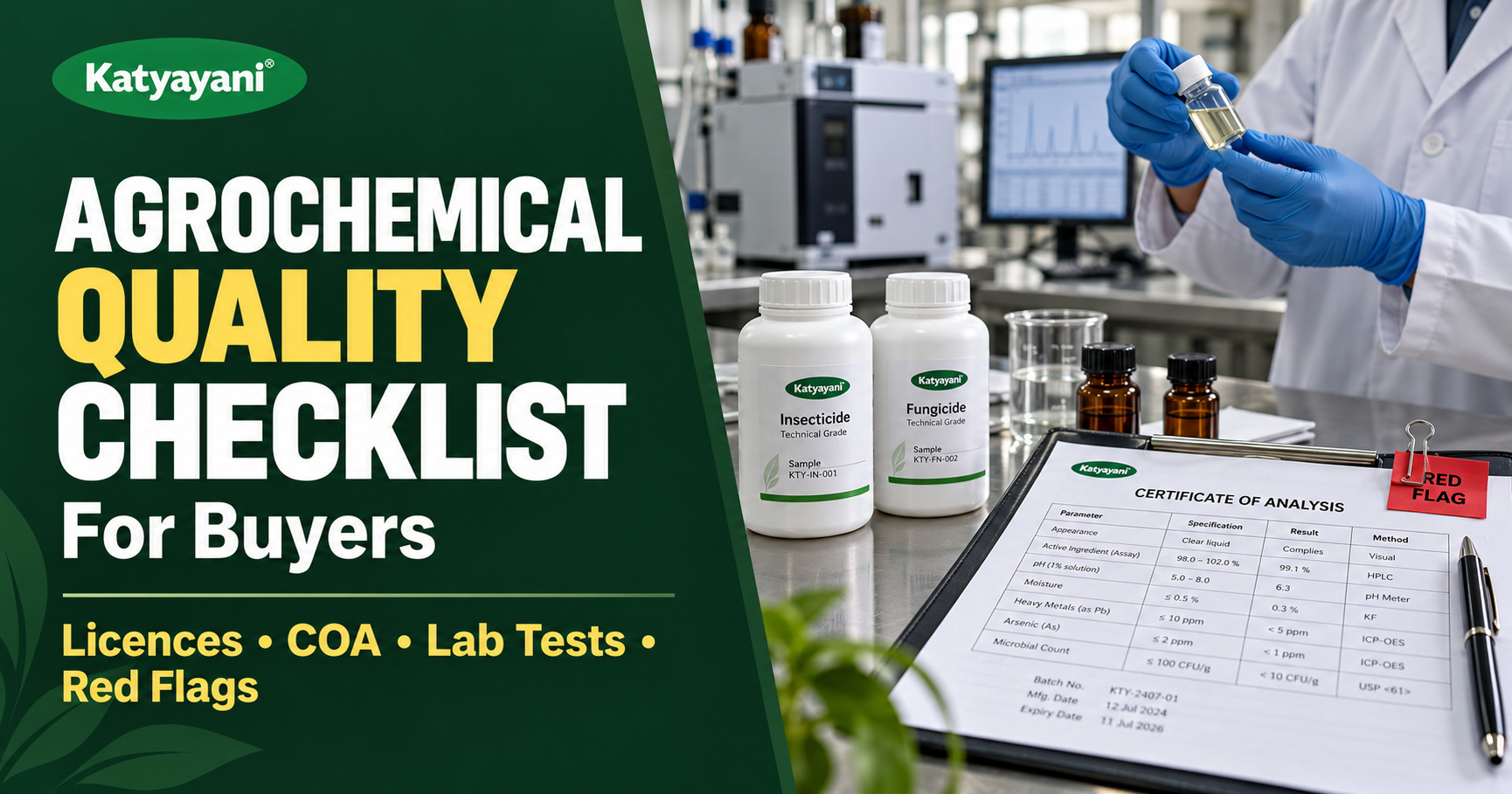
To verify an agrochemical manufacturer, check five things in this order: the CIB&RC registration number for each product, the state manufacturing licence for the exact factory, a batch-wise certificate of analysis (COA) that matches the label, an independent lab test of a pre-shipment sample, and a written supply agreement with return and recall terms. Under the Insecticides Act, a dealer can be prosecuted for selling misbranded stock, even if the maker is at fault, so proof beats promises. A good COA lists the batch number, the tests, the limits and the results. Ask for suspensibility, wet sieve, pH and persistent foam results for suspension and wettable powder products, and the active ingredient content for all products. Test a sealed sample at an accredited lab before the full order, keep a retained sample from every lot, and pay the balance only after the result matches the label.
What does it mean to verify an agrochemical manufacturer, and how is it different from choosing one?
Choosing means making a shortlist from price, range and reputation. Verifying means proving, with documents, a lab test and a site visit, that the maker can deliver the same quality every time. Our broader 10-point manufacturer checklist covers the shortlist stage. This guide starts after that, when you are about to place a real order.
Verification matters most for dealers and FPOs because the licence holder who sells the product is the person an inspector meets first. The same applies to importers, who are also asked to prove registration status in the destination country; see our guide to importing pesticides from India.
Which documents should you verify, and how do you check each one?
Ask for six documents and check each one against a second source: CIB&RC registration certificate, state manufacturing licence, FCO certificate for nutrient products, batch COA, GST and company records, and a copy of the approved label. A document that cannot be matched to the product name, factory address and batch is not proof.
| Document | What to ask for | How to verify it | Common problem |
|---|---|---|---|
| CIB&RC registration certificate | Certificate for each product, with registration number, section (9(3) or 9(3B)) and the crops and uses allowed | Compare against the registered product details on the CIB&RC (PPQS) website. Check that the manufacturer name and the product composition match your order | Certificate is for a similar product or a different company, or the label claims a crop that the certificate does not list |
| State manufacturing licence | Current licence copy for the exact factory address and the products listed on it | Check the licence number, validity date and product list. Ask the state agriculture department licensing officer if you are unsure | Licence is for another site, has expired, or does not list your product |
| FCO certificate (fertilisers, micronutrients, bio-products) | Certificate of registration or authorisation for the specific grade | Check grade name, composition and validity against the certificate. See our bio-stimulant FCO rules guide for the bio-stimulant schedule | Grade on the certificate does not match the grade on the bag |
| Batch COA | Signed lab report for the exact batch you are buying | Match batch number, manufacturing and expiry dates, and test limits to the pack label | Same COA copied for many batches |
| GST and company record | GSTIN, and CIN for a company | Check the GST portal and the Ministry of Corporate Affairs record | Trade name differs from the legal name on the invoice |
| Approved label and leaflet | Sample pack with the label that was approved at registration | Compare the pack against the approved label word for word | Extra claims, missing warnings or a different composition line |
Registration under the Insecticides Act has two common routes. Section 9(3) is the normal registration after the Registration Committee is satisfied the product does what the maker claims. Section 9(3B) is a provisional registration, for a period of two years, for a product being introduced for the first time in India. If a certificate says 9(3B), ask when it expires and whether the full registration has been granted.
What should a batch-wise certificate of analysis (COA) contain?
A proper COA is a signed lab report for one batch. It shows the product name, batch number, manufacturing and expiry dates, each test with the method used and the accepted limit, the actual result, the lab name and the signature of the analyst. A COA without limits or methods is only a statement, not proof.
- Batch details: product name, formulation (for example SC, WP, EC), batch or lot number, manufacturing date, expiry date and quantity.
- Tests and limits: active ingredient content with the allowed range, plus the physical tests that apply to the formulation.
- Method reference: the test method used, for example a CIPAC method number or an in-house method named in the registration.
- Result and verdict: a measured value for each test, and a clear pass or fail.
- Authority: who tested it and who signed. Check that the analyst name is on a real, traceable lab report.
Three quick checks catch most bad COAs. First, read two COAs for different batches: if all numbers are identical to the second decimal, ask why. Second, check the batch number against the pack in your hand. Third, check that active content is stated as a range that matches the label, not just the word "pass".
Which lab tests exist for pesticide quality, and which ones matter for your product?
The main tests are active ingredient content, pH, suspensibility, wet sieve test, persistent foam, wettability, emulsion stability and storage stability. Which ones apply depends on the formulation: suspension and wettable powders need suspensibility and sieve tests, while emulsifiable concentrates need emulsion stability. Active content applies to all.
| Test | What it tells you | Mainly relevant for | Standard method family |
|---|---|---|---|
| Active ingredient content | Whether the product holds the percentage printed on the label | All pesticides | Usually HPLC or GC, method named in the specification or registration |
| pH | Stability and compatibility; wrong pH can damage the product or crop | Most liquids and powders mixed in water | CIPAC MT 75 family |
| Suspensibility | How much active stays suspended in the spray tank after standing | SC, WP, WG | CIPAC MT 184 (newer MT 184.1) |
| Wet sieve test | Share of coarse particles that can block nozzles | SC, WP, WG | CIPAC MT 185 (older MT 59.3) |
| Persistent foam | Amount of foam left after one minute; too much foam causes tank problems | Most water-mixed formulations | CIPAC MT 47.2, newer MT 47.3 |
| Wettability | Time for a powder to wet in water | WP, WG | CIPAC MT 53.3 |
| Emulsion stability | Whether an EC mixes with water and stays mixed | EC | CIPAC emulsion tests |
| Storage stability | Whether the product still meets specification after accelerated storage; the WHO template uses 14 days at 54 degrees C | All, mainly liquids and suspensions | CIPAC storage tests |
CIPAC (Collaborative International Pesticides Analytical Council) publishes the standard methods, and it marks older versions as superseded. That matters because a COA may quote an older method that is still valid for an existing specification. See the CIPAC list of superseded methods if a COA quotes a method number you do not recognise.
Example Only: One published FAO specification for a wettable powder (procymidone) sets pH between 4 and 8, wet sieve residue of at most 2 percent on a 75 micron sieve, suspensibility of at least 60 percent after 30 minutes and persistent foam of at most 60 ml after one minute. These limits belong to that product. Every product has its own specification, so always ask the maker for the specification the COA is measured against.
How do you test a pesticide sample before placing a bulk order?
Ask the manufacturer for a sealed sample drawn from a real production batch, not a lab-made sample. Note the batch number, send part of it to an accredited independent lab with the test list you want, keep the rest sealed, and place the bulk order only after the result matches the label and the COA.
- Define the test list. Active content for all; physical tests that suit the formulation, from the table above.
- Draw the sample yourself or by a witness. Use a sealed sample from the lot that will actually be dispatched. Note the batch number, date and quantity.
- Split it in three. Send one part to the lab, give one to the manufacturer, and keep one sealed with your signature. This copies the three-portion method that the Act uses for inspector samples.
- Choose an accredited lab. Look for labs accredited to ISO/IEC 17025 by NABL for the test you need. For example, the IPFT lab in Udaipur says its analytical lab is NABL accredited for pesticide technical and formulation testing. Confirm the scope covers your product before you pay.
- Compare three numbers. Lab result, COA value and label claim. Small differences inside the allowed range are normal; a result below the label claim is not.
- Pass, fail or retest. If it fails, share the report with the maker and ask for a retest of the retained portion at a lab both sides accept.
- Repeat on the first bulk lot. A good sample is not proof that the first big batch will match, so test it again on arrival.
The state pesticide testing laboratories and the referral Central Insecticides Laboratory test samples that inspectors draw. They are mainly for government action, not routine buyer testing. The PPQS page on the Central Insecticides Laboratory explains that it accepts sealed samples sent by officers and courts, and that it does not accept expired samples.
What does the Insecticides Act say about misbranded and poor-quality pesticides?
Under the Insecticides Act 1968, an insecticide is "misbranded" if its label is false or misleading, if it is unregistered, or if it contains a substance not covered by its registration. Selling, stocking or distributing such stock is an offence. For the main misbranding clauses the first-offence punishment is up to two years in jail or a fine, or both.
| What the law says | Where | What it means for a buyer |
|---|---|---|
| Misbranded includes: false or misleading label, imitation of another product, not registered, or containing a substance not in the registration | Section 3(k) | A product that does not match its registration can be treated as misbranded, whoever made it |
| Manufacturing without a licence, or selling without a licence, is an offence | Sections 17, 18 and 29 | Dealer and maker both need valid licences |
| Selling or stocking stock deemed misbranded under clauses (i), (iii) or (viii) of Section 3(k): first offence up to 2 years in jail, or a fine of Rs 10,000 to Rs 50,000, or both (amended wording) | Section 29(1) | Fine range shown is from the amended text; original 1968 text said up to Rs 2,000 |
| Second and later offences: up to 3 years or a fine of Rs 15,000 to Rs 75,000, or both (amended wording) | Section 29(1) | Repeat offences are treated more strictly |
| Ignorance is not a defence, but a dealer who is not the maker is not liable if he proves he bought from a licensed source, could not have known, and stored it properly | Section 30(1) and (3) | Keep purchase invoices, batch records and storage records |
| Company officers in charge can be held guilty along with the company | Section 33 | Makers are accountable too |
Read the wording on penalties from the amended Section 29 and compare it with the Act text. We found two versions of the fine amount, so confirm the figure with a lawyer or the Gazette before quoting it in a contract or notice. Courts have also treated a product that carries less active ingredient than the label as misbranded; one Supreme Court ruling summary we read dealt with a product falling short of its labelled 40 percent active content.
Fertilisers and bio-products are covered by the Fertiliser (Control) Order 1985, which is enforced through the Essential Commodities Act. The inspector takes samples in parts, one goes to a state-notified lab, and the others are kept for a referee test. We could not confirm the current penalty wording for this route, so check it before relying on it. For identification steps at shop level, see our guide on how to identify fake pesticides and fertilisers.
What happens when an Insecticide Inspector takes a sample from your shop?
The inspector must pay the fair price, state the purpose in writing, divide the sample into three portions in your presence, seal them, and let you add your own seal. One portion stays with you, one goes to the Insecticide Analyst and one goes to court if a case is filed. The analyst must report within sixty days.
- Your copy: the inspector must give you one copy of the analyst report. You then have 28 days from receipt to notify in writing that you will bring evidence against it. If you do not, the report is treated as conclusive.
- Retest: if you contest, the court can send the retained portion to the Central Insecticides Laboratory, whose report is conclusive. The cost is paid by the complainant or accused as the court directs.
- Your protection: keep the sealed portion stored properly and unopened. A dealer who stored stock badly can lose the Section 30(3) defence.
- Limitation: a Supreme Court ruling summary says the time limit for a misbranding complaint runs from receipt of the analyst report. Ask a lawyer how this applies to your case.
The point for buyers is simple: a manufacturer who shares batch COAs, accepts returns of failed lots and supports you with a retest is much safer than one who disappears when a sample fails.
What should you ask during a manufacturing plant audit?
In a plant audit, check what you cannot see on paper: raw material testing, batch records, QC lab equipment, retained samples, storage conditions and labelling control. Ask to see the records for the last three batches of your product, not a prepared folder. A maker confident in quality will show them.
| Area | Ask to see | Good sign | Warning sign |
|---|---|---|---|
| Raw material | Incoming test records for technical and key inputs | Each lot tested and released before use | Only the supplier certificate is used |
| Production | Batch manufacturing record of your product | Batch number, quantities and signatures match the COA | Records are written afterwards or cannot be found |
| QC lab | Instruments, calibration records, test methods, reference standards | Calibrated equipment and a named analyst | No active content testing in-house or by a named outside lab |
| Retained samples | Sealed samples from past batches | Samples kept until after expiry, with labels | No retained samples |
| Storage | Finished goods store, stacking, temperature, FIFO | Clean, dry, batch-wise stacking | Mixed batches, leaking drums, expired stock |
| Label control | Approved label file and print records | Printed only from the approved file | Different pack designs in the same lot |
| Complaint and recall | Complaint register and recall procedure | Written steps, closed complaints with dates | No register, no named person |
If you cannot visit, ask for a short video walk-through and a third-party audit report. The CropLife self-assessment checklist for contract manufacturers and the WHO/FAO quality control guidelines both give useful audit headings.
What red flags show that a manufacturer's quality claims may be weak?
- Repeated COAs: the same numbers on every batch, or COAs without limits, methods or signatures.
- Registration mismatch: the certificate lists a different product, company or crop than the label.
- Reluctance to allow a sample test: refusal of an independent test, or insistence on a lab of their own choosing only.
- Price far below the market: a price that cannot cover raw material cost often means the active content is low or the bulk is cheaper filler.
- Hard payment terms: demand for full advance in cash, or no GST invoice.
- Pack changes between lots: different label wording, colour, seal or batch format in one delivery.
- Weak traceability: no batch number on the invoice, or batch number on the pack that does not match the COA.
- No complaint contact: no named person, phone or email for returns and quality complaints.
One red flag alone is not proof. Three together mean you should stop the order and ask for tests.
How should a buyer approve a new supplier, step by step?
Use a simple five-stage approval: documents, sample, trial lot, bulk order and ongoing review. Move to the next stage only when the earlier one passes. Record each result so that a dispute later can be handled with evidence rather than memory.
| Stage | What you do | Pass condition |
|---|---|---|
| 1. Documents | Verify registration, licence, FCO if relevant, GST and label | All match the product, address and label |
| 2. Sample | Test a sealed production sample at an accredited lab | Result matches label claim and COA |
| 3. Trial lot | Order a small lot; test again on arrival; compare packs | Same quality, labels and batch numbers as the sample |
| 4. Bulk order | Sign supply agreement with quality terms (see below) | Terms accepted in writing |
| 5. Review | Re-test each new lot at random; log complaints and field feedback each season | No repeat failures; complaints closed in time |
For FPO and institutional buyers, the same approval steps fit into purchase rules; our bulk buying guide for FPOs explains MOQ, GST invoice and the quality check at delivery.
What quality clauses should go into a supply agreement?
A supply agreement should state the specification, batch COA for every lot, your right to sample and test, the acceptance limit, what happens if a lot fails, return and replacement timelines, recall duties, shelf life on delivery and who bears the cost of seizure or legal action. Verbal promises do not help when a sample fails.
| Clause | What to write | Why it matters |
|---|---|---|
| Specification | Product name, composition, registration number, formulation and pack size | Defines what "right quality" means |
| Batch COA | Signed COA with every lot, matching the pack batch number | Gives you evidence for every lot |
| Sampling and testing | Your right to draw and test samples; accredited lab; who pays for the test | Avoids argument about lab choice |
| Acceptance limit | Active content and physical limits; retest rule | Sets pass or fail before the order |
| Failed lots | Replacement within a fixed time or credit note, plus pick-up cost | Protects cash flow |
| Shelf life | Minimum remaining shelf life at delivery | Prevents near-expiry stock |
| Recall and complaints | Named contact, response time, written recall procedure | Speed matters when a lot is faulty |
| Legal liability | Maker bears responsibility for misbranding caused by manufacturing or labelling; support in any inspector case | Dealers need support, since the licence holder is the first target |
| Documents on renewal | Supply updated licence and registration copies when they renew | Stops silent expiry |
If you are planning your own brand through a contract maker, the same clauses apply and additional label and ownership terms come in; see our guide to private label fertiliser manufacturing.
How do you check quality for fertilisers, water-soluble products and bio-products?
For fertilisers and bio-products, check FCO certification, nutrient or organism content on the label, and a batch COA. For water-soluble grades, ask for solubility and nutrient analysis; for microbial products, ask for count per ml or gram, date of count and storage conditions. Quality drops quickly for live cultures if stored hot.
- Nutrient content: the COA should give the nutrient percentage against the grade on the bag.
- Solubility and clarity: for water-soluble grades, ask for solubility and insoluble matter results; see our bulk water-soluble fertiliser guide.
- Microbial products: ask for the colony count, the count date and the shelf-life basis.
- Chelates: ask which chelating agent and what share of the metal is actually chelated.
Because the testing methods for biologicals differ from chemicals, ask the maker which method the count uses and whether an independent lab can repeat it.
How should dealers store and record stock so that quality disputes are easier to defend?
Keep every purchase invoice, batch number, COA, delivery photo and storage log. Stack batches separately, keep products off the floor and away from heat and moisture, and rotate stock by expiry. Good records are the evidence behind the Section 30(3) defence, and they speed up complaints to the maker.
- Write the batch number and date received on the stock register for each lot.
- Keep one sealed retained pack from each lot until after expiry.
- Photograph damaged or leaking packs on receipt and report them within a few days.
- Never refill, repack or mix products. Repacking can make the product misbranded.
- Plan stock for the season so you do not hold slow-moving lots past shelf life
- Check that your own dealer licence covers every product you stock; see the state-wise dealer licence guide.
Conclusion
Quality is something you prove, not something you are told. Verify the registration and licence against the product and factory, insist on a batch COA, test a sealed sample at an accredited lab, and write the quality terms into the supply agreement before the bulk order.
Why trust this guide
Written by Team Katyayani, Editorial Team at Katyayani Organics. Cross-checked against published research and university extension programs.
Questions Farmers Ask
How do I verify a pesticide manufacturer in India?
What is a certificate of analysis (COA) for pesticides?
Which lab tests are done on pesticide formulations?
What is suspensibility in a pesticide test?
What is the wet sieve test for pesticides?
Where can I get a pesticide sample tested in India?
What is the penalty for selling misbranded pesticide?
Can a dealer be punished if the manufacturer made the bad pesticide?
What is the difference between Section 9(3) and 9(3B) registration?
What should I ask for in a plant audit of a pesticide factory?
How many samples should I keep from each pesticide lot?
What are the red flags of a poor-quality agrochemical supplier?
Read Next in Bulk & Dealer Buying Guides
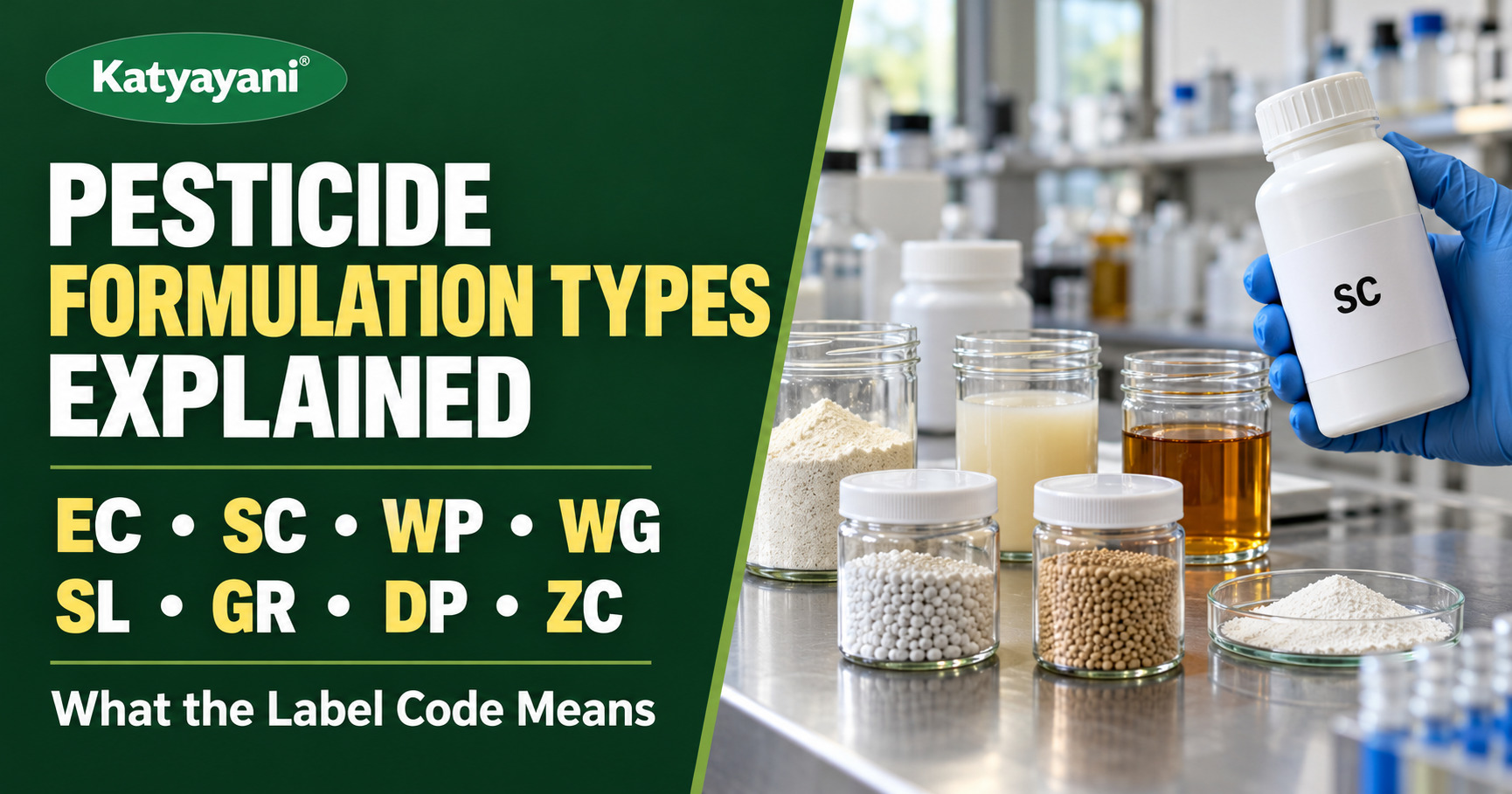
Pesticide Formulation Types Explained: EC, SC, WP, WG, SL, GR, DP, ZC and What the Label Code Means
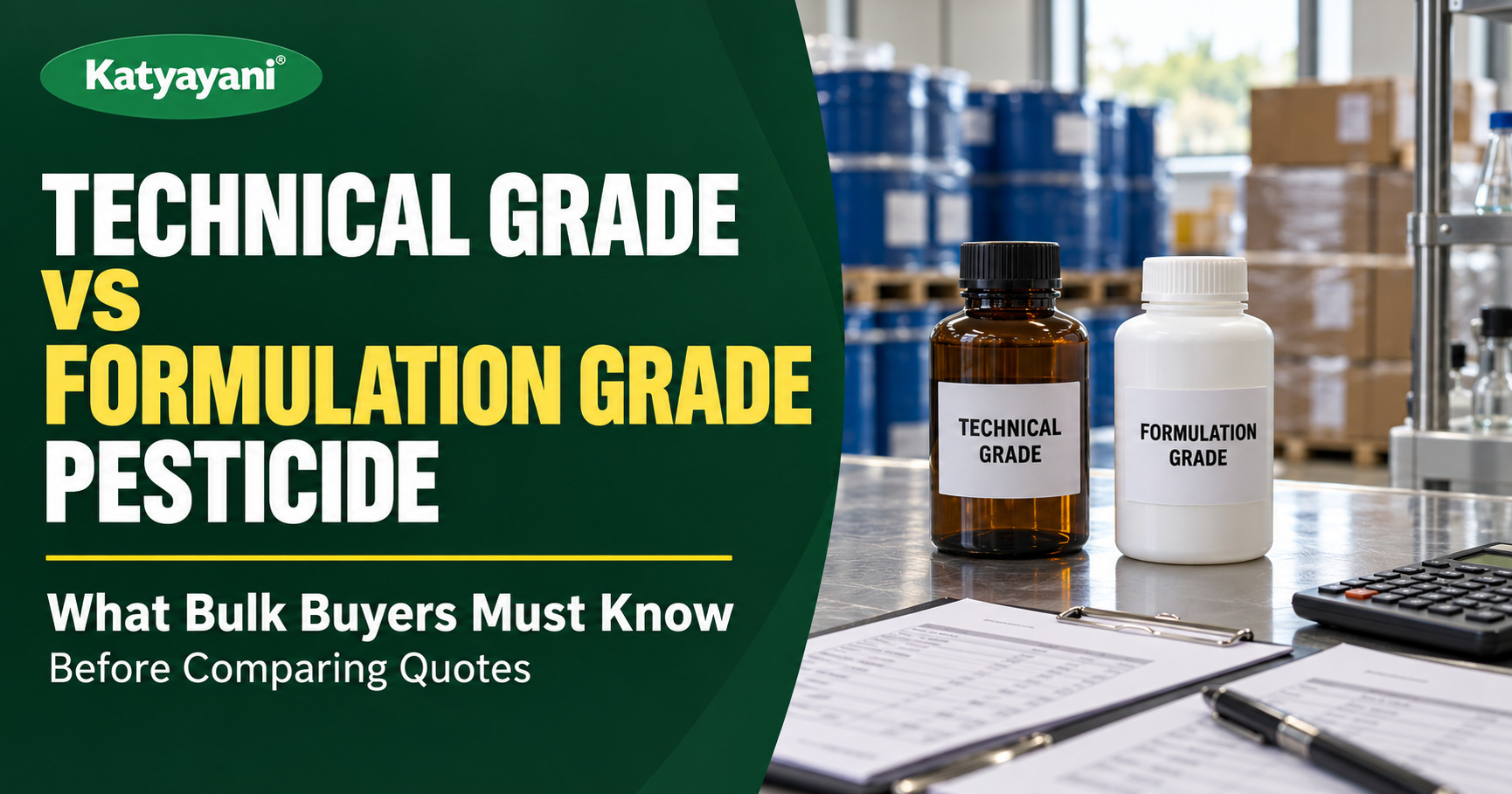
Technical Grade vs Formulation Grade Pesticide: What Bulk Buyers Must Know Before Comparing Quotes

Leave a Comment