 19 min read
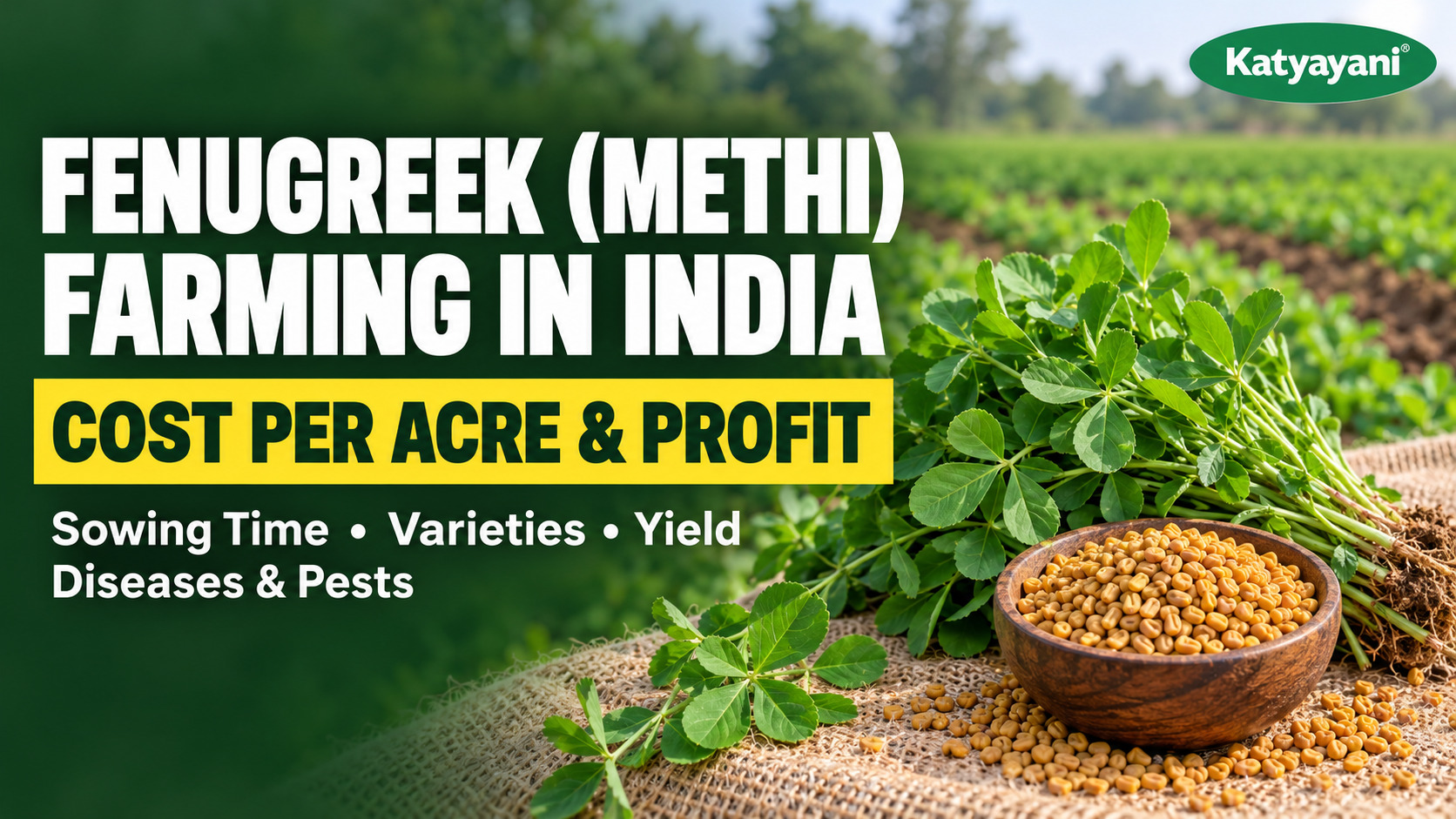
Methi (fenugreek) is a cool-season rabi legume that gives three different products: fresh green leaf, dried kasuri-type leaf and seed. In Rajasthan the seed crop is sown from the last week of October to the first week of November, and Nagaur's dried-leaf pan methi in the second fortnight of October. In ICAR-NRCSS studies, seed methi cost about Rs 20,251 per hectare (about Rs 8,200 per acre) in 2013 to 2019 demonstrations and returned a benefit-cost ratio of 3.2, while dried-leaf pan methi cost Rs 147,366 per hectare (about Rs 59,700 per acre) in 2020-21 and the farmers there netted about Rs 259,279 per hectare (about Rs 105,000 per acre) at about Rs 105 per kg of dried leaf. Profit is yield times your actual price minus cost, so check today's mandi rate. Aphid is the most serious pest, and powdery mildew, downy mildew and root rot are the main diseases. We found no CIB&RC chemical row for fenugreek, so follow the product label and your KVK.
Methi ki kheti: which crop are you growing, leaf, kasuri or seed?
Methi is one plant family but three money crops. Green bunch methi is cut young and sold fresh. Kasuri-type methi is cut again and again, dried in the sun and sold as dried leaf. Seed methi is left to mature for the spice seed. Pick one before you buy seed, because the variety, seed rate, number of cuttings and income are different for each.
Think of a field you have sown to methi. If you cut it once at about a month and pull the rest, you have a bunch crop. If you cut it every ten to fifteen days and dry the leaf, you have a kasuri crop and you will be at it for four to five months. If you cut it once or twice early and then let it flower and set pods, you are growing seed. The same field can do more than one of these, but you plan the sowing, the water and the sprays differently for each.
| Crop | Plant | What you sell | How long in the field | Source |
|---|---|---|---|---|
| Common methi (bunch / leafy) | Trigonella foenum-graecum | Fresh green shoots; also seed if left | First cut about one month after sowing (SKUAST-Jammu); 125 days seed to seed for Pusa Early Bunching | Vikaspedia, SKUAST-Jammu note |
| Kasuri / pan methi (dried leaf) | Trigonella corniculata | Dried scented leaf; seed kept for next sowing | About 150 to 160 days seed to seed (SKUAST-Jammu); Nagaur pan methi 170 to 180 days with 7 to 10 cuttings | Vikaspedia and the ICAR-NRCSS pan methi study |
| Seed methi (spice seed) | Mostly T. foenum-graecum | Dry seed | 120 to 150 days depending on variety (for example RMt 305 120 to 125 days, RMt 143 140 to 150 days) | Vikaspedia variety table |
In plain words: the bunch crop is quick and needs a market close by. The kasuri crop is slow and needs labour and a clean drying yard. The seed crop is the least work but also the lowest income per acre in the studies below.
The name "kasuri" comes from Kasur, now in Pakistan's Punjab province, according to the ICAR-NRCSS paper. In Rajasthan, Nagaur district grows the famous Nagauri pan methi (Trigonella corniculata) for dried leaf, while the seed spice crop is grown in other districts. Nagaur farmers told the NRCSS team that Pusa Kasuri gave leaf with a better look and aroma than the local seed they had been saving year after year.
Methi ki kheti kab karen? Best sowing time and season in India
In north and west India methi is a rabi crop sown from September to November. ICAR-NRCSS demonstrations in Pali, Rajasthan sowed seed methi from the last week of October to the first week of November, and Nagaur pan methi is sown in the second fortnight of October. In hills the window shifts to August to September or March to June.
| Place / crop | Sowing window | Harvest | Source |
|---|---|---|---|
| Pali, Rajasthan, seed methi | Last week of October to first week of November | Seed crop | Pali FLD paper |
| Nagaur, Rajasthan, pan methi | Second fortnight of October | First fortnight of April; first cut 30 to 35 days after sowing | ICAR-NRCSS pan methi paper |
| Sub-tropical zone (Jammu note) | September to November | Leaf cut from about one month | Vikaspedia / SKUAST-Jammu |
| Mid-hills (Jammu note) | August to September | Leaf cut from about one month | Vikaspedia / SKUAST-Jammu |
| High hills (Jammu note) | March to April, May to June | Vikaspedia / SKUAST-Jammu | |
| Tamil Nadu (TNAU) | June to July and October to November | 20 to 25 days for greens, 90 to 100 days for grain | TNAU Agritech |
The table says one simple thing: the window moves with your zone, not with the calendar on the wall. In the plains it is the cool months, in the hills it is the warm half of the year. A small point from the Pali study: some farmers sowed late by mistake, and the late crop did worse. Do not push sowing into the cold of December if you can help it, and ask your KVK for the best date for your district.
A cutting calendar for Nagaur pan methi (our date arithmetic)
| Stage | Days after sowing (study) | Roughly when, if sown about 20 October | What you are doing |
|---|---|---|---|
| Sowing | 0 | Third week of October | Fine bed, broadcast, cover seed, irrigate |
| First cutting | 30 to 35 | Third week of November | Lightest cut, lowest price |
| Cuttings 2 to 5 | 40 to 95 | December to the end of January | Cut every 10 to 15 days, dry 2 to 3 days |
| Cuttings 6 and 7 (peak) | 100 to 125 | February | Heaviest cuts, best price |
| Last cutting | 140 to 145 | Around mid-March | Leaf yield and quality now drop |
| Seed finishing | To 170 to 180 | Up to the first fortnight of April | Crop left to flower and set pods, then harvested |
The days come from the ICAR-NRCSS paper. The month column is our own counting from a 20 October sowing, so slide it a week either way for your sowing date. Notice how long the crop is in the field: close to six months from sowing to seed, which is why it ties up the land for a whole rabi season.
Which soil and climate does methi need?
Methi wants a cool, fairly dry climate and a well-drained loam or clay loam with pH 6 to 7. Avoid fields where heavy continuous rain or waterlogging is common. TNAU says "cool and comparatively dry, frost free", while the Jammu note says methi can tolerate frost and freezing weather, so the sources are not in perfect agreement on frost.
- Soil: rich, well-drained loam (TNAU); clay loam is called ideal in the SKUAST-Jammu note; pH 6 to 7.
- Drainage first. In the Pali study 25.1 percent of farmers listed waterlogging as a problem. A field that holds water after irrigation is a field that will lose seedlings.
- Land preparation: a fine tilth. Nagaur farmers do four to five tractor operations (deep plough, disc harrow, rotavator, cultivator) because the seed is tiny and will not come up well in clods. TNAU forms beds of 3.5 x 1.5 m.
Why methi fits a rotation
Methi belongs to the pea family (Fabaceae), so it is a legume, and it is a short-season rabi crop. The Pali demonstrations were in a fenugreek and cumin cropping system, and Nagaur pan methi farmers put about 26 percent of their land under it, with wheat and gram making up much of the rest. Following a cereal and not planting methi after methi keeps soil-borne disease down, because root rot and charcoal rot fungi stay in the soil for years (NIPHM says charcoal rot spores can persist up to three years). Our crop rotation guide has a basic plan you can adapt.
Which are the best methi varieties for leaf, kasuri and seed?
For seed, RMt 1 and RMt 305 dominate breeder-seed indents in India, and the Pali demonstrations used RMt 305, RMt 143, AFg 3, GM 1 and RMt 1. For leaf, Pusa Early Bunching is the common bunch type and Pusa Kasuri is the kasuri-type variety used in the NRCSS Nagaur demonstration. Choose a variety listed for your district.
| Variety | Type / duration as listed | Dry seed yield listed (kg per ha) | Disease note as listed |
|---|---|---|---|
| Pusa Early Bunching (IARI) | Early bunching type; 125 days seed to seed (SKUAST-Jammu) | Not listed | Resistant to downy mildew and rots (TNAU) |
| Pusa Kasuri | Kasuri-type leaf variety used in the NRCSS Nagaur demonstration | Not listed | Better leaf look and aroma reported by farmers |
| RMt 1 (RAU, Jobner) | Semi-erect, bold yellow grain | 1,400 | Moderately resistant to root knot nematode, powdery mildew, aphids |
| RMt 143 | 140 to 150 days; suits heavier soil | 1,600 | Moderately resistant to powdery mildew |
| RMt 303 | 145 to 150 days | 1,900 | Less susceptible to powdery mildew |
| RMt 305 | 120 to 125 days; early; multi-podded | 1,300 | Resistant to powdery mildew and root knot nematode |
| Hisar Sonali (HAU) | Dual purpose, 140 to 145 days, irrigated | 1,700 | Moderately resistant to root rot and aphids |
| Hisar Suvarna | Dual purpose, 130 to 140 days | 1,600 | Moderately resistant to Cercospora and powdery mildew |
| Hisar Madhavi | Dual purpose, 130 to 140 days, irrigated or rainfed | 1,900 | Moderately resistant to powdery and downy mildew |
| Hisar Muktha | 135 to 140 days, irrigated or rainfed | 2,000 | Moderately resistant to powdery and downy mildew |
| Guj Methi 1 | Dwarf plant | 1,864 | Not listed |
| Pant Ragini | Dual purpose, tall, 170 to 175 days | 1,200 | Resistant to downy mildew and root rots (as listed) |
| Rajendra Kranti | Bushy, early; suits intercropping | 1,300 | Tolerant to Cercospora leaf spot, powdery mildew, aphids |
| Co 1 / Co 2 (TNAU) | Short duration, dual purpose (80 to 90 days) | 680 / 480 | Tolerant to root rot |
How to use this table: if your field had powdery mildew last year, look at the Disease column first and pick RMt 305, RMt 143 or a Hisar type. If you want the shortest crop, RMt 305 (120 to 125 days) and the Co types are the quick ones. If you want leaf, the seed yield column matters less than leaf quality, which is why Nagaur farmers ask for Pusa Kasuri.
The yield and disease columns come from the Vikaspedia variety table, which compiles state university releases, and the TNAU page. Treat "resistant" as a release-time rating that can change by region. "AFg 3" is written as it appears in the Pali paper. We could not confirm the Ajmer Fenugreek-1, -2 and -3 release names or yields from an official page, so they are not tabulated. A newly reported ICAR-NBPGR accession (IC 0624520) matures in 93 days against 120 to 140 days for common cultivars, but it is a germplasm line, not a variety you can buy yet.
How much methi seed per acre, and how do you treat it?
There is no single answer because the goal changes the rate. Seed crops in the Pali study used 20 to 25 kg per hectare, about 8 to 10 kg per acre. TNAU gives 12 kg per hectare, about 5 kg per acre. Nagaur pan methi farmers broadcast up to 250 kg per hectare, about 100 kg per acre, to get more leaf.
| Crop and source | Seed rate per ha | Per acre (our arithmetic) | Spacing / method |
|---|---|---|---|
| Seed methi, Pali FLD (ICAR-NRCSS paper) | 20 to 25 kg | 8 to 10 kg | 30 x 10 cm |
| Dual purpose, TNAU (TNAU) | 12 kg | About 5 kg | 20 x 15 cm, beds 3.5 x 1.5 m |
| Pan methi for dried leaf, Nagaur (ICAR-NRCSS) | 210 to 250 kg | 85 to 100 kg | Broadcast by hand, bed prepared, seed covered, then irrigated |
The reason for the gap is simple. A seed crop wants plants with room to branch and set pods. A leaf crop wants a thick stand that gives more cuttings of small, scented leaf. But thick seed has a price: the NRCSS paper puts pan methi seed at Rs 150 to 200 per kg, so the seed alone cost about Rs 35,000 to 40,000 per hectare, and seed with sowing was the biggest single cost (27 percent of the total). Do not copy a leaf grower's seed rate if you want seed, and the other way round.
Seed treatment. TNAU advises treating seed with Azospirillum and Trichoderma viride before sowing, and the ICAR-NRCSS Nagaur demonstration also used Trichoderma viride on seed. Methi is a legume, so a Rhizobium culture such as Rhizobium bio-fertiliser is the usual idea for legumes; the Katyayani page says it is used for legumes, pulses and oilseeds but does not name methi or give a dose, so read the pack before using it on methi. For the fungus side, Trichoderma viride powder is a general bio-fungicide that the page says works against wilt, rot, blight and damping off; again no crop list or seed-treatment dose is shown on the page, so follow the pack. Mix in the shade, let the seed dry in the shade and sow the same day. Our guide on chana seed treatment to prevent wilt walks through the same steps for a sister rabi legume. The TNAU dose line looks like a typing error (see VERIFY), so we give no dose here.
Fertiliser and manure for methi per acre
Two government-linked sources give a baseline. SKUAST-Jammu: 15 tonnes of farmyard manure, 60 kg nitrogen, 20 kg phosphate and 20 kg potash per hectare, which is about 6 tonnes FYM, 24 kg N, 8 kg P2O5 and 8 kg K2O per acre. TNAU: 20 to 25 tonnes FYM and 30:25:40 NPK per hectare. Let a soil test make the final call.
| Source | FYM per ha | N : P2O5 : K2O per ha | Notes |
|---|---|---|---|
| SKUAST-Jammu (via Vikaspedia) | 15 t | 60 : 20 : 20 (urea 120 kg, DAP 44 kg, MOP 34 kg) | All FYM, phosphorus, potash and a quarter of N at sowing; 20 kg N per ha after every cutting for green, tender leaf |
| TNAU | 20 to 25 t | 30 : 25 : 40 | Top-dress 20 kg N at 30 days after sowing |
| ICAR-NRCSS pan methi demonstration, Nagaur | About 5.1 t | Urea 112 kg, DAP 110 kg per ha, plus sulphur 18 kg, zinc 18 kg, gypsum 3,000 kg per ha | Leaf-focused, heavier input |
Read the table like this: all three agree that manure goes in before sowing and that nitrogen is split. The leaf growers in Nagaur add sulphur, zinc and gypsum on top because cut leaf takes a lot out of the soil and they want dark, scented leaf. If your soil test shows low sulphur or zinc, that is the place to spend. For ammonium-based nitrogen with sulphur in one bag, farmers often look at products such as ammonium sulphate (21 percent N, 24 percent S); that is our suggestion for a sulphur-deficient plot, not a methi dose from the papers, and the nitrogen in it counts toward your N plan.
- Cut leaf crops need nitrogen after each cutting. The Jammu note says 20 kg N per ha after every cutting keeps leaf soft and green.
- Test the soil first. Our soil health card guide shows how to read the N, P, K and sulphur lines before you buy fertiliser.
- Do not over-feed nitrogen on the seed crop. Methi is a legume, and extra soft growth invites aphids (general agronomy advice, not a figure from these papers).
Irrigation and weed control in methi
Give the first irrigation straight after sowing, the second on day three (TNAU), then every 7 to 10 days; the Jammu note says every 8 to 10 days and warns against water stress at pod and seed development. Nagaur pan methi farmers gave 15 to 18 sprinkler irrigations. The Pali demonstrations were described as rainfed in the methods, so not every methi field needs this much water.
- Weeds listed by NIPHM: Chenopodium album (bathua), Anagallis arvensis, sweet clover (Melilotus indica), Fumaria parviflora, Spergula arvensis, Parthenium, Asphodelus tenuifolius, Convolvulus arvensis, Poa annua, Phalaris minor, Cynodon dactylon and sedges.
- The mimic weed. In the NRCSS paper, Melilotus indicus looks like methi, is very hard to remove, and its leaves mixed into dried methi lower the price. Walk the field early and pull it before it gets tall, because a bag of dried leaf with weed leaf in it sells for less.
- Hand weeding: two hoeings and weedings are enough (Jammu note). Thin at 20 to 25 days and eat or sell the thinnings as greens; one pinching at about 4 inches encourages branching (TNAU).
- Herbicides: TNAU lists fluchloralin and the Jammu note lists trifluralin as pre-plant or pre-emergence. We did not find a fenugreek row for either in the CIB&RC list, so read the label for methi before you use any herbicide.
How to cut leaf methi and dry kasuri methi: cuttings, yield per cutting and price
For common leaf methi, nip the shoots about 2 cm above ground about a month after sowing, and the stubs regrow (SKUAST-Jammu). Nagaur pan methi gets its first cut at 30 to 35 days, then a cut every 10 to 15 days until about 140 to 145 days, seven to ten cuts in all. Dry the cut leaf in the sun for two to three days on a clean yard.
| Cutting (Nagaur pan methi) | Days after sowing | Dried leaf yield (kg per ha) | Per acre (our arithmetic) |
|---|---|---|---|
| 1st | 30 to 35 | 236 | 96 |
| 2nd | 40 to 45 | 282.5 | 114 |
| 3rd | 55 to 65 | 393.5 | 159 |
| 4th | 70 to 75 | 440.75 | 178 |
| 5th | 85 to 95 | 492.5 | 199 |
| 6th | 100 to 110 | 565.25 | 229 |
| 7th | 120 to 125 | 562.5 | 228 |
| 8th | 140 to 145 | 435 | 176 |
| Total | 3,409 | 1,380 |
The first cutting looks small in the field and in the bag: about 95 kg of dried leaf per acre. By the sixth and seventh cutting you are getting more than double that, about 228 kg per acre. After that it falls. That is why farmers do not stand and wait for one big harvest; the money comes cut by cut.
- Price moves through the season. Nagaur farmers got Rs 70 to 80 per kg of dried leaf for early and late cuttings and Rs 140 to 150 for mid-season cuttings; the average in the study was Rs 105 per kg (2020-21). Your best leaf is the mid-season leaf, so dry and pack it with the most care.
- Drying matters. Spread the leaf on a levelled, cleaned yard and keep it safe from rain and stray animals. When fully dry, pack it in poly-coated bags so the aroma stays, and sell within about a week, because fresh leaf loses colour and aroma with time (NRCSS paper).
- Machine cutting. Many Nagaur farmers now use motor-drawn leaf cutters; the paper says it cut the cutting cost to less than half of the hand-picking level.
- Late leaf is poorer. After about 140 to 145 days the leaf yield and quality fall, so farmers leave the crop for seed.
Methi cultivation cost per acre and per hectare
The best-sourced cost sheets we found are ICAR-NRCSS studies. Dried-leaf pan methi in Nagaur cost Rs 147,366 per hectare, about Rs 59,700 per acre, in 2020-21. Seed methi in Pali cost Rs 20,251 per hectare, about Rs 8,200 per acre, in the 2013 to 2019 demonstrations. A 2012-13 Rajasthan study gave Rs 23,828 per hectare as total cost.
Per bigha: a bigha is not the same size in every state, so we cannot give one honest per-bigha number. Take the per-acre figure and multiply by the size of your local bigha in acres.
Dried-leaf (kasuri-type) pan methi, Nagaur, 2020-21
| Item | Quantity | Rs per hectare | Rs per acre (our arithmetic) |
|---|---|---|---|
| Land preparation | 4 to 5 tractor operations | 10,039 | 4,064 |
| Seed (210 to 250 kg per ha, Rs 150 to 200 per kg) | Not printed in the table; our subtraction from the printed variable cost | 38,250 | 15,486 |
| Broadcasting and levelling | 4 labour days | 1,450 | 587 |
| Farmyard manure | 5,112 kg per ha | 13,780 | 5,579 |
| Urea | 112 kg per ha | 736 | 298 |
| DAP | 110 kg per ha | 2,662 | 1,078 |
| Sulphur | 18 kg per ha | 1,888 | 764 |
| Zinc | 18 kg per ha | 864 | 350 |
| Gypsum | 3,000 kg per ha | 3,568 | 1,445 |
| Bio-inputs (Trichoderma, Beauveria) | 12.5 kg per ha | 1,250 | 506 |
| Neem oil | 5 litres per ha | 1,500 | 607 |
| Plant protection sprays | 1 to 3 sprays | 5,750 | 2,328 |
| Intercultural operations | 1 to 3 operations | 6,250 | 2,530 |
| Irrigation (sprinkler) | 15 to 18 irrigations | 7,795 | 3,156 |
| Leaf cutting and drying (machine cutting) | 7 to 10 cuttings | 25,500 | 10,324 |
| Seed harvesting | 15 man days per ha | 3,860 | 1,563 |
| Threshing | 1.5 hours per ha | 2,572 | 1,041 |
| Marketing | Lump sum | 1,500 | 607 |
| Interest on working capital (7 percent a year) | 3,876 | 1,569 | |
| Total variable cost | 133,090 | 53,883 | |
| Fixed cost | 14,276 | 5,780 | |
| Total cost of cultivation (Cost C2) | 147,366 | 59,663 |
Source: Meena et al., ICAR-NRCSS, Int J Seed Spices 2021, Table 5. The seed line is not printed in the table; we derived it by subtracting the printed lines from the printed variable cost, and it agrees with the paper's own statement of Rs 35,000 to 40,000. These farmers were given improved seed, bio-inputs and training, so their plant protection cost was about half of what neighbouring farmers spent. Per acre figures divide by 2.47.
Where does the money go? Seed (about Rs 38,000), leaf cutting and drying (Rs 25,500) and manure (Rs 13,780) are the three big lines; irrigation is under Rs 8,000 and plant protection under Rs 6,000. Machine cutting was already used in these figures. If you cut by hand, expect the cutting line to be higher.
Seed methi, Pali district, 2013 to 2019
| Item | Improved package (Rs per ha) | Local practice (Rs per ha) | Improved, per acre |
|---|---|---|---|
| Operational cost of cultivation | 20,251 | 19,128 | 8,199 |
| Gross return | 64,634 | 49,786 | 26,168 |
| Net return | 44,383 | 30,380 | 17,969 |
| Benefit-cost ratio | 3.2 | 2.5 |
Source: front line demonstrations at 321 farmers' fields, Pali, Rajasthan. Read the table this way: the improved package cost only about Rs 1,100 per hectare more than farmer practice, mostly for better seed, and it earned about Rs 14,000 per hectare more. Yield was 16.5 q per hectare against 12.8 q on local practice (about 6.7 against 5.2 quintals per acre).
State-level view, Rajasthan, data year 2012-13
The Annals of Agricultural Research study (Kumar, Jheeba and Kumawat, 2018) found an average total cost of Rs 23,827.81 per hectare (about Rs 9,650 per acre), of which operational cost was Rs 16,902.87 and overhead Rs 6,924.94. Cost of production was Rs 1,128.04 per quintal and each rupee spent returned Rs 1.92. Costs have risen since 2012-13, so use this as a ratio, not a budget.
What We Did Not Find: No sourced cost sheet for ordinary fresh green-leaf (bunch) methi, which is the crop many market-garden farmers grow. For that crop we give the yield range and the profit formula, and we do not invent a cost figure. If you grow fresh methi, add up your own seed, manure, water, labour and transport lines.
How much profit per acre does methi give?
Profit is yield times your selling price, minus your cost. In the ICAR-NRCSS studies, Nagaur pan methi farmers netted about Rs 259,279 per hectare (about Rs 105,000 per acre) over total cost in 2020-21, and Pali seed methi farmers netted Rs 44,383 per hectare (about Rs 18,000 per acre) in 2013 to 2019. Your result depends on your price, yield and weather.
Formula: Net profit per acre = (quintals sold x price per quintal) - total cost per acre. For dried leaf, count the kilograms of dried leaf (not fresh) and the seed separately. The studies below used a 2020-21 price for pan methi and a 2013 to 2019 price for seed methi; today's price will be different.
| Crop | Yield used by the study (per ha) | Price used | Gross per ha | Cost per ha | Profit per ha (per acre) |
|---|---|---|---|---|---|
| Nagauri pan methi, Nagaur 2020-21 | 34 q dried leaf + 2.44 q seed | Rs 105 per kg dried leaf average; seed Rs 20,000 per quintal | Rs 406,645 | Rs 147,366 | Rs 259,279 (about Rs 104,971) |
| Seed methi, Pali 2013 to 2019 | 16.5 q seed | Not printed; our back-calculation from the study's own gross is about Rs 3,900 per quintal | Rs 64,634 | Rs 20,251 (operational) | Rs 44,383 (about Rs 17,969) |
The two lines are not like for like. The Nagaur sheet counts everything including fixed cost and interest, and it sells leaf at a premium price. The Pali sheet counts operational cost only. So do not read "Rs 105,000 versus Rs 18,000" as a fair race between the two crops; read it as two different businesses.
To see how much price matters, here is our own arithmetic using the Nagaur yield of 3,409 kg dried leaf per hectare (about 1,380 kg per acre) and the study's observed price range, with total cost of about Rs 59,700 per acre and seed income ignored.
| Dried leaf price (per kg) | Leaf income per acre | Minus cost of about Rs 59,700 | What it tells you |
|---|---|---|---|
| Rs 70 (early and late cuttings) | Rs 96,600 | Rs 36,938 | Still positive at the study yield, but thin if yield or cutting falls short |
| Rs 105 (study average) | Rs 144,900 | Rs 85,238 | About the study result before seed income |
| Rs 150 (mid-season cuttings) | Rs 207,000 | Rs 147,338 | Only the best cuttings reach this |
Be careful with big claims you see online, such as "lakhs in 30 days from one acre". We found no ICAR, state university or government source that supports a profit like that in a month. A leaf crop earns over four to five months of cuttings, and the Nagaur farmers themselves said low prices, few notified markets and few traders were their main problems. Check the live mandi price on the day (see the price section below) before you plan.
What is the yield of methi per acre, for leaf and seed?
For seed, ICAR-NRCSS demonstrations in Pali gave 13.6 to 18.8 quintals per hectare, a mean of 16.5, which is about 6.7 quintals per acre; the national average for 2019-20 was 1,566 kg per hectare (about 6.3 quintals per acre). Fresh leaf for common methi is 70 to 80 quintals per hectare (about 28 to 32 per acre) in the SKUAST-Jammu note, and dried pan methi leaf was 34 quintals per hectare (about 13.8 per acre) in Nagaur.
| Crop / source | Yield per ha | Per acre (our arithmetic) |
|---|---|---|
| Seed methi, improved package, Pali FLD (2013 to 2019) | 13.6 to 18.8 q; mean 16.5 q | About 5.5 to 7.6 q; mean 6.7 q |
| Seed methi, local practice, Pali FLD | 10.2 to 14.5 q; mean 12.8 q | About 4.1 to 5.9 q; mean 5.2 q |
| Seed methi, common type, SKUAST-Jammu | 15 to 19 q | About 6.1 to 7.7 q |
| Kasuri methi seed, SKUAST-Jammu | 6 to 7 q | About 2.4 to 2.8 q |
| Fresh leaf, common methi, SKUAST-Jammu | 70 to 80 q | About 28 to 32 q |
| Fresh leaf, kasuri type, SKUAST-Jammu | 90 to 100 q | About 36 to 40 q |
| TNAU: greens (20 to 25 days) / grain | 4,000 to 5,000 kg / 500 to 700 kg | About 1,600 to 2,000 kg / 200 to 280 kg |
| Dried leaf, Nagauri pan methi, 8 cuttings | 34 q dried leaf (+ 2.44 q seed) | About 13.8 q dried leaf |
| India average, seed, 2019-20 | 1,566 kg | About 634 kg |
These numbers do not agree because they describe different crops, varieties and cutting plans. Fresh weight and dry weight are not the same, and TNAU's green figure looks like a single early harvest. Compare only like with like. Sources: SKUAST-Jammu notes, TNAU, the Pali FLD paper and the NRCSS pan methi paper.
Which states grow the most fenugreek in India?
In 2019-20, Madhya Pradesh led production with 82,750 tonnes and Rajasthan led area with 45,310 hectares and was second in production with 62,890 tonnes. India grew fenugreek on about 120,340 hectares and produced about 188,480 tonnes, an average of 1,566 kg per hectare, according to DASD data quoted in the ICAR-NRCSS paper.
| State (2019-20) | Area (ha) | Production (tonnes) | Yield (kg per ha) |
|---|---|---|---|
| Madhya Pradesh | 44,858 | 82,750 | 1,845 |
| Rajasthan | 45,310 | 62,890 | 1,388 |
| Gujarat | 9,536 | 18,370 | 1,926 |
| Haryana | 3,563 | 8,610 | 2,417 |
| West Bengal | 2,437 | 2,700 | 1,108 |
| Uttarakhand | 487 | 2,970 | 6,099 (as printed; looks unusual, see VERIFY) |
| India | 120,340 | 188,480 | 1,566 |
Madhya Pradesh and Rajasthan have almost the same area, but Madhya Pradesh gets more seed from it. Within Rajasthan, the leading districts for area in 2018-19 were Bikaner (7,046 ha), Sikar (5,711), Jodhpur (5,184), Churu (4,985) and Pratapgarh (4,542). Pan methi for dried leaf is concentrated in Nagaur and to some extent Jodhpur. A Vikaspedia page says Rajasthan alone gives more than 80 percent of the country's fenugreek; the government table does not support that for 2019-20, so we use the table. Source for the table: DASD (Kozhikode) figures as tabulated in the ICAR-NRCSS paper.
Methi diseases and symptoms: powdery mildew, downy mildew, root rot, leaf spot and more
The NIPHM list for fenugreek names Cercospora leaf spot, charcoal rot, powdery mildew, downy mildew, rust, root and collar rot, damping off, Fusarium wilt and yellow mosaic virus. The quickest way to tell them apart is to look at where the damage starts and what the underside of the leaf looks like.
A scene you may know: you walk the field in the morning after a cool, foggy night, and the top leaves have a white dusty look, or the upper side shows yellow patches while the underside has a grey fuzz. Do not spray in a hurry. Turn the leaf over and use the table.
| What you see | Likely disease | When it flares | What to do |
|---|---|---|---|
| White powdery spots on leaves that spread; yellow spots may show underneath | Powdery mildew (Erysiphe polygoni, Leveillula taurica) | Cool days and humid nights | Choose a tolerant variety (RMt 305, RMt 143, Hisar types are listed); TNAU: dust sulphur 25 kg per ha or spray wettable sulphur 2 g per litre when it first appears |
| Yellow patches on top of the leaf, white to grey-violet cotton-like growth underneath; stunted plant | Downy mildew (Peronospora trigonellae) | Max 18 to 24 C, min 4 to 10 C, humidity above 80 percent | Remove infected plants; avoid dense stands and late evening watering; Pusa Early Bunching and Pant Ragini are listed as resistant |
| Small round sunken spots with a yellow halo; spots on pods | Cercospora leaf spot | 25 to 35 C with warm nights and 90 to 95 percent humidity | Clean up crop residue; it survives on plant debris and seed; Rajendra Kranti and Hisar Suvarna are listed as tolerant |
| Seedlings fall over with a soft, water-soaked, smelly base | Damping off (Pythium) | Wet soil, cloudy weather, crowded seedlings, below 24 C | Better drainage, thinner stand, seed treatment with Trichoderma |
| Roots rot from the tip, "spear-point" root; brown water-soaked patches on leaflets; young plants worst | Root, collar or foot rot (Rhizoctonia, Sclerotium) | High humidity and warm weather; survives in soil for long | TNAU: seed treatment with Trichoderma viride, neem cake in soil, drench with carbendazim or copper oxychloride; rotate |
| Vein clearing, drooping leaves, yellowing from the bottom, brown vessels in the stem | Fusarium wilt | Moist, warm soil, from flowering to pod fill | No cure once wilted; rotate and use clean seed |
| Black cankers on the stem, tiny black dots (sclerotia) inside the tissue; wilting | Charcoal rot (Macrophomina) | Hot, dry weather; the fungus lives in soil up to three years | Rotation and irrigation to avoid stress |
| Orange-brown to dark brown pustules on leaves and stalks | Rust (Uromyces trigonellae) | 20 to 25 C and 86 to 92 percent humidity | Remove residue; scout early |
| Vein clearing, mottling, curled margins, small leaves, tiny curled pods with shrunken seed | Yellow mosaic virus (bean yellow mosaic virus) | Spread by aphids in warm weather | Manage aphids early; remove infected plants |
Symptoms and conditions are from the NIPHM fenugreek disease pages; the control lines for powdery mildew and root rot are TNAU advice (see TNAU). University advice is not a legal label, so see the label section below.
If you see powdery mildew
Start with the cheapest step: confirm it is mildew and not dust, and check how widespread it is. TNAU's advice is sulphur, either dusted or sprayed as wettable sulphur at the first sign. A sulphur product such as sulphur 80 percent WDG fungicide fits that advice; the Katyayani page lists powdery mildew but shows no crop list or dose, so read the pack for methi, for the dose and for the waiting period. If you are cutting leaf every 10 to 15 days, count back from your next cutting before you spray, and do not spray the day before a cut.
If you see downy mildew
Yellow top patches with grey fuzz below are the sign, and cool, humid, cloudy weather is the cause. Pull and remove badly hit plants, thin a dense stand, and water in the morning. If you decide to spray, the downy mildew fungicides collection lists the products Katyayani groups for this disease; it is a general collection with no crop list, so check the label for methi and the waiting period before you buy, especially on a leaf crop.
If your seedlings fall over or roots rot
Damping off topples seedlings at the base, and root rot starts at the root tip, mostly in wet, warm soil. Prevention is cheaper than cure: drain the field, do not sow too thick, and treat the seed with Trichoderma (see the seed treatment section). If a patch is already going, the root rot fungicides collection is a starting point; it is generic, so take the label with methi in mind. TNAU's own advice for root rot is neem cake in the soil, Trichoderma viride on the seed and a carbendazim or copper oxychloride drench.
What Pali farmers actually listed as their problems
| Problem (160 farmers, Pali) | Share naming it | Rank |
|---|---|---|
| Lack of suitable high-yielding variety | 89.8 percent | 1 |
| Low technical knowledge | 81.2 percent | 2 |
| Termite infestation | 76.4 percent | 3 |
| Vagaries of weather (low rain, frost, heat) | 71.8 percent | 4 |
| Wild animals (blue bulls, wild pigs) | 55.3 percent | 5 |
| Pod borer | 44.7 percent | 6 |
| Powdery mildew | 33.6 percent | 7 |
| Weeds | 28.8 percent | 8 |
| Waterlogging | 25.1 percent | 9 |
In rainfed western Rajasthan, termites and animals mattered at least as much as mildew. A good variety was the top complaint, so start there. Source: Pali FLD paper.
Methi pests: aphids, leaf hopper and others, with symptoms and control
Aphid (Aphis craccivora) is the most serious insect pest of fenugreek. Both nymphs and adults suck sap, causing leaf curling, discoloured spots, stunting and sticky honeydew with sooty mould. Yield losses of 62.3 to 68.8 percent from aphids have been reported (as cited in an ICAR journal paper). Scout every few days from early growth.
In the field this looks like a few curled tip leaves, a shine of honeydew and then black sooty film, and often ants walking up the stems. Look at the top 10 cm of the shoot on a few plants in each corner, not only along the bund.
| Pest | What it does | Notes |
|---|---|---|
| Aphid (Aphis craccivora) | Colonies on shoots, leaves, flowers and pods; leaf curl, spots, stunting; honeydew and sooty mould; also spreads yellow mosaic virus | Most serious pest; reported loss 62.3 to 68.8 percent |
| Leaf hopper (Empoasca kerri) | Sucks sap from leaves | Counted per three leaves in the trial below |
| Whitefly (Bemisia tabaci) | Sap sucking | Listed in the paper |
| Leaf miner (Liriomyza) | Mines inside leaves | Listed by NIPHM and the paper |
| Thrips, spotted pod borer (Maruca), stem fly, mite, lucerne weevil (Hypera postica), tobacco caterpillar (Spodoptera litura) | Various | Listed by NIPHM / the ICAR paper; pod borer was named by 44.7 percent of Pali farmers |
| Termite | Kills seedlings and plants in dry fields | Third-ranked problem in Pali (76.4 percent) |
In a three-season trial (rabi 2018-19 to 2020-21, Jagudan, Gujarat, variety Gujarat Methi 2) published by SDAU scientists in the International Journal of Seed Spices, two sprays gave the best result: Beauveria bassiana 1.15 WP at 40 g per 10 litres, followed after 10 days by azadirachtin 10,000 ppm at 30 ml per 10 litres. The first spray went on when aphids or leaf hoppers first appeared. It gave an aphid index of 1.22 against 7.47 in untreated plots, 1,512 kg seed per hectare and a protection cost-benefit ratio of 7.95. Beauveria followed by azadirachtin 1,500 ppm came second.
This is a gentle plan, which suits a leaf crop you cut often. Katyayani sells a Beauveria bassiana liquid (2 x 10^8 CFU per ml on its page, which is not the 1.15 WP powder used in the trial) and neem oil with azadirachtin 10,000 ppm, the same strength as the second spray in the trial. Neither page names methi or gives a crop-wise dose in its text, so follow the pack and do not copy the trial grams per litre onto a different formulation. If you want to browse more options, the aphid control products collection includes Verticillium (Lecanicillium) lecanii products; the NRCSS Nagaur demonstration used Lecanicillium lecani, but the collection also holds chemical insecticides, so on a leaf crop check the label and the waiting period before you choose.
The NRCSS Nagaur demonstration also used neem oil, Beauveria bassiana and Lecanicillium lecani, and spent about half as much on plant protection as neighbours. For how these bio-agents fit with chemicals, read our biopesticides guide and where bio and chemical inputs each win. Aphid scouting and spray timing for another rabi crop are in our mustard aphid control guide; the thresholds there are for mustard, not methi.
Is there a registered pesticide for methi (fenugreek) in India?
We searched the full text of the CIB&RC "Major Uses of Pesticides" list (registered under the Insecticides Act, up to 30 September 2025) for fenugreek, methi and Trigonella and found no row. The same list has rows for cumin, another seed spice. A newer approval is possible, so check cibrc.gov.in or the product label before you spray methi.
| Item | What we found |
|---|---|
| CIB&RC list, fenugreek / methi / Trigonella | No row found in the text of the 104-page document |
| Cumin (sister seed spice) | Rows exist, for example for aphid and thrips |
| Advice in this post for sulphur, carbendazim, copper oxychloride, fluchloralin, trifluralin | University advice from TNAU and SKUAST-Jammu, not a label claim. A label may not allow methi. |
| Katyayani product pages and collections linked in this post | None names methi or fenugreek, and the usage and dose sections were empty on the product pages |
The practical rule for leaf methi: you eat the leaf fresh or dried within days of cutting, so avoid synthetic sprays close to a cutting and use only products whose label carries methi and a waiting period you can meet. This is advice, not a number from the papers; your KVK can confirm. Read the CIB&RC list yourself or ask the dealer to show the methi line on the label. Buy only from a licensed dealer and keep the bill.
How do you harvest methi seed, and when?
Harvest the seed crop when pods turn brown and leaves dry. For a seed crop, the Jammu note takes one or two green cuttings in the first month, applies 20 kg N per hectare after the cutting and irrigates, then leaves the crop for seed. Nagaur farmers leave the crop for about a month after the eighth cutting, then harvest by hand or with a reaper and thresh.
- Isolation for seed production: methi is mainly self-pollinated; keep 10 m for foundation seed and 5 m for certified seed (Jammu note).
- Do not stress the crop at pod and seed fill. Keep irrigation regular (Jammu note).
- Seed worth: the NRCSS study valued pan methi seed at Rs 20,000 per quintal in 2020-21, and about Rs 150 to 200 per kg when farmers bought it for sowing. Many Nagaur farmers keep their own seed for next year.
- Keep good seed. Lack of a suitable variety was the number-one complaint in Pali; buy certified seed of a variety listed for your district.
Methi price today: who buys, when, and how to check the mandi rate
We cannot quote a live methi price here, because it changes daily and by mandi, grade and cutting. Dried pan methi in Nagaur sold at Rs 70 to 150 per kg in 2020-21. Check the day's rate for your nearest mandi on the Government of India Agmarknet portal, or ask the commission agent for the last three days, before you decide which type of methi to grow.
- Dried leaf: Nagaur farmers take dried leaf to the Mundwa or Nagaur markets within about a week of drying, and the price rises to the fifth and sixth cuttings and then drops (NRCSS paper). The paper also says the crop is exported to countries including the USA, Japan, Qatar, UAE, Tanzania, Nigeria, China, Australia and Nepal, so spice traders and exporters are the end buyers.
- Seed: sold to village traders or in regulated markets. A 2012-13 Rajasthan study found about 61 percent sold to village traders and 39 percent in regulated markets, with village sales costing about Rs 30.55 more per quintal (as summarised by search; see VERIFY).
- Fresh bunch methi: sold in your nearest vegetable mandi or town market. We found no sourced price series, so check locally.
- Write down three prices: fresh methi bunch rate in your town, dried methi rate at the nearest big mandi, and seed rate. Put them in the profit formula above.
- Nagaur's problem is yours too: the paper says farmers wanted notified markets and price assurance. Selling in a group helps.
Common mistakes that cut methi income
| Mistake | What happens | Do this instead |
|---|---|---|
| Growing leaf methi from a seed-type variety, or the reverse | Wrong plant habit and low leaf quality or low seed yield | Use Pusa Early Bunching or a kasuri type for leaf, RMt or Hisar types for seed |
| Using the same seed rate for every goal | Overspending on seed or a thin stand | Seed crop about 8 to 10 kg per acre, leaf crops higher (Pali vs Nagaur) |
| Sowing late | Late crop did worse in Pali | Sow in the window for your district |
| Waterlogged or crowded field | Damping off and root rot | Drain well, thin at 20 to 25 days |
| Skipping seed treatment | Seedling diseases | Treat seed with Trichoderma before sowing |
| Ignoring aphids until leaves curl and turn sticky | Yield and leaf quality fall, virus spreads | Scout early, use Beauveria then a neem-based spray at first sign as in the ICAR trial |
| Spraying right before a leaf cutting | Residue on a leaf you sell as food | Count back from the next cutting and follow the label waiting period |
| Letting the mimic weed (Melilotus) grow | Mixed leaf sells for less | Hoe early; hand-pull before flowering |
| Poor drying of kasuri leaf | Loses colour and aroma | Sun-dry on a clean yard for two to three days; pack in poly bags; protect from rain |
| Believing "lakhs in a month" claims | Wrong budget | Use the formula with your own price |
If you only fix two things from this table, fix the seed rate for your goal and the drainage of the field. Those two decide most of your early losses.
What is methi used for, and why does the market pay for kasuri leaf?
Methi seed is a spice and seasoning, used in pickles and vegetables; leaves are eaten fresh or dried. Kasuri-type dried leaf is a flavouring agent prized for its aroma, and the NRCSS paper lists it as a source of folic acid, vitamins A, B6 and C, riboflavin, niacin, potassium, iron, phosphorus and calcium. That aroma is the reason buyers pay more for mid-season Nagauri leaf than for early or late cuttings.
Methi seed (T. foenum-graecum) is reported to contain 26.2 percent protein, 5.8 percent fat and 7.2 percent fibre by the Gujarat researchers who wrote the 2025 pest paper. By area it is the third seed spice in India after cumin and coriander (840,000 and 629,000 hectares against 120,000 for methi in 2019-20), and our guide on coriander varieties is worth reading if you plan a seed spice rotation.
Conclusion
Match the crop to the market and the labour you have: fresh bunch for a nearby town, dried kasuri-type leaf where you can cut and dry well, or seed where water is short. ICAR-NRCSS studies show seed methi returning a benefit-cost ratio of 3.2 and dried-leaf pan methi netting about Rs 105,000 per acre at 2020-21 prices, but your result depends on today's price, a good variety, clean seed, early aphid control and a drained field. Check the product label and your KVK before spraying, and do the profit sum with your own numbers.
Questions Farmers Ask
Methi ki kheti kab ki jati hai?
What is the cost of fenugreek cultivation per acre?
How much profit per acre does methi give?
What is the yield of methi per acre?
How much seed is needed for methi per acre?
What is the difference between methi and kasuri methi?
Which diseases attack methi?
Which is the most serious pest of methi?
How do you control aphids in methi without heavy chemicals?
How many cuttings can you take from kasuri methi?
Which state grows the most fenugreek in India?
Which methi variety is best for seed and which for leaf?

Microbiologist
Microbiologist at Katyayani Organics. MSc in Microbiology, 2.6 years of experience.
View all authorsRead Next in Rabi & Horticulture Crop Guides

Integrated Pest Management (IPM) in Banana: Weevils, Aphids, Thrips, Nematodes, Sigatoka and Panama Wilt, Stage by Stage

Beetroot Farming in India: Sowing Time, Varieties, Seed Rate, Fertiliser, Diseases, Yield, Cost and Profit per Acre

Leave a Comment