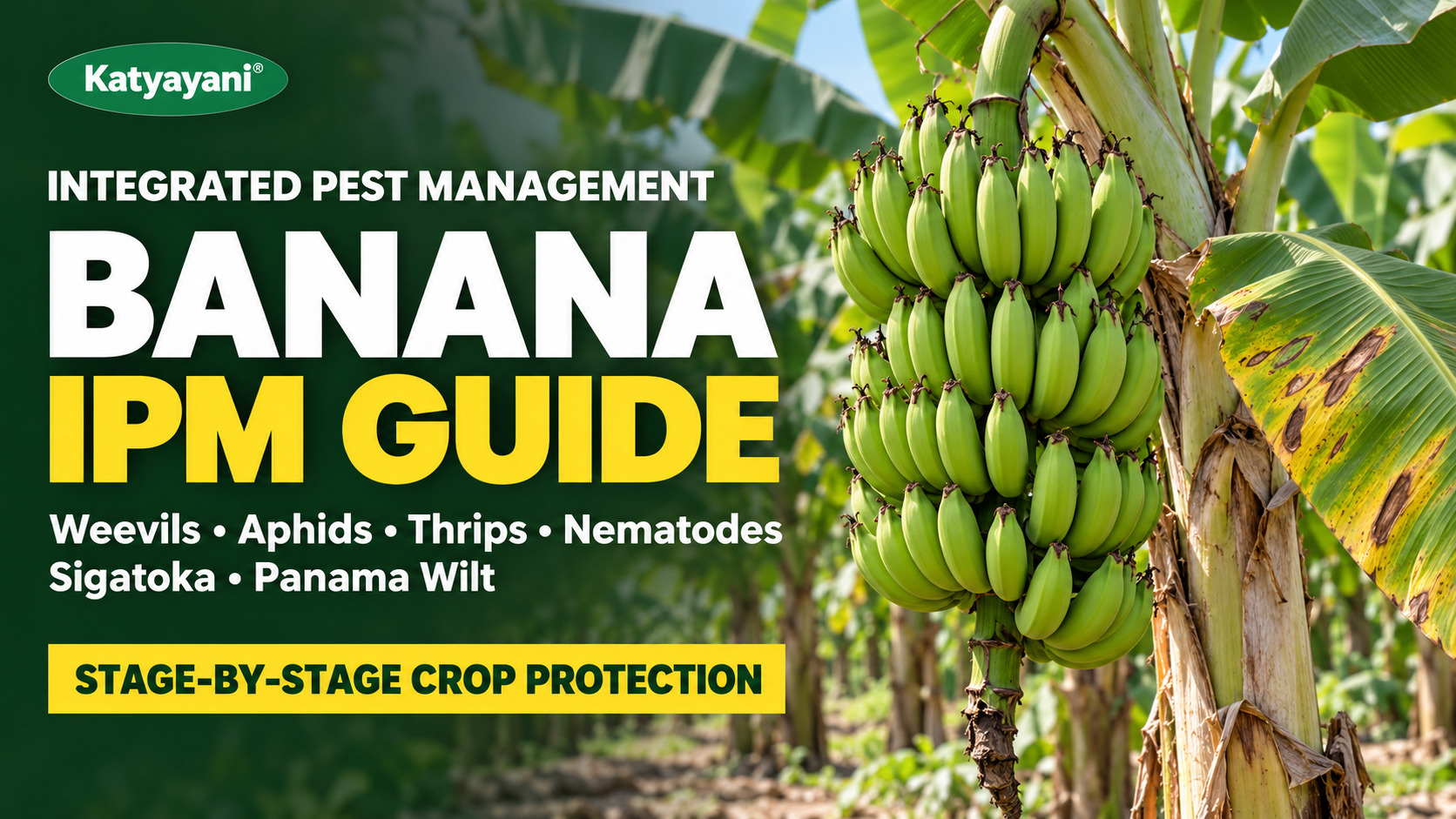
 18 min read
Integrated pest management (IPM) in banana means starting with clean, virus-free planting material, keeping the field sanitary, watching the crop on a schedule, using traps and bio-agents first, and spraying only when scouting shows a real problem. The big problems are the rhizome and pseudostem weevils, the aphid that spreads bunchy top, rust thrips on the fruit, nematodes, Sigatoka leaf spot and Panama (Fusarium) wilt. For Sigatoka, keep at least 17 to 20 green leaves up to six months, 12 to 15 at shooting and 7 to 10 at harvest. For wilt and bunchy top there is no cure: remove the plant, protect the field.
What is IPM in banana, and why does a spray calendar fail?
Integrated pest management is a plan with four steps: prevent the problem, watch the field, use the gentlest control that works, and spray only when the field shows a real need. In banana it matters more than in most crops because the plant stays in the field for a year or more, the pests live inside the stem and the corm where a spray never reaches, and the two worst diseases (Panama wilt and bunchy top) have no cure.
The national IPM schedule for banana pests, published in 2012 under the National Horticulture Mission and hosted by TNAU, is built on exactly this order. Clean planting material and sanitation come first. Traps and bio-agents come next. Bio-agents and sanitation carry most of the plan.
A fixed spray calendar fails because it treats every field the same. A weevil in the corm is not touched by a leaf spray. A virus is not touched by an insecticide at all; the bulletin says plainly that using insecticides on the aphid vector does not control bunchy top effectively. If you are still planning the crop, our G9 banana farming guide covers spacing, cost and the fertiliser schedule, and this guide covers what protects the money you put in.
Which pests and diseases hurt banana most in India, and how do you tell them apart?
Nine problems cause most of the loss: rhizome weevil, pseudostem weevil, banana aphid with bunchy top, rust thrips, burrowing and root-knot nematodes, Sigatoka leaf spot and Panama wilt. Yellowing alone does not tell you which one it is, so match the table below to what you see, then dig up a plant or cut a stem before you decide.
| Problem | What you see | When it bites | First move |
|---|---|---|---|
| Rhizome (corm) weevil | Sick look, yellow lines on top leaves; later a tapered stem near the crown, small leaves, poor bunch, choked throat; tunnels in the corm | Early plant vigour; any stage | Clean suckers, sanitation, traps |
| Pseudostem weevil (Odoiporus) | Jelly-like ooze on the stem, hollow stem, plant snaps at the top | Flowering and bunch formation | Traps, clean field, remove badly hit plants |
| Banana aphid (Pentalonia) | Dark aphids under the leaf base; curled, dwarfed leaves; small bunches | Winter in the plains, summer in the hills (bulletin) | Scout from the first month; rogue virus plants first |
| Bunchy top (virus) | Short, narrow, brittle leaves in a rosette; dark green dots and streaks on the stalk; no fruit | From infected suckers; spreads by aphid | Dig out the whole mat; use certified plants |
| Rust thrips | Rust-coloured scarring on the peel | Bunch stage | Cover the bunch early; remove neglected plants |
| Burrowing nematode | Yellowing, stunting, root decay; plants fall in a slight wind at fruiting | Whole crop | Pared, treated suckers; neem cake; rotation |
| Root-knot nematode | Galls on feeder roots; stunted plant with yellow leaves often mistaken for nutrient deficiency | Whole crop | Nematode-free suckers; enriched FYM |
| Sigatoka leaf spot | 1 mm light green specks on older leaves, turning brown; leaves dry from the tip; fewer than 10 leaves left | Humid, rainy weather | Monthly leaf removal; drainage |
| Panama (Fusarium) wilt | Yellow streaks on the oldest leaves, leaves collapse at the stalk, split outer sheath; plant dead in 4 to 6 weeks | Usually from 5 months (can be earlier) | No cure: remove the plant, protect the field |
Symptoms in this table follow the national IPM bulletin. Two checks save you from spraying the wrong thing. For wilt, cut the corm: a brown to reddish discoloured ring or streaks point to a soil fungus, not a leaf problem. For weevil, split the lower stem and look for tunnels and grubs.
What is the stage-wise IPM plan for banana, from planting to harvest?
Do the cheap, preventive jobs before and at planting, because they decide the rest of the year. After that, the plan is a monthly walk, a bio-agent top-up at the 3rd, 5th and 7th month, and two risk windows: the monsoon for Sigatoka and wilt, and flowering for the pseudostem weevil.
| Stage | What to do | Source |
|---|---|---|
| Before planting (field) | Choose a well-drained field with no history of wilt. Where wilt or nematodes have occurred, grow paddy or sugarcane once or twice before banana. Fallow three months after the last banana crop to starve burrowing nematodes | Bulletin: Panama wilt and nematode sections |
| Before planting (planting material) | Use healthy suckers or virus-indexed tissue-culture plants. Pare suckers, removing roots and dark lesions. For nematodes, dip pared suckers in hot water at 50 to 55 degrees C for 30 minutes. | Bulletin |
| At planting | Mix bio-agents (Trichoderma, Pseudomonas fluorescens, Bacillus subtilis powder, 15 g per plant as the first of four doses) into the pit. Add 2 kg farmyard manure enriched with Trichoderma harzianum and Paecilomyces lilacinus, and neem cake (400 g per plant for burrowing nematode). Marigold can go in as an intercrop | Bulletin |
| Month 2 onwards | Remove Sigatoka-infected leaves once a month, starting from the second month, and burn them away from the field or bury them in a manure pit. Remove side suckers on time. | Bulletin: Sigatoka section |
| Months 3, 5 and 7 | Repeat the 15 g bio-agent dose around the plant at the 3rd, 5th and 7th month. Give the second neem cake dose at 4 months. Repeat the enriched FYM every 6 months. Check weevil traps monthly | Bulletin |
| From month 7 to flowering | Watch for jelly ooze on the stem. Remove and destroy badly hit plants and keep the traps going | Bulletin: pseudostem borer |
| Shooting and bunch | Keep 12 to 15 green leaves. Cover the bunch early against rust thrips. Remove neglected plants and volunteers nearby | Bulletin; TNAU |
| Harvest and after | Cut the plant at ground level after harvest. Cut the old pseudostem into 30 cm pieces and use them as weevil traps instead of leaving heaps. Avoid leaving the plant to rot in weevil areas. | Bulletin |
Treat month numbers as the bulletin's guide for the regions it covers. For how spray, dust and drench differ in practice, our fungicide application methods guide explains it plainly.
How do you start clean? Planting material, sucker treatment and tissue culture
Start with clean planting material. The bulletin names infected suckers as the main way weevil, nematodes, Panama wilt and both viruses reach a new field, and says that suckers can carry the pathogen with no visible symptom. A tissue-culture plant is clean only if the mother plant was virus-indexed, because bunchy top and bract mosaic also travel through tissue-culture plants.
- Buy from a nursery that can show virus indexing. The bulletin asks for certified virus-free plants and a vector-proof mother block.
- Never take suckers from a garden with wilt, bunchy top or bract mosaic. Even healthy-looking suckers from such a garden may carry the pathogen.
- Pare the sucker. Trim away roots and dark patches on the corm so the nematodes and weevil grubs inside are removed.
- Hot water for nematodes. Pared planting material dipped at 50 to 55 degrees C for 30 minutes was effective in rendering it nematode-free, per the bulletin.
- Do not plant banana after banana. Rotation and fallow are IPM tools, not extras.
Spacing and planting month matter too. The bulletin links Sigatoka severity to close spacing (1.25 x 1.25 m), poor drainage, no rotation and year-round planting, and recommends planting in June and October at 1.5 x 1.5 m. Those months and that spacing are for the zones the bulletin covers.
How do you control the banana rhizome (corm) weevil?
The weevil lives and breeds in the corm and the cut stem. Control rests on clean planting material, field sanitation and trapping, with Beauveria bassiana or an insect-killing nematode on the traps. Remove dried leaves and debris, and burn them or bury them in a mulch pit.
| Measure | What the official sources say | Notes |
|---|---|---|
| Monitoring trap | Longitudinal cut-stem trap, 30 cm size, 10 to 15 per acre (bulletin). TNAU gives a corm split trap at 65 per hectare | Numbers differ between the two documents; use the range and the trap catch to judge |
| Pheromone trap | Cosmolure trap, 5 per hectare, position changed once a month (bulletin and TNAU) | Cosmolure is the pheromone lure for this weevil |
| Bio-agent trap | Once weevils are coming to the traps, swab the cut face of split traps with Beauveria bassiana or Heterorhabditis indica nematode, 20 g per trap, and lay them cut-face down. | Bio-agent on the trap faces |
Sources: the national bulletin and the TNAU rhizome weevil page. TNAU also advises avoiding the susceptible varieties Robusta, Karpooruvally, Malbhog, Champa and Adukkar where weevil is a known problem, and growing less susceptible types such as Poovan, Kadali, Kunnan and Poomkalli. That list is for Tamil Nadu conditions, so it is a hint, not a ranking for G9.
For the bio-agents, the bulletin names Beauveria bassiana and Metarhizium on the trap faces. Katyayani sells Beauveria bassiana powder and Metarhizium anisopliae powder. The Metarhizium page lists root weevils, beetles and grubs; the bulletin's guide is 20 g per trap. Beauveria is a live fungus: keep it out of the sun, and do not mix it with a fungicide in the same tank.
How do you control the banana pseudostem weevil (Odoiporus)?
The pseudostem weevil attacks around flowering and bunch formation and can stop the bunch from developing. The early sign is jelly-like ooze on the stem. Keep the field clean, trap the adults, and uproot and burn badly infested plants.
- Clean cultivation. Remove old and dead leaves. In severe attack the bulletin says to uproot and burn the plants.
- Traps. Use longitudinal split traps (30 cm) or disc-on-stump traps at 10 to 15 per hectare, and swab the cut face with 20 g of Beauveria bassiana, Metarhizium anisopliae or the nematode Heterorhabditis indica.
- Spray. The bulletin gives azadirachtin at 5 ml per litre, two or three times at three-week intervals. Azadirachtin products differ in strength, so the dose follows the strength of the product.
- After harvest. Cut the tree at the base. Do not leave the plant to rot in weevil areas. Cut old pseudostems into 30 cm pieces for use as traps rather than leaving them in heaps.
For neem, the bulletin names azadirachtin; a neem oil such as Dr Neem 3000 is the same family. Its page lists aphids, whiteflies and thrips, so use it as a supporting spray.
How do you control the banana aphid and bunchy top virus?
Bunchy top has no cure. Plants with short, rosette-like, brittle leaves should be dug out with the whole mat and destroyed. Clean planting material is the real control. The bulletin warns that killing aphids alone does not control bunchy top effectively.
The banana aphid (Pentalonia nigronervosa) sits under the leaf base and does little direct damage. Its harm is the virus it carries. Infected suckers and tissue-culture plants are the main source; the aphid spreads it from there. The bulletin adds that spread is higher in winter in the plains and in summer in the hills, when the aphid is most active.
| Step | What the bulletin says |
|---|---|
| Rogue first | Dig out the whole mat, chop it, dry it and burn it |
| Hygiene | Remove weeds and unwanted suckers that carry aphids and the virus |
| Area approach | Where more than 50 percent of plants are affected, the bulletin suggests holding the crop for two to three seasons and a community-level clean-up |
| Prevention | Certified virus-free tissue-culture plants; do not use suckers from affected gardens, even if they look clean |
The bulletin names the fungus Beauveria bassiana against the aphid. Katyayani's Verticillium lecanii powder lists aphids and thrips among its targets, so it is a general-purpose option for aphid colonies.
How do you protect banana bunches from rust thrips?
Rust thrips scar the peel and make the fruit look bad rather than taste bad, but a scarred bunch sells for less. The TNAU pest page gives the approach: destroy volunteer plants and neglected plantations, plant pest-free suckers and cover bunches early. Check the fruit under the cover regularly.
- Cover the bunch early. TNAU advises covering bunches early and checking the fruit under the cover regularly.
- Remove neglected plants. Abandoned plantations and volunteers are where the thrips multiply.
- Plant pest-free suckers. TNAU lists pest-free planting material as part of the approach.
How do you manage nematodes in banana (burrowing and root-knot)?
Nematodes hide in the roots and corm, so prevention matters more than any later treatment. Use nematode-free, pared and hot-water-treated suckers, add neem cake at planting, apply bio-agent-enriched farmyard manure every six months, and rotate or fallow. Do not rely on a single measure alone.
| Measure | What the bulletin says | Pest |
|---|---|---|
| Fallow and flooding | Fallow for three months after harvest suppresses burrowing nematode; flood fallowing for five months destroyed it and Fusarium | Burrowing |
| Neem cake | 400 g per plant at planting and again after four months; the bulletin notes lower nematode numbers and higher bunch weight. Neem cake at 500 g per plant with the mycorrhiza Glomus mosseae was most effective in one trial | Burrowing |
| Crop rotation | Paddy, sugarcane, green gram, cotton or turmeric reduced the burrowing nematode and raised yield | Burrowing |
| Marigold or sunn hemp | Marigold intercrop works as a trap crop; Crotalaria juncea intercropping lowered burrowing nematode | Both |
| Hot water and paring | Pared planting material in hot water at 50 to 55 degrees C for 30 minutes | Both |
| Bio-agents | Paecilomyces lilacinus, VA mycorrhiza, Pasteuria penetrans reduce soil and root nematodes. For root-knot, 2 kg farmyard manure enriched with Trichoderma harzianum and Paecilomyces lilacinus at planting, then every 6 months | Both |
The bulletin names Paecilomyces lilacinus as a promising bio-agent. Katyayani's Paecilomyces lilacinus bio-nematicide (Nema Cure) lists root-knot, cyst, reniform and stunt nematodes. Use it as a supporting input with the enriched-manure method above. If you want to see what else is in the range, the bio-pesticides collection lists the bio-agents together.
How do you manage Sigatoka leaf spot in banana?
Sigatoka (yellow, black and Septoria leaf spot) kills leaf area, and a banana plant needs leaves to fill the bunch. Keep at least 17 to 20 green leaves in the first six months, 12 to 15 at shooting and 7 to 10 at harvest. Remove infected leaves monthly from the second month, fix drainage and avoid close spacing.
The bulletin lists the reasons the disease gets severe: close spacing, late or missed sprays, poor sanitation, poor drainage, no rotation and banana planted all year round. It spreads by wind and water-borne spores and by moving leaves that carry it, including diseased leaves used to wrap bunches. A badly hit orchard produces small fingers, early ripening and peel splitting.
Pseudomonas fluorescens is part of the bulletin's wilt schedule (planting pit, then the 3rd, 5th and 7th month doses). Katyayani lists Pseudomonas fluorescens powder, whose page lists wilt and root-knot nematodes among its targets. Whatever you spray, a clean, well-set sprayer matters; see our guide on choosing the right agricultural sprayer.
How do you manage Panama (Fusarium) wilt and TR4 in banana?
There is no cure for Panama wilt. The fungus lives in the soil for years, enters through injured roots and moves in infected suckers, soil, water and tools. Keep infected material out, rotate with paddy or sugarcane, drain the field, protect roots from injury and nematodes, and remove diseased plants with the soil around them at once.
The national bulletin lists these steps. Restrict the movement of suckers from infested areas. Grow paddy or sugarcane once or twice, then banana for two to three cycles. Clean tools before they go into a clean field. Avoid root injury during inter-cultivation and control nematodes, since wounds let the fungus in. Apply Trichoderma, Pseudomonas fluorescens and Bacillus subtilis powder at 15 g per plant four times (at planting and at 3, 5 and 7 months). Neem cake at 250 kg per hectare was the best organic amendment tested.
In one trial, Trichoderma viride as a chaffy-grain formulation at 20 g per plant with farmyard manure at planting and two applications at two-monthly intervals cut Fusarium wilt by up to 80 percent in the Rasthali variety, both in tissue-culture and sucker-derived plants. That is a trial result on one variety, not a promise.
A newer race, Tropical Race 4 (TR4), has changed the picture for G9 growers. The ICAR abstract reports TR4 incidence above 50 percent in Grand Naine in Katihar and Purnea (Bihar), Faizabad (UP), Burhanpur (Madhya Pradesh) and Surat (Gujarat), that the fungus can survive in soil for more than 40 years without a host, and that it spreads through planting material, soil, irrigation water and bunch stalks. If you suspect wilt on G9, report it to your horticulture department rather than moving plants or soil. Do not share tools, and do not move suckers from the plot.
Katyayani's Trichoderma viride powder page mentions wilt, rot and damping-off among its targets. It is a soil-health support, not a cure, and it cannot be relied on against TR4. More bio-fungicides sit in the bio-fungicides collection. Our post on crop rotation shows how to fit paddy or sugarcane into the plan.
At what level should you act? Thresholds and action triggers in banana
For the banana weevils, aphids, thrips and nematodes, act on the trap catch, the first symptom and your plant counts. For Sigatoka the bulletin does give a real number: the minimum count of green leaves. For wilt and bunchy top the threshold is one plant.
| Problem | Action trigger |
|---|---|
| Sigatoka | Green leaves below 17 to 20 at six months, below 12 to 15 at shooting, below 7 to 10 at harvest (bulletin). Spray number rises or falls with disease and weather |
| Rhizome weevil | Put out traps and watch the catch. Once weevils are coming to traps, add bio-agents (bulletin) |
| Pseudostem weevil | Jelly ooze on the stem, or adults in the traps |
| Aphid / bunchy top | First sign of aphids on the plant (bulletin); a single plant with bunchy top is removed |
| Rust thrips | Cover the bunch early; check fruit under the cover |
| Nematodes | Prevention first; check roots for galls, lesions and decay |
| Wilt | A single wilting plant triggers removal and field-level hygiene |
The practical approach in the bulletin is to keep trapping, record what you catch each month, and escalate to bio-agent traps when the catch rises.
Which bio-agents work in banana IPM, and where does each fit?
| Bio-agent | Target | Official guide (bulletin) | KO product page |
|---|---|---|---|
| Beauveria bassiana | Rhizome and pseudostem weevil; aphid | 20 g per trap on split-stem traps; also named against the aphid | Beauveria bassiana powder |
| Metarhizium anisopliae | Pseudostem weevil | 20 g per trap on split traps | Metarhizium powder (lists root weevils) |
| Paecilomyces lilacinus | Nematodes | In enriched FYM at planting and 6-monthly; promising bio-agent | Paecilomyces lilacinus (nematodes) |
| Trichoderma | Panama wilt, soil fungi | 15 g per plant four times; chaffy grain 20 g per plant with FYM | Trichoderma viride (wilt) |
| Pseudomonas fluorescens | Wilt; root-knot | 15 g per plant, same schedule as Trichoderma | Pseudomonas fluorescens (wilt, root-knot) |
| Verticillium (Lecanicillium) lecanii | Aphid, thrips | Not in the bulletin schedule | Verticillium lecanii (aphids, thrips) |
All six are live organisms, so heat, sun and chemicals shorten their life. Store them cool and dry, mix on the day, apply in the evening, and keep the fungal and bacterial products apart from copper or strong fungicides. Our guide to types of biopesticides and their advantages explains how each group works and where it fits. To judge whether a product is genuine, see what to check before buying agricultural products, which covers licence, batch and bill.
What mistakes make banana IPM fail?
| Mistake | Why it hurts | Do this instead |
|---|---|---|
| Planting suckers from a wilt or bunchy-top garden | Suckers may carry the pathogen with no symptom | Buy virus-indexed tissue-culture plants from a verified nursery |
| Spraying a leaf product for a stem or corm problem | Weevils and nematodes are inside the plant or soil | Use traps, bio-agents and sanitation |
| Using insecticide alone for bunchy top | The bulletin says vector control alone does not control it | Rogue plants and use clean planting material |
| Leaving cut pseudostems in heaps | They become weevil breeding sites | Cut into 30 cm bits and use them as traps |
| Skipping leaf removal in monsoon | Sigatoka spores multiply on dead leaves | Remove infected leaves monthly from month 2 |
| Poor drainage and root injury | Opens the way for wilt fungus and nematodes | Drain the field; cultivate carefully |
| Moving soil, tools or suckers between plots | Spreads wilt, including TR4 | Clean tools; do not move material from affected plots |
Conclusion
Banana IPM is mostly work done before the pest arrives: clean, virus-free plants, a field that drains, monthly leaf removal, traps and bio-agents on a schedule, and a plan for the two diseases that cannot be cured. Treat Panama wilt on G9 as a problem to report, not a spray problem.
Questions Farmers Ask
What is integrated pest management in banana?
What are the major pests of banana in India?
How do you control the banana rhizome weevil?
How do you control the banana pseudostem weevil?
How do you control banana bunchy top virus?
What causes Sigatoka leaf spot and how is it managed?
How do you control Panama wilt (Fusarium wilt) in banana?
What is TR4 and why does it matter for G9 banana?
How do you control nematodes in banana?
How do you protect banana bunches from rust thrips?
How many green leaves should a banana plant have?
How do you tell Panama wilt from rhizome weevil damage?

Microbiologist
Microbiologist at Katyayani Organics. MSc in Microbiology, 2.6 years of experience.
View all authorsRead Next in Rabi & Horticulture Crop Guides

Beetroot Farming in India: Sowing Time, Varieties, Seed Rate, Fertiliser, Diseases, Yield, Cost and Profit per Acre
Integrated Disease Management (IDM) in Pomegranate: Bacterial Blight, Wilt, Fruit Spot, Anthracnose and Heart Rot, with a Stage-Wise Spray Schedule


Leave a Comment