 14 min read
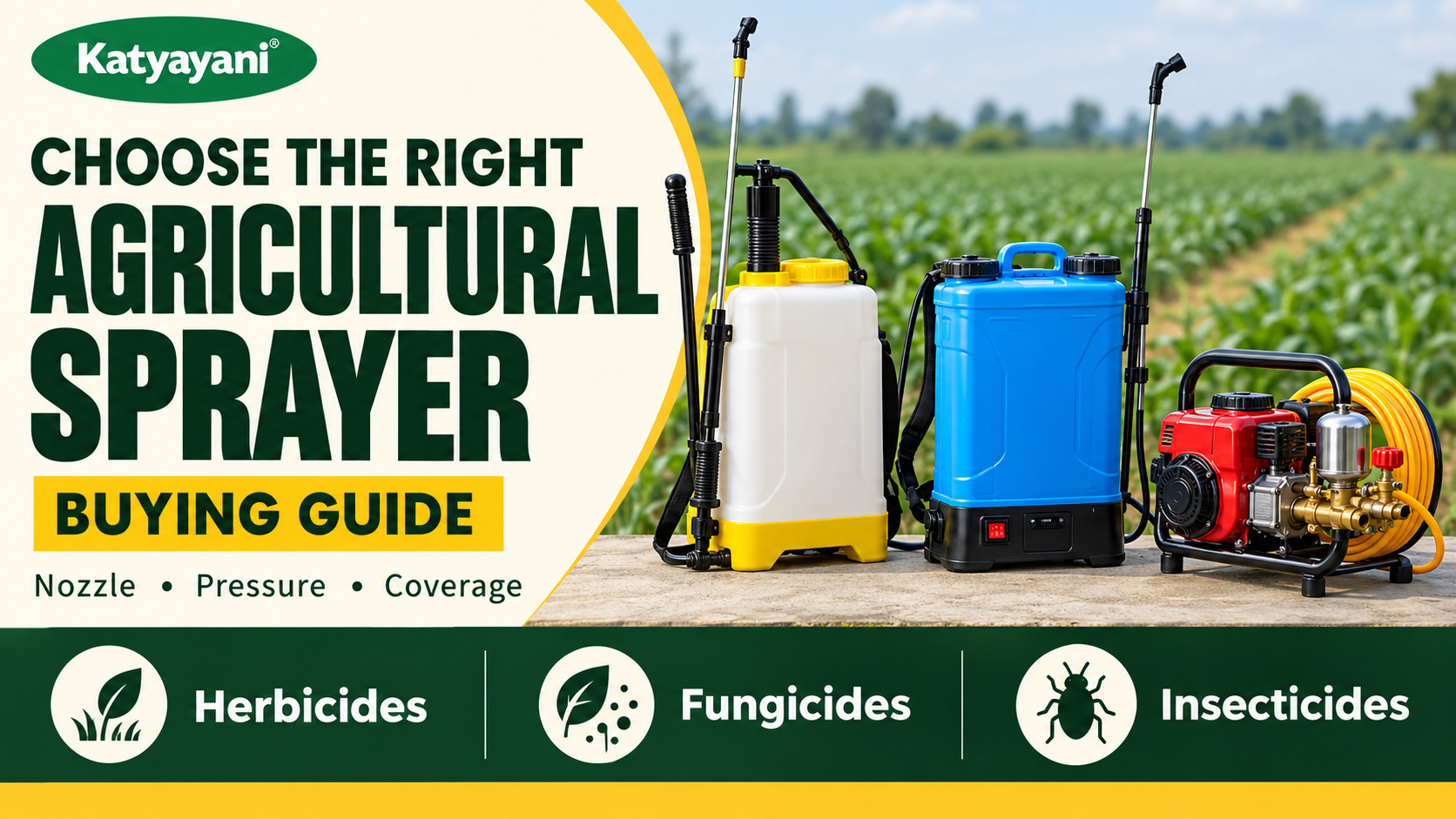
Pick the sprayer by the job. For up to about 2 to 3 acres, a 16 litre knapsack sprayer (manual or battery) is enough. For 5 acres or more, or for tall crops and orchards, a petrol power sprayer saves time. Use a flat fan nozzle for broadcast herbicide spraying, because it gives coarse droplets that drift less. Use a hollow cone nozzle for fungicides and insecticides that must reach the underside of leaves. Check the pesticide label for the water volume per acre, test your sprayer with plain water, and never use the same unwashed sprayer for a herbicide and then a crop spray.
What are the main types of agricultural sprayers?
A sprayer breaks liquid into droplets using pressure, air or spinning. TNAU explains that sprayers use hydraulic energy (a pump pushes liquid through a nozzle), gaseous energy (a fan blows the spray) or centrifugal energy (a spinning disc throws fine droplets). Every common machine uses one of these three. The table lists the types you will meet in a shop or on a farm.
| Sprayer type | How it works | Best use | Watch out for |
|---|---|---|---|
| Hand compression sprayer | You pump air into the tank by hand, and air pressure pushes liquid out | Kitchen garden, nursery, small plots, spot spraying | Pressure falls as the tank empties, so spray rate changes |
| Manual knapsack (lever) sprayer | Worn on the back. A lever pumps liquid through a nozzle | Most small farms. All three sprays: herbicide, fungicide, insecticide | Tiring on large areas. Uneven pumping gives uneven dose |
| Battery (electric) knapsack sprayer | Rechargeable battery runs a pump. Some models use a spinning disc | Small and medium farms, vegetables, pulses, cotton | Battery life, weight, and poor quality pumps in cheap models |
| Petrol (power) knapsack sprayer | A small engine drives a pump or a blower. Often called a Taiwan or motorised sprayer | Larger plots, tall crops, orchards, quick work | Noise, fuel, engine care, and heavy vibration for the operator |
| High volume sprayer with long hose (HTP) | An engine drives a high pressure pump, with a long hose and spray gun | Tall trees, plantations, big areas with high water volume | Needs a helper to handle the hose. Uses a lot of water |
| Boom sprayer (tractor mounted or trailed) | A pump feeds many nozzles fixed on a boom | Wide open fields of wheat, soybean, maize, cotton, sugarcane | Needs flat land, good calibration, and careful nozzle spacing |
| Mist blower or air blast sprayer | A fan blows the spray as a fine mist into the canopy | Orchards, plantation crops, tall vegetables | High drift. Not for herbicides |
| Spinning disc (ULV or CDA) sprayer | A fast spinning disc makes small, even droplets with very little water | Special low volume jobs where the label allows it | Only for products labelled for low volume use |
| Spray drone | A multirotor drone carries a tank and sprays from above | Large areas, wet or difficult fields, hired services | Needs rules, trained pilot, and a product that is allowed for drone use |
TNAU also notes that these tools can be portable (one person can carry them) or movable (on wheels, or lifted by two or more persons). Buying a sprayer is a long-term spend, so TNAU advises checking six points before you buy: suitability for the job, ease of use and care, performance, service support, spare parts and a fair price.
Knapsack sprayer vs power sprayer vs battery sprayer: which is better?
None is better in every case. It depends on how many acres you spray and how often. The figures below are the TNAU specifications for a typical battery sprayer and a typical petrol knapsack power sprayer.
| Point | Manual knapsack | Battery knapsack | Petrol knapsack power sprayer |
|---|---|---|---|
| Tank size | Usually 15 to 16 litres in the market (VERIFY model) | 10 litres, 12 V battery, 17 kg (TNAU) | 12 litres, 1.2 hp engine, 18 kg (TNAU) |
| Area per day | Not given by TNAU | About 1.5 ha, or 3.7 acres (TNAU) | 3 to 4 ha, or about 7 to 10 acres (TNAU) |
| Water use style | High volume is normal | Low volume. TNAU says 50 litres per ha, about 20 litres per acre | Medium volume (TNAU) |
| Cost (estimate only) | Not fetched. Check local dealers | TNAU pages show Rs 2,000 (2016 page) and Rs 40,000 (2023 page). These conflict, so ask for a current quote | About Rs 15,000 on the TNAU page updated April 2023 |
| Good for | Herbicide, fungicide and insecticide on small plots | Light work all day with little effort | Tall crops and bigger farms |
| Main drawback | Operator tires, uneven pressure | Battery runs down, pump wears | Fuel, noise, vibration, finer droplets that drift |
The price row is for orientation only. These are TNAU figures from pages dated 2016 and 2023, not current market prices. Always take two or three quotes, check the pump and nozzle quality, and ask for a bill with a warranty. TNAU specification pages: battery operated sprayer and knapsack power sprayer.
Simple Rule: Under about 3 acres: manual or battery knapsack. Five to ten acres or tall crop: power sprayer. Wide open field crops with a tractor: boom sprayer. Rented drone service: for big blocks, when the product label allows it.
Which tank size and sprayer do you need for your acreage?
The best size comes from two numbers: how much water the label asks for per acre, and how many acres you finish in a day. TNAU defines the volume bands (see the next section). The table below is plain arithmetic from those bands, to show how many tank loads a job needs. It is not a recommendation. Your pesticide label sets the real water volume.
| Water per acre | For 1 acre | For 5 acres | For 10 acres | Tank loads of a 16 litre knapsack (1 / 5 / 10 acres) |
|---|---|---|---|---|
| About 20 litres (low volume) | 20 L | 100 L | 200 L | About 1.3 / 6 / 12.5 loads |
| About 60 litres (start of high volume) | 60 L | 300 L | 600 L | About 4 / 19 / 38 loads |
You can see why a manual knapsack becomes slow past 3 to 5 acres at high volume. Every refill also costs walking time and fresh clean water. For larger blocks, a power sprayer, a tractor sprayer or a low volume battery sprayer reduces the number of refills. Keep a water source near the field, and always measure the pesticide for each tank load from the per-acre dose. For example, if the label says a certain amount of product in 200 litres of water per acre, a 16 litre tank needs 16 divided by 200, or 8 percent of that product amount.
How much water is needed per acre for spraying?
TNAU sorts spraying into three bands by the water used per hectare. Divide by 2.47 to get litres per acre.
| Band (TNAU) | Litres per hectare | Approx. litres per acre | Suited for | Typical equipment |
|---|---|---|---|---|
| High volume (HV) | More than 150 | More than about 60 | Insecticides, fungicides, herbicides | Manual knapsack, tractor mounted sprayers |
| Low volume (LV) | About 10 to 150 | About 4 to 60 | Insecticides, fungicides | Motorised knapsack, spinning disc |
| Ultra low volume (ULV) | About 1 to 5 | About 0.4 to 2 | Insecticides | High speed spinning disc, special attachments |
Notice that TNAU lists herbicides only under high volume. Weed killers need good, even wetting of the soil or the weed, and low volume spraying can leave gaps or cause crop burn. Many pesticide labels in India ask for 200 litres of water per acre or more for some crops (VERIFY on each label). Follow the label first. If you switch from a high volume pump to a low volume battery sprayer, do not simply cut the water. The product needs to be right for that volume. Ask the label or your agri officer.
Which nozzle should you use for herbicide, fungicide and insecticide?
The nozzle decides droplet size, spray pattern, dose and drift. TNAU calls the nozzle tip one of the most important and least expensive parts of a spraying system. The table sums up what TNAU, UGA and CSU say.
| Nozzle | Spray pattern and droplets | Typical pressure | Best for | Not good for |
|---|---|---|---|---|
| Flat fan | Flat, oval fan. Medium to coarse drops | 15 to 30 psi (TNAU); 20 to 30 psi (UGA) | Broadcast spraying of most herbicides; some insecticides where deep leaf coverage is not needed (UGA, CSU) | Dense canopy where spray must reach under leaves |
| Even flat fan | Same dose across the pattern | 20 to 30 psi (UGA) | Banding a herbicide over a crop row (UGA, CSU) | Broadcast spraying |
| Hollow cone | Ring of fine droplets | 40 to 80 psi (UGA); TNAU says 40 and above | Insecticides and fungicides that must reach under leaves; contact herbicides that need canopy cover (CSU) | Open-field herbicides where wind can carry the fine spray |
| Flood jet (flooding) | Wide fan, large drops | 5 to 25 psi (TNAU) | Pre-plant and pre-emergence herbicides, high rates and speeds (TNAU, CSU) | Jobs needing very even coverage |
| Adjustable (cone to jet) | Solid stream to wide cone | Varies | Reaching trees and out-of-reach targets (TNAU) | Careful dose work. TNAU says it is hard to calibrate |
Why a flat fan nozzle for herbicides?
UGA says the flat fan gives a very even pattern when the fans are overlapped correctly, which is why it is generally the best choice for broadcast herbicide work. It makes medium to coarse drops that drift less than fine ones. UGA advises 50 to 60 percent overlap of the fans on a boom, and warns that drift becomes a big concern above 40 psi. On a knapsack with a single nozzle, keep a steady height and a steady walking speed so the strip is wetted evenly. In India, the flat fan or the flood jet is the usual choice for herbicides on open ground.
Why a hollow cone nozzle for fungicides and insecticides?
Fungus and many insects sit on the underside of the leaf or low in the plant. Hollow cone nozzles give fine droplets that UGA says cover the underside of leaves better than any other nozzle type. The price you pay is drift, so keep the nozzle close to the crop and avoid windy times. TNAU says the same: use hollow cone where plant foliage penetration is essential and drift is not a major worry.
Worn Nozzle Warning: CSU reports that after 50 hours of spraying a brass nozzle can pour 10 to 15 percent more, while a hardened stainless steel nozzle changes about 2 percent. A worn nozzle means a heavier dose than you planned. Check the flow with plain water each season and change the tip when it is worn. TNAU notes steel tips resist wear best, brass wears faster and plastic is rising in use.
How do droplet size and drift affect your spray?
Droplet size is a trade-off. Fine droplets cover more area and reach under leaves, but they float away in wind. Coarse droplets stay on target but can run off or bounce. TNAU lists both sides:
| Coarse droplets | Fine droplets | |
|---|---|---|
| Swath | Narrow | Wider |
| Under-leaf coverage | Less | More |
| Water needed | More | Less |
| Run-off from leaf | Droplets join and run off | Droplets stay on the leaf |
| Loss to wind | Less | More |
| Effect on the pest | Poorer, per TNAU | Better, per TNAU |
TNAU also says most waste comes from the biggest drops, which fall fast and bounce off the leaf, and that a narrow range of drop sizes is best, avoiding drops above about 300 microns and below about 100 microns. As a size guide, a 400 micron drop carries 1,000 times the dose of a 40 micron drop. You do not need to measure microns in the field. You only need the right nozzle, the right pressure and a calm day.
How many droplets per square centimetre are enough?
- Translocated (systemic) herbicides: 5 to 10 droplets per sq cm.
- Most insecticides and systemic fungicides: about 20 droplets per sq cm.
- Non-systemic (contact) fungicides: 50 to 70 droplets per sq cm.
The reason is simple. A contact fungicide only protects where it lands, so you need many small spots to cover the leaf. A systemic product moves inside the plant, so fewer spots work. These are broad TNAU guide figures, not label rules. Use them to understand why a fungicide spray needs better coverage than a systemic herbicide spray.
How does sprayer choice differ for herbicide, fungicide and insecticide?
| Point | Herbicide (weed killer) | Fungicide | Insecticide |
|---|---|---|---|
| Main goal | Wet weeds or soil evenly, no drift to the crop | Cover the full leaf, mostly the underside | Reach the pest where it sits (underside, whorl, stem) |
| Nozzle | Flat fan or flood jet. Hood or shield near sensitive crops | Hollow cone for coverage | Hollow cone for sucking pests; flat fan if pests are on the top surface (UGA) |
| Droplets | Medium to coarse. Fewer needed for translocated products | Fine to medium. Many droplets for contact products | About 20 per sq cm for most products |
| Water | High volume (TNAU lists herbicides under HV) | Often high volume for good coverage | HV, LV or ULV depending on label |
| Cross-contamination risk | Very high. Small traces can burn other crops | Low to medium | Low to medium |
| Best sprayer habit | Keep one sprayer only for herbicide if you can | Spray early morning or late evening | Scout first; spray when pest crosses threshold |
If you can afford it, keep one sprayer for herbicides and another for fungicides and insecticides. It is the easiest way to avoid damage from leftover weed killer. If you only have one machine, follow the cleaning steps in the next sections carefully. To see what each family of products does, browse the Katyayani herbicide, fungicide and insecticide collections. For weed killers, the pages for selective herbicides and non-selective herbicides will help you match the spray area to the product. Read the label for crop, dose, water volume and safety for any product you buy.
Bio products need care too. Many bio pesticides contain living organisms or oils that can clog fine filters and nozzles. Our guide to biopesticides: types, examples and limits explains how to mix and spray them, and our post on fungicide application methods explains spray, drench, dust and seed treatment in plain terms.
How do you calibrate a knapsack sprayer step by step?
Calibration means finding out how much water your sprayer puts on a known area. Without it you are guessing the dose. TNAU recommends it before any spraying and gives a method an ordinary farmer can follow: spray a marked area with plain water, note the volume used, then scale up to the whole field. Here is that method with an example (our arithmetic).
- Check the sprayer first. Clean strainers and nozzle, replace worn washers and the tip, look for leaks.
- Mark a test strip. For example 10 m by 10 m, which is 100 sq m. Fix your walking speed and nozzle height, and use the same pressure you will use in the field.
- Fill with a known amount of plain water and spray the marked area the way you would spray the crop.
- Measure what is left. Subtract it from the starting amount to find the water used.
- Scale up. One hectare is 10,000 sq m and one acre is about 4,047 sq m. If the 100 sq m strip used 1.5 litres, that is 150 litres per hectare, or about 61 litres per acre.
- Compare with the label. If the label asks for more or less water, change speed, pressure or nozzle size, and repeat.
- Add the product only after this. Work out the product per tank from the per-acre dose and your tank size.
Colorado State University Extension adds a point about why this matters. In a Nebraska study, two thirds of applicators had rate errors above 5 percent, and in a North Dakota test 60 percent of sprayers had calibration errors above 10 percent. Most of the errors came from poor calibration and worn nozzles. Calibrate again whenever you change the nozzle, the pressure, the pump, the crop stage or the person doing the spraying.
How do you clean a sprayer so herbicide does not damage the next crop?
A trace of weed killer left in the tank, hose or filter can scorch a vegetable or cotton crop sprayed later with a fungicide. The label of the herbicide is the final guide on how to clean. These steps are the general good practice, and the TNAU safe-use page also says always clean equipment properly after use and never leave unused pesticide in the sprayer.
- Spray the leftover mix on the target crop area if the label allows. Do not dump it in a canal, pond or drain. TNAU says empty leftovers into pits on wasteland, away from water.
- Rinse with clean water and spray the rinse water out through the nozzle, not just pour it out. This washes the hose and the nozzle too.
- Repeat the rinse three times. Fill about a quarter of the tank each time, shake, and spray out.
- Use a cleaner if the label asks for one. Some herbicide labels name a household ammonia or detergent wash. Follow the label for the type and amount.
- Take out and wash the strainer, filter and nozzle tip separately. These small parts trap the most residue.
- Let it drain dry, oil the metal parts and store it away from children, food and feed (TNAU).
Keep It Separate: Best practice: a dedicated herbicide sprayer, marked with paint, and a second one for fungicides and insecticides. It costs more once but saves a crop later.
What PPE and safety steps do you need while spraying?
Use the checklist from the TNAU safe-use page. The key points are below.
| Stage | What to do (TNAU) |
|---|---|
| Before spraying | Identify the pest and check if it has crossed the economic injury level. Use the least toxic recommended product. Read the label and the sprayer manual. Check strainers, tank, cut-off and nozzle. Replace worn O rings, seals, gaskets, hose clamps and tips. Calibrate. Keep soap, a towel and plenty of clean water at hand. |
| While mixing and spraying | Take only the day's pesticide to the field. Never pour pesticide into other containers. Pour liquids slowly to avoid splashing. Do not spray in high wind, high heat or rain. Start at the downwind edge and move upwind, so you walk into unsprayed ground. Never eat, drink or smoke. Never blow a clogged nozzle with your mouth. Keep children and animals away. |
| After spraying | Dump leftovers in a pit on wasteland, never in canals or ponds. Wash buckets, sticks and measuring jars. Remove and wash the clothes and boots. Wash yourself and wear clean clothes. Keep a record of what you sprayed. Mark the sprayed plot with a flag and keep people out until it is safe. |
For protective gear, the label shows what is needed for each product. As a minimum, most spraying needs a full-sleeve shirt and long trousers, rubber gloves, boots, a face mask or respirator, a cap and eye protection. In hot weather, spray early morning or evening. Heat is a big reason farmers skip gear, so plan the work for the cool hours rather than skipping the gear. If you feel dizzy, sick or have burning eyes, stop and go to a doctor, and carry the pesticide label with you.
What is the best time and weather for spraying?
Weather decides how much of your spray reaches the target. The TNAU safe-use page says do not spray in high wind, high heat or rain. Rain washes off the product before it works. Heat dries fine droplets in the air, so the spray never lands. Wind carries fine droplets onto the next field, a pond, or a neighbour's crop.
- Time of day: early morning or late evening, when the air is calm and cool. This also keeps you comfortable in your protective gear.
- Wind: if you can feel a steady breeze on your face, it is too strong for fine hollow cone sprays. Wait, or switch to a coarser nozzle and lower pressure.
- Direction: start at the downwind edge of the field and walk upwind, so you do not walk through wet crop (TNAU). Never spray with the wind blowing toward grazing animals.
- Pressure: UGA warns that drift becomes a major concern above 40 psi with flat fan nozzles, and that fine droplets form at higher pressure. Keep pressure at what the nozzle is made for.
- Height: hold the nozzle or boom at the correct height. TNAU lists proper height and direction as the two simple ways to reduce drift.
- Neighbours: before spraying a herbicide, look at what is growing next door. Sensitive crops near your field are the main reason to choose a coarse nozzle and a calm day.
On a boom or a multi-nozzle lance, TNAU also warns about overlap and gaps. Overlap gives a double dose that can harm the crop, and a gap leaves a strip untreated, so the pest or weed survives. Keep the nozzle spacing and height as the maker advises, and walk at a steady pace. A uniform walking speed matters as much as the nozzle. If you speed up, you apply less per acre. If you slow down, you apply more.
How should you maintain a sprayer so it lasts longer?
- After each use: rinse the tank, hose, filter and nozzle with clean water. TNAU says clean the equipment properly and oil it before storing.
- Every month in season: check seals, O rings, washers and hose clamps for leaks. Replace worn ones (TNAU).
- Each season: test the nozzle flow with plain water. Replace worn tips. CSU advises hardened stainless steel or ceramic tips because they keep a steady flow far longer than brass or plastic.
- Battery sprayers: charge the battery fully, do not leave it dead for months, and keep the charger dry.
- Petrol sprayers: use the fuel mix the maker states, clean the air filter and spark plug, and drain fuel before long storage.
- Storage: dry, shaded, locked, away from fertilizer and food. Keep spare parts ready before the season starts.
Are there subsidies on sprayers, and what about drones?
Many state agriculture departments support plant protection equipment, often under the Sub-Mission on Agricultural Mechanisation (SMAM) or state schemes. The rate, cap and eligible machine list differ by state and year, and some pages we saw in search showed small fixed rupee caps for knapsack sprayers. The exact amounts are not repeated here because the official guideline was not read (VERIFY with your district agriculture office). Read our agriculture subsidy schemes in India guide for how to apply, and our post on drone subsidy for farmers for spray drone support. For drones, check the product label or state advisory first, because a drone uses far less water than a knapsack, and not every product is cleared for drone use.
What should you check before buying an agricultural sprayer?
Use this list in the shop. It is built from the TNAU buying checklist.
- Job fit: what will you spray most, and on how many acres?
- Build quality: look at welded joints and seams, moving parts and finish. Parts should fit tight and come apart easily.
- Demo: ask the dealer to run it with water. Check the pump pressure, the nozzle spray pattern and the flow.
- Nozzle kit: ask for a flat fan and a hollow cone tip, and a spare set. Prefer steel or ceramic tips.
- Tank: a wide mouth, a strainer, clear litre marks and a tight lid.
- Comfort: padded straps and a balanced frame. A 17 to 18 kg loaded machine is heavy over a full day.
- Service and parts: a local dealer, genuine spares and a warranty card (TNAU).
- Price: do not be put off by a higher price, as TNAU notes it usually means better quality, but compare quotes and check the bill.
- Safety: a cut-off valve at the lance, leak-free hose, and a guard for the engine exhaust on petrol models.
Credit for equipment can come through bank loans. See our Kisan Credit Card scheme guide for working capital options.
Conclusion
The right sprayer is the one that matches your acreage, your crop height and what you spray. Use a flat fan nozzle for herbicides and a hollow cone nozzle for fungicides and insecticides, check the label for water per acre, calibrate with plain water, clean the tank and nozzle after every herbicide, and spray in calm, cool weather with full protective gear. Good habits protect your crop, your money and your health.
Why trust this guide
Written by Team Katyayani, Editorial Team at Katyayani Organics. Cross-checked against published research and university extension programs.



Leave a Comment