 11 min read
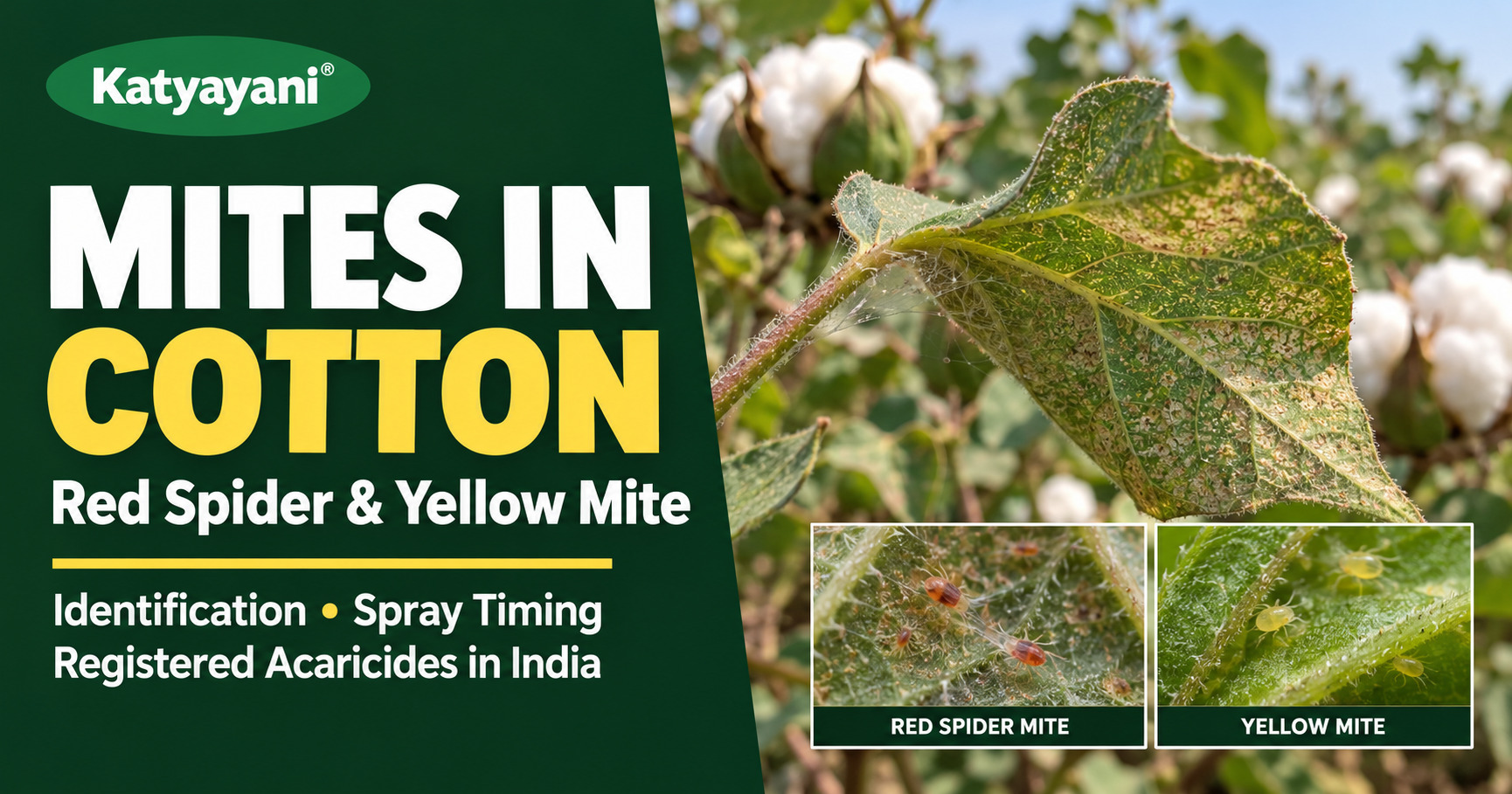
Cotton mites are tiny sucking pests that live on the underside of leaves. The red spider mite (Tetranychus) causes pale speckles that turn bronze or red, with fine webbing. The yellow or broad mite (Polyphagotarsonemus latus) makes young top leaves curl, harden and stay small. Check leaf undersides with a 10x lens, scout twice a week in hot, dry spells and act only when mites are spreading, not on a few plants. In the CIB&RC list (up to 30 September 2025) only two single-ingredient acaricides have a cotton row that names mites: spiromesifen 22.9 percent SC and fenpyroximate 5 percent EC. Rotate, spray the leaf underside with 500 litres of water per hectare, and avoid pyrethroid and similar sprays that kill the mites' natural enemies and make mites flare.
What are mites in cotton, and which ones matter in India?
Mites are not insects. They are tiny eight-legged relatives of spiders that suck cell contents from the leaf, mostly on the underside. For cotton growers the practical groups are red spider mites (genus Tetranychus) and the yellow or broad mite (Polyphagotarsonemus latus). Most field problems come from red spider mites.
The reference BigHaat page names Tetranychus neocaledonicus as the red spider mite and Polyphagotarsonemus latus as the yellow mite on Indian cotton. A general Indian survey of mite pests also lists T. urticae and T. neocaledonicus as major spider mites. We could not find a cotton-specific Indian species survey, so treat the species name as something your KVK or state university should confirm. The control steps below are the same for all red spider mites.
| Group | Common name | Size and colour | Where it sits |
|---|---|---|---|
| Tetranychus species | Red spider mite, two-spotted spider mite | About 0.3 mm at the largest, so you need a lens. Pale green, yellowish or reddish with dark body spots; eggs are round and clear | Underside of leaves, under fine webbing |
| Polyphagotarsonemus latus | Yellow mite, broad mite | Even smaller than spider mites, so it is rarely seen without magnification | Young top leaves and buds |
| Not a cotton mite | Dust mites, scabies mites | Search results mix these in | Irrelevant to cotton |
How to identify mites in cotton in the field
Turn the leaf over and look at the underside with a 10x hand lens, as the New Mexico State University note advises. Moving specks, round clear eggs, shed skins and fine silk threads mean spider mites. Pale speckles on the upper side and a dull or bronze look confirm the diagnosis. Check leaves from the middle of the plant, not only the top.
- Take a 10x lens to the field. Without one you will confuse mites with dust, thrips or leaf spot. Cheap pocket lenses are enough.
- Check field edges first. Early infestations are spotty and often start along dusty roads, weedy bunds and rows next to other host crops (New Mexico State University note).
- Look for silk. Fine webbing on leaf undersides and between leaf and stalk is a spider mite sign. Yellow mite does not make heavy webbing.
- Shake a leaf over white paper. Tiny specks that start to crawl are mites. This is a quick field trick, not a laboratory test.
If you cannot be sure, take a photo of both leaf surfaces and show it to the local KVK or agriculture officer before you spend money on a spray.
What are the damage symptoms of mites in cotton?
Spider mites cause tiny pale speckles on the upper leaf, which merge into yellow, bronze or red patches. Leaves dry, curl and fall, and squares and bolls may drop. Yellow mite instead makes young top leaves hard, brittle, downward curled and stunted. Damage is permanent, so catch it early.
| Mite | What you see | What it does to the plant |
|---|---|---|
| Red or two-spotted spider mite | Fine pale stipples, then a dull, olive, yellow, bronze or reddish leaf; silk on the underside; damage often starts near the leaf stalk or in leaf folds | Less photosynthesis. Leaves dry and drop; squares and bolls can be shed. Heavy infestation can defoliate whole patches (NMSU, Australian guide) |
| Yellow or broad mite | Young leaves curl down, become rough and brittle, and growth is stunted (BigHaat description) | Poor growth at the tip and fewer healthy leaves. Severe cases cut yield and quality |
| Damage from both | Patches in the field first, spreading outward | Each feeding puncture kills cells, so damage is cumulative |
Is it mites or something else? Look-alike problems
Reddening and drying of cotton leaves also comes from jassids, nutrient stress, drought and leaf diseases. The difference is on the underside: mites leave speckles, silk and moving specks, while jassid damage starts at the leaf edge and the insect is a visible hopper. Check before you spray.
| Look-alike | How it differs from mite damage | Action |
|---|---|---|
| Jassid (leaf hopper) damage | You can see small green hoppers that run sideways; leaf edges yellow, curl and turn red or brown | This is an insect. Manage as a sucking pest, not with an acaricide. See our thiamethoxam guide for how a sucking-pest insecticide works. Thiamethoxam does not control mites. |
| Red cotton bug | A visible bug (the PAA "red cotton bugs" question is about this); not a mite | Different pest and different advice. Do not use acaricide |
| Whitefly | White flies fly up when the plant is shaken; sooty mould on leaves | Spiromesifen has a cotton row for both white fly and mite, but still confirm which one you have |
| Nutrient reddening or drought stress | Reddening or yellowing with no speckles, silk or moving specks on the underside | Check soil moisture and the nutrient plan, ideally against a soil health card |
| Dust on leaves | Wipe the leaf; if the dull look stays and specks move, it is mites | Dust also helps mites, so see the next section |
This table is a field guide from our reading of the sources above, not a laboratory key. When in doubt, send a leaf sample to your KVK or plant protection office.
Why do mites increase in cotton?
Mites multiply fastest in hot, dry, dusty weather on stressed plants, and when sprays kill the predators that normally hold them down. In hot summer weather a spider mite generation can take under a week (NMSU). Heavy nitrogen and weedy field borders add to the problem.
- Hot, dry and dusty conditions. Both the New Mexico and Auburn notes link outbreaks to heat, drought stress and dusty roadsides.
- Loss of natural enemies. Broad-spectrum sprays, including pyrethroids and acephate, can kill predators such as thrips, lady beetles, big-eyed bugs and predatory mites, while mites that are already on the leaf survive and then multiply. An Indian mite survey reports that mixtures including synthetic pyrethroids and monocrotophos have provoked spider mite outbreaks on crops generally; this is not a cotton-specific finding.
- Too much nitrogen. Auburn authors flag lush, soft growth from excess nitrogen as a risk when mite and drought stress combine. Balance the dose with a soil test.
- Weeds and other hosts. Mites live on many weeds and neighbouring crops and move onto cotton, helped by wind and silk.
- Repeated use of the same acaricide. Spider mites have developed resistance to many acaricides worldwide (Crops & Soils, NMSU).
The Auburn University authors describe spider mites as a signal that something in the system is out of balance, rather than only a pest to be sprayed. Their Crops & Soils article is a US view, but the logic applies to our fields as well.
When are mites most harmful in cotton?
Mites hurt most when they build up from squaring to boll development, because the plant is then feeding squares and bolls. In the Australian guide, control is judged on how fast mites are rising, and it is not worth spraying after about 20 percent of bolls are open. Crop-stage advice for your district should come from your KVK.
In Australia, naturally occurring predators (especially thrips) usually hold mites down between emergence and squaring, so early sprays are only needed if numbers start to climb. After the crop passes 20 percent open bolls, the guide says control is no longer warranted. Climate, varieties and crop calendars differ in India, so use this only as a guide to timing.
How do I scout for mites, and what is the threshold to spray?
We could not find an official Indian economic threshold for cotton mites. A practical rule from foreign extension is to spray when about 25 to 30 percent of plants or leaves have active, rising mites, not on a few edge plants. Scout twice a week in hot, dry spells and always check the underside.
| Source | What it says | Note |
|---|---|---|
| Australian Cotton Pest Management Guide 2013-14 | About 30 percent of plants infested through most of the season; act earlier if mites rise more than 1 percent of plants per day on two checks. Late in boll opening, only when more than 60 percent are infested and rising fast. No control after 20 percent open bolls | Foreign, for two-spotted mite. A decision guide, not an Indian label |
| US notes quoted by Auburn authors | Often 25 to 30 percent of plants, or 30 to 50 percent of leaves, with active mites and symptoms, and rising | Foreign, general |
| BigHaat (reference page) | Act when mites or webbing are on about one third of leaves checked or speckled patches are spreading; spot spray if limited to edges | No source given. No official threshold is stated |
- Walk the field in a W or zigzag pattern. Include the edges and any dusty or weedy patch.
- Pick 20 to 25 plants across the field. Turn a middle-canopy leaf on each and look at the underside with a lens.
- Count the share of plants with live mites. Note the date.
- Check again after three to four days. A rising share means act. A falling share after rain or after predators move in means wait.
- If mites are only on the edge rows, a spot spray on those rows may be enough (NMSU suggests this for early, margin-only cases).
What cultural steps help control mites in cotton?
Cultural steps lower the pressure before any spray. Keep plants out of long water stress with timely irrigation, avoid excess nitrogen, remove weeds on bunds and borders early, and avoid dust build-up near the field. These steps cost little and cut down the mites that spray cannot reach.
- Irrigate on time. Both the Auburn and New Mexico notes say that drought stress favours mites. A heavy rain can also wash mites off leaves, but you cannot rely on it.
- Balance nitrogen. Split the dose and follow a soil test rather than topping up out of habit.
- Clean the borders. Remove weeds early, and do not let them dry out and push mites onto the crop. Burn down winter weeds well before sowing.
- Keep an eye on neighbouring crops. Brinjal, okra, chilli and vegetables can carry mites into cotton.
- Do not spray unnecessarily for other pests early. Each broad-spectrum spray can remove predators.
Can natural enemies and bio-products control cotton mites?
Natural enemies, mainly predatory mites, thrips, lady beetles, big-eyed bugs and minute pirate bugs, do a lot of the work in a healthy cotton field. Protect them by avoiding unnecessary broad-spectrum sprays. Bio-products can support control, but we could not confirm a CIB&RC cotton mite claim for neem or Beauveria in this review.
Neem-based products are widely used as a first, gentle step. BigHaat advises repeating a neem spray after about a week. We found no independent trial result and no CIB&RC cotton-mite row for neem in the list we read, so treat neem as a supporting step on young infestations, not a guaranteed cure. Always use the label dose. For how bio-products fit alongside chemicals, read our biopesticides guide and the comparison of bio and chemical inputs.
Releasing predatory mites is mostly described for greenhouses and is not a common field practice on cotton in India. The NMSU note also says it can be costly and may clash with later sprays.
Which acaricides are registered for mites in cotton in India?
In the CIB&RC "Major Uses of Pesticides" list (up to 30 September 2025), the single-ingredient insecticides with a cotton row that names mites are spiromesifen 22.9 percent SC (white fly and mite) and fenpyroximate 5 percent EC (jassids and mites). A few combination products also list mites on cotton. This is guidance, not a legal document, so check your product label.
| Active ingredient and formulation | Cotton row in CIB&RC list | Dose per hectare (a.i. / product / water) | Waiting period |
|---|---|---|---|
| Spiromesifen 22.9 percent SC | White fly and mite | 144 g / 600 ml / 500 litres | 10 days |
| Fenpyroximate 5 percent EC | Jassids, mites | 37.5 g / 750 ml / 500 litres | 15 days |
| Fenazaquin 10 percent + Bifenthrin 4 percent EC (combination) | White fly and mites | 125 + 50 g / 1,250 ml / 500 litres | 74 days |
| Diafenthiuron 40.1 percent + Acetamiprid 3.9 percent WP (combination) | Thrips, mites and white fly | 200.5 + 19.5 up to 240.6 + 23.4 g / 500 to 600 g / 500 litres | 21 days |
| Diafenthiuron 48 percent + Dinotefuran 8 percent WG (combination) | Thrips, jassids, white fly, mites (Tetranychus urticae) | 300 + 50 g / 625 g / 500 litres | 43 days |
Our arithmetic from these hectare doses: 600 ml per hectare is about 240 ml per acre, 750 ml per hectare is about 300 ml per acre, and 500 litres per hectare is about 200 litres per acre. Per litre, that is 1.2 ml of spiromesifen or 1.5 ml of fenpyroximate in 500 litres of spray. Always follow the dose and water volume on the pack you buy.
Single-ingredient diafenthiuron and tolfenpyrad do have cotton rows, but those rows name sucking insects, not mites. Chlorfenapyr has a cotton row for Spodoptera and thrips only. The combinations above carry long waiting periods, so check the picking schedule before you use them.
Label Check: A site listing a product for "mites" does not make it legal on cotton. The right test is: does the CIB&RC list or the product label show cotton and the pest? Hexythiazox, abamectin, propargite, etoxazole and bifenazate had mite rows for crops such as tea, chilli, apple, brinjal, grapes, rose or okra in the list we read, but no cotton row.
Which popular mite actives have no cotton row in the CIB&RC list?
In the list we read, hexythiazox 5.45 percent EC, abamectin 1.9 percent EC, propargite 57 percent EC, etoxazole 10 percent SC and bifenazate have mite rows for other crops but no cotton row. The reference BigHaat mite pages recommend some of these for cotton. That is a gap worth knowing before you buy.
| Active | Crops with a mite row in the list | Cotton row? |
|---|---|---|
| Hexythiazox 5.45 percent EC | Tea, chilli, apple, grapes, rose, brinjal, okra | No |
| Abamectin 1.9 percent EC | Rose, grapes, apple, tomato | No |
| Propargite 57 percent EC | Tea, chilli, apple, brinjal | No |
| Etoxazole 10 percent SC | Brinjal, tea, apple | No |
| Bifenazate (50 percent WP, 22.6 percent SC) | Rose, grapes | No |
We are not saying these products do not work on mites. We are saying that the list we read does not show a cotton label for them. Using a product on a crop that is not on its label goes against the label and the Insecticides Act, and residue clearance for that crop may be missing. If a dealer recommends one, ask to see the cotton line on the label. A newer approval after 30 September 2025 is possible, so check the current CIB&RC list.
How do I use spiromesifen on cotton mites?
Spiromesifen 22.9 percent SC has a CIB&RC cotton row for white fly and mite at 600 ml per hectare in 500 litres of water, with a 10-day waiting period. Apply it as the label directs, ideally before mites build up. The Katyayani product is Ozil (spiromesifen 22.9 percent SC); its page lists cotton.
The product page does not state a dose in text, so follow the label on your pack. If a blog gives a much lower dose (one reference page gives 0.3 ml per litre), check it against the CIB&RC row and your label before using it. Under-dosing helps resistance to build up. Spiromesifen is in IRAC group 23 and was noted by NMSU as best used late in the season on US labels, which is a foreign use pattern.
How do I use fenpyroximate on cotton mites?
Fenpyroximate 5 percent EC has a CIB&RC cotton row for jassids and mites at 750 ml per hectare in 500 litres of water, with a 15-day waiting period. It is in IRAC group 21 (per the NMSU table). The cotton row names the EC formulation only, so check that your label lists cotton.
We did not link any Katyayani fenpyroximate product: the KO Mite Free product is fenpyroximate 5 percent SC, and its page lists chilli and tea but not cotton. NMSU suggests using fenpyroximate early to mid season, before populations build, with no more than two applications. Treat that as US advice.
How do I manage resistance and rotate acaricides?
Rotate between different IRAC mode-of-action groups and avoid repeating the same active. With only two single-ingredient cotton options in India, plan on one spiromesifen spray (group 23) and one fenpyroximate spray (group 21) at most per season, supported by cultural and bio steps. Do not use the same group back to back.
- One active per season, then switch. New Mexico advice for cotton is to use one miticide once per season and switch if a second spray is needed.
- Full dose, enough water. Under-dosing and poor coverage select for resistant mites. Use the label rate and water volume.
- Repeat only when needed. Where eggs keep hatching, extension advice from Auburn authors is a second application 5 to 7 days later with a different mode of action, if the label allows.
- Switch next year too. Resistance is inherited and does not fade quickly.
- Keep records. Write down date, product, group and dose for each field.
Spider mites have already shown resistance to many acaricides worldwide, so keeping the few cotton-labelled options effective matters. If you see a spray fail, do not simply double the dose. Check coverage, the date and the product, and ask your KVK about local resistance.
Spray tips: how to get a good kill
- Wet the leaf underside. Mites hide there, so aim the nozzle upward and spray until the underside is covered.
- Use the labelled water volume. The CIB&RC rows above use 500 litres per hectare. Cotton at the squaring stage needs enough volume to cover the canopy.
- Spray in the cool part of the day. Early morning or late evening reduces evaporation and leaf burn risk.
- Spot spray first when mites are only at the edges. It saves product and spares predators.
- Do not mix with a pyrethroid for convenience. It can defeat the purpose by killing predators. Read the label for what mixes safely.
- Respect the waiting period. 10 days for spiromesifen and 15 days for fenpyroximate per the CIB&RC rows.
- Wear gloves, mask and full sleeves, and keep children and animals away.
- Re-scout after 5 to 7 days. Count again to check that the spray worked.
For correct nozzles, calibration and other spraying basics, our application methods guide covers the general method, even though it is written for fungicides.
Common mistakes that make cotton mites worse
| Mistake | Why it backfires | What to do instead |
|---|---|---|
| Spraying a pyrethroid or other broad-spectrum insecticide for mites | Gives a short-term drop and then a fast resurgence, because predators die (NMSU advises against pyrethrins, pyrethroids and organophosphates for spider mites) | Use a label-approved acaricide only when scouting says so |
| Early-season sprays for other pests with no scouting | Kills thrips, lady beetles and other predators that hold mites down before squaring | Spray for bollworm and sucking pests only at threshold |
| Too much nitrogen | Lush, soft growth plus water stress suits mites (Auburn authors) | Follow a soil test and split the dose |
| Using an acaricide with no cotton row because a website listed it | Not allowed under the label and no residue clearance | Check the CIB&RC list or label for cotton |
| Wrong diagnosis | Mites, jassids and drought stress look similar from a distance | Check the leaf underside with a lens |
| Spraying only the top of the plant | Mites sit on the underside and in the middle canopy | Aim upward and cover the underside |
| Repeating the same active every week | Speeds up resistance | Rotate groups and limit use |
| Under-dosing to save cost | Poor kill and resistance | Use the label dose |
| Buying cheap, unlabelled or fake product | Poor quality gives poor control and wastes the spray window | Buy from a licensed dealer and keep the bill; see our guide to spotting fake pesticides |
Is neem oil enough for mites in cotton?
Neem oil may help on a light, early infestation and is gentle on beneficial insects, but we found no cotton-mite trial or CIB&RC cotton row for it in this review. Do not rely on it alone when mites are spreading fast. Use it as a first step with regular scouting, and move to a label-approved acaricide if numbers keep rising.
Neem acts slowly and needs good coverage of the leaf underside. Repeat as the label says, avoid spraying in the heat of the day and do not mix it with other chemicals unless the label permits.
A simple mite plan for the cotton season
| Crop stage | What to do | Note |
|---|---|---|
| Before sowing | Clear weeds on bunds and borders; plan irrigation; soil test for nitrogen | Cuts the mites that survive on weeds |
| Seedling to early squaring | Scout the edges every week; avoid broad-spectrum sprays unless a pest has crossed its threshold | Predators such as thrips keep mites low (Australian guide) |
| Squaring to flowering | Scout twice a week in hot, dry spells; use the underside check; spot spray edges if needed | This is the main risk window |
| Boll development | Act if mites are rising fast; use one label-approved acaricide with full coverage; observe the waiting period | Check the picking dates before choosing a product |
| Boll opening | Avoid new sprays unless mites are heavy; mind the waiting period | The Australian guide says control is not warranted after 20 percent of bolls are open |
If you also face bollworm and sucking pests, ask your KVK for a combined plan so that each spray fits with the mite plan and does not undo it.
Conclusion
Mites on cotton are best handled by identifying them early with a lens, scouting before a spray, and using only a label-approved acaricide. In the CIB&RC list we read, that means spiromesifen 22.9 percent SC or fenpyroximate 5 percent EC for single-ingredient options, used with rotation, good underside coverage, and care not to kill natural enemies. Confirm the current label with your KVK or dealer before you spray.
Why trust this guide
Written by Team Katyayani, Editorial Team at Katyayani Organics. Cross-checked against published research and university extension programs.




Leave a Comment