 16 min read
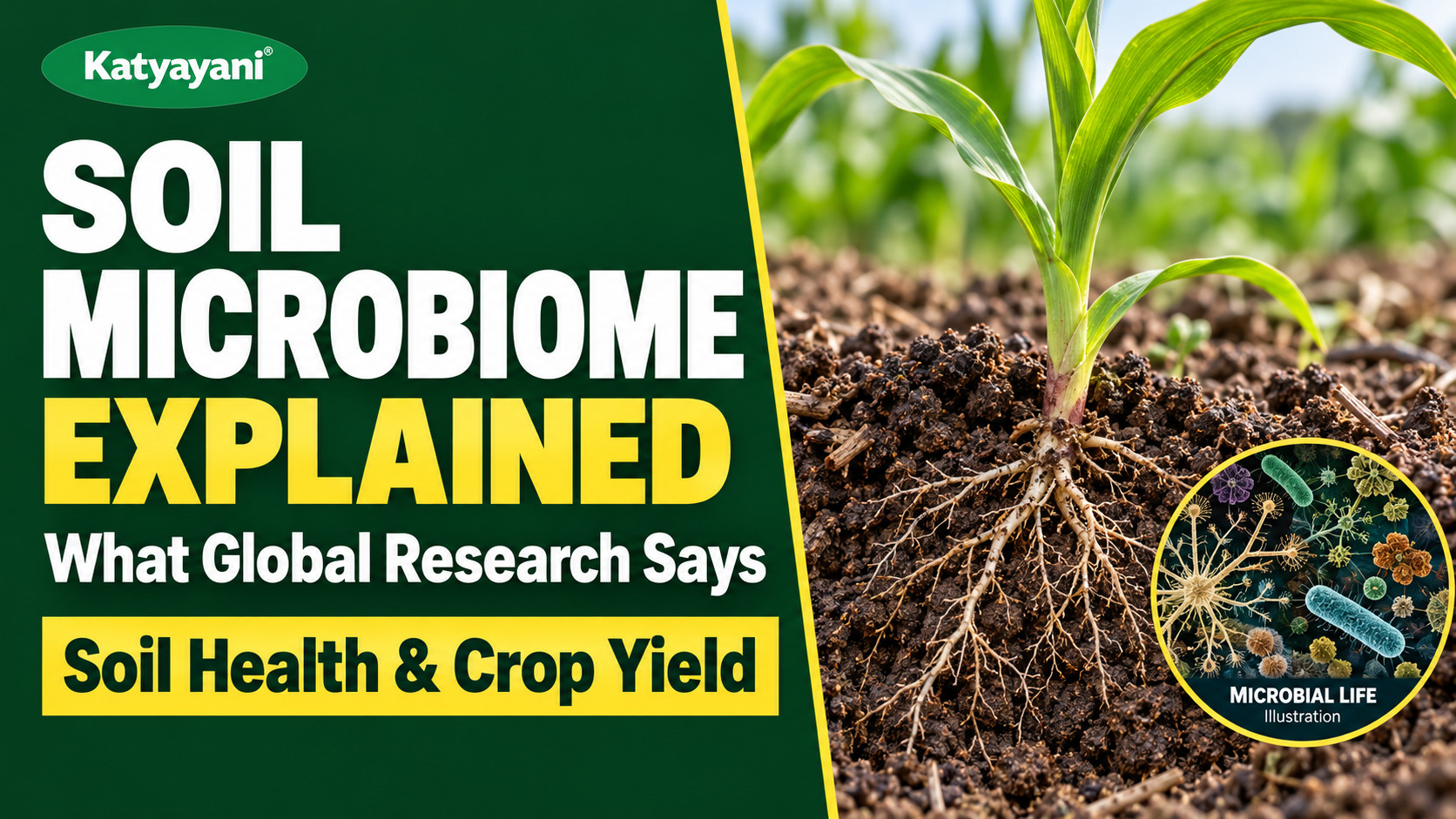
The soil microbiome is the whole community of microscopic life in soil (bacteria, archaea, fungi, protists, viruses, and small animals like nematodes) together with their genes. A gram of healthy topsoil commonly holds 100 million to 1 billion culturable bacteria, and far more kinds than that when counted by DNA. These organisms recycle nutrients, build soil crumbs, store carbon and compete with disease organisms. Adding organic matter, keeping roots and residue in the soil, and not over-using nitrogen are the best supported ways to feed them.
What is the soil microbiome?
The soil microbiome is the community of microorganisms living in soil, together with their genes and the soil habitat they live in. One review says a single gram of soil can hold thousands of microbial types, covering viruses and all three domains of life (Fierer, Nature Reviews Microbiology, 2017). The same review notes that most soil microbes are still undescribed.
These are the main groups and what each does in plain terms. The roles are standard soil-science knowledge; the numbers come from the sources named.
| Group | What it is | Main job in soil | A sourced number |
|---|---|---|---|
| Bacteria | Single-celled, no nucleus. The most numerous group. | Break down residue, fix nitrogen, dissolve phosphate, make sticky glue that holds soil crumbs together | 10^8 to 10^9 culturable cells per gram (BioNumbers, citing Metting 1993) |
| Archaea | Single-celled, look like bacteria but are a separate branch of life. | Take part in nitrogen cycling, including turning ammonia into nitrate | Only 0.009% of sequences in one forest soil, but 4% to 12% in three farm soils (Roesch 2007) |
| Fungi | Threads (hyphae) and spores. Include yeasts, moulds and mycorrhiza. | Break down tough residue, carry water and phosphorus to roots (mycorrhiza), bind soil particles | About 90% of fungal species live in soil (Anthony 2023) |
| Protists | Single-celled organisms with a nucleus, such as amoebae. | Eat bacteria and release the nitrogen locked in them | No soil-specific count found for this post |
| Viruses | Infect bacteria, fungi and other microbes. | Control microbe numbers and move genes between microbes | Present in soil, per Fierer 2017; no count found |
| Nematodes | Tiny worms. Some feed on bacteria and fungi, some on roots. | Move nutrients through the food web; a few are crop pests | 4.4 x 10^20 in the top soil layer worldwide, about 0.3 gigatonnes of biomass (van den Hoogen 2019) |
Microbiota or microbiome: is there a difference?
Yes, though many people use them as the same word. In common use, microbiota means the living organisms, and microbiome means those organisms plus their genes and the habitat around them. A 2020 paper in the journal Microbiome (Berg et al.) says its authors "clearly separate" the two terms, but I could not read the full definitions. Check that paper if you need the exact wording for a thesis or ppt.
The bigger fact is where life sits. A 2023 PNAS paper estimated that soil is home to 59 ± 15% of all species on Earth, about double earlier estimates (Anthony et al.). Soil is the most species-rich single habitat on the planet.
How many bacteria live in 1 gram of soil?
A common answer is 100 million to 1 billion bacteria per gram (10^8 to 10^9), but this counts only bacteria that grow on lab plates. Counting kinds of bacteria by DNA gives a very different and much less certain answer. Every number below is an estimate.
| What is counted | Estimate | Source and caution |
|---|---|---|
| Culturable bacteria (colony-forming units) per gram | 10^8 to 10^9, which is 100 million to 1 billion | BioNumbers entry citing Metting (1993). Secondary compilation. Plate counts miss most soil microbes. |
| Species of bacteria per gram | 2,000 to 8.3 million | Range quoted in the abstract of Roesch et al., ISME Journal 2007. The authors say the top figure may be too large to test. |
| Unique 16S sequences (close to species) found by sequencing, per site | No more than about 52,000 | Same paper, four soils from the Americas, 26,140 to 53,533 sequences each. |
| "Thousands of microbial taxa" per gram | Thousands | Fierer, Nature Reviews Microbiology, 2017 abstract. |
Why the spread? Plate counts only grow the few types that like lab food. DNA methods see more but depend on how many sequences are read and how "species" is defined for bacteria. So a post that gives one clean number, such as "1 billion bacteria per gram", is hiding this uncertainty. A safe sentence is: healthy topsoil usually holds hundreds of millions of culturable bacteria per gram, and thousands to hundreds of thousands of types.
What does the soil microbiome do for crops?
It recycles nutrients, builds soil structure, stores carbon and helps plants resist disease and stress. A review in Nature Reviews Microbiology lists more than 40 separate soil microbiome functions that contribute to soil, plant, animal and human health, and reports that microbial diversity is generally positively linked to those outcomes (Banerjee and van der Heijden, 2023).
| Function | What happens in plain terms | Who does it |
|---|---|---|
| Nutrient cycling | Microbes break down dead roots and residue and release nitrogen, phosphorus and sulphur in forms roots can take up. | Bacteria, fungi, protists |
| Nitrogen fixation | Turn nitrogen gas from air into plant-usable nitrogen. Rhizobium does this inside root nodules of pulses. | Rhizobium, Azotobacter, Azospirillum |
| Phosphate solubilisation | Release phosphorus locked in soil minerals using acids and enzymes. | Phosphate-solubilising bacteria and fungi, mycorrhiza |
| Aggregate (crumb) formation | Sticky microbial compounds and fungal threads bind sand, silt and clay into crumbs. Crumbs hold air and water. | Fungi, bacteria |
| Carbon storage | Microbes turn plant carbon into stable soil organic matter or release it as carbon dioxide. The balance sets whether soil gains or loses carbon. | All groups |
| Disease suppression | Beneficial microbes compete with, feed on or poison plant pathogens, and prime plant defences. | Bacillus, Pseudomonas, Trichoderma and others |
| Stress tolerance | Root-associated microbes help crops handle drought, salinity and nutrient shortage. | Mycorrhiza and root bacteria |
| Detoxification | Some microbes break down pollutants and certain pesticide residues. | Diverse bacteria and fungi |
The function list above is standard textbook content, summarised in plain words. I did not open the full text of the 2023 review to confirm each row. One point is better supported: soil diversity links to function. A study of urban green spaces in 56 cities on six continents found that soil biodiversity was positively related to multiple ecosystem functions (Fan et al., Nature Ecology and Evolution, 2023). It is correlation, not proof that adding microbes will raise yield.
What have the biggest global soil microbiome studies found?
Global studies show that a small group of bacteria dominates soil, that bacteria and fungi follow different rules, and that we still lack data on how diversity links to function. Four large projects are summarised below.
| Study | What they did | Main finding | Limit |
|---|---|---|---|
| Delgado-Baquerizo et al., Science, 2018 (abstract) | Sampled 237 locations on six continents | About 2% of bacterial types (roughly 500) make up almost half of soil bacterial communities worldwide | Describes who is common, not how any one field is doing |
| Bahram et al., Nature, 2018 (abstract) | DNA analysis of 7,560 topsoil subsamples from 189 sites | Bacterial diversity peaks in temperate habitats, fungal diversity does not. Bacteria and fungi respond differently to rainfall and soil pH. | Snapshot at one time point |
| Thompson et al., Nature, 2017 (Earth Microbiome Project) | Samples from hundreds of researchers, processed with one common method | A shared reference catalogue of bacterial and archaeal sequences that other studies can compare against | The abstract gives no headline numbers |
| Guerra et al., Nature Communications, 2020 | Reviewed soil studies from 17,186 sampling sites | Only 0.3% of sites measured both soil biodiversity and ecosystem function. Almost no repeat-over-time data. | It maps research gaps, it is not a species atlas |
Two plain lessons follow. First, soil pH and rainfall steer which microbes live where, which is why the same bio-product behaves differently from Punjab to Kerala. For how pH affects what plants can take up, read our guide on soil pH and nutrient lock. Second, the data gap in the Guerra paper means no one can yet say how many of each microbe a field "should" have. Anyone who gives you an ideal count is guessing.
What are the rhizosphere and mycorrhizae, and why do they matter?
The rhizosphere is the thin zone of soil around living roots, where microbes feed on sugars that roots leak. Mycorrhizae are fungi that live in or on roots and trade soil nutrients and water for plant sugars. A review of plant families estimated that about 72% of vascular plant species form arbuscular mycorrhiza (Brundrett and Tedersoo, New Phytologist, 2018). So most crops already expect this partner.
- Rhizosphere: root sugars attract bacteria and fungi. Many of the nitrogen-fixing, phosphate-solubilising and disease-fighting jobs in the table above happen here.
- Mycorrhizal fungi: their threads reach pores that roots cannot enter. They help most with phosphorus, which moves slowly in soil.
- What switches them off: very high phosphate fertiliser, bare fallow with no living roots, and repeated deep tillage can all reduce mycorrhizal activity. The 171-study biofertiliser analysis below found mycorrhizal inoculants worked better in soils with low organic matter, and gains grew as soil phosphorus rose (Schutz 2017). Treat the first two points as general soil science, not as findings of that paper.
What damages the soil microbiome? What the evidence really says
Several farm practices lower microbial numbers or diversity, but the size of the effect depends on soil, climate and how long the practice lasts. The table gives the best evidence found, including where studies disagree.
| Practice | What research found | Honest nuance |
|---|---|---|
| Excess nitrogen | A meta-analysis of 82 field studies found microbial biomass fell about 15% under nitrogen addition (Treseder, Ecology Letters, 2008). Larger drops in longer studies and with more nitrogen added. | Another analysis of 107 datasets from 64 long-term cropping trials found mineral fertiliser raised microbial biomass carbon by 15.1%, but lowered it in soils below pH 5 (Geisseler and Scow, 2014). Treseder covered many ecosystems; Geisseler and Scow covered cropped fields, where fertiliser also grows more roots and residue. |
| Tillage | A meta-analysis of 60 studies found conservation tillage (reduced or no tillage with over 30% residue cover) raised total microbial biomass by 37%, fungi by 31% and bacteria by 11% (Chen et al., 2020). | No significant effect in sandy soils. The gain was in the top 20 cm and linked to more soil carbon. So the benefit comes through carbon, not through the plough alone. |
| Pesticide misuse | A meta-analysis of 54 studies (294 observations) found pesticides reduced soil animal abundance and diversity. Broad-spectrum products, insecticides and multi-chemical mixes cut diversity even at label doses (Beaumelle et al., 2023). | That paper is about soil animals, not bacteria. A 2025 US study of repeated herbicides in sugar beet found only small, short-lived changes in bacterial communities (Gaylord et al.). Effects differ by chemical class. |
| Residue burning | In a two-season Karnal trial on sandy loam, zero-till wheat with rice residue kept on the surface had 47.9% to 60.4% more soil microbes than conventional tillage with residue burned or removed (Korav et al., Scientific Reports, 2024). | The trial changed tillage and residue together, so burning alone cannot be separated out. One site, one soil type. |
| Compaction | One compaction event raised bulk density about 15% and cut air movement by 94%. Air-loving microbes mostly declined, and low-oxygen microbes increased. The effect lasted four seasons (Longepierre et al., ISME Communications, 2021). | Effects varied a lot between field blocks, and microbial change did not always match yield change. |
| Salinity | A review found respiration per unit of soil carbon is strongly reduced at higher salt levels (Rath and Rousk, 2015). | Microbial biomass results were inconsistent across studies. |
| Monoculture | No meta-analysis opened for this post. A meta-analysis of organic versus conventional farming names crop rotation and legumes in the rotation as important practices for microbial size and activity (Lori et al., 2017). | Support is indirect. |
| Low organic carbon | Soil organic carbon was a major contributor to the microbial gain seen under long-term fertiliser (Geisseler and Scow, 2014), and higher soil carbon went with higher fungal and bacterial biomass (Chen 2020). | This is the one factor that appears in several independent studies. |
The pattern is that carbon supply decides a lot. Nitrogen, tillage and residue management matter mostly because they change how much organic matter the microbes get.
How can you increase the soil microbiome?
Feed it carbon, keep living roots and residue in the soil, disturb it less, and avoid big swings in nitrogen and pH. Biofertilisers can help in some cases but are not the main lever. The table lists each practice with its strongest evidence found.
| Practice | Evidence found | Strength |
|---|---|---|
| Organic inputs (compost, manure, farmyard manure) | Organic systems had 32% to 84% higher microbial biomass carbon, microbial biomass nitrogen, PLFA and enzyme activities than conventional systems in 56 papers and 149 comparisons (Lori et al., 2017). A 20-plus year Swiss trial found organic management raised microbial richness, mainly due to manure (Hartmann et al., 2015). | Strong |
| Cover crops and green manure | Across 60 studies, cover crops raised microbial abundance 27%, activity 22% and diversity 2.5% compared with bare fallow (Kim et al., 2020). Effects were weaker in continental climate, with chemical termination, and under conservation tillage. | Moderate to strong |
| Return crop residue, do not burn it | Karnal trial: 47.9% to 60.4% more microbes with zero-till plus residue retained (Korav 2024). See our guide on parali management with a decomposer. | Moderate (one site) |
| Reduced tillage | 37% higher microbial biomass overall in 60 studies, but not in sandy soils (Chen 2020). | Moderate |
| Crop rotation, with pulses | Named as an important practice in Lori 2017. Pulses also host Rhizobium. See biofertiliser for chana. | Moderate, indirect |
| Balanced fertiliser, not just more nitrogen | Long-term fertiliser raised microbial biomass by 15.1% in cropped soils, except below pH 5 (Geisseler and Scow 2014). Excess nitrogen cut biomass about 15% in Treseder 2008. | Mixed, depends on pH and dose |
| Avoid compaction | Effects last at least four seasons after one pass (Longepierre 2021). | Moderate |
| Microbial inoculants (biofertilisers) | See the next section. Results vary. | Variable |
Both chemical and biological inputs have a place. Our guide on where bio and chemical inputs each win sets out when to use which. For organic carbon on the farm, a well-made compost is the practical start. Katyayani lists an enriched vermicompost, which the product page describes as 30% to 40% organic matter. The page does not give an application rate, so follow the rate advised by your state agriculture university or KVK.
Do biofertilisers and microbial inoculants really work?
Sometimes. A global analysis of 171 studies found yield gains, but the size depends on climate and soil, and several reviews say field results are variable. Treat biofertilisers as a support to good soil management, not a replacement for it.
- A global meta-analysis of 171 studies found average yield gains of +20.0% in dry climates, +14.9% in tropical, +10.0% in oceanic and +8.5% in continental climates. Gains were small when soil phosphorus was low (Schutz et al., 2017).
- A 2019 review in the Journal of Advanced Research (Compant et al.) says field success of microbial inoculants is "often variable".
- A 2017 review of phosphate-solubilising microbes (Alori et al., Frontiers in Microbiology) says they "have yet to replace conventional chemical fertilizers" in commercial farming.
A cautious way to buy and use them:
- Check the count and date. Under the Fertiliser (Control) Order, a carrier-based Rhizobium, Azotobacter, Azospirillum or phosphate-solubilising biofertiliser must carry at least 5 x 10^7 CFU per gram, or 1 x 10^8 CFU per ml for liquids, and the count must stay above 1 x 10^7 per gram (5 x 10^7 per ml for liquids) through its shelf life (FCO Schedule III). Mycorrhizal products are judged on propagules and infectivity, not CFU.
- Match the organism to the job. Rhizobium for pulses, Azotobacter or Azospirillum for cereals and vegetables, phosphate-solubilisers where soil phosphorus is present but locked.
- Use fresh stock, store cool, use before expiry, and apply as per label.
- Keep a plain comparison. Leave a small untreated strip and compare yield and root health at harvest. Your own strip is the best proof for your soil.
For crop-specific use, see the bio-fertilizer range. As an example of a root-zone product, the VAM-G mycorrhizal liquid lists many crops, but its page does not state a count or dosage, so ask for the batch certificate first. For making compost faster, the decomposing culture activator lists Trichoderma, Basidiomycetes, Actinomyces and Clostridium thermocellum, again with no CFU on the page. For gardeners, our post on using Trichoderma and Beauveria at home covers the safe basics.
How do you measure soil microbiome health?
No single test gives a "microbiome score". Farmers can track three or four simple signs year on year, while labs and researchers use DNA sequencing. The table shows what each method tells you and what is realistic.
| Method | What it tells you | Who can do it | Limit |
|---|---|---|---|
| Soil organic carbon (SOC) | The food supply for microbes. Rising SOC usually means a healthier soil system. | Any farmer, through a Soil Health Card lab test (organic carbon is one of its parameters) | Slow to change; compare the same field and depth each year |
| Microbial biomass carbon | How much living microbial matter is present. | Research and some private labs | Needs a lab method; less common in Indian testing |
| Soil respiration (CO2 release) | How active microbes are right now. | Field kits (colour-chart type) and lab CO2-burst tests | Depends on moisture and temperature. One duplicate-sample poster reported high repeatability errors in a field kit (search result only; VERIFY). |
| DNA sequencing (16S for bacteria, ITS for fungi) | Which microbes are present and in what mix. | Research labs and a few commercial labs | Shows who is there, not whether they work. No "ideal" profile exists. |
| Spade test and earthworm count | Crumb structure, root depth, smell, presence of earthworms. | Any farmer, at no cost | I found no verified Indian benchmark for earthworm numbers. Use it to track your own field over time. |
A practical routine: dig a spade-sized block in the same three spots each season, note colour, smell, crumb size, root depth and worm count, and take a photo. Pair this with the organic carbon value on your Soil Health Card each cycle. Our guide on how to read the Soil Health Card explains the other numbers.
What is happening on soil microbiomes in India?
India has a national project mapping soil microbes, a card scheme that tests soil chemistry, and a legal standard for biofertilisers. The weak spot is that routine soil testing does not yet measure biology.
- Indian Soil Microbiome Project: run by ICAR-NBAIM to build a microbial diversity map of India across agro-ecological zones. Its website dashboard showed 17 states, 412 soil samples, 14 agro-ecological zones, 13,270 microbes isolated (9,900 bacteria and 3,370 fungi), 1,266 identified and 137 metagenomes sequenced when I read it on 19 Oct 2026. The project is ongoing, so these figures will change (project website). I could not confirm what raw data is public.
- Soil Health Card: reports 12 parameters: nitrogen, phosphorus, potassium, sulphur, zinc, iron, copper, manganese, boron, pH, electrical conductivity and organic carbon (PIB factsheet as shown in a search result; the page itself blocked my fetch, so VERIFY). Biology is not on the card.
- What the card data shows: a 2025 analysis by the Centre for Science and Environment of about 1.3 crore Soil Health Card samples from 2023-25 found 48.5% low in organic carbon and 64% low in nitrogen. CSE also said the card tests only chemical parameters and that physical and biological indicators should be added. Older CSE work using a wider "deficient" band gave about 85%, so do not compare the two figures.
- Biofertiliser law: biofertilisers are regulated under the Fertiliser (Control) Order, with count limits as described in the previous section. An older copy of the Order lists 10^7 per gram, so confirm the current gazette text before quoting a number in a contract or label review.
- Related policy and inputs: see our posts on the National Mission on Natural Farming subsidy for support available to farmers moving toward lower-chemical systems.
What are the 8 micronutrients found in soil?
The eight micronutrients that plants need in small amounts are boron, chlorine, copper, iron, manganese, molybdenum, nickel and zinc. Older books list seven because nickel was added last. Microbes affect all of them, since they change pH, make acids and form chelating compounds that free or lock these metals.
| Micronutrient | Symbol | One role in the plant |
|---|---|---|
| Boron | B | Cell wall strength, flowering and fruit set |
| Chlorine | Cl | Photosystem II (part of photosynthesis) and water balance in cells |
| Copper | Cu | Enzymes for photosynthesis and lignin formation |
| Iron | Fe | Chlorophyll making and respiration |
| Manganese | Mn | Photosynthesis and enzyme activation |
| Molybdenum | Mo | Part of nitrogenase (used by nitrogen-fixing microbes) and nitrate reductase |
| Nickel | Ni | Part of urease, which handles urea nitrogen |
| Zinc | Zn | Enzymes, growth hormones and protein making |
The Soil Health Card covers five of the eight (zinc, iron, copper, manganese, boron). Molybdenum, chlorine and nickel are not on the card. Counting conventions differ: the eight-element list is the common answer in extension sources, and seven-element lists leave out nickel. Roles for boron, copper, iron, manganese and zinc are textbook summaries; I did not open a source for them. If you suspect a deficiency, a leaf or soil test should come before any product.
What is a practical 12-month plan to improve soil microbiome health?
Start by measuring, then add organic matter, then cut the practices that harm, then review. The plan below fits a typical kharif and rabi cycle. Adjust dates to your region and crop.
| Month | Action | Why |
|---|---|---|
| 1 | Get a Soil Health Card test. Note organic carbon, pH and EC. Dig three spade blocks, photograph and write down colour, smell, crumb size and worm count. Mark the three spots. | Baseline. You cannot judge progress without it. |
| 2 | Plan the rotation to include a pulse. Order compost or farmyard manure. Plan how residue will be handled so it is not burned. | Organic carbon and legume nitrogen |
| 3-4 | Apply well-made compost or manure before sowing. Use a chemical fertiliser dose based on your card, not on habit. | Feeds microbes and avoids nitrogen excess |
| 4-5 | If using a biofertiliser, check CFU count, batch and expiry. Leave one untreated strip. | Fair test on your own field |
| 6 | Keep residue on the field or incorporate it with a decomposer. Do not burn. | Retained residue supported higher microbial counts in the Karnal trial |
| 7-8 | Sow a cover crop or green manure in the gap between main crops where water allows. Reduce tillage passes and avoid working wet soil. | Cover crops raised microbial abundance 27% in 60 studies; wet-soil traffic compacts |
| 9 | Repeat the spade test in the same three spots. Compare against Month 1. | First visible change in crumbs and roots |
| 10 | Review pesticide use: spot-spray, rotate chemical classes, and prefer narrow-spectrum products where they work. | Broad-spectrum insecticides cut soil fauna diversity even at label doses |
| 11 | Compare yield and plant health in treated and untreated strips. | Evidence for your own soil |
| 12 | Take a second Soil Health Card test at the same time of year. Compare organic carbon. Plan next year. | Organic carbon changes slowly, so expect small shifts in one year |
Do not expect big changes in one year. Soil carbon builds slowly, and one-year changes may fall within normal test variation. Judge the plan over three to five years.
Conclusion
The soil microbiome is a very large, mostly unknown community that recycles nutrients, builds soil crumbs and stores carbon. Global studies show it is shaped by pH, rainfall and carbon supply, and that we still lack data linking diversity to function. The best supported way to look after it is to feed it organic carbon, keep residue and roots in the field, disturb the soil less and avoid excess nitrogen. Biofertilisers can add value, but results vary, so check the count, the batch and your own untreated strip. Start with a baseline test and a spade, and let three to five years of records, not a single product, show what works on your land.
Why trust this guide
Written by Team Katyayani, Editorial Team at Katyayani Organics. Cross-checked against published research and university extension programs.



Leave a Comment