
 17 min read
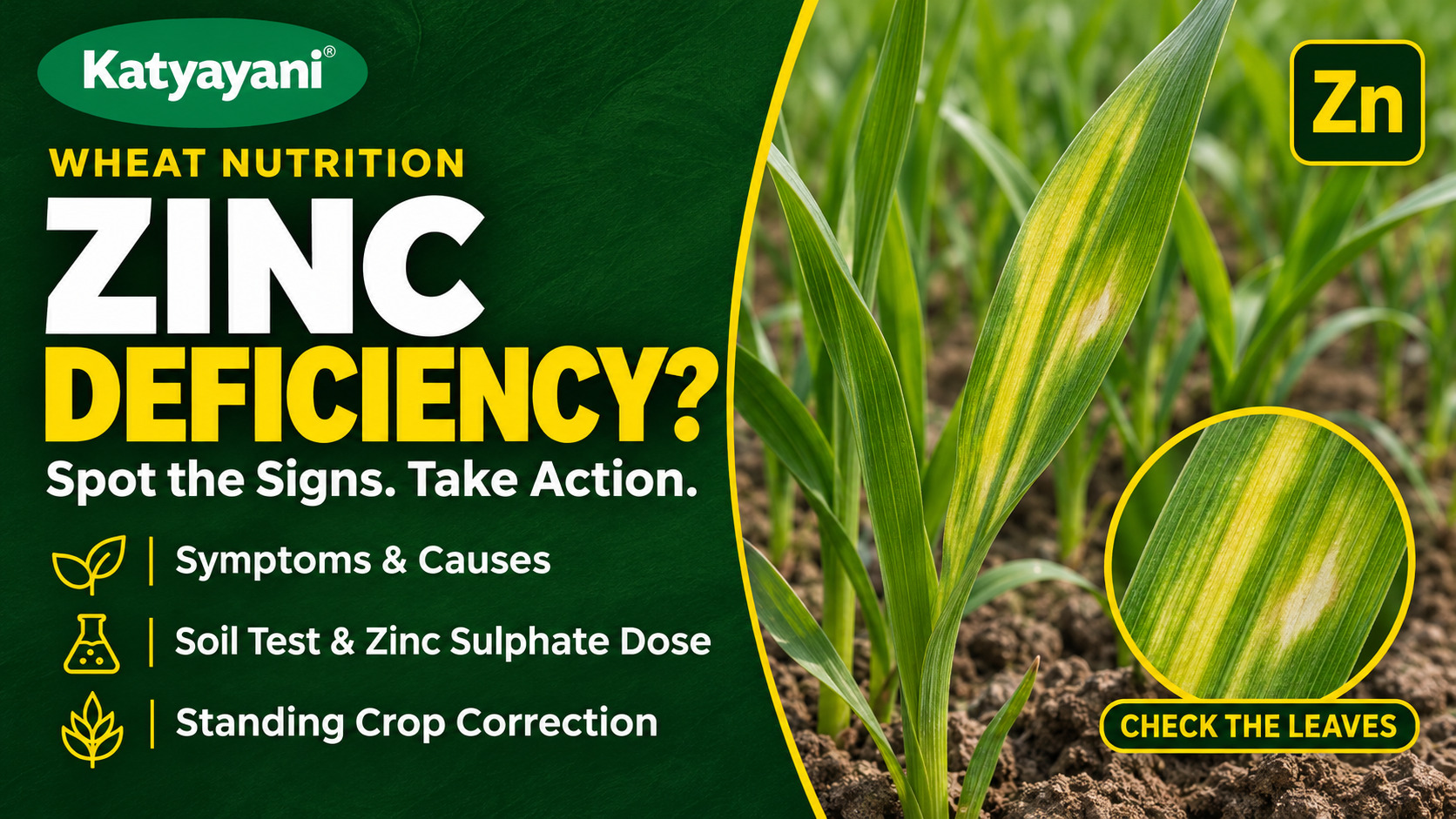
Zinc-short wheat is stunted and bushy, with leaves yellow in the middle that later break and keep hanging, and TNAU adds yellowing between veins, short internodes and dead patches that dry out (PAU, TNAU). It is most likely on alkaline soils and soils with high phosphorus. Confirm with a DTPA soil test (below 0.6 mg per kg is the usual Indian cut-off), not by looks alone, because manganese, sulphur, nitrogen and yellow rust look similar. PAU's fix for a standing crop is a 0.5 percent zinc sulphate spray with lime, two or three times at 15-day intervals. For the next crop, PAU says 25 kg of zinc sulphate (21 percent) per acre lasts 2 to 3 years, and it is best put on the kharif crop in a rice-wheat field.
What does zinc deficiency in wheat look like?
Zinc-short wheat is a stunted, bushy crop. PAU describes leaves that turn yellow in the middle and later break and keep hanging. TNAU adds yellowing between the veins, short gaps between nodes (internodes), and dead patches on the leaf that dry out. Compare the affected patch with a healthy one before deciding.
Only two sources are used for symptoms here, both from Indian agricultural universities. PAU gives the stunted, bushy crop with leaves yellow in the middle that later break and hang. TNAU gives interveinal chlorosis, short internodes, necrotic spots and drying of the leaf. Severity varies with variety and weather, so use the pattern as a prompt for a soil test, not as a diagnosis on its own.
| Sign | Where on the plant | Source |
|---|---|---|
| Stunted, bushy crop | Whole plant | PAU |
| Leaves chlorotic (yellow) in the middle, later breaking and hanging | Affected leaves | PAU |
| Yellowing between veins (interveinal chlorosis) | Leaves | TNAU |
| Short internodes | Stem | TNAU |
| Necrotic spots and drying of the leaf | Leaves | TNAU |
Winter paleness can have other causes, and for the cold-weather side see our post on nutrient uptake in cold weather.
Why does wheat need zinc?
Zinc is a micronutrient needed in small amounts, but a shortage costs yield. Trials summarised by M.V. Singh show 5 to 10 kg zinc per hectare raised grain yield by 0.2 to 2.6 t per hectare in Indian cropping systems. Wheat also supplies about half of daily zinc intake in India (Frontiers in Soil Science, 2024).
Chattha and colleagues, in a field trial in Pakistan, found that grain yield and grain zinc were positively correlated, and that zinc application lowered grain phytic acid, a compound that binds zinc and reduces how much of it people can use. Zinc in the field therefore matters for the crop and for the plate.
Zinc-rich soil and zinc-rich grain matter beyond the farm gate for this reason. The Frontiers review adds that modern wheat varieties are inherently low in grain zinc. That is covered in the section on zinc-rich varieties.
How common is zinc deficiency in Indian soils and wheat fields?
Zinc is the most widespread micronutrient gap in Indian soils. Soil Health Card data for 2015 to 2019 show about 39 percent of samples below 0.6 mg per kg DTPA zinc, with states ranging from 2 percent in Delhi to 67 percent in Bihar. Your own district can be far above or below the national figure.
| Measure | Figure | Source |
|---|---|---|
| Indian soils below 0.6 mg/kg DTPA zinc (Soil Health Card, 2015-2019) | 39.1 percent | Frontiers in Soil Science, 2024 |
| State range in the same data | 2 percent (Delhi) to 67 percent (Bihar) | Frontiers in Soil Science, 2024 |
| Other states in the same review | Uttar Pradesh 29 percent, Odisha 48 percent | Frontiers in Soil Science, 2024 |
| Soil Health Card cycle 1 (2015-2017) versus cycle 2 (2017-2019) | About 40 percent versus about 38 percent | Frontiers in Soil Science, 2024 |
| Samples tested low in zinc in Haryana, Punjab and Uttar Pradesh before 1980 | 77, 69 and 53 percent | M.V. Singh, 2011 |
| Same states by 2007-08, after regular zinc sulphate use in paddy-wheat | 19, 22.6 and 39 percent | M.V. Singh, 2011 |
The history in the last two rows is worth reading twice. Singh attributes the fall in northern India to regular zinc sulphate use in paddy-wheat systems. The same paper reports the opposite trend in southern states, where deficiency rose from 42 percent (1975) to 70 percent (2006-07) and where farmers often used micronutrient mixtures that left much less residual effect than zinc sulphate. That is a sourced observation about a pattern, not a guarantee for your village. The map of wheat zinc is shaped by what farmers have already applied.
One caution on numbers: the Frontiers review itself flags that its surveys use different methods and that some thresholds differ by state (0.5 mg per kg in Gujarat, 1.2 in Tamil Nadu, 0.6 as the general limit). Treat district percentages as a prompt to test, not a replacement for it.
What causes zinc deficiency in wheat?
The usual causes are high soil pH, high phosphorus, and years of cropping without any zinc added. In alkaline Indian plains soils the zinc is often present but locked up, because of low solubility, so adding more can still help. A soil test tells you which of these applies to your field before you spend on zinc.
The ICAR-CSSRI and IIWBR paper makes the Indo-Gangetic point directly: in alkaline soils the deficiency is due to low solubility of zinc rather than low zinc content in the soil. PAU adds that crops grown on alkali (sodic) soils generally show zinc deficiency and need zinc sulphate at higher rates than normal soils. Chattha and colleagues describe a phosphorus-zinc antagonism in plants, and Oregon State ties a yield response to DTPA zinc below 0.3 ppm together with moderate to high soil phosphorus and pH above 7.5.
| Cause | What it does | Source |
|---|---|---|
| High pH (alkaline or calcareous soil) | Zinc becomes less soluble even when total zinc is fine | ICAR-CSSRI and IIWBR paper, PAU, Oregon State |
| High soil phosphorus or heavy phosphate use | Phosphorus is described as antagonistic to zinc and lowers zinc in the plant | Chattha and colleagues, Oregon State |
| Years without zinc in an intensive rice-wheat system | Soil stock is drawn down; where zinc sulphate was applied regularly, deficiency fell | M.V. Singh, 2011 |
Salty or sodic fields add a layer. High pH is part of what makes a sodic soil hard to feed, which is why our guides on soil salinity and the wider soil pH and nutrient lock are worth a read if your field is alkaline. They explain the pH side. Zinc dose and timing come from this post.
How do I tell zinc deficiency from other causes of yellow wheat?
Look at which leaves are affected and in what pattern. PAU says sulphur starts on the younger leaves, nitrogen on the lower leaves, and manganese on the middle leaves as yellow between the veins with specks. Zinc gives a stunted, bushy crop with leaves yellow in the middle. Yellow powder that rubs off is rust.
| Problem | Where it starts | Pattern | Source |
|---|---|---|---|
| Zinc | Whole plant stunted and bushy | Leaves yellow in the middle, later breaking and hanging; TNAU adds yellowing between veins and short internodes | PAU, TNAU |
| Manganese | Middle leaves, light soils, rice-wheat | Yellow between veins with greyish-yellow to pinkish-brown specks on the lower two-thirds of the leaf; specks join into bands | PAU |
| Sulphur | Youngest, topmost leaves | Fading green, top leaves light yellow except the tip; lower leaves stay green longer | PAU |
| Nitrogen | Lowest, oldest leaves | Yellowing starts at the bottom, plant pale, fewer tillers | PAU, our nitrogen guide |
| Yellow rust | Any leaf, patchy | Yellow powder that rubs off | See rust post |
PAU draws the line between sulphur and nitrogen in plain words: sulphur starts on the younger leaves, whereas in nitrogen deficiency the yellowing starts with the lower leaves. For the nitrogen picture, see our guide to nitrogen deficiency in plants. For the full wheat yellowing decision flow, including manganese doses and the rust rub test, use our post on why wheat turns yellow. If the yellow powder rubs off, you are dealing with a disease, and the range of fungicide for wheat rust is the place to start reading labels.
A mixed problem is common. Manganese and zinc can both be short in the same light, alkaline rice-wheat soil, and PAU records both as seen in the state. If a spray of one nutrient does not clear the problem in a week or two, do not simply repeat it. Test the soil.
How do I confirm zinc deficiency with a soil test?
The standard test is DTPA-extractable zinc in the soil. Below 0.6 ppm (mg per kg) is the usual Indian limit for a likely response, though a few states set their own limit. Sampling the affected patch and a healthy patch separately makes the result easier to read.
| Test | Threshold | What it means | Source |
|---|---|---|---|
| DTPA soil zinc, general Indian limit | Below 0.6 mg/kg | Likely to respond to zinc | Frontiers in Soil Science, 2024 |
| DTPA soil zinc, Haryana wheat trial | Below 0.6 mg/kg | Wheat yield rose from 4 to 5.6 t/ha with 5 kg ZnSO4.7H2O per ha | Frontiers in Soil Science, 2024 |
| Gujarat and Tamil Nadu state limits | 0.5 and 1.2 mg/kg | Local limits differ; follow your state lab | Frontiers in Soil Science, 2024 |
| DTPA soil zinc, US dryland wheat | Below 0.3 ppm, with moderate-high phosphorus and pH above 7.5 | Yield response more likely (a US contrast, not an Indian limit) | Oregon State |
Our guide to reading a Soil Health Card shows how to collect a representative sample and read the zinc rating, and it uses the same 0.6 ppm DTPA limit. If your card gives a rating on a different scale, trust the card, because labs and states set their own limits.
A leaf or tissue test is not used as a basis here, because no Indian university or ICAR source for a wheat leaf threshold could be opened. Rely on the soil test.
How much zinc sulphate should I apply to wheat per acre?
PAU recommends 25 kg of zinc sulphate (21 percent) per acre on zinc-deficient wheat land, enough for 2 to 3 years. Its general range is 10 to 25 kg per acre depending on the crop. If the previous kharif crop got the recommended dose, PAU says wheat can skip it.
Units trip people up. PAU quotes per acre. The trial papers and the Frontiers review quote per hectare. The table puts them side by side with the conversion shown.
| Source | Recommendation | Per hectare equivalent (our arithmetic) | Note |
|---|---|---|---|
| PAU Rabi 2025-26 | 25 kg zinc sulphate (21 percent) per acre, enough for 2-3 years | About 62 kg per ha | Zinc-deficient soil. Omit for wheat if the recommended dose went on the kharif crop |
| PAU, soil test section | 10-25 kg zinc sulphate (21 percent) per acre, depending on the crop | About 25-62 kg per ha | Best put on the kharif crop in a cropping sequence |
| ICAR-IARI, Indian Journal of Agricultural Sciences, 2020 | 25 kg ZnSO4.7H2O per ha soil application, with or without one 0.5 percent spray at anthesis, in a 2-year New Delhi trial | 25 kg per ha | A trial treatment, not a recommendation. The paper reports it on par with the other zinc levels tested |
| Frontiers in Soil Science review | Haryana trial: 5 kg ZnSO4.7H2O per ha raised wheat from 4 to 5.6 t/ha; Bhopal: 5-10 kg ZnSO4.7H2O per ha raised grain zinc from 43 to 64 mg/kg | 5-10 kg per ha | Single trials quoted in the review, not a recommendation |
| M.V. Singh, 2011 | 5-10 kg Zn per ha raised grain yield by 0.2-2.6 t/ha in rice-wheat, rice-rice, maize-wheat and rice-pulse systems | 5-10 kg Zn per ha (elemental) | Elemental zinc, not product weight |
Why the gap between PAU and the other rows? PAU quotes per acre and the trials quote per hectare, and the trial papers describe single-season treatments rather than state recommendations. Do not mix the units. A farmer who reads 25 kg per hectare as 25 kg per acre will apply less than half of what PAU intended, and one who does the reverse will over-apply.
Zinc sulphate comes in two common grades. PAU gives the equivalence for another crop as 10 kg of the 21 percent heptahydrate or 6.5 kg of the 33 percent monohydrate per acre, so 25 kg of the 21 percent grade carries about the same zinc as 16 kg of the 33 percent grade. Check the zinc percentage printed on your own bag before converting, and use your soil test and your state university for the rate.
Our live post on wheat sowing time and seed rate mentions 25 kg per hectare once a year or 10 kg per hectare per crop, from a general package page. PAU, a state agricultural university, is the more trusted source, so use PAU for Punjab-type conditions and your own state university elsewhere.
When should zinc be applied to wheat: sowing, kharif crop or standing crop?
In a rice-wheat field, apply the soil dose to the kharif crop if you can, because PAU says that gives the maximum benefit and the wheat then does not need it again. Otherwise put it on at or before wheat sowing. Once the crop is standing, use a foliar spray.
PAU states the sequence rule twice: in a cropping sequence zinc sulphate should preferably be made to the kharif crop, and if the recommended dose has gone on the kharif crop, its application may be omitted for the following wheat. Applying it before wheat sowing is still correct if rice did not get any.
| Situation | Practical timing | Basis |
|---|---|---|
| Rice-wheat field, zinc not applied to rice | Before or at wheat sowing, worked into the soil | PAU soil test section |
| Zinc sulphate already applied to kharif crop at the recommended dose | Skip soil zinc for wheat; watch the crop and test if symptoms appear | PAU |
| Wheat after a crop other than rice | Soil test first; apply before sowing if below the cut-off | Frontiers 2024 |
| Symptoms in a standing crop | Foliar spray (next section); soil application next season | PAU, TNAU |
| Grain zinc enrichment | Spray at heading to milk stage (see foliar section) | PAU, Singh |
For how zinc fits with the rest of the basal fertiliser and the urea splits, our post on sowing time and seed rate covers the basal split, and a sibling post on the first irrigation at the crown root stage and urea top dressing timing is planned in this series. This post stays on zinc.
How do I spray zinc on a standing wheat crop?
PAU recommends a 0.5 percent zinc sulphate spray, made by dissolving 1 kg zinc sulphate and half a kg of unslaked lime in 200 litres of water, which covers one acre once. Give two or three sprays at 15-day intervals. TNAU also gives 0.5 percent, which is 5 grams per litre.
- Weigh 1 kg zinc sulphate (21 percent) for each acre you plan to spray.
- Dissolve it in a part of the water first, then add half a kg of unslaked lime for each kg of zinc sulphate, as in the PAU recipe. The lime is there to neutralise the solution.
- Make up the volume to 200 litres per acre (PAU). That is the 0.5 percent strength: 5 grams per litre.
- Spray the whole canopy evenly on a calm day, and give the second and third sprays at 15-day intervals if the crop still shows symptoms (PAU).
- For a crop that is already treated, check new leaves a week later. Old damaged leaves will not turn green again; judge by the new growth.
The table shows the foliar figures from each source in one place.
| Source | Foliar figure | Purpose |
|---|---|---|
| PAU | 0.5 percent zinc sulphate (21 percent); 1 kg + 0.5 kg unslaked lime in 200 L per acre; 2-3 sprays, 15 days apart | Correct deficiency in standing wheat |
| TNAU | 0.5 percent zinc sulphate (5 g per litre) | Correct deficiency |
| PAU | 1-2 sprays of 0.5 percent zinc sulphate heptahydrate (21 percent) from anthesis to early grain development, in the evening | Raise grain zinc content |
| M.V. Singh, 2011 | Two sprays of 0.5 percent zinc sulphate (not neutralised) at blooming and milk stages | Raised grain zinc 3 to 4 times over zinc-deficient or basal-only plots |
Singh also reports that zinc sulphate sprays at heading and milk stage worked about as well as zinc chelates, and that a zinc chloride spray had a harmful effect on major cereal and pulse crops. So stick to zinc sulphate, which is what PAU and TNAU specify, unless a label for wheat says otherwise. Foliar sprays correct the crop in front of you. They do not fix the soil, which is why a soil dose is planned for the next season.
Our post on water-soluble versus granular fertiliser makes the same point from the cost side: a foliar micronutrient spray is a rescue tool for visible deficiency, and a soil dose suits a deficiency you already know about.
Is soil or foliar zinc better for wheat?
Soil zinc restocks the field, and PAU says one dose lasts 2 to 3 years. A foliar spray is a quick rescue for a standing crop and the route to more zinc in the grain. In a Pakistan trial, soil plus foliar together gave the highest grain zinc and the best combination of yield and grain zinc.
PAU recommends one or two evening sprays of 0.5 percent zinc sulphate from flowering to early grain development to raise grain zinc, and Singh reports 3 to 4 times higher grain zinc with two sprays at blooming and milk stages. Chattha and colleagues, working in Pakistan, found grain zinc rose from 33.1 and 33.7 mg per kg with no zinc to 62.3 and 63.1 mg per kg with soil plus foliar zinc, the treatment they judged best for both yield and grain zinc, over two seasons. They set the biofortification goal at 35 to 45 mg per kg. The paper states different percentage increases in its text than its own table implies, so the table values are the ones used here.
| Question | Soil application | Foliar spray |
|---|---|---|
| Best for grain zinc | Soil plus foliar gave the highest grain zinc (Chattha) | Sprays at flowering and milk stage raised grain zinc 3-4 times (Singh); PAU advises evening sprays |
| Speed | Slow, works through roots | Quick on leaves |
| Effect lasts | PAU: 2-3 years at 25 kg per acre | One season; repeat sprays needed |
| Best use | Known low-zinc field, before sowing or on the kharif crop | Visible symptoms in a standing crop; grain zinc enrichment |
There is also a limit to what any of this can do. Oregon State, working on dryland winter wheat in a very different system, reports that zinc fertilisation was not economical in its research trials and should be tried on small areas first. Its response threshold was DTPA zinc below 0.3 ppm, moderate to high phosphorus and pH above 7.5. The point carries over: test first. Zinc pays where the soil is short and does little where it is not.
Which zinc fertiliser should I use: zinc sulphate, chelated zinc or zinc bacteria?
Zinc sulphate is the reference source in the PAU and TNAU recommendations and in the Indian trials cited here. Chelated zinc is another foliar option, and Singh found sulphate sprays as beneficial as chelates at heading and milk stage. Zinc-solubilising bacteria are a biological add-on, not a replacement for a deficient field.
PAU specifies zinc sulphate at 21 percent heptahydrate for both soil and foliar use, and gives a 33 percent monohydrate equivalence. Singh warns that a zinc chloride spray harmed major cereal and pulse crops. Of our product pages, only the one below names wheat, and its label should be your dosing guide.
| Product page | What the page says | Note |
|---|---|---|
| Zinc solubilizing bacteria | Liquid biofertiliser that the page says converts insoluble zinc to soluble zinc; wheat named under cereals | No bacterial count on the page; a biological option, not a quick fix |
For readers who want the biological route in general, the bio fertilizer collection lists the zinc-solubilising product. A bacterial product helps zinc already present in the soil become available. It does not add zinc, so on a field that tests very low it complements, and does not replace, a zinc sulphate dose. That is our reading of how such products work, not a claim from the product page, which gives no yield data.
Does too much phosphorus or DAP cause zinc deficiency in wheat?
High phosphorus can aggravate zinc deficiency. Chattha and colleagues describe a phosphorus-zinc antagonism in plants, and Oregon State lists moderate to high soil phosphorus with pH above 7.5 as the setting where a zinc response is likely. The fix is not to drop phosphorus but to match it to the soil test and add zinc on purpose.
PAU notes that wheat is more responsive to phosphorus than kharif crops, which is why it recommends applying phosphorus to wheat and omitting it from the following kharif crop. That is sound for yield. The side effect is that fields with years of DAP behind them can carry high phosphorus, and Oregon State lists moderate to high soil phosphorus together with pH above 7.5 as the setting where a zinc response is likely. In India that setting is common on the alkaline plains.
- Do not cut phosphorus on a hunch. Use the Soil Health Card phosphorus rating.
- Where phosphorus is already high and zinc is low, add zinc rather than more phosphate.
- If DAP is short and you are comparing alternatives, our guide to DAP alternatives compares phosphate sources on cost per kilogram of P2O5. It does not discuss zinc, so apply the zinc rules from this post alongside whichever phosphate you choose.
Chattha and colleagues also report that zinc application lowered grain phytic acid, which they link to lower phosphorus uptake and accumulation. That is a grain quality note, not an advice to cut phosphorus.
How should zinc be managed in a rice-wheat system?
Treat the system, not the crop. Put zinc on the kharif crop when you can, test before assuming, and watch fields where only micronutrient mixtures have been used. Northern India shows what steady zinc sulphate use does, while parts of southern India show what skipping it does.
The best Indian evidence is the long-term trend. Singh reports that deficiency in Haryana, Punjab and Uttar Pradesh fell from 77, 69 and 53 percent of tested samples before 1980 to 19, 22.6 and 39 percent by 2007-08 because of regular zinc sulphate use in paddy-wheat systems. The ICAR-CSSRI and IIWBR paper adds consumption numbers for the same trend: zinc sulphate use rose from 1,752 to 22,600 tonnes a year in Uttar Pradesh, 1,692 to 11,470 in Haryana and 16,292 to 48,000 in Punjab between 1988 and 2008.
In practice that means:
- Keep a record of when zinc was last applied to each field. The PAU 2 to 3 year window only makes sense if you know the last year.
- Do not rely on a micronutrient mixture as your main zinc source in a field with a low zinc test. Singh links the rise in southern deficiency to mixtures that leave little residual effect. A mix has its place for a mixed deficiency, but check the zinc share on the label.
- Check for manganese in light soils after rice. PAU records manganese deficiency in wheat after rice in sandy soils, treated with a 0.5 percent manganese sulphate spray before the first irrigation. That is a separate problem with a separate spray.
- On alkaline or sodic land, read zinc together with the soil pH and salinity picture. Our overview of soil types in India describes zinc as the most common micronutrient gap in Indian soils and notes the alluvial plains are the main base for wheat and rice.
Can organic manure and green manure help with zinc in wheat?
Yes, in one sourced long-term study. Over 10 years in a rice-wheat system, plots that replaced part of the chemical NPK with legume biomass, green manure, farmyard manure or crop stubble had better zinc availability and movement into the plant than plots on 100 percent inorganic fertiliser, including added zinc.
The paper is from ICAR-CSSRI Karnal with an ICAR-IIWBR co-author, in the Journal of Cereal Research (2026). The 100 percent inorganic plot received NPK plus zinc fertiliser and still showed that a soil buildup of zinc did not translate into proportionate availability in soil solution or better movement into the plant. All the organic-supplemented plots, especially legume-based ones, gave higher availability of zinc, iron and copper in soil solution and better translocation into plants, and total zinc harvest under legume-based management was comparable with zinc fertilisation.
Read this with care. The organic plots also had 45 percent less NPK. It was a rice-wheat case study at one location, and the authors themselves say effects on human nutrition would need dedicated studies. It supports adding organic matter and a summer legume or green manure where it fits your calendar, and it does not tell you to skip zinc on a field that tests low.
Do zinc-rich wheat varieties make zinc fertiliser unnecessary?
No. Zinc-rich varieties carry more zinc in the grain, but they still draw it from the soil. ICAR lists WB 02 at 42.0 ppm and HPBW 01 at 40.6 ppm grain zinc, against about 32.0 ppm in popular varieties. On a low-zinc field the plant, and the yield, still need zinc supplied.
| Variety or measure | Grain zinc | Other facts | Source |
|---|---|---|---|
| WB 02 (ICAR-IIWBR, released 2017) | 42.0 ppm | Iron 40.0 ppm; yield 51.6 q/ha; maturity 142 days; irrigated timely sown; Punjab, Haryana, Delhi, Rajasthan (part), Western UP (part) and other listed areas | ICAR circular |
| HPBW 01 (PAU, under ICAR-AICRP, released 2017) | 40.6 ppm | Iron 40.0 ppm; yield 51.7 q/ha; maturity 141 days; irrigated timely sown | ICAR circular |
| Popular varieties, as compared in the circular | About 32.0 ppm | Iron 28.0-32.0 ppm | ICAR circular |
| PBW Zinc 2 (2023) and PBW 1 Zn (2017) | Described as higher in grain zinc; ppm not stated in the PAU text | PBW Zinc 2 yield 23.0 q per acre; PBW 1 Zn yield 22.5 q per acre | PAU Rabi 2025-26 |
| Typical modern wheat grain, India | 20-31 mg/kg; whole wheat about 29 mg/kg | Wheat supplies about half of daily zinc in India | Frontiers in Soil Science, 2024 |
Biofortified varieties are a useful addition when they suit your zone and sowing date. Check your own state university for current recommended varieties before switching, and note that WB 02 and HPBW 01 are listed in the ICAR circular for irrigated, timely sown conditions.
Grain zinc can also be raised from the field side. PAU says grain zinc can be raised by one or two evening sprays of 0.5 percent zinc sulphate heptahydrate from anthesis to early grain development, and Singh reports a 3 to 4 times higher enrichment with two sprays at blooming and milk stages. Both are about nutrition quality. They are not a yield recommendation.
How much yield can zinc add, and is it worth the cost?
Where the soil is truly short, the gain can be large. In a Haryana trial, wheat yield rose from 4 to 5.6 t per hectare, and Singh reports 0.2 to 2.6 t per hectare across Indian systems. Where the soil is not short, the gain can be zero. Test first.
| Trial or review | Result | Source |
|---|---|---|
| Haryana, 5 kg ZnSO4.7H2O per ha on a zinc-deficient soil | Wheat yield 4 to 5.6 t/ha | Frontiers in Soil Science, 2024 |
| Zinc application of 5-10 kg Zn/ha across Indian systems | Grain response of 0.2-2.6 t/ha | M.V. Singh, 2011 |
| Pacific Northwest dryland winter wheat | Zinc fertilisation not economical in research trials | Oregon State FG 84 |
The range between a large gain and no gain tells you that zinc is a soil-specific input. The Indian trial figures are the better anchor for a rice-wheat farmer, and your own soil test is the best of all.
On cost, a back-of-envelope check is easy. Multiply the kilograms you plan to apply per acre by your local bag price, and compare it with the value of the yield you could lose. We have not stated prices here because they change from season to season. The rule that follows from the evidence is simple. Where the test is low, the dose is cheap compared with the grain it protects. Where the test is adequate, skip it.
What mistakes should I avoid when correcting zinc in wheat?
The common errors are spraying without testing, mixing up per acre and per hectare doses, repeating a spray when the real problem is manganese or sulphur, skipping lime in a zinc sulphate spray, and waiting too late. Most of these are cheap to avoid.
- Treating by looks alone. Manganese, sulphur and nitrogen each have their own pattern, shown in the look-alike table above.
- Mixing units. PAU is per acre. The trial papers and the Frontiers review are per hectare.
- Forgetting the lime. The PAU recipe adds half a kg of unslaked lime for each kg of zinc sulphate in 200 litres.
- Expecting damaged leaves to recover. Judge the spray by new leaves, not old ones.
- Using the wrong zinc salt. Singh reports that a zinc chloride spray harmed major cereal and pulse crops.
- Applying zinc twice over. PAU says the soil dose may be omitted for wheat if the kharif crop received the recommended dose.
- Skipping the soil dose next season because the spray worked. A spray fixes one crop. It does not restock the soil.
- Mistaking cold-weather paleness for zinc deficiency. Our post on cold-weather nutrient uptake helps you decide.
What is a simple step-by-step plan for zinc in wheat?
Check the pattern, test the soil, apply zinc to the soil where the test is low, spray only as a rescue, and plan the next crop. This sequence follows the PAU, TNAU and Frontiers material above and keeps spending tied to evidence.
| Step | Action | Basis |
|---|---|---|
| 1. Look | Walk the field. Zinc shows as patches of stunted, bushy plants with leaves yellow in the middle. Compare with the look-alike table. | PAU, TNAU |
| 2. Test | Send soil from the affected and a healthy patch for DTPA zinc, and read your Soil Health Card. Below 0.6 mg per kg likely needs zinc. | Frontiers 2024 |
| 3. Rescue | If symptoms are active, spray 0.5 percent zinc sulphate with lime, two or three times at 15-day intervals. | PAU |
| 4. Restock | Next season, apply the soil dose, ideally to the kharif crop in a rice-wheat field. PAU: 25 kg zinc sulphate (21 percent) per acre lasts 2-3 years. | PAU |
| 5. Balance | Match phosphorus to the soil test and keep manganese and sulphur in view. | Chattha, PAU |
| 6. Record | Note the date and dose for each field so the next decision is easy. | Practice |
For dealers: the questions to ask a farmer at the counter are the field pattern, the last zinc application, the soil test if any, and whether the crop followed rice. Our rabi checklist, agri-input dealer stock list for rabi, mentions zinc deficiency in rice-wheat soils and the zinc sulphate recommendation of 25 kg per acre on deficient soils, and lists micronutrient mixes and chelated zinc and boron foliar sprays for November to December stocking.
Conclusion
Zinc deficiency in wheat is common, cheap to fix when it is confirmed, and easy to confuse with other problems when it is not. Read the leaf pattern, rule out manganese, sulphur, nitrogen and rust, and confirm with a DTPA soil test, using 0.6 mg per kg as the usual Indian cut-off. Rescue a standing crop with PAU's 0.5 percent zinc sulphate and lime spray, then restock the soil with the PAU dose on the kharif crop. Keep an eye on phosphorus and pH, keep records, and spend where the test says it will pay.



Leave a Comment